Hunting the Late-Season January Rut Lull
By January, a lot of Georgia hunters have quietly given up. The rut is over, the bucks you saw chasing in November have vanished, and the stands that produced all fall now show nothing but squirrels. It feels like the woods went empty. They did not. Deer in the post-rut lull follow a different, very predictable pattern. This guide explains what is happening to deer in January and how to adjust your hunting to fill a tag before the season closes.
What the January Rut Lull Really Is
The term rut lull gets used for a couple of different periods, but in January it describes the stretch after breeding activity has mostly wrapped up. Bucks have spent weeks chasing does, eating little and covering huge distances. They come out of the rut worn down, sometimes having lost a large share of their body weight. Does are mostly bred, and the herd shifts from breeding mode to survival mode.
That shift is the key to January hunting. A buck that ignored food for a month now has one job: recover before the hardest part of winter. That makes him far more predictable than he was in November, as long as you hunt the things he now cares about.
Why Georgia’s Timing Is Different
Georgia’s rut timing varies a lot from region to region. In parts of the western Piedmont, peak breeding can hit in mid to late October. Across much of the state, it falls in November. In some parts of South Georgia and the Coastal Plain, breeding runs later, into December. See When the Georgia Rut Peaks for a regional breakdown.
That variation matters in January. A hunter in a county where the rut peaked in October has been in the post-rut for two months, and deer there have long since settled into winter patterns. A hunter in a late-rut area of South Georgia may still see some breeding activity in early January, with a lull that feels shorter and less dramatic.
The Second Rut Question
You will hear hunters talk about a second rut. It is real, but it is usually small. Does that were not bred during their first cycle come back into estrus about four weeks later, and some doe fawns reach estrus for the first time late in the season. That can trigger a brief flurry of chasing in December or January.
Do not plan your whole January around a second rut. Treat it as a bonus. If you see a buck trailing a doe with his nose to the ground in January, take notice, but build your strategy around food and cover first.
What Deer Need in January
| Need | What It Looks Like in Georgia | Where to Hunt |
|---|---|---|
| High-energy food | Winter wheat, oats, rye, clover plots, leftover acorns, honeysuckle and greenbrier | Food plots, field edges, cutovers |
| Security cover | Thick pine plantations, clear-cuts in the regrowth stage, briar thickets | Edges of bedding areas |
| Thermal cover | South-facing slopes, dense evergreen stands, creek bottoms out of the wind | Bedding areas and travel routes between them and food |
| Low pressure | Areas other hunters ignore or cannot easily reach | Back corners of leases, thick public land pockets |
Where to Find Deer in the Post-Rut
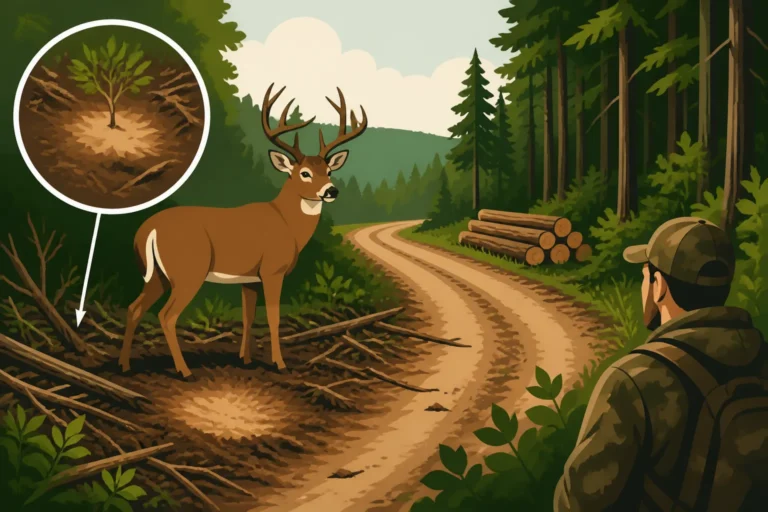
The biggest change in January is that deer movement collapses into a small loop between bed and food. Your job is to find that loop and hunt it without blowing it up.
Food Is Everything
Acorns are mostly gone or picked over by January in many parts of Georgia, though a heavy acorn crop can last into winter in some hardwood bottoms. Once acorns run out, deer turn to whatever green food and browse they can find. Planted winter wheat, oats and rye are often the hottest spots in the late season. Clover plots can be strong too, especially in milder winters. In big woods without plots, honeysuckle, greenbrier and other evergreen browse become important.
See Late-Season Food Sources for Georgia Whitetails for a complete list of the foods deer target in winter.
Tips:
- Look for fresh tracks and droppings at the edges of plots and fields.
- Check cutover areas where new growth offers browse.
- Glass fields in the last hour of light to see where deer enter.
Bedding Areas and Cover
In January, deer bed in thick cover close to food. Pine plantations, cutovers and briar thickets are prime spots. On cold days, deer bed on south-facing slopes to soak up the sun. On windy days, they bed in creek bottoms and protected hollows.
Bucks coming out of the rut often bed in the thickest, nastiest cover available, places hunters avoid because they are miserable to walk through. Young planted pines that have grown just above head height, with briars underneath, are classic examples. These spots give a tired buck security and quick access to nearby food.
Tips:
- Do not hunt directly in bedding areas. You will push deer out.
- Note which bedding cover sits closest to the best food, because deer will use the shortest safe route between them.
- Hunt the edges of bedding areas and the trails between bedding and food.
- Use aerial imagery to identify thick cover close to food sources.
Travel Corridors
Between bed and food, deer use predictable travel corridors: creek crossings, fencerows, field edges, logging roads and narrow strips of cover. These are the places to set up.
See Working a Fencerow for Late-Season Deer and Working a Creek Bottom for Late-Season Deer for detailed setups.
The best January corridors are often short. On a typical Piedmont tract, the distance between a thick cutover where deer bed and a wheat plot where they feed might be only a few hundred yards. A stand placed halfway along that route, tucked into a cedar or a cluster of pines for cover, can catch deer moving well before dark, when they would still be in the woods and out of sight from the field.
How to Hunt the January Lull
The goal in January is to catch deer moving between bed and food during legal light. Here is how to do it.
Hunt the Afternoon
In January, deer tend to move most in the afternoon, especially on cold days. They want to feed before dark. Morning hunts can produce, but the afternoon is usually better.
Tips:
- Get to your stand by early afternoon.
- Sit until the end of legal shooting time.
- Hunt over food or the trails leading to it.
Here is a typical January evening on a Middle Georgia lease. The afternoon high reaches the low 50s, the wind settles out of the northwest, and nothing moves for the first three hours of the sit. Then, with about 30 minutes of light left, a group of does eases out of a pine thicket and onto a wheat plot. Ten minutes later, a buck with one broken tine follows the same trail. Hunters who left at 5 p.m. to beat the cold never see him. Patience at the end of the day is often the whole game in January.
Watch the Weather
Cold fronts are your best friend in January. When temperatures drop sharply, deer need to eat more to stay warm, and they often move earlier in the afternoon. The day after a front, with clear skies and a high-pressure system, can be the best hunt of the late season.
Tips:
- Watch the forecast for cold fronts.
- Hunt the first afternoon after a front passes.
- On warm days, hunt later in the afternoon or skip the hunt.
Georgia winters swing hard. A week of 70-degree afternoons can shut deer movement down almost completely, and then a front drops the overnight low into the 20s and the woods come alive. If you have limited days to hunt, save them for the cold snaps. A warm, humid January afternoon in South Georgia rarely matches the first frosty evening after a front.
Keep Pressure Low
By January, deer have been hunted for months. They know where hunters sit and when hunters come and go. Keep pressure as low as possible.
Tips:
- Hunt each stand only when the wind is right.
- Do not overhunt any one stand.
- Use quiet entry and exit routes.
- Consider new stand locations that deer have not associated with hunters.
Trail cameras can help, but they can also add pressure if you check them too often. Use cellular cameras if you have them, or check cards only when you are already walking in to hunt with a good wind. A camera on the trail into a food plot will tell you when deer are arriving, which helps you decide whether you need to be in the stand by 3 p.m. or can wait until 4.
Field Edge Setups
Food plot and field edges are classic January setups. See Sitting a Field Edge in Late Season for the details. Set up on the downwind side of the field, near where deer enter from cover.
Mature bucks often hang back in the cover along the field edge until close to dark, watching the does feed. If you consistently see does in the field but no bucks, move your setup back into the woods along the main entry trail, 50 to 100 yards from the field. That puts you where the buck stages before he steps out, giving you a chance during legal light.
Building a Late-Season Afternoon Setup
- Pick the food. Choose a plot or field that shows heavy fresh sign.
- Find the entry trail. Walk the edge at midday and look for the most-used trail from bedding cover.
- Check the wind. Set up so the wind blows from the trail toward you, or across it, never toward the bedding area.
- Plan your exit. Make sure you can leave after dark without walking through the field while deer are feeding.
- Dress for the sit. Layers, insulated boots and a hand warmer let you stay still until the last minute of light.
Hunting Standing Cover
In agricultural areas, standing crops left after harvest can be great cover and food. See Hunting Standing Cover Left After Harvest.
A strip of standing corn or soybeans in South Georgia farm country can hold deer all day in January, giving them food and cover in one place. Hunting the downwind edge of that strip, or the travel route between it and a nearby pine thicket, puts you right in their daily loop.
Calling in January
Calling in January can work, but it is less effective than during the rut. A soft grunt or doe bleat can sometimes pull a buck in, especially during a second rut. Rattling is usually less effective.
A light touch is best. A couple of soft contact grunts when you see a buck passing out of range can turn him. Repeated loud calling in January is more likely to make educated deer nervous than to draw them in.
Shot Selection and Tags
By January, many hunters have filled some tags. Review your remaining tags and know what you can legally harvest. See Georgia Antlered Buck Limits and How Many Antlerless Deer You Can Take.
Many hunters choose to fill antlerless tags in January to stock the freezer. Others hold out for a mature buck.
Late in the season, also be careful to identify bucks that have already dropped their antlers. A big-bodied deer without antlers in late January may be a buck, not a doe. Look for a heavier neck, a blockier head and pedicles on the skull before you decide to shoot an antlerless deer.
Finishing the Season Strong
The Extended Season
Some southwest Georgia counties have an extended deer season that runs past the statewide close. See The Extended Southwest Georgia Season and Hunting Into the Extended Southwest Season for details.
If you hunt outside those counties, the statewide firearms season usually ends in mid January, so check Georgia Statewide Firearms Season Dates and make the most of the last few weekends. Hunters who stick it out to the final days are often rewarded, because pressure drops sharply as other hunters give up.
Shed Antlers
Bucks begin shedding antlers in late winter. See When Georgia Bucks Shed Antlers. Do not be surprised if you see a buck without antlers late in the season.
Planning for Next Season
January is a great time to scout for next season. Note where deer are bedding and feeding, and plan food plots and stand locations.
Planning tools like GoHunt can help you research areas and plan hunts, especially if you plan to hunt out of state. GoHunt’s maps can also be useful for scouting. Combine digital research with on-the-ground scouting.
After the season closes, walk your hunting property while sign is still fresh. Rubs, scrapes, trails and bedding areas from the fall are easy to see once the leaves are down. Mark them on a map, whether that is a paper aerial or an app such as GoHunt, and use that information to plan stands for next fall.
Final Tips
- Hunt food sources that still have fresh sign.
- Hunt the afternoon and stay until the end of legal light.
- Save your best days for the first cold afternoon after a front.
- Keep pressure low with careful entry, exit and wind choices.
- Stay persistent through the final weekends, when many other hunters have quit.
The January rut lull can be frustrating, but it can also be one of the best times to fill a tag if you understand what deer need.
Disclaimer
This article is for general informational purposes only and does not constitute professional advice. Laws, prices and regulations vary by location and change over time. Consult a qualified professional for guidance on your specific situation.