Optics for Georgia Mountains and Swamp
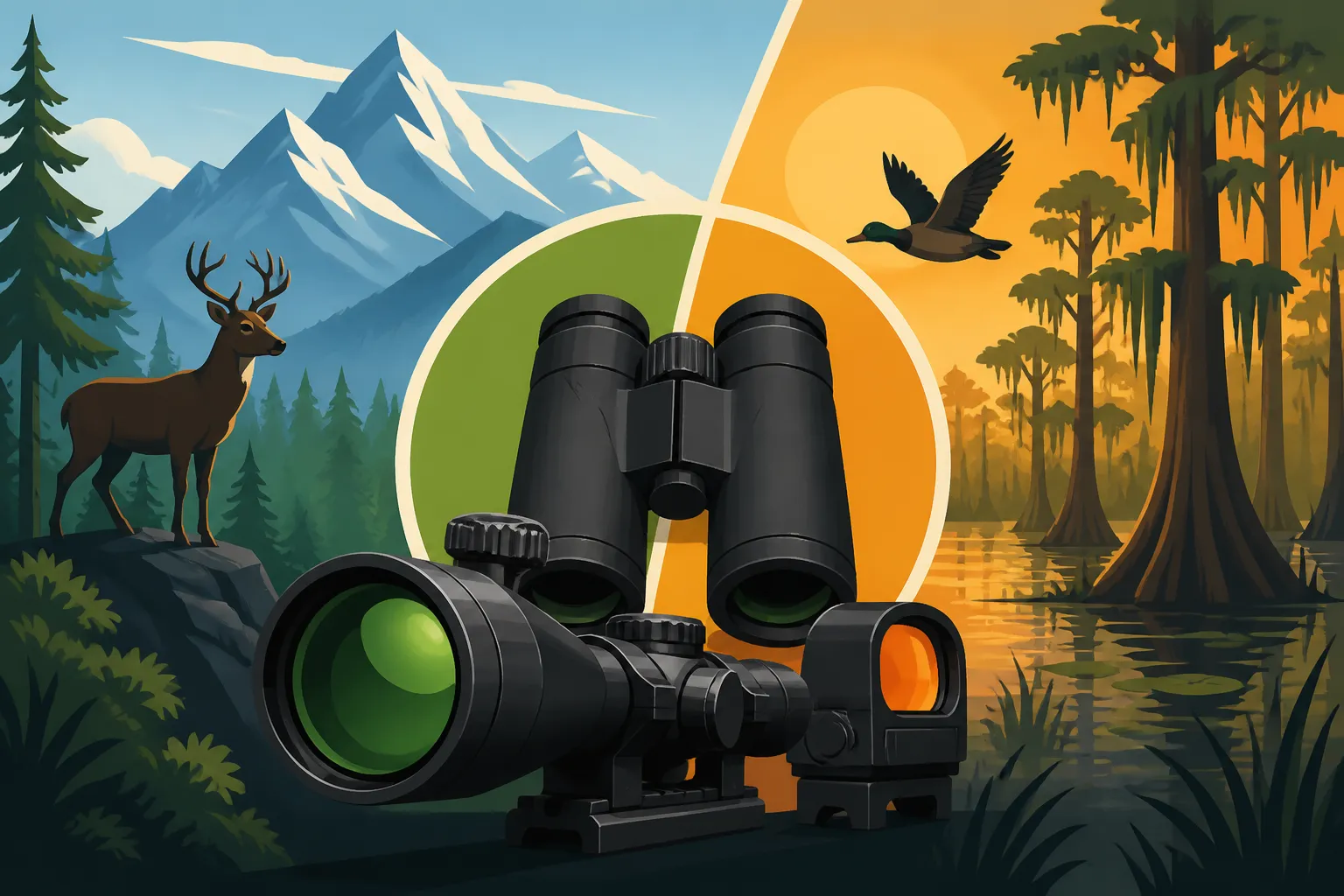
Hunting in Georgia is a truly unique experience, offering everything from the rugged peaks of the Blue Ridge to the dense, steamy swamps of the coastal plain. But with such varied terrain comes a host of challenges, especially when it comes to seeing your target clearly. Many hunters find themselves frustrated, realizing too late that the optics perfect for a wide-open field in another state are completely out of their depth in a Georgia river bottom, or vice versa. This guide will meticulously break down the best optical choices for various Georgia hunting scenarios, from high-powered rifle scopes for mountain long shots to compact binoculars for thick swamp timber, helping you make informed decisions for success.
Understanding Georgia's Diverse Landscapes and Their Optical Demands
Georgia isn't just one type of hunting ground; it's a tapestry of environments, each demanding a different approach to how you spot and acquire game. From the steep, unforgiving inclines of the North Georgia mountains to the sprawling, watery expanses of the Okefenokee Swamp, your optics need to be a true extension of your eyes, tailored to the specific challenges you'll face. Trying to use a heavy, high-magnification scope in a dense pine thicket, or squinting through low-power binoculars across a vast powerline cut, will only lead to frustration and missed opportunities.
The Mountain Challenge: Elevation, Distance, and Density
Up in the North Georgia mountains, like the Chattahoochee National Forest, you're dealing with serious elevation changes and often surprisingly long sightlines, especially from one ridge to another. You might be glassing a distant clear-cut or a saddle where deer are likely to cross, meaning you need optics that can resolve detail at hundreds of yards. However, once you drop into those deep hollows or dense timber stands, the conditions change drastically. Suddenly, you're in incredibly thick cover where shots are often measured in mere dozens of yards, and quick target acquisition is paramount. The sun can also play tricks, with harsh glare off exposed rock faces or deep shadows in shaded ravines. Understanding Reading a Ridge for North Georgia Deer is crucial here.
The Piedmont Puzzle: Mixed Habitat and Varied Distances
The Piedmont region, stretching across the middle of the state, offers a mosaic of agricultural fields, mature hardwoods, and dense pine plantations. Here, you might be sitting on a field edge watching deer cross at dusk, or still-hunting through a mixed oak flat. Shot distances can vary wildly from 20 yards in the thick stuff to 200+ yards across a peanut field. The optical challenge in the Piedmont is versatility. You need binoculars that can pick apart a distant tree line for movement, and a rifle scope that can handle both close, fast shots and more deliberate, longer-range engagements. It's often where hunters feel the most pressure to compromise, trying to find one optic that does it all.
The Swamp and Coastal Plain: Humidity, Low Light, and Close Quarters
Down in South Georgia, particularly around river bottoms like the Altamaha or in the vastness of the Okefenokee, you're battling humidity, low light, and unbelievably thick cover. Deer often move through dense palmettos, cypress swamps, and canebrakes. Your opportunities for a shot might be fleeting, in tight windows, and at very close range. Optics need to be incredibly fog-proof and durable against moisture. High magnification often becomes a liability, as it narrows your field of view and makes quick target acquisition difficult. Hunters here often focus on Hunting Georgia Swamp and River Bottom Deer and need gear that can withstand the elements.
Binoculars: Your Eyes in the Georgia Woods
Binoculars are, without a doubt, one of the most underappreciated tools in a Georgia hunter's arsenal. They are your primary scouting tool, your first line of defense in identifying game, and essential for making ethical shot decisions. Relying solely on your rifle scope for glassing is a dangerous habit that can lead to unnecessary movement and missed opportunities. Investing in good binoculars is investing in your overall hunting success.
Magnification and Objective Lens for Georgia's Terrain
When it comes to binoculars, the numbers matter: the first number is magnification, the second is the objective lens diameter in millimeters. For the average Georgia deer hunter, an 8×42 or 10×42 binocular is generally the sweet spot. An 8x magnification provides a wider field of view, which is fantastic for scanning dense cover in the Piedmont or quickly picking up movement in a river bottom. It's also steadier to hold without a tripod. A 10x magnification gives you a bit more reach, excellent for breaking down distant tree lines, clear-cuts, or mountain slopes. For most situations, a 42mm objective lens gathers plenty of light, even in dim conditions like dawn or dusk, without adding excessive bulk.
Consider a compact 8×32 or 10×32 model if you prioritize weight and size, especially for long walks into deep public lands. While they gather less light, modern coatings can make them surprisingly bright. On the flip side, some mountain hunters might lean towards 10×50 or even 12×50 for extended glassing sessions, but these are heavier and often require a tripod to maintain a steady image, which isn't always practical in Georgia's varied terrain. For most hunters, balancing power and portability, the 8×42 or 10×42 are the workhorses.
Features Essential for Georgia's Humid Climate
Georgia's humidity can be a real killer for optics. Fogging is a constant battle, especially when moving from a cool vehicle into the warm, damp woods. That's why nitrogen or argon purged, O-ring sealed binoculars are non-negotiable. This prevents internal fogging and keeps moisture, dust, and debris out. Look for good quality lens coatings that enhance light transmission, reduce glare, and protect the lenses from scratches. Even with the best coatings, having a good lens cloth is paramount.
Another often-overlooked feature is an ergonomic design with a grippy, rubber-armored exterior. You're going to be handling these in potentially wet or muddy conditions, and a secure grip is vital. An adjustable diopter allows you to fine-tune the focus for each eye, ensuring a crisp image if your eyesight isn't perfectly symmetrical. And don't forget a comfortable neck strap or, even better, a binocular harness. A harness keeps your binoculars secure, close to your chest, and prevents them from bouncing around, making them more accessible and less of a nuisance when still-hunting. Consider brands like GoHunt that offer durable, weather-resistant models designed for rigorous outdoor use. Good binocular choice can make or break your ability to scout Where South Georgia Pine Flat Bucks Bed.
Rifle Scopes: Precision for Every Shot
Your rifle scope is the direct link between your eye and the target. It's what allows you to place a shot precisely, ensuring a quick and ethical harvest. But just like binoculars, not all scopes are created equal, and what works beautifully on a western plains hunt might be a hindrance in Georgia's diverse landscapes.
Variable Power vs. Fixed Power for Georgia Hunting
Most Georgia hunters opt for variable power scopes, and for good reason. They offer the flexibility to dial down the magnification for close, fast shots in thick timber or dial up for longer engagements across food plots or clear-cuts. A common range for Georgia might be a 3-9×40, 2-10×44, or even a 4-12×40. Lower magnification settings, like 2x or 3x, provide a wide field of view, making it easier to track moving game or quickly acquire a target that suddenly appears in dense cover. This is especially useful in those situations when you're deer drives with three or four hunters.
Conversely, the higher end of the magnification (9x, 10x, 12x) gives you the precision needed for those longer shots, allowing you to clearly see your aim point on a deer at 150-200 yards. For dedicated mountain hunting, some might go even higher, like a 4-16x or 5-20x, but understand that these come with increased weight and a smaller field of view at lower powers. Fixed power scopes, while incredibly durable and simple, usually aren't practical for the varied distances encountered across Georgia. You'd likely be over-magnified for close shots or under-magnified for longer ones.
Low Light Performance for Dawn and Dusk
Many deer in Georgia are taken during the low light periods of dawn and dusk. This is where a good quality rifle scope truly shines. Several factors contribute to a scope's low-light performance: the size of the objective lens, the quality of the glass, and the lens coatings. A larger objective lens (e.g., 40mm, 44mm, 50mm) gathers more light, providing a brighter image. However, larger objective lenses also mean a heavier scope and often require higher rings, which can affect your cheek weld.
High-quality glass and multi-coated lenses are equally, if not more, important. They reduce glare, prevent light loss, and transmit a clearer, brighter image. Look for scopes with a good exit pupil, which is the diameter of the light beam that exits the eyepiece. A larger exit pupil (typically 4-7mm in hunting scopes) makes it easier for your eye to gather all available light, especially when your pupil dilates in low light. Some scopes also offer illuminated reticles, which can be a huge advantage when the crosshairs might otherwise get lost against a dark animal in deep shadow. This is critical for Rifle Scopes for Low-Light Swamp Edges.
Durability and Reliability in the Field
A rifle scope in Georgia takes a beating. It's exposed to rain, sweat, humidity, bumps, and rubs against tree branches. Your scope needs to be built tough. Just like binoculars, look for scopes that are nitrogen or argon purged and O-ring sealed to prevent internal fogging and water intrusion. The tube itself should be a single piece, typically 1-inch or 30mm, for maximum strength.
Turrets should have crisp, repeatable clicks for precise adjustments, and ideally, be capped to prevent accidental turning. The recoil of even a mild deer cartridge can slowly shift point of impact if the internal mechanisms aren't robust. While specific brands can't be listed for pricing, investing in a reputable scope known for its durability and optical clarity will pay dividends over years of hunting. A reliable scope means confidence when that buck steps out of the hardwoods, whether you're Still-Hunting South Georgia Pine Flats or sitting a stand in the mountains.
Rangefinders: The Key to Ethical Shots
Rangefinders have revolutionized hunting, transforming guesswork into precise data. In Georgia, where shot distances can vary wildly even within the same hunt, a good rangefinder isn't just a luxury; it's a critical tool for making ethical and accurate shots. There's nothing worse than second-guessing your shot placement because you misjudged the distance, especially when you're aiming for a vital area on a deer.
Why Every Georgia Hunter Needs a Rangefinder
Imagine you're hunting a Piedmont field edge. One minute a deer is at 75 yards, the next it's at 200 yards across the same field. Without a rangefinder, estimating these distances under pressure, in varying light, can lead to significant errors. For archers, it's even more crucial, as a 10-yard misjudgment can mean the difference between a clean kill and a missed opportunity. Modern compound bows are incredibly accurate, but only if you know the exact distance. For rifle hunters, especially those using calibers with a flatter trajectory, knowing the precise range helps you understand holdovers or dial in your turrets, leading to a much more ethical shot.
Furthermore, a rangefinder aids in scouting. When setting up a stand, you can range prominent landmarks like trees, rocks, or fence lines to establish clear shooting lanes and maximum ethical distances. This preparation can reduce panic and improve your confidence when a deer finally appears. It's about taking the guesswork out of a critical moment, making sure you're always within your effective range for a clean harvest. When considering how to approach Hanging a Stand on a Mountain Saddle, ranging key spots beforehand is invaluable.
Features to Look For in a Georgia Rangefinder
When choosing a rangefinder for Georgia, several features stand out. First, speed and accuracy are paramount. You want a unit that provides a quick, consistent reading, especially if game is on the move. Look for models that can range deer-sized targets out to at least 400-500 yards, even if your personal maximum shooting range is less. This extra capability ensures accurate readings at your practical distances.
Second, angle compensation is a must, particularly for mountain hunting. When shooting uphill or downhill, the horizontal distance to the target is what truly matters for bullet or arrow trajectory, not the line-of-sight distance. Many modern rangefinders, including some offerings from GoHunt, feature incline/decline technology that provides the "shoot-to" distance, saving you from complex mental math in the field. Third, durability and weather resistance are key. Just like your binoculars, your rangefinder will face Georgia's humidity and occasional rain. A waterproof or water-resistant unit with a robust housing is essential. A good grip and compact size also make it easier to handle and carry, especially when Rangefinders in Thick Coastal Plain Cover.
| Feature | Importance for Georgia Mountains | Importance for Georgia Swamps/Piedmont |
|---|---|---|
| Angle Compensation | Critical for steep uphill/downhill shots | Highly useful for subtle inclines or shooting from treestands |
| Deer Ranging Cap. | 400-500+ yards for distant clear-cuts or ridge-to-ridge shots | 300-400 yards adequate for most scenarios |
| Speed/Accuracy | Essential for quick reads on moving game | Crucial for fleeting opportunities in dense cover |
| Weatherproofing | Important for rain and morning dew | Non-negotiable for high humidity, fog, and rain |
| Compact Size | Good for ease of carry in rugged terrain | Excellent for quick deployment in tight quarters |
| Scan Mode | Useful for ranging multiple targets or moving game | Helps range through light brush or track moving animals |
Spotting Scopes: When Distance Demands Detail
While not as universally used as binoculars or rifle scopes, a spotting scope can be an incredibly valuable tool for specific hunting scenarios in Georgia, especially when long-range observation is key. It allows you to scrutinize distant animals without disturbing them, confirming species, sex, and antler size, saving you precious time and energy.
Uses for Spotting Scopes in Georgia
The primary use for a spotting scope in Georgia is in expansive, open areas where game might be visible at extreme distances. Think of large powerline cuts that run for miles through the mountains or Piedmont, vast agricultural fields in South Georgia, or even certain open areas of Wildlife Management Areas (WMAs). If you're hunting an area where you might spot deer hundreds of yards away and need to confirm if that distant speck is a legal buck, a spotting scope is your friend. This can be particularly useful when trying to identify Which Deer Count Toward the Season Limit.
For bear hunters in the North Georgia mountains, a spotting scope can be invaluable for glassing distant slopes or clear-cuts where bears might be feeding. It allows you to determine if it's a legal bear and assess its size before making a long, arduous hike. While not typically needed for dense swamp hunting where visibility is limited, if you're overlooking a vast marsh or large body of water for waterfowl or even hogs, a spotting scope could help identify distant movement.
Magnification, Portability, and Stability
Spotting scopes typically offer much higher magnification than binoculars, often ranging from 20x to 60x, sometimes even higher. This extreme magnification allows you to resolve fine details at distances where binoculars would simply show a blurred image. However, with higher magnification comes a significantly smaller field of view and an absolute necessity for a stable platform. Using a spotting scope without a tripod is practically impossible.
When choosing a spotting scope for Georgia, consider the balance between magnification and portability. A compact 60mm objective lens scope with 15-45x magnification might be a good compromise for versatility, offering excellent detail without being overly heavy for packing into more remote areas. For dedicated long-range glassing from a fixed position, an 80mm or larger objective with 20-60x or even 25-75x magnification will provide superior brightness and detail, especially in lower light. Angle eyepieces are generally preferred for comfort during extended viewing sessions, as they allow for a more natural head position. Just remember that even a lightweight spotting scope and tripod add significant bulk to your pack, so evaluate if your hunting style truly necessitates one.
Night Vision and Thermal Optics: Hunting Beyond Daylight
While traditional hunting in Georgia is primarily a daylight affair, the rules around feral hog hunting allow for specific opportunities after dark, making night vision and thermal optics incredibly relevant for a growing number of hunters. These technologies open up an entirely new dimension of hunting, providing a clear advantage when the sun goes down.
Night Vision for After-Dark Hogs
Night vision amplifies ambient light (starlight, moonlight) to create a visible image. For hunting feral hogs at night in Georgia, a night vision scope or monocular can be a game-changer. Hogs are largely nocturnal, and being able to spot them in the dark allows hunters to be active when the hogs are. Traditional night vision, often referred to as Gen 1, 2, or 3, typically renders images in shades of green. Higher generations offer better clarity, resolution, and performance in very low light.
When choosing night vision, consider whether you want a dedicated scope for your rifle or a handheld monocular for scanning. A monocular allows you to survey an area without pointing your rifle, which is a key safety consideration. Some hunters use a night vision monocular for spotting and then switch to a weapon-mounted thermal or a dedicated night vision scope for the shot. Remember to always be aware of Georgia Night Hog Hunting Light Rules and other specific regulations when using these devices. The ability to see in the dark can also help you with Hunting Hogs Alongside Any Other Georgia Season.
Thermal Optics: Seeing Heat Signatures
Thermal optics don't rely on light at all; instead, they detect heat signatures. This means they can "see" through complete darkness, fog, and even some light cover that would obscure a conventional optic or even night vision. For feral hog hunting in Georgia, thermal is often considered superior to night vision because it cuts through the common environmental challenges like thick brush and humid fog, which can impede standard night vision devices. A hog's body heat stands out dramatically against the cooler background, making them incredibly easy to spot.
Thermal scopes or monoculars come in various resolutions and refresh rates. Higher resolution provides a clearer, more detailed image, while a higher refresh rate offers smoother tracking of moving animals. Many hunters opt for a thermal monocular for scanning and spotting, then use a conventional rifle scope or a lower-end thermal scope for the actual shot. The ability of thermal to pierce through cover and darkness means you can detect hogs much earlier and at greater distances, making it an incredibly effective tool for managing these destructive animals. It’s important to understand Thermal Scopes Legal for Georgia Hogs and local laws before investing.
Maintaining Your Optics in Georgia's Challenging Environment
Georgia's climate is tough on gear. The combination of heat, humidity, rain, and dust can quickly degrade even high-quality optics if not properly cared for. Neglecting your optics can lead to blurry images, internal fogging, and ultimately, failure in the field. A little preventative maintenance goes a long way in ensuring your investment lasts for years.
Protecting Against Humidity and Fog
Humidity is the silent killer of optics in Georgia. Moving optics from a cool air-conditioned house or vehicle into the warm, damp air of the woods almost guarantees external fogging. While nitrogen or argon purging prevents internal fogging, external fogging is a simple condensation issue. To combat this, try to equalize the temperature of your optics by leaving them out in the shaded ambient air for a while before you hunt. Storing them in a breathable soft case rather than a sealed hard case can also help.
Once in the field, avoid breathing directly onto lenses. If lenses do fog externally, resist the urge to wipe them with your shirt. Use a specialized lens cleaning cloth or a lens pen, which often includes a soft brush to remove dust first, followed by a non-abrasive pad. For really stubborn moisture, a small microfiber cloth is best. Always store optics with desiccant packs in their cases when not in use to draw out any residual moisture. This is especially true after a hunt in the rain or heavy dew. Consider our guide on Fogging Optics in Georgia Humidity for more tips.
Cleaning Lenses and Housings Properly
Cleaning your lenses correctly is paramount to optical clarity and longevity. The biggest mistake hunters make is wiping lenses that have dust or grit on them. This acts like sandpaper, slowly scratching the delicate lens coatings. Always start by gently blowing off any loose dust or debris with a can of compressed air or a soft lens brush. Once the large particles are removed, you can use a lens cleaning solution specifically designed for optics, applied to a microfiber cloth, not directly to the lens. Gently wipe in a circular motion from the center outwards.
The housing of your optics also needs attention. Mud, sweat, and grime can accumulate in crevices and around turrets. Use a damp cloth to wipe down the exterior, and a soft brush (like an old toothbrush) for hard-to-reach areas. For heavily soiled areas, a mild soap solution can be used, but ensure no water gets into seals or moving parts. Always dry thoroughly afterward. Pay particular attention to the rubber armor, as it can degrade over time, losing its grip and protective qualities. Regular cleaning prevents buildup that can trap moisture and accelerate wear.
Storage and Transport Tips
Proper storage and transport are key to protecting your optics between hunts. When not in use, store binoculars, rangefinders, and scopes in their protective cases in a cool, dry place, ideally with a desiccant pack. Avoid leaving them in a hot car for extended periods, as extreme heat can degrade internal lubricants and sealants.
For transport to and from the hunting grounds, ensure your optics are secured. Binoculars should be in a padded harness or case. Rifle scopes should be covered with lens caps (objective and ocular) and, if possible, the rifle itself should be in a padded soft or hard case. This prevents jarring impacts that can knock a scope out of zero or damage internal components. Using a good quality pack that secures your gear can also prevent damage during a long trek into the woods. If you're using a Packs Built for a Chattahoochee Day Hunt, ensure your optics have their own dedicated, protected compartment.
Making the Right Choice: Matching Optics to Your Hunt
Navigating the world of hunting optics can feel overwhelming, but by understanding your specific hunting style and the Georgia terrain you frequent, you can make informed decisions. The goal isn't to buy the most expensive gear, but the right gear that enhances your experience and increases your success.
Assessing Your Hunting Style and Primary Terrain
Before you even start looking at brands or price tags, take an honest inventory of how and where you hunt most often.
- Are you primarily a still-hunter in thick South Georgia pine flats or river bottoms? Your needs will lean towards compact, durable, fog-proof binoculars (8x) and a low-magnification, wide field-of-view rifle scope (1-4x or 2-7x). A rangefinder will still be useful, but extreme long-range capability isn't a priority.
- Do you spend most of your time in the North Georgia mountains, often glassing clear-cuts and ridge lines? Here, 10x binoculars become more valuable, possibly with a spotting scope for detailed long-range scouting. Your rifle scope might benefit from a slightly higher top-end magnification (3-9x or 4-12x) and angle-compensating rangefinder is a must.
- Is the Piedmont, with its mix of fields and timber, your primary stomping ground? You'll need versatile optics that bridge the gap. A good 8x or 10x binocular, a versatile rifle scope (e.g., 3-9x), and a reliable rangefinder will serve you well for varying distances.
Your personal ethical shot distance also plays a huge role. If you limit your rifle shots to 150 yards, you don't need a scope designed for 500-yard precision. Match the optic's capability to your capability.
Balancing Cost and Performance
Optics range wildly in price, from budget-friendly options to those costing thousands of dollars. While it's tempting to save money, remember that you often get what you pay for in terms of glass quality, coatings, durability, and low-light performance. Generally, it's wise to invest as much as you can comfortably afford in your optics, as they directly impact your ability to see and shoot accurately.
However, "more expensive" doesn't always mean "better for you." A high-end 20x magnification scope might be wasted if you only hunt dense cover. Prioritize the features that directly benefit your specific hunting needs in Georgia. A mid-range binocular with excellent fog-proofing and a good ergonomic design will serve a swamp hunter far better than a top-tier, heavy binocular with excessive magnification. Don't forget that many reputable brands, including some offered by GoHunt, provide excellent performance at various price points, ensuring there's a reliable option for every hunter's budget and specific requirements. Just make sure the features align with the challenges of hunting Wind and Thermals on a Mountain Ridge or stalking Hunting a Funnel Between Two Swamps.
Future-Proofing Your Optics Investment
As you invest in optics, think about their versatility and longevity. While you might hunt one area today, you might explore others next season. Choosing optics that are durable and have a good reputation for reliability will ensure they serve you for many years, even if your hunting locations or styles evolve. Look for brands with good warranties and customer service.
Technology in optics is always advancing, but core principles remain. Good glass, robust construction, and practical features will always be valuable. While dedicated night vision or thermal might be specific to hog hunting, a high-quality set of binoculars and a versatile rifle scope will be staples of your Georgia hunting kit for any species or terrain. By carefully considering your needs and the unique demands of Georgia's diverse hunting landscapes, you can assemble an optical setup that truly enhances your time afield.
Disclaimer
This article is for general informational purposes only and does not constitute professional advice. Laws, prices and regulations vary by location and change over time. Consult a qualified professional for guidance on your specific situation.