Rifle Scopes for Low-Light Swamp Edges
Hunting Georgia's shadowy swamps and dense river bottoms can be an absolute thrill, but it also presents a unique challenge: making a clean, ethical shot when legal shooting light is fading or hasn't quite arrived. Many hunters struggle to confidently identify targets or see their reticle in those critical minutes, leading to missed opportunities and frustration. This guide is all about helping you understand how rifle scopes specifically designed for low-light conditions can transform your hunting experience in these tricky Georgia environments.
The Georgia Swamp Edge: A Low-Light Challenge
Let's be honest, hunting the swamps and thick river bottoms of Georgia isn't like hunting open fields out West. We're dealing with different kinds of low-light scenarios that demand specific features from our optics. It's not just about dawn and dusk; it's about the ever-present gloom under a dense canopy.
Thick Canopies and Deep Shadows
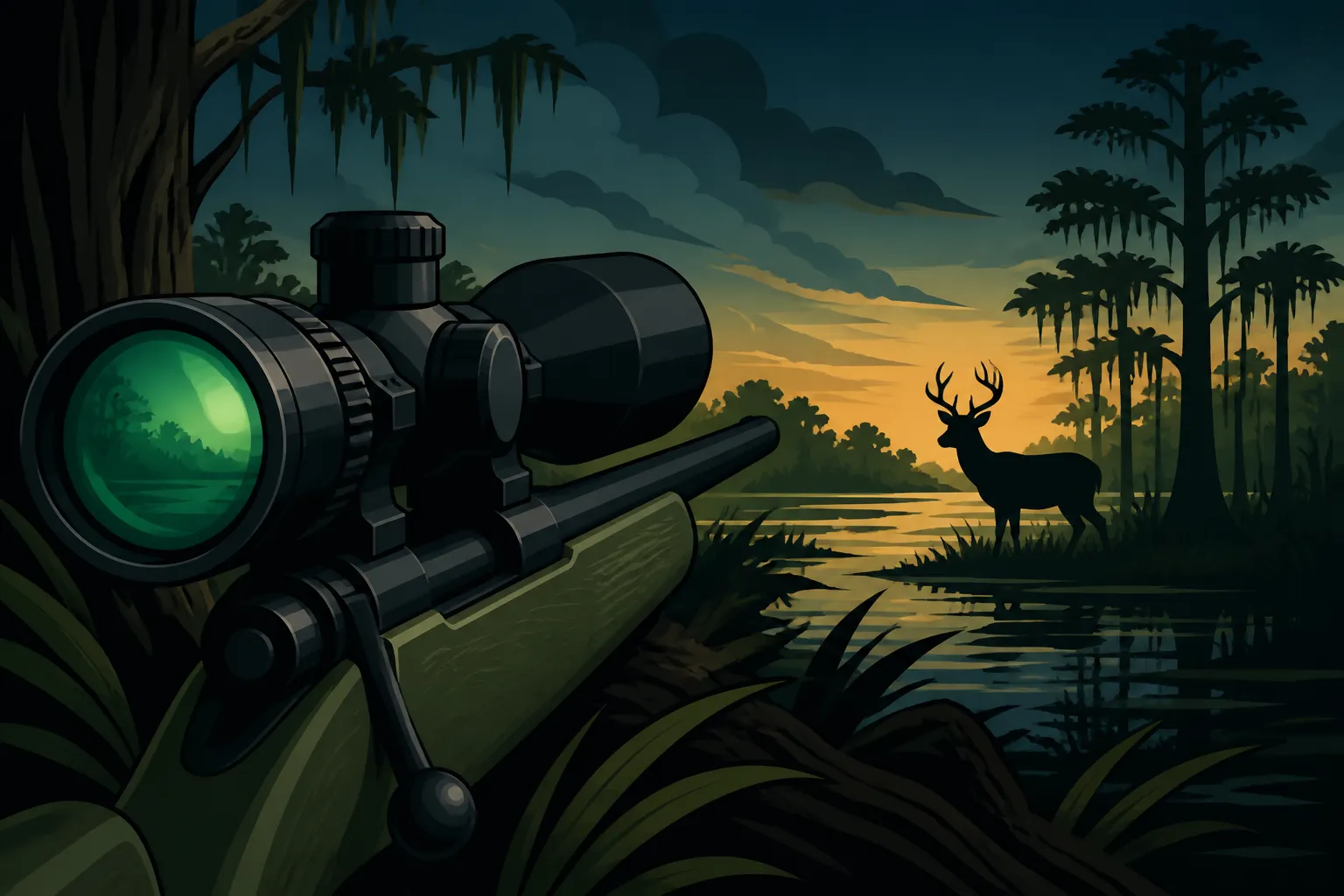
Imagine you're tucked into a stand on the edge of a cypress swamp in south Georgia, or perhaps deep in a river bottom in the Altamaha corridor. Even at midday, the sunlight struggles to penetrate the thick canopy of cypress, tupelo, and hardwoods. This creates a perpetual state of deep shadow and dappled light, making it incredibly difficult to pick out details like antlers or the vitals of a deer, even when they're close. Your eyes are constantly working overtime, trying to adjust to the stark contrasts between pools of light and dense shade. A standard, run-of-the-mill scope often feels like looking through a dark tube in these conditions, obscuring the very details you need to make a responsible shot.
This isn't just a comfort issue; it's a safety and ethical one. You absolutely need to be able to identify your target clearly and ensure a humane shot placement. A scope that enhances light transmission and contrast can literally be the difference between confidently taking a deer and having to pass because you can't be sure of what you're seeing in those deep shadows. The frustration of seeing a silhouette but not being able to confirm it's a legal buck is something many Georgia hunters know all too well.
The Critical Low-Light Windows
While the deep shadows are a constant, the most crucial times for hunting in these environments are often those first and last 30 minutes of legal shooting light. Deer are incredibly active during these crepuscular periods, using the cover of darkness to move undetected. However, these are precisely the times when a standard scope falters. When the sun is barely kissing the horizon, or has just dipped below it, every photon of light becomes precious.
A scope optimized for low-light excels here because it maximizes the light that reaches your eye, giving you those precious extra minutes of visibility at dawn and dusk. This can mean the difference between seeing that big swamp buck step out onto the edge of a slough and only hearing him disappear into the thicket. Many of us have experienced that heart-sinking moment when you know a deer is there, but your optics just can't gather enough light for you to seal the deal. This is particularly true when you're targeting deer that often linger in cover, moving only when the light is most forgiving. If you hunt areas where the season includes late-season opportunities, those cold, grey mornings and evenings can be especially tough on optics.
Humidity, Rain, and Your Optics
Georgia's weather, especially in the low-lying areas, can be brutal on optics. High humidity is a constant companion, particularly during the early archery and primitive weapons seasons. This humidity can lead to external lens fogging, especially when moving from a cooler vehicle to the warmer, damp air of the swamp, or simply due to your own body heat. Beyond humidity, sudden rain showers are common, and a wet scope lens can severely degrade image quality.
An inadequate scope can become completely useless in these conditions. Imagine spending hours on a Hunting a Funnel Between Two Swamps stand, only for your scope to fog up just as a deer steps out. It's an infuriating and preventable problem. Therefore, any scope chosen for Georgia's swamp edges must have superior waterproofing, fogproofing, and robust lens coatings to shed water and resist smudging. You need optics that can withstand the elements, not just deliver good light transmission on a clear, dry day.
Decoding Low-Light Optical Performance
When we talk about rifle scopes for low light, we're really diving into the physics of how light is gathered and transmitted through the lens system to your eye. It’s not just marketing jargon; these are real design features that make a tangible difference in the field.
Objective Lens and Light Gathering
The objective lens is the front lens of your scope, the one closest to the target. Its primary job, besides focusing the image, is to gather light. Generally, a larger objective lens can gather more light. Think of it like a bigger bucket catching more raindrops. For low-light hunting in deep shadows or at dawn/dusk, this extra light gathering capacity is crucial. Common objective lens sizes range from 32mm up to 56mm, with 40mm to 50mm being popular choices for hunting.
However, it's not simply "bigger is better." A larger objective lens also means a larger, heavier scope, which can throw off the balance of your rifle and make it cumbersome to carry, especially when Dragging a Deer Out of a Swamp. It also requires higher rings, which can affect your cheek weld and shooting consistency. The trick is finding a balance between sufficient light gathering for Georgia's dim environments and a practical size for your specific rifle and hunting style. For example, a 50mm objective often hits a sweet spot, offering excellent light transmission without turning your rifle into a telescope.
Glass Quality and Proprietary Coatings
This is where much of the magic, and the cost, of a low-light scope truly lies. Even with a large objective lens, if the glass itself is poor quality or the coatings are substandard, much of that gathered light will be lost or distorted. High-quality glass, often referred to as "ED" (Extra-low Dispersion) or "HD" (High Definition), minimizes chromatic aberration (color fringing) and allows more light to pass through clearly. It provides a sharper, more true-to-life image, which is vital for distinguishing details in dim conditions.
Beyond the raw glass, manufacturers apply various proprietary lens coatings to multiple air-to-glass surfaces within the scope. These coatings serve several critical functions:
- Anti-reflection: They reduce light reflection off the lens surfaces, allowing more light to transmit through the scope to your eye. This is probably the most important coating for low-light performance.
- Scratch resistance: Protecting the delicate lens surfaces from the bumps and scrapes of hunting.
- Hydrophobic (water-shedding): These coatings cause water droplets to bead up and roll off, preventing rain and dew from obscuring your view—an absolute must for humid Georgia.
A scope with "fully multi-coated" optics means that all air-to-glass surfaces have received multiple layers of anti-reflective coatings. This is what you should be looking for in any serious hunting scope for our conditions. Cheap scopes might only be "coated" or "multi-coated," which isn't enough to perform when it really counts. Many top brands invest heavily in their coating technology, and it's a significant factor in their price point and performance, especially in those critical moments on a Hunting Georgia Swamp and River Bottom Deer expedition.
Exit Pupil and Eye Relief Considerations
The exit pupil is the diameter of the column of light that leaves the eyepiece and enters your eye. You can see it as the bright circle when you hold the scope at arm's length. A larger exit pupil means more light is delivered to your eye. To calculate it, divide the objective lens diameter by the magnification (e.g., a 40mm objective at 8x magnification has a 5mm exit pupil). For low-light conditions, an exit pupil of 5mm or greater is generally preferred, as your eye's pupil dilates to around 5-7mm in dim light. This ensures your eye is receiving as much light as it can process.
Eye relief is the distance your eye needs to be from the eyepiece to see a full, clear image without "blackouts" or "tunnel vision." Adequate eye relief is vital for safety, especially with higher-recoil rifles, as it prevents the scope from hitting you in the brow. It also provides comfort and flexibility in head position, which is important when you're trying to get a quick, stable shot from an awkward angle in a treestand. Scopes typically offer eye relief ranging from 3 to 4.5 inches. For hunting in Georgia where quick target acquisition and sometimes contorted shooting positions are common, ensuring enough eye relief prevents unnecessary fumbling and allows you to stay focused on the target.
Choosing the Right Reticle for Dark Timber
The reticle, or crosshairs, is your aiming point, and its design can be just as crucial as the glass quality in low-light situations. What works perfectly in a brightly lit shooting range might disappear entirely in the shadows of a Georgia river bottom.
Simple Duplex vs. Ballistic Styles
For hunting in dense cover and low light, simpler is often better. A classic duplex reticle, with its thick outer posts and thin center crosshairs, is incredibly effective. The thick posts guide your eye to the center quickly, and the fine crosshairs allow for precise aiming. In extremely low light, even if the fine center becomes hard to see, you can often still bracket your target with the thicker outer portions for a close-range shot. Many Georgia hunters appreciate this no-nonsense approach in the woods.
More complex ballistic reticles (like BDC, Christmas tree, or mil-dot) offer holdover points for long-range shooting. While useful for wide-open spaces, they can become a cluttered mess in low light and dense cover. All those extra lines and dots can obscure your target or make it harder to quickly identify the main aiming point. Unless you are consistently taking shots at distances where holdovers are critical (which is rare in our thick woods), a simpler reticle will usually serve you better, particularly when hunting Piedmont Farmland Deer where you might have mixed distances.
The Power of an Illuminated Reticle
This feature is a game-changer for low-light hunting, especially in Georgia's deep woods. An illuminated reticle has a central dot or section of the crosshairs that glows, typically in red or green, with adjustable brightness settings. When you're trying to aim at a dark-bodied deer against a dark background of trees, a standard black reticle can completely disappear. An illuminated reticle provides a bright, crisp aiming point that stands out, allowing for confident shot placement even when ambient light is minimal.
It's important to choose a scope with an illumination system that offers very low brightness settings. A reticle that's too bright in dim conditions can create glare and wash out your vision, much like staring at a bright phone screen in a dark room. The best illuminated reticles allow you to dial down the brightness to just a subtle glow that's visible without being distracting. Also, consider battery life and ease of battery replacement, as you don't want your reticle to die when you need it most. This feature can truly give you those crucial extra minutes of shooting light that make or break a hunt. Illuminated Reticles for Dark Timber are quickly becoming a favorite for many seasoned hunters.
First Focal Plane vs. Second Focal Plane
This refers to where the reticle is placed within the scope's optical system, and it has implications for how the reticle appears at different magnifications.
-
Second Focal Plane (SFP): This is the most common type for hunting scopes. The reticle is located near the eyepiece, meaning its size appears constant regardless of the magnification setting. As you zoom in, the target gets bigger, but the reticle stays the same size. This is generally preferred for hunting because the reticle always looks consistent and doesn't become too thick or too fine at different zoom levels. If your reticle has ballistic holdover points, these will only be accurate at one specific magnification setting (usually the highest or a marked setting). For most Georgia hunting, where shots are typically closer and you're using simple aiming, SFP is perfectly adequate.
-
First Focal Plane (FFP): The reticle is placed closer to the objective lens, meaning it changes in size as you adjust the magnification. When you zoom in, the reticle gets larger; when you zoom out, it gets smaller. The main advantage of FFP is that any ballistic holdover points remain accurate at all magnification settings, as the reticle subtensions change proportionally with the target. However, for hunting purposes, an FFP reticle can become very fine and difficult to see at low magnification in dense cover, or excessively thick and obscuring at high magnification. While popular with long-range tactical shooters, FFP is often less ideal for the quick, close-to-mid range shots common in Georgia's woods and swamps, where a consistent reticle presentation is often more important.
Beyond the Glass: Durability and Mounting
A scope is only as good as its ability to withstand the rigors of hunting, especially in Georgia's often-challenging environments. All the fancy glass and coatings won't matter if your scope fogs up, breaks, or can't hold zero.
Waterproofing, Fogproofing, and Shockproofing
These "proofings" are non-negotiable for a Georgia hunting scope.
- Waterproofing: This means the scope is sealed to prevent moisture from entering. Look for scopes purged with inert gases like nitrogen or argon, which are then sealed. This prevents water from getting in if you're caught in a downpour, drop your rifle in a puddle, or even during a quick dunk in a creek.
- Fogproofing: The internal lenses of a scope can fog up due to rapid temperature changes. The nitrogen or argon purging mentioned for waterproofing also takes care of fogproofing. By replacing humid air with dry, inert gas, internal fogging is eliminated. This is absolutely critical in our humid climate, preventing frustrating moments of Fogging Optics in Georgia Humidity.
- Shockproofing: Your scope needs to withstand the recoil of your rifle, accidental bumps, and the inevitable drops that happen in the field. Good shockproofing means the internal components are robustly designed and secured to prevent them from shifting or breaking under impact. This ensures your scope consistently holds its zero, shot after shot.
Reputable scope manufacturers test their products rigorously for these qualities. Don't skimp on a scope that lacks these fundamental protections, especially if you plan on hunting areas like the Okefenokee Swamp or deep river bottoms where conditions can turn harsh quickly.
Weight, Size, and Balance on Your Rifle
While a large objective lens can improve light gathering, it also adds bulk and weight. A heavy, unbalanced rifle is a pain to carry through thick brush and swamps, and it can negatively impact your ability to hold steady for an accurate shot. Consider the overall weight and dimensions of the scope in relation to your rifle and your hunting style.
If you're still-hunting miles through timber or frequently using a climber stand, a lighter, more compact scope might be preferable, even if it sacrifices a tiny bit of low-light performance. Conversely, if you're primarily hunting from a permanent box blind or a carefully set Treestand Setups in North Georgia Mountains, a slightly heavier scope might be acceptable for the added optical benefits. The goal is a balanced setup that feels natural and points instinctively. Take your rifle to the store, if possible, and feel different scope sizes mounted on it to get a sense of the balance.
Mounting Systems and Ring Choice
The best scope in the world is useless if it's not mounted securely and correctly. A robust mounting system is crucial for maintaining zero and ensuring accuracy, especially under recoil and in the rough and tumble of Georgia hunting.
- Rings: Scope rings connect the scope to the base on your rifle. They come in various heights (low, medium, high) to accommodate different objective lens sizes and provide proper clearance between the scope and the barrel. Choose rings made from strong, durable materials like steel or aircraft-grade aluminum. Precision-machined rings ensure a tight, even grip on your scope tube without damaging it.
- Bases: The base attaches to your rifle's receiver and provides the platform for the rings. Common types include Weaver-style, Picatinny, and proprietary designs for specific rifle actions. Ensure your base is securely fastened and of high quality.
- Installation: Proper installation is paramount. Use a torque wrench to tighten screws to the manufacturer's specifications to prevent overtightening (which can damage the scope tube) or undertightening (which can lead to the scope shifting under recoil). If you're unsure, have a qualified gunsmith mount your scope. Many hunters overlook the importance of good mounts, but they are the critical link between your rifle and your optic. You wouldn't put cheap tires on a sports car, so don't put cheap rings on a good scope.
Investing Wisely: Scope Options for Every Budget
Scopes for low-light conditions can range dramatically in price, from a couple of hundred dollars to several thousand. Understanding what you get for your money and aligning it with your hunting needs is key. Brands like GoHunt can be a great resource for researching various options and reading reviews before you make a purchase.
Entry-Level Scopes: Getting Started
For hunters on a tighter budget, entry-level scopes can still offer significant improvements over no scope at all, or a very basic optic. These scopes typically feature fully multi-coated lenses, often with a 40mm or 44mm objective lens. They usually have a standard duplex reticle, and sometimes an illuminated option is available at the higher end of the entry-level price range. You can expect decent light transmission, but perhaps not the exceptional clarity or edge-to-edge sharpness of more expensive models.
These scopes are a good starting point for someone who primarily hunts during daylight hours but wants a bit of an edge in those critical low-light minutes. They are generally robust enough for typical hunting use, but might not stand up to extreme abuse as well as premium options. Just be mindful of their limitations, especially in the deepest shadows of a cypress swamp. Check reviews on sites like GoHunt to see what other hunters are saying about their real-world performance.
Mid-Range Performers: Balancing Value and Quality
This is often the sweet spot for many Georgia hunters. Mid-range scopes offer a substantial leap in optical quality, durability, and features without breaking the bank. Here, you'll find higher-quality glass, more advanced proprietary lens coatings, and often better eye relief and a more generous eyebox. Many scopes in this category will feature excellent waterproofing and fogproofing, illuminated reticles with good low-light settings, and robust construction. Objective lens sizes frequently range from 44mm to 50mm, providing a strong balance of light gathering and manageable size.
Scopes in this tier provide a noticeable difference in image brightness, contrast, and clarity, allowing you to discern more detail in dim conditions. They are often the best value, offering performance that rivals scopes costing significantly more, while still being practical for a range of hunting scenarios. This is where you really start to feel confident in those tricky early morning and late evening shots. When researching, looking at user feedback on platforms like GoHunt can highlight scopes that consistently over-perform for their price.
Premium Scopes: The Ultimate Low-Light Edge
If you demand the absolute best and your budget allows, premium scopes represent the pinnacle of optical engineering. These scopes feature the finest ED or HD glass, cutting-edge lens coatings that maximize light transmission and contrast, and often larger objective lenses (up to 56mm) without excessive weight. They boast superior resolution, exceptional edge-to-edge clarity, and virtually no chromatic aberration. The internal mechanisms are incredibly precise, ensuring consistent tracking and rock-solid zero retention.
Premium scopes often include highly advanced illuminated reticles with a wide range of brightness settings, including very low ones specifically designed for extreme low light. While the price tag is substantial, the performance in challenging conditions is often unmatched. These are the scopes that can literally give you minutes of extra shooting light at either end of the day, allowing you to confidently take a shot when others are packing up. For hunters who spend extensive time in the most challenging low-light environments, such as during Bowhunting Georgia's Early Archery Season or Primitive Weapons Hunting in Georgia, the investment can pay dividends in opportunities.
| Feature | Entry-Level Scopes | Mid-Range Scopes | Premium Scopes |
|---|---|---|---|
| Glass Quality | Standard optical glass | Good quality, some ED/HD features | Superior ED/HD glass, exceptional clarity |
| Lens Coatings | Fully Multi-Coated | Advanced Proprietary Multi-Coatings | Cutting-edge, multi-layered anti-reflection |
| Objective Lens | 40mm – 44mm | 44mm – 50mm | 50mm – 56mm |
| Light Transmission | Decent, functional | Very good, noticeable improvement | Exceptional, maximum light delivery |
| Reticle Options | Basic Duplex, some illuminated options | Duplex, mild ballistic, good illumination | Wide range, advanced FFP/SFP, superior illumination |
| Durability | Good waterproofing/fogproofing | Excellent waterproofing/fogproofing/shockproofing | Extreme durability, built for harsh conditions |
| Eye Relief | Adequate (3-3.5 inches) | Generous (3.5-4 inches) | Excellent, forgiving eye box (4+ inches) |
| Image Quality | Clear center, some edge softness | Sharp, good contrast, minimal distortion | Razor sharp, true color, edge-to-edge clarity |
Ultimately, choosing the right rifle scope for Georgia's low-light swamp edges comes down to understanding the specific challenges of our hunting environments and matching them with the optical features that will genuinely make a difference. Prioritize light transmission, rugged durability, and a functional reticle, and you'll find yourself much more prepared to capitalize on those fleeting opportunities when the sun is barely up or just about gone.
Disclaimer
This article is for general informational purposes only and does not constitute professional advice. Laws, prices and regulations vary by location and change over time. Consult a qualified professional for guidance on your specific situation.