Rangefinders in Thick Coastal Plain Cover
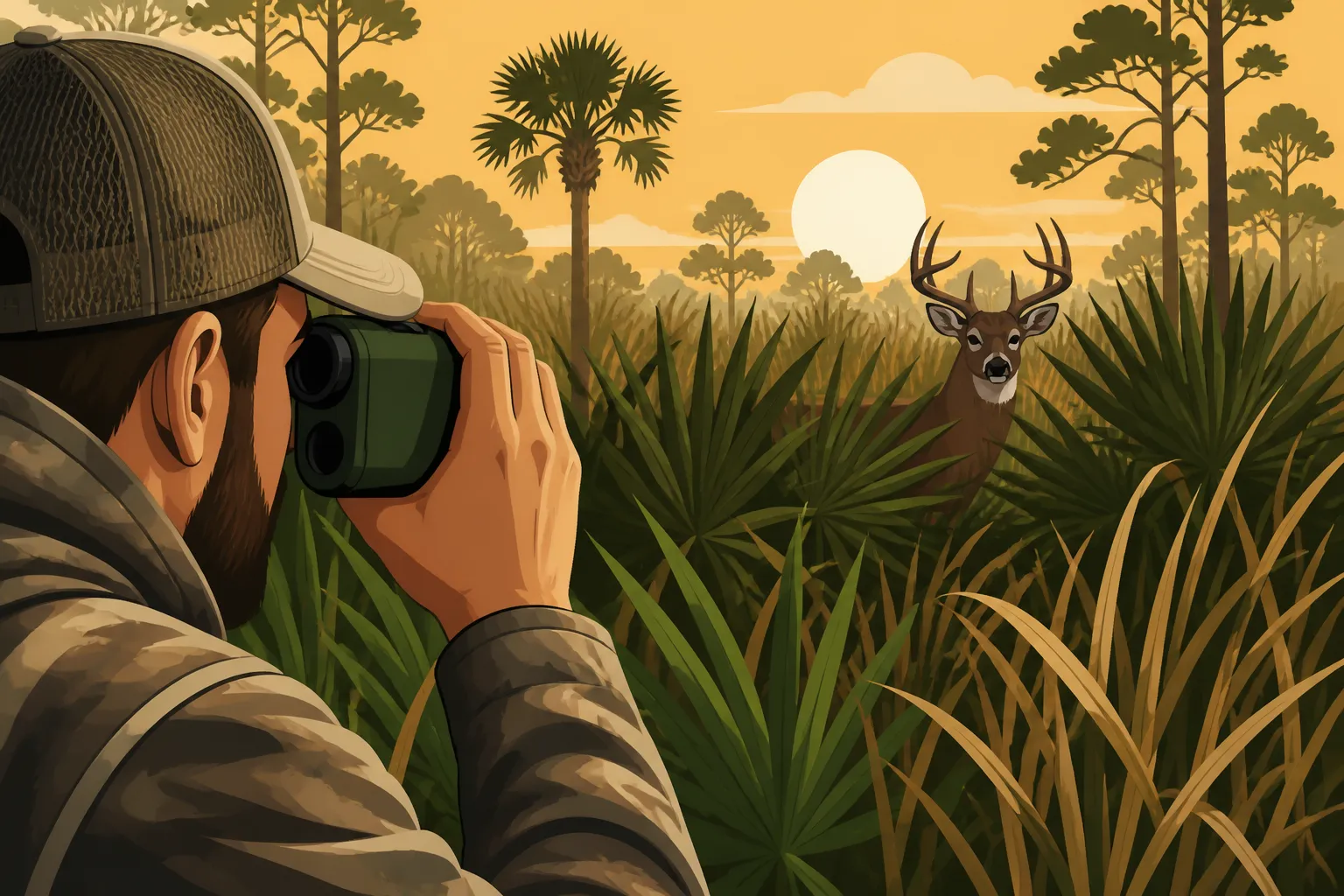
If you've ever found yourself hunting deer or hogs in the vast, dense landscapes of Georgia's Coastal Plain, you know the frustration of trying to get an accurate range reading when your target is obscured by palmettos, thick brush, or a seemingly impenetrable wall of pines. It's a common scenario: you spot a nice buck easing through the undergrowth, raise your rangefinder, only to get a reading off a sapling 10 yards closer or, worse, nothing at all. This guide is here to help you navigate those specific challenges, providing practical strategies and feature insights for using rangefinders effectively in the unique, often unforgiving, environment of South Georgia's thick cover.
The Unique Challenge of Rangefinding in Georgia's Coastal Plain
Hunting in Georgia's Coastal Plain isn't like glassing open fields out West or even picking through relatively sparse hardwoods in the Piedmont. The landscape down here, from the longleaf pine flats to the cypress swamps, presents a very particular set of obstacles when it comes to accurately determining distance. It's a beautiful, wild place, but it demands specific tactics and gear considerations.
Dense Undergrowth and Obstructions
One of the most obvious hurdles in the Coastal Plain is the sheer density of vegetation. Imagine trying to range a deer standing in a patch of gallberry bushes or just inside a pine thicket. Your laser beam, no matter how powerful, is going to hit the first obstruction in its path. That could be a pine needle, a palmetto frond, a small branch, or even a blade of sawgrass. Often, you'll get a reading that's several yards short of your actual target, leading to a missed shot or, in the worst case, a wounded animal. This "false positive" reading is a nightmare for bowhunters especially, where even a couple of yards can be the difference between a clean kill and a long, difficult track. It's a constant battle against the landscape itself.
The problem is compounded by the fact that many game animals, particularly deer and hogs, thrive in this thick cover. They use it for bedding, feeding, and escaping pressure. This means you're often targeting animals within the worst of the obstructions, not just on their edges. A big boar hog might be wallowing in a dense patch of titi, offering only a small window, or a deer might be browsing just inside a brushy creek bottom. Your rangefinder needs to be able to punch through some of that noise or give you a reliable reading off the animal itself, not the leafy screen in front of it.
Humidity and Atmospheric Distortion
While not as immediately visible as dense brush, Georgia's notoriously high humidity and haze can play a subtle but significant role in rangefinder performance. Anyone who's spent a summer or early fall morning in the Coastal Plain knows that thick, soupy air. This atmospheric moisture can diffuse laser light, potentially reducing the effective range of your device and making it harder to get a consistent reading on distant, dark, or non-reflective targets. It’s not just about what's physically in the way; it's about what’s in the air itself.
Beyond just diffusing the laser, humidity can lead to optics fogging up at the most inconvenient times. You step out of an air-conditioned truck or climb into a stand before dawn, and suddenly your lenses are completely obscured. While most quality rangefinders are sealed against moisture, the rapid temperature changes and persistent dampness can challenge even the best designs. A fogged lens means no accurate reading, and often, no shot opportunity. You need a rangefinder that can handle not just the physical environment but also the pervasive moisture that defines the South Georgia climate.
The Elusive Nature of Distances in Open Pine vs. Hardwoods
The Coastal Plain offers a mosaic of habitats, each with its own rangefinding quirks. You might be hunting vast, open longleaf pine savannas one day, where visibility stretches for hundreds of yards, and then shift to dense bottomland hardwoods or cypress swamps the next, where 50 yards feels like a mile. The visual cues for distance are dramatically different, and your brain can easily be fooled. What looks like 70 yards across a field edge might only be 55, or conversely, a shot through sparse pines that feels like 30 might actually be 45.
This variability means a static estimation isn't reliable. In open pine woods, particularly where controlled burns are common, distances can look deceptively short due to the lack of mid-story vegetation. Then you move into a thick bayhead or a creek bottom choked with hardwoods, vines, and thick undergrowth, and suddenly 20 yards feels like a long shot. Your rangefinder becomes a critical tool for sanity, ensuring you're not guessing in these visually challenging transitions. It’s about building confidence in your shot, regardless of the immediate visual environment.
Essential Features for a Coastal Plain Rangefinder
Given the unique challenges presented by Georgia's Coastal Plain, not just any rangefinder will do. You need specific features that are designed to combat dense cover, variable distances, and the ever-present humidity. Choosing the right tool for the job makes all the difference when milliseconds matter.
Angle Compensation Technology
Many hunting scenarios in the Coastal Plain, especially along creek bottoms, subtle ridges, or when shooting from a treestand, involve uphill or downhill angles. A straight-line distance, what your rangefinder measures to the target, isn't the true "shoot-to" distance on an incline. Gravity acts differently, and without angle compensation, you could easily shoot high or low. This is where Angle Range Compensation (ARC) or similar technology comes into play. It calculates the equivalent horizontal distance, giving you the actual ballistic range for an accurate shot.
While the Coastal Plain isn't known for towering mountains, even slight elevation changes from a treestand or a low ridge can make a difference, especially for archers. If you're 20 feet up a pine tree and a deer is standing at a straight-line distance of 30 yards, the actual horizontal distance might be closer to 28 yards. Without ARC, you might aim for 30, and your arrow could sail over the back of your target. Most modern rangefinders from reputable brands like GoHunt offer this feature, and it's absolutely non-negotiable for serious hunters who find themselves in varied terrain.
Pinpointing and Through-the-Brush Modes
This is perhaps the most critical feature for hunting in thick cover. Standard rangefinders often struggle to isolate the target from the foreground clutter. Many manufacturers have addressed this with advanced modes. "First Target Priority" or "Brush Mode" is designed to ignore closer obstructions and provide a reading on the farthest object in the beam's path – ideally, your animal. Conversely, "Last Target Priority" is useful in open country to range past distant trees to an animal. For the Coastal Plain, you want a mode that prioritizes the closest object that isn't an immediate obstruction.
Some rangefinders offer more sophisticated algorithms, often marketed as "pine tree mode" or similar, which use a smaller laser divergence or multiple readings to try and pierce through light brush to the intended target. When you're trying to pick out a deer's shoulder through a screen of saplings, these modes are invaluable. Without them, you're constantly getting readings off the closest leaf, which is completely useless. When comparing models, look specifically for how they handle cluttered foregrounds and read reviews from hunters who operate in similar environments.
Optical Quality and Magnification
A rangefinder is also a mini-monocular, and the quality of its optics can't be overlooked. In the low light of dawn or dusk, or under the heavy canopy of a swamp bottom, bright, clear glass makes a huge difference. You need to be able to clearly identify your target and precisely place your reticle on it. Look for rangefinders with fully multi-coated lenses, which maximize light transmission and reduce glare, providing a crisp image even in challenging conditions.
Magnification also plays a role, though higher isn't always better for a rangefinder. Most models offer 6x or 7x magnification, which is a good balance between seeing enough detail to pinpoint your target and maintaining a wide enough field of view to quickly acquire it. Too much magnification can make holding the unit steady and finding your target difficult, especially when you're breathing hard after a stalk or dealing with a case of buck fever. A good balance allows you to see the deer's body clearly enough to know you're ranging the animal, not the branch just in front of its chest.
Durability and Weatherproofing
Georgia is tough on gear. From the stifling humidity to sudden torrential downpours, your equipment needs to withstand the elements. A rangefinder for the Coastal Plain absolutely must be waterproof and fog-proof. Look for units that are O-ring sealed and nitrogen-purged to prevent internal fogging and protect against moisture intrusion. This ensures that a pop-up shower or a heavy morning dew doesn't render your expensive optics useless.
Beyond water resistance, consider overall construction. A rugged housing, often rubber-armored, provides shock absorption against accidental drops and offers a secure grip, even with wet hands or gloves. Batteries should be easily accessible, but the compartment should also be well-sealed. You're not just buying a piece of glass and electronics; you're investing in a tool that needs to survive bumps, scrapes, and the general abuse of being carried through thick cover, day in and day out. The last thing you want is a piece of gear that fails when you're miles deep in a swamp on a crucial hunt.
Mastering Rangefinder Techniques in Thick Cover
Having the right rangefinder is only half the battle; knowing how to use it effectively in the challenging environment of the Coastal Plain is the other. There are specific techniques that can help you get accurate readings when the cover is dense and the visibility is limited. It's about being strategic and understanding your tool's limitations and strengths.
Targeting Specific Objects Versus the Animal
When a deer is partially obscured by brush, trying to range its exact vitals can be futile. The laser will almost certainly hit a branch or leaf in front. Instead, try to find a clear spot very close to the animal – perhaps a clear patch of ground directly beneath its chest, a bare tree trunk just behind it, or a section of its body that is momentarily unobstructed. Range that clear spot, and then mentally adjust for the small difference to the animal itself. This takes practice, but it's often more reliable than trying to force a reading directly through a wall of leaves.
Another tactic is to range a distinct, clear object that is known to be at the same plane as the animal. For example, if a deer is standing on a logging road that passes through a thick area, and you can range a clear spot on that road either in front of or behind the deer, that can give you a very close approximation of the animal's distance. This technique relies on you knowing your target's position relative to something else you can range. It’s a workaround, but an effective one when the direct shot is impossible. This is where scouting and knowing the terrain really pays off. You might even use a feature like GoHunt's mapping tools during scouting to identify key features and their relative distances.
Scanning and Pre-Ranging Key Landmarks
One of the best habits you can develop for hunting in thick cover is pre-ranging. Before an animal even appears, use your rangefinder to establish known distances to various landmarks around your stand or along your likely path of travel. Range that big pine tree at 35 yards, the fallen log at 20, the bend in the trail at 50, or the edge of the clear-cut at 75. Memorize these distances. This creates a mental map of your shooting lanes and helps you quickly estimate the range to an animal that appears between these known points.
When an animal does step out, you can often "scan" with your rangefinder, slowly sweeping it across the area where the animal is. Many modern rangefinders have a "scan mode" that continuously updates the distance as you move the reticle. This can sometimes help pick up the animal when a single static reading might miss it due to foreground interference. By scanning, the rangefinder has multiple opportunities to get a clean hit on the target, especially if the animal is moving or briefly steps into a clearer lane. Consider how this technique can be applied when Hunting the Rut in Mid-October or trying to get a bead on a buck in dense cover.
Utilizing Reflective Surfaces (Where Applicable)
While animals are generally not highly reflective, there are instances where you can use other surfaces to your advantage. In some cases, a wet leaf, a shiny patch of bark, or even a puddle on the ground might offer a more reflective surface to bounce your laser off than the animal itself. If you can range such a surface that is immediately adjacent to your target, it can sometimes provide a more consistent reading, especially if your rangefinder struggles with less reflective objects.
This is more of an opportunistic technique rather than a primary strategy. You won't always have a conveniently reflective surface near your deer or hog. However, in extremely dense situations, it's worth keeping an eye out for any element in the environment that might give you a better laser return. For example, Hunting the Georgia Swamp and River Bottom Deer often puts you near water, and a quick range off a section of the river bank near your target might yield better results than directly ranging a dark-haired hog in the shadows. Always prioritize ranging the animal directly if possible, but don't discount these environmental aids.
Common Pitfalls and How to Avoid Them
Even with the best rangefinder and solid technique, things can go wrong. Hunting in Georgia's Coastal Plain introduces specific challenges that can lead to misreads or missed opportunities. Being aware of these common pitfalls can help you avoid costly mistakes when that trophy animal finally steps into view.
Ranging the Wrong Object
This is arguably the most common and frustrating mistake in thick cover. You're focused, heart pounding, on that deer, you push the button, and the rangefinder gives you a number. You trust it, make your shot, and then realize you ranged the large tree trunk 5 yards behind the deer, or the thick bush 8 yards in front of it. In thick pine flats or dense hardwoods, distinguishing the animal from its immediate surroundings can be difficult, especially under pressure.
To avoid this, take an extra second if you can. Don't just accept the first number you see. If possible, try to range the animal multiple times, wiggling the reticle slightly, or using a "scan" feature if your unit has one. If you get wildly different numbers, it's a clear sign of interference. If you have an angle compensation feature, ensure it's active and you understand what number it's giving you (true distance vs. angle-compensated distance). Always prioritize putting your reticle on a clear, distinct part of the animal's body, like its belly or shoulder, rather than an antler tip or ear that might be obscured.
Over-reliance and Not Trusting Your Instincts
While a rangefinder is an indispensable tool, it shouldn't completely replace your ability to estimate distance. There will be times when your rangefinder simply cannot get a clear reading, or you don't have time for one. In these moments, falling back on practiced estimation skills is crucial. If you've spent years hunting and have a good eye for distance, sometimes your gut feeling, combined with pre-ranged landmarks, will be more reliable than a quick, possibly inaccurate, rangefinder reading.
It's important to practice both. When you're out scouting or walking to your stand, mentally estimate distances to various objects, then pull out your rangefinder (like one from GoHunt, for example) and verify. This trains your eye and builds confidence in your own judgment. If your rangefinder gives you a reading that feels wildly off compared to your estimation and known landmarks, double-check it or consider an alternative strategy. A broken or dead-battery rangefinder won't help you, so having a backup plan is vital. This holds true whether you're Still-Hunting South Georgia Pine Flats or picking your way through cypress.
Battery Failure at the Crucial Moment
This is a classic rookie mistake, but it happens to even experienced hunters. You get to your stand, the sun is just coming up, and that monster buck steps out. You reach for your rangefinder, hit the button, and… nothing. Dead battery. Hunting in the Coastal Plain often means long days, sometimes in cold weather or with equipment sitting in damp conditions for extended periods, all of which can drain batteries faster.
Make it a habit to check your rangefinder's battery level before every hunt, or at the very least, before opening day. Carry a spare set of fresh batteries in your pack, especially for multi-day trips. Store your rangefinder indoors in a dry place when not in use. Many rangefinders use common CR2 or CR123 batteries, which are readily available but often forgotten until it's too late. Don't let a cheap battery ruin an expensive hunt. Proactive battery management is a simple step that can save a lot of heartache in the field.
When Technology Fails: Alternative Range Estimation Methods
Sometimes, despite having the best rangefinder with all the bells and whistles, the conditions in Georgia's Coastal Plain conspire against you. Maybe the brush is too thick, the light is too low, or you simply don't have time for a reading. In these moments, falling back on traditional range estimation techniques can be the difference between making a confident shot and passing on an opportunity. These aren't just old-school tricks; they're essential skills for any serious hunter.
The Power of Practiced Step-Counting
One of the oldest and most reliable methods of range estimation is step-counting. This isn't just about counting steps in the woods; it's about calibrating your pace to a known distance. Before the season, or even during a walk in the woods, find an open area and measure out known distances – 20, 30, 40, and 50 yards. Walk each of these distances and count how many of your natural steps it takes. Do this multiple times to get an average. You'll soon develop a feel for how many steps equal a certain yardage for your stride.
In the field, you can then apply this. When you walk to your stand, count your steps from various landmarks. If you know it's 30 steps to that oak, and you know your 30 steps equal 40 yards, you've pre-ranged it without even pulling out a device. When a deer appears, you can quickly estimate its distance relative to these pre-determined points. This method is incredibly effective in flat, relatively open areas like Where South Georgia Pine Flat Bucks Bed, but can be adapted for slightly more varied terrain too. It's a skill that requires practice, but once mastered, it’s a valuable backup.
Using Known Distances and Markers
Beyond step-counting, actively identify and memorize physical markers in your hunting area that correspond to known distances. This is a critical component of setting up any hunting stand or determining a still-hunting route. For a treestand, hang ribbons at 20, 30, and 40 yards, or identify distinct trees or bushes at those distances. For ground blinds on a field edge, pick out a specific clump of grass or a prominent stump.
During your scouting trips, or even just walking to your stand, use your rangefinder to measure distances to multiple prominent features: the edge of a particular brush patch, a bend in a creek, a large cypress tree, or a specific opening in the canopy. Commit these to memory. When an animal appears, you can quickly gauge its distance by comparing it to these known markers. This technique works exceptionally well in areas like Setting Up on a Piedmont Field Edge or when hunting along logging roads in pine plantations. The more you scout and familiarize yourself with your surroundings, the more effective this strategy becomes.
Environmental Cues and Target Appearance
Your eyes and brain are powerful tools for estimating distance, especially with practice. Learn to recognize how a deer or hog appears at various distances. At 20 yards, you can make out individual hairs and subtle movements. At 40 yards, the animal still looks substantial, but details are softer. At 60 yards, it starts to shrink, and specific features become harder to discern without optics. Pay attention to how prominent certain features are, like the ears, the length of the legs relative to the body, or the size of the head.
Also, observe environmental cues. How does the ground between you and the animal appear? Are there small bumps and dips that disappear at longer ranges? How far apart do the trees appear? All of these subtle visual cues contribute to an accurate estimation. Practice makes perfect here. When you use your rangefinder, also take a mental snapshot of how the animal and its surroundings look at that exact distance. Over time, you’ll develop an instinctual feel for range that can augment or even replace your rangefinder in a pinch. This combination of mental markers and visual training provides a robust strategy for hunters facing the challenges of the Coastal Plain.
Maintaining Your Rangefinder for Peak Performance in Humid Climates
The humid, often damp environment of Georgia's Coastal Plain is notoriously hard on electronics and optics. Your rangefinder, a precision instrument, needs regular care and attention to ensure it performs when you need it most. Neglecting maintenance can lead to fogging, battery failure, or outright damage, rendering your expensive tool useless.
Protecting Against Moisture and Debris
Moisture is the silent killer of electronics in humid climates. Even waterproof rangefinders benefit from additional protection. Always store your rangefinder in a dry, well-ventilated place when not in use. After a hunt, especially if it was damp or rainy, take it out of your pack and let it air dry completely. Don't leave it in your truck overnight, where condensation can build up. A small desiccant pack (like silica gel) in your rangefinder case can help absorb ambient moisture.
Beyond moisture, the Coastal Plain is full of fine dust, sand, and pine needles. These can get into small crevices, scratch lenses, or interfere with buttons. Keep lens caps on when not actively ranging. When carrying it, use a protective case or a dedicated pocket in your hunting vest to shield it from direct contact with dirt and debris. Avoid dropping it in mud or water if at all possible, even if it's rated as waterproof, as seals can degrade over time. Treating your rangefinder like the sensitive instrument it is will prolong its life and ensure its reliability. This is particularly relevant when you are on a Feral Hog Hunting Year-Round in Georgia trip where conditions can be quite mucky.
Battery Management and Storage
As discussed earlier, battery failure is a common issue. Proper battery management is crucial. Always use fresh, high-quality batteries. Cheaper batteries might save a few dollars upfront but can drain faster or even leak, causing damage to your device. When storing your rangefinder for an extended period (off-season), remove the batteries. This prevents leakage and corrosion, which can permanently damage the battery contacts or internal electronics.
Keep spare batteries stored in a dry, cool place, preferably in their original packaging or a small, sealed container to prevent them from accidentally discharging or getting lost. In the field, consider carrying your spare batteries in a waterproof baggie to keep them dry and ready for use. A battery check before each outing should become part of your routine. Some rangefinders, like certain models from GoHunt, even feature low-battery indicators to give you a heads-up before total failure.
Proper Cleaning of Optics
Clear optics are paramount for accurate rangefinding. Scratched or dirty lenses can obscure your view, make it difficult to target precisely, and reduce light transmission, especially in low-light conditions. Always use a proper lens cleaning kit – never use your shirt, a paper towel, or harsh chemicals. A lens cleaning pen, a soft brush, and a microfiber cloth are your best friends here.
First, gently brush away any loose dust or debris from the lenses. Then, if necessary, use a small amount of specialized lens cleaning solution applied to a microfiber cloth (not directly to the lens) and gently wipe in a circular motion from the center outwards. Avoid excessive rubbing. If you notice any stubborn smudges, use breath fog or a tiny drop of water, followed by a clean microfiber cloth. Handle your rangefinder with care, and keep those lenses pristine; your shot accuracy depends on it. This level of care for your optics is just as important as it is for your Rifle Setups for Georgia Deer Hunting.
Summary of Coastal Plain Rangefinder Essentials
Here's a quick overview of what to look for and how to handle your rangefinder in Georgia's unique environment:
| Feature/Strategy | Importance in Coastal Plain | Notes |
|---|---|---|
| Angle Compensation | High | Crucial for treestand hunters and varied terrain; prevents high/low shots. |
| Pinpointing/Brush Mode | Very High | Essential for separating target from dense foreground clutter like palmettos and thickets. Look for "First Target Priority" or similar. |
| Optical Quality | High | Bright, clear, multi-coated lenses improve visibility in low light and heavy canopy. |
| Durability/Weathering | Very High | Must be fully waterproof, fog-proof (O-ring sealed, nitrogen-purged), and rubber-armored to withstand humidity, rain, and impacts. |
| Pre-Ranging Landmarks | Very High | Crucial for quickly estimating distances when an animal appears between known points; saves crucial time. |
| Scanning Technique | High | Continuously updating range can help the laser find a clear path to the target through light brush. |
| Spare Batteries | Critical | Always carry a fresh set; humidity and cold can drain batteries faster. Remove for long-term storage. |
| Proper Cleaning | High | Use lens pens and microfiber cloths to remove dust and smudges; never use harsh materials. |
| Moisture Protection | High | Store in a dry place, use desiccant packs, air dry after damp hunts to prevent internal fogging and corrosion. |
| Trusting Instincts | Medium | Use as a backup when technology fails or in conjunction with readings to confirm accuracy. Practice estimation skills. |
Navigating the thick cover of Georgia's Coastal Plain with a rangefinder might seem daunting at first, but with the right gear and practiced techniques, you can overcome these challenges. Remember to prioritize features that help cut through the brush, manage your batteries diligently, and maintain your optics meticulously. This approach will ensure your rangefinder remains a reliable asset in your Georgia hunting adventures. Whether you're chasing deer, hogs, or even Alligator Hunting in Georgia, knowing your distances accurately is a fundamental part of responsible and successful hunting.
Disclaimer
This article is for general informational purposes only and does not constitute professional advice. Laws, prices and regulations vary by location and change over time. Consult a qualified professional for guidance on your specific situation.