Wind and Thermals on a Mountain Ridge
There are few things more frustrating for a Georgia deer hunter than putting in the hard work to scout a beautiful mountain ridge, only to have your entire hunt blown by an unpredictable wind. That swirling, shifting air current can carry your scent right to a mature buck you’ve worked so hard to find, leaving you wondering what went wrong. This guide is dedicated to demystifying the complex world of wind and thermals on a mountain ridge, helping you understand, predict, and ultimately use these natural forces to your advantage, especially when hunting the challenging terrain of North Georgia.
Understanding the Basics of Mountain Wind
Hunting in Georgia's mountains, especially in areas like the Chattahoochee National Forest, introduces a whole different dynamic to wind prediction. It’s not just about what the weather app says the prevailing wind is doing; you’re dealing with an intricate dance between true wind and localized thermal currents that can make your head spin. Getting a handle on these forces is the first step toward consistent success.
How Thermals Work in Georgia's Mountains
Thermals are essentially localized air currents created by temperature differences, and they are the primary reason mountain winds feel so unpredictable. Think about it: the sun hits different slopes at different times, heating the ground unevenly, and that's where the magic (or misery) begins.
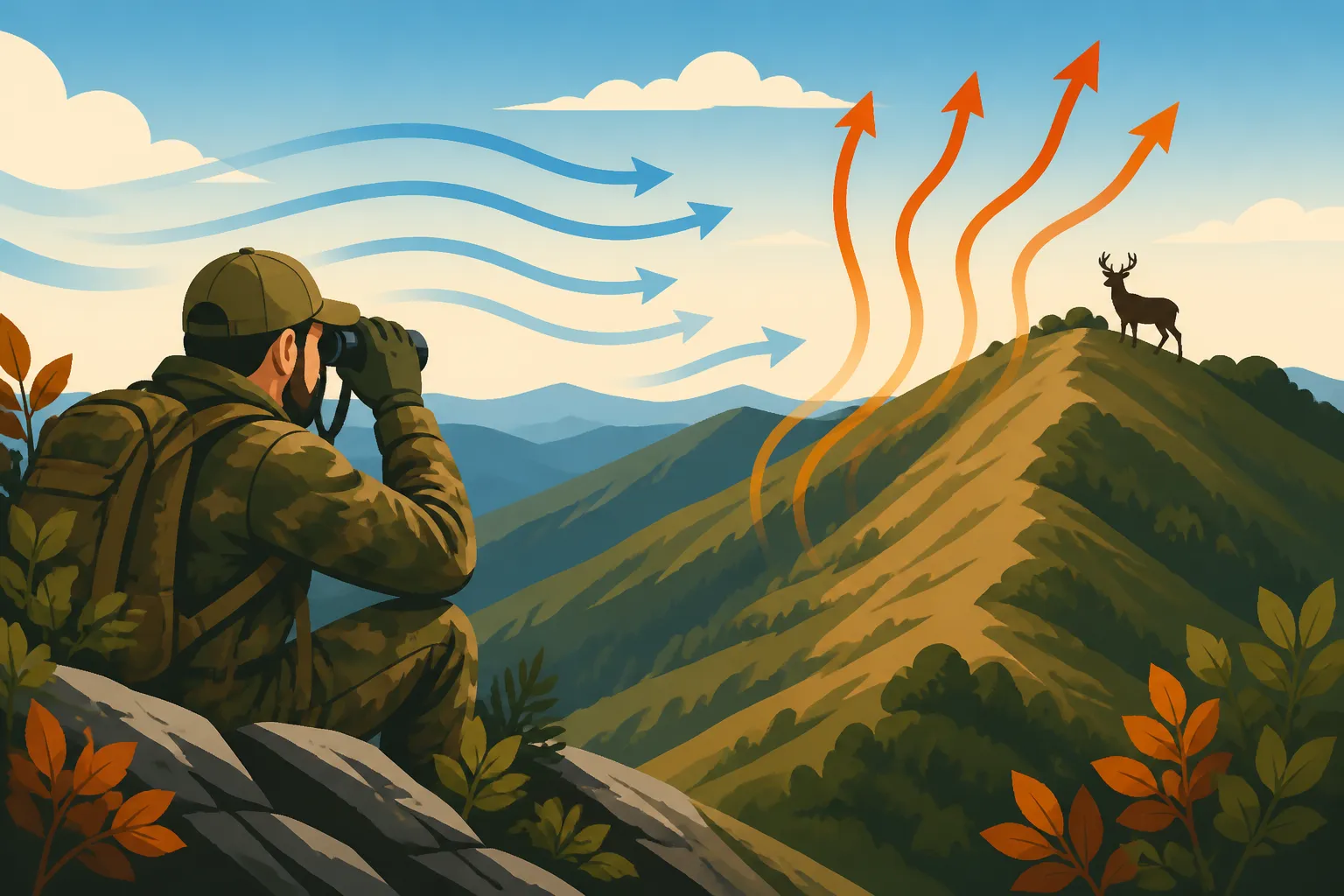
In the morning, as the sun begins to warm the earth, it hits the east-facing slopes first. This warmth causes the air near the ground to heat up and rise. This rising air creates what we call an "updraft" or an "upslope thermal." If you’re hunting early, your scent will naturally be carried up the mountain. This is a crucial piece of information. Imagine you’ve set up on a saddle overlooking a draw; if you’re too low and the sun is already hitting your side of the ridge, your scent is going straight up, potentially alerting any deer bedded higher up. Conversely, if you’re high enough, that rising thermal might carry your scent over their heads.
As the day progresses and the sun moves higher, more of the mountain warms up, and these rising thermals become stronger and more widespread. By mid-day, especially on a sunny, calm day, you'll feel your scent being pulled straight uphill. This makes daytime still-hunting on a ridge tricky if you're not constantly adjusting.
As evening approaches and the sun starts to set, the opposite effect takes place. The air begins to cool, especially in the shaded hollows and draws. Cooler air is denser and heavier, so it starts to sink, creating a "downdraft" or "downslope thermal." Your scent will be carried down the mountain and into the valleys and creek bottoms. This is why an evening hunt often calls for a different strategy than a morning hunt, typically requiring you to be positioned higher on the ridge to keep your scent from blowing down into where deer are likely to be moving up to feed.
These transitions—dawn and dusk—are often the most volatile times for thermals. The air currents are shifting from one pattern to the other, creating swirling, unpredictable conditions where your scent could go just about anywhere. It's during these periods that you need to be extra vigilant with your wind checks and be prepared to move if conditions aren't favorable.
True Wind Versus Thermal Drift
While thermals are a product of temperature and topography, "true wind" is the broader atmospheric movement, often driven by high and low-pressure systems. On a flat plain, true wind is usually pretty consistent. On a Georgia mountain ridge, however, true wind gets severely distorted by the terrain.
Imagine a prevailing west wind hitting a north-south running ridge. That wind isn't just going to sail smoothly over the top. It'll be deflected, funneled through saddles and gaps, and pushed around by steep cliffs and deep ravines. A saddle, for instance, can act like a funnel, intensifying the wind as it squeezes through, or it can create a localized eddy where the wind swirls back on itself. This is often where the dreaded "swirling" effect happens, where your scent feels like it's going in circles. Hanging a Stand on a Mountain Saddle requires a keen understanding of these dynamics.
Microclimates are another fascinating aspect. One side of a ridge might be a dense, shaded laurel thicket, while the other is an open, sun-drenched oak flat. These differing cover types and aspects will heat and cool at different rates, creating their own miniature thermal systems that can interact with the larger prevailing wind and thermals, causing even more localized shifts. This is why your little wind checker can show one direction at eye level and a completely different one just ten feet up or down. A true wind from the northwest might be hitting the ridge hard, but a south-facing bench below the crest could still have a faint upslope thermal carrying your scent in the opposite direction for a short distance.
The Impact of Cloud Cover and Humidity
Beyond the sun's influence, other atmospheric conditions play a significant role in how wind and thermals behave on a mountain ridge. Cloud cover, for instance, can be a hunter's friend or foe, depending on the situation.
On heavily overcast days, especially with thick clouds, the sun's heating effect on the ground is minimized. This means that the dramatic upslope and downslope thermal shifts you see on clear, sunny days are often much less pronounced. The air temperature is more uniform, leading to more stable, albeit sometimes lighter, wind conditions. While this can reduce the swirling, it can also mean that a light true wind becomes the dominant factor, and your scent might still drift more consistently in one direction, albeit slowly. These days often present good opportunities for still-hunting as the wind is more predictable, even if it's light.
Humidity, a constant companion in much of Georgia's hunting season, has a different but equally critical impact: it significantly amplifies scent detection. Water molecules in the air bond with scent molecules, allowing them to travel farther and linger longer. So, even if the wind seems light, high humidity means your scent is essentially "sticking" to the air and can be carried a greater distance, making a strong thermal or a swirling true wind even more detrimental. A light, swirling breeze on a humid morning can be just as problematic as a stronger, steady wind on a dry day, if not more so. This is especially true during the early archery season, where Lightweight Layering for Warm-Weather Sits is key but managing scent in the humidity remains a challenge.
Reading the Ridge: Practical Scouting and Setup
Successfully hunting mountain ridges isn't just about showing up; it's about putting in the groundwork before you even step foot in the woods. Modern tools and old-school observation combine to give you the best chance at outsmarting a Georgia buck.
Using Topographical Maps and Apps for Wind Planning
Before you ever leave your couch, you should be deep-diving into topographical maps. Whether you're using a physical map, the Georgia Outdoors app, or a sophisticated hunting platform like GoHunt, understanding the lay of the land is paramount. These tools allow you to visualize elevation contours, which are essentially lines connecting points of equal elevation. The closer the lines, the steeper the terrain.
Look for key topographical features that will act as wind highways and funnels:
- Saddles: These are dips or low points along a ridge. They are notorious for funneling wind and thermals, creating predictable (or unpredictable) pathways for air movement. A saddle can be a fantastic pinch point for deer travel, but your stand placement needs to account for the swirling air.
- Draws and Hollows: These are depressions in the terrain that drain water downhill. They also act as natural funnels for sinking evening thermals and rising morning thermals.
- Benches: Flat or gently sloping areas on the side of a steep ridge. Deer often travel or bed on benches to avoid the steepest climbs. Wind and thermals tend to be more stable on benches compared to sheer faces.
- Ridgelines and Spurs: The highest points, where true wind will have the most influence, but where thermals will also cause updrafts or downdrafts depending on the time of day.
When you're studying your map, visualize how air would move over and through these features. If the prevailing wind is from the west, how will it hit that east-west running ridge? Will it be deflected north and south, or will it pour over a low spot? Using a wind feature in an app like GoHunt, which overlays predicted wind direction at various altitudes on the topo map, can give you a powerful edge. This planning allows you to identify potential ambush points and, crucially, plan your entry and exit routes. You want to walk into the wind or crosswind to your stand, never blowing your scent ahead of you into your hunting area, especially when Scouting Georgia Public Land Before Season is crucial.
On-the-Ground Wind Checks and Scent Control
Mapping tools are excellent for pre-planning, but nothing beats real-time, on-the-ground wind checks. As you approach your hunting area, and certainly once you're in your stand, constantly verify the wind direction.
My go-to is a small squeeze bottle of unscented powder or, even better, a handful of milkweed seeds. These are incredibly sensitive to the slightest air current and will show you exactly what your scent is doing. Don't just check at your chest height; toss some powder or seeds up into the air and watch how they drift as they fall. Do they go straight down? Do they eddy around a tree trunk? Do they get pulled uphill then flatten out? This tells you a lot about the thermal layers you're encountering. Check it again when you get into your stand, and continue to do so every 15-30 minutes, especially during those tricky thermal transition periods.
Scent control becomes exponentially more important in mountain terrain with swirling winds. While no amount of scent control will completely hide you from a deer if your wind is consistently blowing directly at them, it can reduce the radius of your scent cone, giving you more leeway in unpredictable conditions. This means meticulous attention to detail: showering with scent-free soap, using scent-free detergent on your hunting clothes, storing them in airtight bags, and dressing in the field rather than at home. Many hunters use ozone-generating products, and while their effectiveness is debated, they certainly can’t hurt. The goal isn't to be completely scent-free, but to minimize your odor enough that an occasional swirl might just push a diminished scent stream past a deer rather than directly into its nose. Remember, even with the best scent control, if a deer gets directly downwind, it's likely game over.
Strategic Stand Placement on a Mountain Ridge
When considering Treestand Setups in North Georgia Mountains, your stand placement is everything. It's a delicate balance between intersecting deer travel patterns and maintaining a favorable wind advantage.
For morning hunts, with those rising thermals, you often want to position yourself higher on the ridge. This allows your scent to blow up and over the ridge, ideally above the deer moving below you, or for it to be carried away by the upslope thermal before it reaches lower-lying areas where deer might be feeding or traveling. A good spot might be on the upper third of a leeward (downwind) slope, where the prevailing true wind might push your scent down, but the rising thermal tries to carry it up and over the ridge. This creates a more stable, albeit complex, scent cone.
For evening hunts, as thermals begin to fall, the reverse is often true: a lower position can be better. Setting up closer to the base of the ridge, or in a bench or hollow where the down-falling thermal will carry your scent into the valley below and away from deer moving up, can be effective. Again, consider the leeward side of the ridge relative to the prevailing wind. The key is to be slightly above the deer’s expected travel path, but low enough that your scent isn't continually pouring into the areas they are approaching.
It's also critical to identify areas where the wind consistently swirls due to abrupt terrain features. Sometimes, these are unavoidable deer travel corridors, and you might have to accept a higher risk, or only hunt them on days with very specific, stable wind conditions. Other times, it means finding an alternative route or stand location that offers a more consistent wind pattern. Always consider the deer's likely escape routes. If they bust you on scent, where are they going to go? Can you position yourself so they move away from you, offering a shot, instead of directly under you? This deep understanding of terrain is part of Reading a Ridge for North Georgia Deer.
Hunting Strategies for Shifting Mountain Air
Once you’ve put in the scouting and chosen your stand location, the real test begins: adapting your hunting approach to the ever-changing mountain air. It's a dynamic game, not a static one.
Adapting Your Approach Throughout the Day
The mountain environment demands flexibility. What works in the morning won't necessarily work in the evening.
Morning Hunts: As mentioned, with rising thermals, getting in early is crucial. The pre-dawn calm might offer a brief window where thermals haven't fully established, or are still falling slightly. As soon as the sun hits, expect your scent to begin climbing. This is when setting up high can pay off. Focus on deer that are already moving from lower feeding areas back to higher bedding grounds. Your goal is to intercept them before they've settled in. If the true wind is strong and steady from one direction, it might override the thermal effect, pushing your scent horizontally. This offers a good opportunity for still-hunting if you can work into that true wind, knowing your scent is primarily moving in one predictable direction.
Evening Hunts: As the afternoon progresses and the sun begins to dip, thermals will transition from rising to falling. This is often the most predictable shift. Hunters should ideally be in position for an evening hunt well before this transition, often mid-afternoon. As the air cools, particularly in the deep hollows and creek bottoms, your scent will sink. Setting up on the downwind side of a ridge or spur, a bit higher than where you expect deer to feed, allows your scent to drop into the valley below their travel paths. Deer will typically move from higher bedding areas down to feeding grounds in the valleys or along benches.
Mid-Day Stillness: On exceptionally calm days, especially those with thick cloud cover, you might experience a period of relative stillness around midday. The thermals aren't strong enough to create distinct up-or-down drafts, and the true wind is negligible. This can be a challenging time for deer movement, but it can also be a prime opportunity for a careful still-hunt or to make a silent move to a new stand location. Always be aware that thermals can re-establish quickly if the sun breaks through or a temperature change occurs. A sudden cold front pushing through can completely alter the dynamics, often bringing strong, consistent true winds that temporarily dominate thermal activity. During Hunting the Georgia Rut in Mid-October, bucks are often on their feet more, even mid-day, making these shifts even more critical to monitor.
Still-Hunting and Stalking with the Wind
Sometimes, a fixed stand isn't the answer, especially in rugged mountain terrain. Still-hunting or stalking demands an even more intimate understanding of wind and thermals. Your body is the scent source, and you are constantly moving.
The golden rule is always to move into the wind or with a slight crosswind. This keeps your scent behind or to the side of you. On a mountain ridge, this often means adjusting your path to utilize the terrain. If you're hunting an upslope thermal in the morning, you'd want to move up the ridge, keeping your scent behind you. In the evening, with falling thermals, you might need to contour around the ridge or move down into a hollow, always ensuring the wind is carrying your scent away from where deer are likely to be.
Use elevation changes to your advantage. If you're on a bench, and you know the thermal is rising, you might be able to slip below a subtle crest, staying out of the direct line of a deer’s nose. Move slowly, literally one step at a time, pausing to listen and scan. Every five to ten minutes, do a quick wind check. Toss a bit of powder. Observe. A subtle change in terrain, a small draw, or even a dense patch of timber can create a micro-eddy that momentarily shifts your scent. This dynamic approach is essential when you're covering ground, especially if you're exploring new sections of Chattahoochee-Oconee National Forest Hunting.
Managing Your Scent Cone in Tricky Terrain
Visualizing your "scent cone" is a powerful tool. Imagine a cone extending from your body, widening as it moves with the wind. In mountain terrain, this cone is rarely a perfect shape; it's twisted, bent, and stretched by thermals and topography.
The goal is to position this cone so it never intersects with where a deer is or where it's likely to be. If you're on a ridgetop with a prevailing wind, your cone will be blown down one side. Make sure you're set up on the appropriate side so deer on the opposite slope are safe, or deer moving up the downwind slope are headed into your shot, not your scent.
Here’s a practical table summarizing thermal behavior:
| Time of Day | Thermal Movement | Ideal Hunter Position (General) | Scent Direction | Primary Concern |
|---|---|---|---|---|
| Morning (Post-Sunrise) | Air heats, rises upslope | Higher on the ridge (or side-hill) | Up and over the ridge | Deer moving from low feeding to high bedding |
| Mid-Day | Can be stable, light, or slightly rising | Variable, often good for careful still-hunting | Varies, less pronounced vertical movement | Maintaining consistent wind awareness |
| Evening (Pre-Sunset) | Air cools, falls downslope | Lower on the ridge (or side-hill) | Down into valleys/hollows | Deer moving from high bedding to low feeding |
| Transitions (Dawn/Dusk) | Unpredictable, swirling | Extremely cautious, frequent wind checks | Highly variable, turbulent | Blowing out deer during peak movement |
If you realize your scent cone is drifting directly into a prime bedding area or a known travel corridor, you have a decision to make. Sometimes, it’s best to cut your losses, quietly climb down, and move to a different location or even call it a day. Pushing your luck when the wind is wrong is a surefire way to educate deer and make them even more wary. Hunting North Georgia Mountain Country requires patience and an understanding that some days, the conditions just aren't right for a specific spot. Having multiple scouted locations for varying wind directions can save your hunt. Make sure you have the right gear, too, including Packs Built for a Chattahoochee Day Hunt that allow for easy movement and quiet access. Remember to bring your Optics for Georgia Mountains and Swamp to identify deer from afar before you commit to a stalk.
Ultimately, mastering wind and thermals on a mountain ridge in Georgia is a continuous learning process. It blends scientific understanding with intuitive observation and a deep respect for the dynamic natural world. The more time you spend in the mountains, observing the subtleties of the air currents, the better you’ll become at predicting and adapting.
Disclaimer
Hunting is an inherently dangerous activity. Always prioritize safety, follow all Georgia Department of Natural Resources regulations, and ensure you have proper training and equipment. The information provided here is for educational purposes only and should not replace professional guidance or personal judgment. Be aware of your surroundings, hunt ethically, and respect wildlife.