Fixed Versus Mechanical Broadheads
Choosing the right broadhead for your bowhunting setup in Georgia can feel like an endless debate among hunters, stirring up strong opinions faster than a covey of quail flushing from a pine thicket. It's a critical decision that directly impacts ethical harvesting and success in the field, especially when you're aiming for a Georgia whitetail. This guide aims to cut through the noise, offering an in-depth look at both fixed-blade and mechanical broadheads to help you make an informed choice for your specific hunting style and the unique challenges of Georgia's diverse landscapes.
Understanding Fixed-Blade Broadheads for Georgia Hunting
Fixed-blade broadheads are the traditional workhorses of bowhunting, dating back centuries in their fundamental design. They are what many experienced hunters in Georgia grew up using, and for good reason. Their simplicity often translates to reliability, a quality highly valued when you're deep in the Altamaha River bottom or high in a treestand in the North Georgia mountains.
The Core Design and Why it Matters
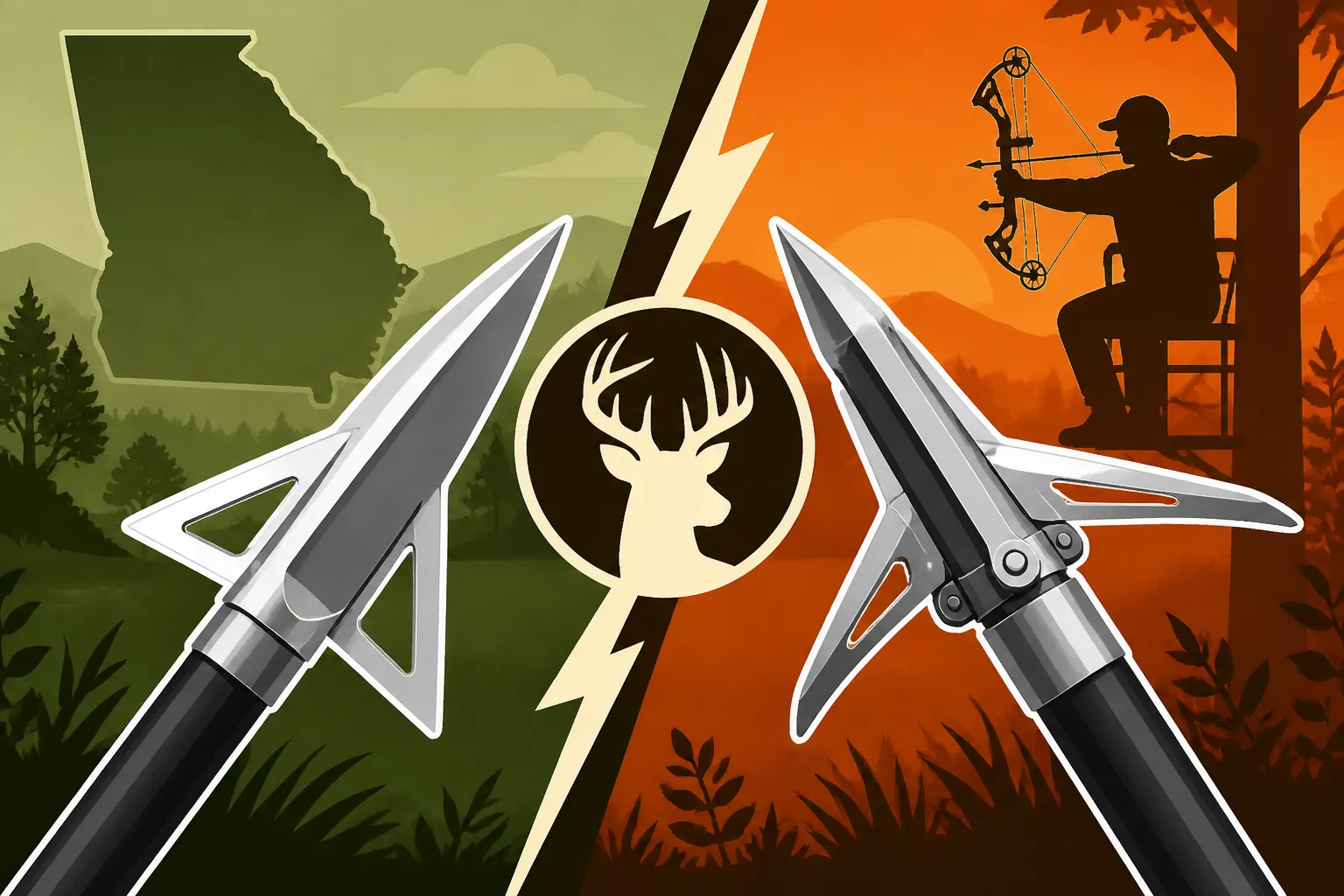
At its heart, a fixed-blade broadhead is exactly what it sounds like: a broadhead where the blades are permanently affixed to the ferrule (the main body) and do not move. This design means the blades are always open and ready for action, presenting a full cutting diameter from the moment of impact. Common designs include two, three, or four blades, often with a cut-on-contact tip that slices through hide and tissue immediately, rather than pushing through. This cut-on-contact feature is particularly beneficial for animals with tough hide or heavy bone, driving penetration from the very first point of contact.
Consider a scenario where a buck quarters away, and your arrow must pass through a rib. A fixed-blade, especially one with a strong, sharp tip, starts cutting immediately upon impact with the hide and continues to slice through the rib, often splitting it rather than deflecting. This direct, uncompromising approach is a huge confidence booster, especially for those challenging shots that don't always offer a perfect broadside presentation. The sheer structural integrity of a fixed-blade also means there are fewer moving parts to potentially fail, a significant consideration when you're counting on your equipment to perform flawlessly every single time.
Advantages of Fixed Blades in Georgia's Diverse Terrain
Georgia's hunting environments are incredibly varied, from dense pine plantations and thick kudzu patches to open field edges and rocky mountain terrain. Fixed-blade broadheads often shine in these diverse conditions due to their inherent strength and reliability. One of their primary advantages is superior penetration, particularly on less-than-ideal shots or when encountering bone. Because the blades are fixed and rigid, all of the arrow's kinetic energy is directed into pushing those blades through the target, minimizing energy loss from blade deployment or flex. This is crucial if you hit a deer in the shoulder or a heavier bone structure, as that rigid design helps ensure maximum pass-through potential.
Furthermore, fixed blades generally create a clean, consistent wound channel. This is vital for leaving a good blood trail, which can be the difference between a quick recovery and a long, frustrating search, especially when Tracking a Deer Through Georgia Pine Straw or trying to locate a downed animal in thick, swampy cover. Hunters who pursue larger game, like Georgia black bears, often prefer fixed blades for their robustness and penetrating power. The minimal energy required for penetration, coupled with their structural integrity, gives hunters peace of mind when targeting tough animals or aiming for precise vital shot placement, particularly when dealing with the heavy bone structure of an adult bear. The predictability of a fixed-blade flight path is also a significant plus for many bowhunters, especially those who prioritize extreme accuracy over long distances or in windy conditions.
Disadvantages and When They Might Fall Short
While fixed blades are celebrated for their reliability, they do come with their own set of considerations. Perhaps the most commonly cited disadvantage is their potential for erratic flight, particularly with bows shooting at higher speeds or with arrows that aren't perfectly tuned. The exposed blades can catch the air during flight, acting like small fletchings and causing the arrow to plane or "kite," leading to reduced accuracy. This can be incredibly frustrating after countless hours practicing with field points, only to find your broadheads flying completely differently. Tuning your bow meticulously—adjusting rest height, nocking point, and fletching orientation—is often necessary to achieve optimal fixed-blade flight. This process can be time-consuming and sometimes requires professional assistance, adding another layer of complexity to your setup.
Another point of contention for some hunters is the generally smaller cutting diameter of many fixed-blade designs compared to mechanicals. While they cut from the start, some argue that a smaller cutting diameter might lead to less impressive blood trails on marginal hits. If a deer makes a sudden move, and your shot isn't perfectly placed, a broadhead that creates a larger entry and exit wound could potentially improve recovery chances. Finally, some fixed-blade designs can be more prone to dulling or damage if they encounter hard objects like rocks or thick branches during practice or even after hitting an animal and impacting the ground. While many modern fixed blades are incredibly robust, blade replacement or sharpening can be more involved than simply swapping out a mechanical head.
Exploring Mechanical Broadheads for Georgia Whitetails
Mechanical broadheads, sometimes called expandable broadheads, represent a more modern approach to bowhunting terminal tackle. They gained immense popularity for their promise of field-point accuracy and devastating wound channels. For many Georgia hunters, especially those new to bowhunting or frustrated with fixed-blade flight, mechanicals offer an appealing alternative.
How Mechanicals Work: The Expanding Blade Concept
The fundamental principle behind mechanical broadheads is ingenious: the blades remain tucked away or collapsed during flight, creating a streamlined profile that mimics a field point. This is the secret to their often superior accuracy, as there are no exposed blades to cause aerodynamic drag or planing. Upon impact with the target, usually due to the force of the broadhead hitting hide or bone, these blades deploy or "expand," creating a much larger cutting diameter than their in-flight profile. Some designs feature rear-deploying blades that pivot backward, while others use front-deploying blades that swing outward.
Imagine stalking a mature buck through a stand of hardwoods in the Piedmont. You've dialed in your bow, and your field points are stacking perfectly. Switching to mechanicals means you can expect similar flight characteristics, boosting your confidence for that crucial shot. This design allows hunters to achieve wider cutting diameters—sometimes well over two inches—which, upon successful deployment, can create massive wound channels. The kinetic energy of the arrow is initially used to drive the narrow tip through the hide, and then the blades deploy, maximizing the damage after penetration has begun. This delayed expansion is what gives mechanicals their unique blend of accuracy and terminal performance.
The Appeal of Mechanicals: Accuracy and Devastation
The biggest draw for mechanical broadheads is undoubtedly their field-point accuracy. Because their profile is so narrow in flight, they are far less susceptible to wind drift and tuning issues than many fixed-blade designs. This means less time fussing with your bow setup and more time confidently practicing with the exact broadheads you'll be using in the field. For hunters using modern, high-speed bows, or those who struggle to achieve perfect fixed-blade flight, mechanicals can be a game-changer, offering a significant boost in confidence at various ranges. This accuracy can be particularly valuable when Hunting a Green Field Planted for Deer, where shots might stretch out a bit further.
Once deployed, mechanicals deliver a devastating blow. Their typically wider cutting diameters result in larger entry and exit wounds, which generally translates to significantly better blood trails. On a perfectly executed broadside shot, a mechanical broadhead can slice through vitals with incredible efficiency, leading to rapid blood loss and a quick, ethical harvest. Many hunters report shorter tracking jobs and easier recoveries when using mechanicals due to these impressive wound channels. This can be especially important during Bowhunting Georgia's Early Archery Season when warm weather means quick recoveries are paramount to preserving meat quality.
Potential Drawbacks and Specific Scenarios to Consider
Despite their advantages, mechanical broadheads are not without their potential downsides. The most significant concern for many hunters revolves around reliability and penetration. Because mechanicals rely on moving parts to deploy their blades, there's always a small chance of mechanical failure. Blades might not deploy fully, or they might deploy prematurely if the arrow brushes against a branch during flight. If blades fail to deploy, you're essentially shooting with a field point, dramatically reducing terminal effectiveness.
Penetration can also be a concern, especially on hard quartering shots or when encountering heavy bone. The energy required to deploy the blades, coupled with the increased drag of a wider cutting diameter after deployment, can reduce overall penetration compared to a rigid fixed blade. For hunters with lower draw weights or those taking shots at larger, tougher animals like bears or very large mature bucks, this can be a critical factor. Minimum Draw Weight for Georgia Deer regulations consider this, as adequate penetration is vital. Some mechanicals are designed with stronger tips and more robust blade retention systems to mitigate these issues, but it's a factor every hunter should research thoroughly. Finally, mechanical broadheads tend to be more expensive per unit than most fixed blades, and replacing blades after each shot can add up, particularly if you do a lot of practice shooting with them.
Here's a quick comparison of the two types to help visualize the key differences:
| Feature | Fixed-Blade Broadheads | Mechanical Broadheads |
|---|---|---|
| Flight Accuracy | Can be challenging; requires precise tuning; prone to planing | Generally field-point accurate; streamlined in flight |
| Penetration | Excellent; all energy focused on cutting; robust for bone | Good to excellent; energy used for deployment; can be less for bone |
| Wound Channel | Consistent; typically smaller cutting diameter | Potentially wider and more devastating; larger cutting diameter |
| Reliability | High; no moving parts; always "open" | Relies on blade deployment; potential for mechanical failure |
| Durability | Very durable; strong tips; can be resharpened | Blades can be fragile; often require replacement after impact |
| Cost | Generally more affordable per unit | Often more expensive; blades may need frequent replacement |
| Best For | Large game, marginal shots, traditionalists, deep penetration | Accuracy, larger wound channels, high-speed bows, confident shots |
Choosing the Right Broadhead for Your Georgia Hunt
Making the final decision between fixed and mechanical broadheads isn't about one being inherently "better" than the other. It's about matching the broadhead to your specific hunting style, equipment, target species, and the conditions you expect to encounter in the Georgia woods. Think of it less like a competition and more like choosing the right tool for the job at hand.
Factors to Weigh: Target Species, Shot Placement, and Equipment
When you're out there Hunting the Rut in Mid-October, the last thing you want is doubt about your gear. The species you're pursuing plays a huge role. For Georgia whitetails, both types of broadheads are highly effective when placed correctly. However, if you anticipate tough shots, like a hard quartering-away angle or the possibility of hitting heavy shoulder bone, a robust fixed blade might offer a greater margin of error in terms of penetration. If you're chasing black bears, their thicker hide and denser bone structure often make fixed blades a preferred choice for many experienced bear hunters.
Your bow setup is another critical factor. Modern compound bows, especially those shooting at blistering speeds, can exacerbate fixed-blade planing issues, making mechanicals more appealing for their consistent flight. However, if you shoot a traditional bow or a compound with a moderate draw weight, the deeper penetration of a fixed blade might be more advantageous. Consider your Bow Draw Weight for Georgia Whitetails and ensure your broadhead choice is optimized for that power. Furthermore, consider your comfort level with Crossbow Versus Vertical Bow in Georgia. Crossbows, with their often higher speeds, can sometimes benefit from the accurate flight of mechanicals, though many fixed blades are designed specifically for crossbow speeds.
Finally, honest self-assessment of your typical shot placement and shooting ability is paramount. Are you confident in only taking broadside or slightly quartering-away shots, or do you sometimes find yourself in situations where a less-than-perfect angle is all you're offered? If your shot placement is consistently precise, mechanicals can offer devastating results. If you need a broadhead that can punch through unexpected resistance, a fixed blade might provide more insurance.
Comparing Performance: Fixed vs. Mechanical in the Field
In real-world hunting scenarios across Georgia, both broadhead types have proven their efficacy. Consider hunting the thick river bottom areas, like those described in Hunting Georgia Swamp and River Bottom Deer. Here, shots are often close, and a quick, clean kill is essential. A fixed blade might be favored for its reliable penetration through dense muscle and potential light bone, leaving a strong blood trail in mucky terrain. The simplicity and unwavering performance can be a real asset when Dragging a Deer Out of a Swamp.
On the flip side, if you're set up on a wide-open Setting Up on a Piedmont Field Edge where shots could range a bit further, the field-point accuracy of a mechanical might give you the edge in confidence. Imagine a slight crosswind; a mechanical's more streamlined flight path could prevent a missed opportunity on a trophy buck. Ultimately, field performance boils down to shot placement first and foremost. A well-placed shot with any sharp, quality broadhead will get the job done. The difference lies in how much margin for error each broadhead provides under varying conditions and shot angles. Many hunters even opt for a hybrid approach, using fixed blades for practice and a specific type of mechanical for hunting, or even carrying both for different scenarios.
Tips for Testing and Tuning Your Broadheads
No matter which broadhead you choose, proper testing and tuning are non-negotiable. You wouldn't hit the woods with an untuned rifle, and your bow setup deserves the same attention. Start by shooting your field points to ensure your bow is sighted in and grouping tightly. Once you're confident in your field point accuracy, switch to your broadheads. For fixed blades, you'll need to shoot them at various distances (20, 30, 40 yards) to check for planing. If your broadheads are consistently hitting differently from your field points, it's time to tune your bow. This might involve small adjustments to your arrow rest, nocking point, or even your grip and follow-through. Sometimes, simply rotating a fixed blade a quarter turn on the arrow shaft can make a difference. Websites and apps like GoHunt offer incredible tools for understanding ballistics and trajectory, which, while more rifle-focused, can inform your understanding of consistent arrow flight.
For mechanical broadheads, the tuning process is usually simpler, as they are designed to fly like field points. However, you should still shoot them to confirm their flight path and ensure they are deploying correctly into a suitable target. Use a broadhead target specifically designed for mechanicals to avoid damaging your blades or the target itself. Shoot a few arrows at different distances to confirm consistency. Remember, practice makes perfect, and shooting your actual hunting broadheads (or practice versions of them) is the only way to build true confidence. Ensure your arrows are properly spined for your bow and broadhead weight, and check that your fletchings are adequate for stabilizing your chosen broadhead. This diligent preparation before Scouting Georgia Public Land Before Season will pay dividends when that moment of truth arrives.
In the world of Georgia bowhunting, the fixed versus mechanical broadhead debate will likely continue as long as arrows fly. There are passionate advocates on both sides, and both options are proven to be highly effective in taking down game cleanly and ethically. The best broadhead for you is the one that gives you the utmost confidence, flies accurately from your bow, and provides the terminal performance you demand. Take the time to understand your equipment, practice religiously, and choose wisely. Your success in the Georgia woods—and the ethical harvest of the game you pursue—depends on it.
Disclaimer
This article is for general informational purposes only and does not constitute professional advice. Laws, prices and regulations vary by location and change over time. Consult a qualified professional for guidance on your specific situation.