Bow and Crossbow Setups for Georgia
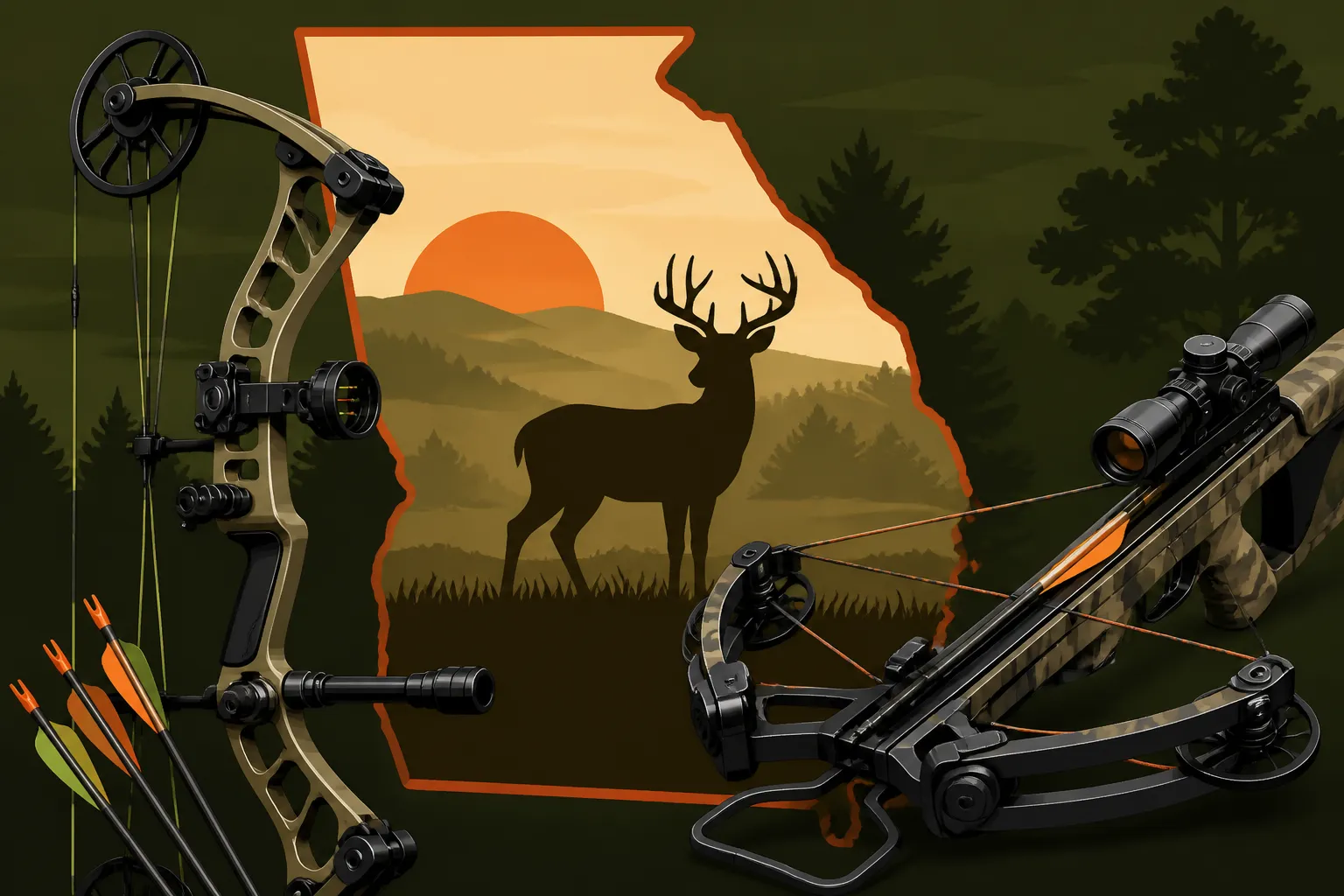
There's nothing quite like the thrill of chasing Georgia whitetails with a bow or crossbow, but many hunters find themselves overwhelmed by the sheer number of gear options and the unique demands of our diverse Southern landscape. This comprehensive guide is designed to cut through the confusion, helping you assemble the perfect archery setup that not only meets Georgia's regulations but also performs flawlessly whether you're in the mountains, the Piedmont, or the swamp.
Navigating Georgia's Bowhunting Landscape: Why Your Setup Matters
Stepping into the woods with a bow or crossbow means you're embracing a challenge that demands precision, stealth, and equipment finely tuned for the task at hand. Georgia offers a vast array of hunting environments, from the rugged mountains of the north to the dense, humid swamps of the south, each presenting its own set of considerations for your archery setup. A poorly chosen bow or an ill-suited accessory can quickly turn a promising hunt into a frustrating experience.
Many hunters make the mistake of buying the latest, most expensive gear without truly considering how it aligns with their specific hunting style, physical capabilities, or the terrain they'll be frequenting. This isn't just about personal preference; it's about optimizing your chances of a successful and ethical harvest. Understanding the nuances of Georgia's landscape, coupled with a solid grasp of state regulations, forms the bedrock of building an effective and enjoyable archery setup.
The Unique Challenges of Georgia's Diverse Terrain
Georgia's topography is incredibly varied, and this diversity directly impacts the type of archery setup that will serve you best. In the rolling hills and thick timber of North Georgia, shots are often close, steep, and require maneuverability in a treestand. You're dealing with elevation changes, thick undergrowth, and sometimes unpredictable wind currents, all of which can affect arrow flight and shot placement. A bulky bow or a setup that's too heavy might become a hindrance during long hikes or when trying to get into position quickly. For more on navigating these areas, check out Treestand Setups in North Georgia Mountains.
Move further south into the Piedmont, and you'll find a mix of pine plantations, open hardwood bottoms, and agricultural fields. Here, you might encounter longer shot opportunities across food plots or field edges, but also dense creek bottoms and funnels where deer travel. Your setup needs to be versatile enough to handle both scenarios, with optics that perform well in varying light conditions and broadheads that can penetrate effectively after a potentially longer flight. The occasional swampy pocket can also mean dealing with high humidity and bug pressure.
Then there's South Georgia, dominated by vast pine flats, cypress swamps, and river bottoms. The humidity here can be brutal, and thick cover often limits visibility, forcing very close shots. Equipment needs to be robust, resistant to moisture, and quiet to prevent alerting game in dense environments. Tracking in these areas can also be particularly challenging, making a clean pass-through and a visible blood trail paramount. Think about Hunting a Funnel Between Two Swamps for more context on these tricky environments.
Understanding Georgia's Archery Season Regulations
Before you even start thinking about specific models, it’s crucial to be intimately familiar with Georgia’s hunting regulations concerning bows and crossbows. Georgia has a generous archery season, often opening well before firearms season, offering bowhunters a unique opportunity to pursue deer with less pressure. Understanding these specific dates and rules is the first step in planning your hunts. For exact dates, you'll want to review Georgia Archery Season Dates.
Georgia law defines what constitutes a legal bow and crossbow for hunting purposes. For vertical bows, there are typically minimum draw weight requirements to ensure sufficient kinetic energy for an ethical kill. While specific numbers can change, the general idea is to ensure your equipment is powerful enough for the game you're pursuing. Likewise, crossbows have their own set of rules, including specifications on draw weight and minimum bolt length. It's always best to check the current regulations published by the Georgia Department of Natural Resources (DNR) or through resources like those found on a platform like GoHunt, as these details are subject to change.
Furthermore, hunters need to be aware of any restrictions on arrow or bolt components, such as broadhead type. While mechanical and fixed-blade broadheads are generally permitted, understanding their performance differences is key to making an informed choice. There might also be rules regarding illuminated nocks or other electronic components that could affect your setup. Ignorance of the law is never an excuse, so a thorough review of the current regulations is a non-negotiable part of preparing for your season. You can often find detailed breakdowns of these rules on the Georgia DNR website, or by using tools that aggregate hunting regulations like those available from GoHunt.
Crafting the Ideal Vertical Bow Setup for Georgia
For many, the vertical bow represents the pinnacle of bowhunting, demanding skill, practice, and an intimate connection with your equipment. Building an ideal vertical bow setup for Georgia involves careful consideration of the bow itself, your arrow and broadhead combination, and the various accessories that enhance your accuracy and efficiency in the field.
The goal isn't just to have a bow that shoots; it's to have a bow that you can shoot consistently and accurately under real hunting conditions. This means a setup that feels comfortable, provides confidence, and is durable enough to withstand the rigors of Georgia's unpredictable weather and terrain.
Choosing Your Bow: Poundage, Axle-to-Axle, and Cam Systems
When selecting a vertical bow, three primary factors stand out: draw weight (poundage), axle-to-axle length, and the type of cam system. The draw weight is perhaps the most critical for an ethical hunt. Georgia generally has a Minimum Draw Weight for Georgia Deer requirement, often around 40 pounds for deer. However, simply meeting the minimum isn't always enough. You need to choose a draw weight that you can comfortably and repeatedly pull back, hold, and shoot accurately without straining. An overly heavy draw weight leads to poor form, inconsistent shots, and fatigue in the stand, especially in warm Georgia weather. Most serious deer hunters aim for 50-70 pounds, depending on their physical ability.
Axle-to-axle length refers to the distance between the cam axles. Shorter bows (under 32 inches) are generally lighter and more maneuverable, making them excellent choices for tight spots, thick timber, or hunting from ground blinds. They're easier to carry through dense woods and less likely to snag on branches. However, shorter bows can be less forgiving to shoot, meaning minor errors in form are magnified. Longer bows (32 inches and up) are typically more stable and forgiving, which can translate to greater accuracy, especially at longer distances. The trade-off is increased weight and bulk, which can be cumbersome in a treestand or during long walks. Consider your primary hunting environment: tight cover favors shorter, open fields or longer shots might benefit from longer.
Cam systems dictate the draw cycle and speed of the bow. Single cam bows are known for smooth draws and minimal moving parts, making them reliable and generally quieter. Dual cam and hybrid cam systems often offer higher speeds and more aggressive draw cycles, but can sometimes be less forgiving if cams aren't perfectly synchronized. The choice here often comes down to personal preference for draw feel and desired arrow speed. Modern bows across all cam types are remarkably efficient, so focus on what feels best to you during a test shot.
Arrow and Broadhead Selection for Georgia Whitetails
The arrow and broadhead combination is just as critical as the bow itself. Your arrow choice impacts speed, kinetic energy, and penetration. For Georgia deer, a good balance of weight and stiffness (spine) is essential. Arrows that are too light might fly fast but carry less momentum, especially after hitting bone. Arrows that are too heavy can drop quickly at longer distances. Carbon arrows are popular due to their durability, consistency, and straightness. When selecting arrows, match the spine to your bow's draw weight and length, and ensure they are properly fletched for stable flight. Many archers find a total arrow weight between 350-450 grains ideal for whitetails, providing a good blend of speed and penetration.
Broadheads are the business end of your arrow, and their selection is paramount for an ethical kill. In Georgia, both fixed-blade and mechanical broadheads are widely used. Fixed-blade broadheads are known for their reliability, durability, and ability to hold an edge after impact. They typically offer excellent penetration, especially with two or three-blade designs, which is crucial when hitting shoulder bone or pushing through thick hide. They require precise tuning with your bow to fly accurately, mimicking the flight of your field points.
Mechanical broadheads, on the other hand, feature blades that deploy on impact. They often fly more like field points, which can simplify tuning for some archers, and create larger wound channels once deployed. However, they rely on energy to deploy their blades, and in some cases, blades might not fully deploy or could break upon impact with heavy bone. For a detailed comparison, see Fixed Versus Mechanical Broadheads. Whichever type you choose, ensure they are razor-sharp and matched to your arrow's weight and your bow's power for optimal performance and ethical harvesting of Georgia whitetails. Regularly inspect them for damage before and after each hunt.
Essential Vertical Bow Accessories: Sights, Rests, and Stabilizers
Beyond the bow and arrow, several accessories are non-negotiable for a complete vertical bow setup. Your bow sight is critical for aiming. Common options include multi-pin sights for various distances, single-pin adjustable sights for precision at specific ranges, and even hybrid designs. Fiber optic pins are popular for their brightness in low-light conditions, which is frequently encountered in Georgia's dense woods during legal hunting hours. Look for sights that are durable, easy to adjust, and provide clear visibility. Some sights feature small lights for pin illumination during dawn and dusk, which can be invaluable, but check local regulations on electronic light use while hunting.
The arrow rest supports your arrow during the draw cycle and release. Drop-away rests are extremely popular as they cradle the arrow during the draw and then drop out of the way just before impact, minimizing fletching contact and improving accuracy. Containment rests, which fully capture the arrow, are also common, offering security in windy conditions or when maneuvering in a stand. The key is a rest that holds the arrow consistently, quietly, and allows for clean fletching clearance.
A good stabilizer helps balance your bow, reduces vibration, and can improve accuracy, especially on longer shots. They come in various lengths and weights, and choosing the right one often depends on personal preference and how the bow feels in your hand. Longer stabilizers generally offer more balance and vibration dampening but can add bulk. Shorter, lighter options are good for maneuverability. Experimentation is key to finding the right balance for your shooting style. Other accessories, like quivers (whether detachable or integrated), wrist slings, and peep sights, all contribute to a functional and efficient setup. The goal is to equip your bow with reliable components that work together seamlessly, allowing you to focus on the shot when the moment arrives.
Mastering the Crossbow for Georgia Hunting
Crossbows have become increasingly popular in Georgia, offering an alternative for hunters who might have physical limitations, prefer a different shooting style, or simply enjoy the unique challenge. Just like vertical bows, setting up a crossbow effectively for Georgia hunting requires specific considerations for the crossbow itself, its bolts and broadheads, and the specialized optics and accessories that enhance its performance.
The perception of crossbows being less "skill-intensive" than vertical bows is often misleading; while the draw cycle is different, accuracy, patience, and understanding your equipment remain paramount for ethical hunting. A well-tuned crossbow setup can be incredibly effective in Georgia's diverse environments.
Crossbow Selection: Speed, Weight, and Cocking Mechanisms
When selecting a crossbow for Georgia, speed, weight, and the cocking mechanism are major factors. Crossbows are generally categorized by their speed, often measured in feet per second (FPS). While a faster crossbow sends bolts downrange quicker, potentially flattening trajectory and reducing lead on moving targets, extreme speed isn't always necessary for whitetails in Georgia. Many shots occur at closer ranges, especially in thick cover. Focus on a crossbow that provides a comfortable shooting experience, rather than just chasing the highest FPS number. A speed of 350-400 FPS is more than adequate for most deer hunting scenarios.
The weight and balance of a crossbow are crucial, particularly if you'll be carrying it for extended periods or holding it steady in a treestand. Lighter models, often made with carbon or aluminum components, are easier to maneuver and reduce fatigue. A well-balanced crossbow will feel more natural to shoulder and aim. Holding a heavy, front-heavy crossbow steady for a shot can be difficult. It’s important to physically handle various models to see what feels right for you.
Cocking mechanisms significantly impact the ease of use. Most crossbows require a considerable amount of force to draw the string back. Manual rope cockers are common, affordable, and effective, allowing you to cock the bow with half the effort. Integrated crank cocking devices are increasingly popular, reducing cocking effort to a minimum and ensuring a consistent, even draw every time, which contributes to accuracy. While they add weight and cost, they can be a game-changer for hunters with physical limitations or those who value convenience. Electric cocking devices are also available on some high-end models, offering the ultimate in ease. Consider how often you'll be cocking the bow and your physical strength when making this choice.
Bolts and Broadheads: Maximizing Performance and Accuracy
Just like with vertical bows, the bolts (crossbow arrows) and broadheads you choose are integral to your crossbow's performance. Crossbow bolts are generally shorter and stiffer than vertical bow arrows due to the higher speeds and different launch dynamics. They come in various lengths and weights. It's crucial to use bolts that are recommended by your crossbow manufacturer to ensure safe and accurate shooting. Using incorrect bolts can damage your crossbow or lead to inaccurate shots.
Weight is an important factor. Heavier bolts generally carry more kinetic energy and offer better penetration, which is vital for an ethical kill on a deer. Lighter bolts might be faster but can lose energy more quickly. A good balance between speed and penetration is often achieved with bolts in the 380-450 grain range for most deer hunting. Pay attention to the front-of-center (FOC) balance of your bolts, as this influences flight stability and accuracy. Proper fletching is also key for consistent bolt flight, especially at high speeds.
Broadhead selection for crossbows mirrors that for vertical bows, but with some specific nuances. Both fixed-blade and mechanical broadheads are viable options. Mechanical broadheads are particularly popular with crossbows because their compact profile often allows them to fly very much like field points at high speeds, simplifying tuning. However, as mentioned earlier, ensure the mechanical broadhead is designed to withstand the forces generated by a crossbow and deploys reliably. Fixed-blade broadheads provide maximum penetration and reliability, but may require more precise tuning with your specific crossbow and bolts to achieve consistent flight. No matter the type, always ensure your broadheads are razor-sharp and match the grain weight of your field points for consistent practice and hunting performance. You can often find valuable discussions on broadhead performance and specific bolt pairings on hunting forums or through resources like those offered by GoHunt.
Crossbow Optics and Additional Accessories
Most crossbows come with some form of optic, typically a scope, which is a significant advantage for aiming accuracy compared to traditional open sights on vertical bows. Crossbow scopes are designed to withstand the forward recoil unique to crossbows and often feature multiple reticle dots or hash marks to compensate for bolt drop at various distances. Some even have variable speed settings to match the scope's reticle to your specific crossbow's FPS, allowing for more precise aim points.
When selecting or upgrading a crossbow scope, look for features like good light gathering capability for low-light conditions, durable construction, and clear, crisp glass. Variable power scopes offer flexibility, allowing you to zoom in for precise shots or zoom out for a wider field of view in dense cover. Reticle illumination can also be a significant benefit during dawn and dusk. Ensure the scope is properly mounted and sighted in thoroughly before heading to the field.
Beyond the scope, several other accessories enhance the crossbow hunting experience. A good sling is essential for comfortable carrying, especially during long walks to and from your stand in Georgia's varied terrain. Quivers designed for crossbow bolts are often side-mounted or detachable. Noise dampeners for the string and limbs can help quiet the shot, which is important for not alarming game nearby. Decocking devices or bolts are crucial for safely unloading your crossbow at the end of a hunt or if you decide not to take a shot, preventing damage to the crossbow or premature wear on the string and limbs. Lastly, a bipod or shooting sticks can provide additional stability, particularly for longer shots from a ground blind or open stand.
Tailoring Your Archery Setup for Specific Georgia Environments
Georgia's incredible diversity means that a "one-size-fits-all" archery setup might leave you wanting in certain situations. While a versatile setup can certainly perform across various terrains, fine-tuning your gear for the specific environment you'll be hunting most frequently can significantly boost your effectiveness and enjoyment.
Whether you're scaling a mountain, sitting on a field edge, or wading through a swamp, understanding how to adapt your bow or crossbow setup will give you a distinct advantage. It's about optimizing for the challenges and opportunities each unique landscape presents.
North Georgia Mountains: Navigating Steep Terrain and Tight Shots
Hunting the North Georgia mountains with archery equipment is a physically demanding but incredibly rewarding experience. The terrain is often steep, covered in dense hardwood timber and thick undergrowth, making every step a climb or descent. Shots here are frequently at close range, often under 30 yards, and can be severely angled due to elevation changes. This environment calls for a setup that prioritizes maneuverability, quiet operation, and comfort during long treks.
For vertical bow hunters, a shorter axle-to-axle bow (around 28-32 inches) is often preferred. Its compact nature makes it easier to navigate through thick brush, climb into treestands without snagging, and shoot from awkward angles in steep terrain. A lighter overall bow weight will also be appreciated during uphill climbs. Quiet accessories are paramount; limb dampeners and string stops reduce noise, which can travel far in the crisp mountain air. Broadheads that provide maximum penetration, like two or three-blade fixed designs, are excellent for close-range, high-angle shots where you might encounter shoulder bone.
Crossbow hunters in the mountains benefit from compact, lighter models that are easy to carry and quick to shoulder. A well-balanced crossbow reduces fatigue during stalking and holding on target. A quiet cocking mechanism, such as an integrated crank, is also valuable to minimize noise that could spook deer on an approaching ridge. Optics with a wide field of view and decent low-light performance are helpful for navigating the dense timber and spotting deer at dawn or dusk. For tactics in these challenging areas, definitely check out Reading a Ridge for North Georgia Deer.
Piedmont Farmland and Pine Plantations: Openings and Mid-Range Engagements
The Piedmont region of Georgia presents a different set of challenges and opportunities. Here, you'll find a mix of rolling hills, mature hardwood stands, pine plantations, and expansive agricultural fields. Shots can vary from tight timber to open field edges where a 40-yard shot isn't uncommon. This environment favors a setup that offers a good balance of accuracy at moderate distances and stealth in the timber.
Vertical bow hunters might lean towards a slightly longer axle-to-axle bow (32-35 inches) for increased stability and forgiveness on longer shots across a field or food plot. Speed can be a slight advantage here, helping to flatten trajectory. A multi-pin sight is ideal for quickly acquiring targets at various known distances. For more on how to approach these areas, read Setting Up on a Piedmont Field Edge. When it comes to broadheads, both fixed and mechanical perform well, but mechanical broadheads can offer a larger cutting diameter for potentially wider blood trails on deer that might run into thicker cover after the shot.
Crossbow users will appreciate scopes with multiple aiming points to dial in for various distances across open fields. Good optical clarity and light transmission are important for spotting deer in low light at the edges of cover. A consistent, easy-to-use cocking mechanism is still valuable, especially if you anticipate having to recock for multiple opportunities or practice shots. Bolts that offer a good balance of speed and kinetic energy will ensure effective shots whether the deer is 20 yards away in a creek bottom or 40 yards out in a cut cornfield. Tools and apps that offer aerial views of these areas, such as those that can be accessed via GoHunt, can be very helpful in visualizing shot opportunities and escape routes.
South Georgia Swamps and River Bottoms: Humidity, Thick Cover, and Close Quarters
Hunting in South Georgia's swamps, river bottoms, and dense piney woods is perhaps the most demanding on equipment due to extreme humidity, constant moisture, and incredibly thick cover. Shots are almost always close, often under 25 yards, and require quick, quiet movements. Durability and corrosion resistance are paramount for any gear heading into these environments.
For vertical bow hunters, once again, a more compact bow shines here. Its maneuverability in dense palmetto thickets or low-hanging branches is invaluable. All components should be as waterproof or water-resistant as possible. Avoid materials that can swell or rust easily. Quietness is critical; any metallic "clink" or bow twang will be magnified in the still, humid air. Fixed-blade broadheads are often preferred in these environments for their reliability and superior penetration through thick hide, muscle, or potential small branches. Think about Hunting Georgia Swamp and River Bottom Deer for more insight.
Crossbows in the swamp need to be equally robust. Synthetic stocks and durable finishes are preferable. Integrated crank cocking devices are excellent here, keeping internal mechanisms sealed from moisture and dirt. Optics should be fog-proof and waterproof, capable of performing in the humid air. Given the close quarters, a good red dot sight or a low-magnification scope with an illuminated reticle can be highly effective for quick target acquisition. Bolts should be on the heavier side to maximize kinetic energy for pass-throughs, which are crucial for leaving a strong blood trail in the dense, often water-logged undergrowth. Protecting your gear from the elements with appropriate covers and cases is essential when hunting these challenging, yet incredibly productive, areas.
Maintenance, Practice, and Safety for Archery Hunters
Having the right bow or crossbow setup is only half the battle. To truly be effective and ethical in the field, you must commit to consistent maintenance and regular practice. Georgia's unique climate and hunting conditions amplify the importance of these often-overlooked aspects. Furthermore, safety should always be your top priority, especially when operating from elevated positions or handling sharp broadheads.
Neglecting your equipment can lead to malfunctions at the worst possible moment, and failing to practice means your skills won't match your gear's potential. A well-maintained and proficiently handled archery setup ensures confidence and maximizes your chances of a clean harvest.
Keeping Your Equipment Ready in Georgia's Climate
Georgia's climate, characterized by high humidity, sudden downpours, and wide temperature swings, can be tough on archery equipment. Proper maintenance is not just about cleaning; it's about preserving the integrity and performance of your bow or crossbow. Regularly inspect all components: strings, cables, limbs, cams, screws, and accessories. Look for any signs of wear, fraying, or loosening.
For vertical bows, strings and cables are particularly susceptible to humidity and wear. Waxing them regularly helps protect them from moisture and UV damage, extending their life. Check for nock point movement or peep sight rotation, which can be affected by changes in humidity. Keep all moving parts, like arrow rests and cam axles, clean and free of dirt and debris. After a rainy hunt, always wipe down your bow thoroughly and allow it to air dry before storing it in a cool, dry place.
Crossbows require similar attention. Inspect the string and cables, and apply wax as recommended by the manufacturer. Pay close attention to the rail, which should be kept clean and lightly lubricated (if specified by the manufacturer) to ensure smooth bolt flight. Check all screws and bolts for tightness, especially those on the scope mount, as the forward recoil can loosen them over time. Optics should be kept clean and dry, using lens cloths designed for optical surfaces. Consider investing in a good quality hard case that protects your bow or crossbow from impacts and moisture during transport and storage, especially if you're traveling through different climate zones or using a platform like GoHunt to scout new areas.
Developing Your Archery Skills for Real-World Scenarios
Consistent practice is the cornerstone of ethical bowhunting. It's not enough to shoot a few arrows a week from a comfortable stance at a known distance. For Georgia hunting, your practice regimen should mimic real-world scenarios as closely as possible. Practice from an elevated position, like a treestand or a platform that simulates one. This helps you get accustomed to shooting at steep angles and managing your equipment in a confined space. If you plan to use a ground blind, practice shooting from a seated position, paying attention to window clearance and sight lines.
Vary your shooting distances. While most deer are taken at under 30 yards, being proficient out to 40 or 50 yards (if your comfort and ethical limits allow) provides a greater margin of error and more confidence. Practice shooting when slightly out of breath, mimicking the exertion of walking to your stand. Practice with your hunting broadheads (or at least identical-weight practice broadheads) to ensure they fly true with your setup. Pay attention to your form, grip, and release. Any inconsistencies in practice will be amplified in a high-pressure hunting situation.
Many hunters find it beneficial to engage in scenario-based practice. Set up targets in various positions, simulating how a deer might appear through thick cover or on an open field edge. Work on quickly and quietly drawing your bow or cocking your crossbow. Timing yourself to see how quickly you can get a shot off, while still maintaining accuracy, can be a valuable exercise. Remember, the goal is not just to hit the target, but to consistently hit the vital zone with precision under conditions that simulate the hunt.
Prioritizing Safety in the Treestand and Beyond
Safety should always be the absolute first priority for any hunter, and archers often face specific risks, particularly from elevated stands. Treestand accidents are a leading cause of serious hunting injuries. Always use a full-body safety harness from the moment your feet leave the ground until they return. This means attaching your harness to the tree or lifeline before climbing, remaining attached throughout your hunt, and only detaching once you are safely back on the ground. Never climb into a stand without a reliable lifeline or safety rope. For a deeper dive into safety, refer to Treestand Safety Gear for Wet Ground.
When using a bow, always use a haul rope to raise and lower your bow and quiver, whether it's a vertical bow or a crossbow. Never climb with your bow in hand. Ensure your broadheads are properly covered until you are ready to shoot to prevent accidental cuts. Be mindful of your surroundings; look before you draw or cock, and ensure you have a clear, safe shooting lane free of obstructions and that you can identify your target clearly.
For crossbows, always engage the safety immediately after cocking. Never walk with a cocked crossbow, and only disengage the safety when you are ready to take a shot. Be aware of your finger placement, keeping it off the trigger until the moment of the shot. Decocking a crossbow safely is also critical; never dry fire it. Use a decocking bolt or a designated decocking target. Proper hunter education, which is required for many hunters in Georgia, will cover these and many other critical safety practices. If you need to brush up on the requirements, check out Georgia Hunter Education Requirements. Always be cautious, deliberate, and prioritize the well-being of yourself and those around you.
Making Smart Gear Investments for Your Georgia Archery Hunt
Assembling a quality bow or crossbow setup can be a significant investment, and it's easy to get caught up in the allure of new gear. However, a smart approach to purchasing ensures you get the best value for your money and equipment that will perform reliably for many seasons. It's not always about buying the most expensive item, but rather choosing components that offer the best balance of performance, durability, and features for your specific hunting needs in Georgia.
Understanding what makes a piece of gear a good value, and how to budget effectively, will help you build a setup that you're proud of and confident in, without breaking the bank.
Understanding the Costs and Value of Archery Equipment
The cost of a complete bow or crossbow setup can vary widely. A basic, entry-level vertical bow setup might start lower, while a high-end, fully accessorized crossbow could be considerably more. It's important to differentiate between initial cost and long-term value. Sometimes, paying a bit more upfront for quality components can save you money and frustration in the long run by avoiding frequent replacements or performance issues.
Consider the core components first: the bow/crossbow itself, the sight/scope, and the arrow rest (for vertical bows). These are the pieces that most directly impact accuracy and reliability. Cheaping out on these can lead to frustration. For example, a quality arrow rest that provides consistent arrow flight is invaluable for a vertical bow hunter. Similarly, a clear, durable scope on a crossbow makes a huge difference in aiming confidence.
Accessories like quivers, stabilizers, cases, and releases (for vertical bows) can be upgraded over time. It's perfectly acceptable to start with more budget-friendly options for these items and then upgrade as your skills and budget allow. Many brands offer a range of products at different price points, allowing you to build a functional setup within your financial comfort zone. Don't feel pressured to buy everything at once or to purchase the absolute top-tier model right out of the gate. A reliable online platform like GoHunt can be useful for comparing features and reading reviews from other hunters to gauge real-world value.
Here's a general idea of component considerations:
| Component | Vertical Bow Considerations | Crossbow Considerations | Value Focus |
|---|---|---|---|
| Bow/Crossbow | Comfort, fit, adjustability, reputable brand | Speed, weight, cocking mechanism, reputable brand | Ergonomics, reliability, matching to physical capabilities. |
| Sight/Scope | Bright pins, durability, ease of adjustment | Clarity, reticle type, durability, low-light performance | Optical quality, robust construction, appropriate aiming features. |
| Arrow Rest | Consistency, quiet operation, full containment (optional) | N/A | Precision, consistent arrow launch, preventing fletching contact. |
| Arrows/Bolts | Correct spine, straightness, durability, weight | Manufacturer recommendation, weight, straightness, durability | Consistent flight, kinetic energy for ethical kills, safety. |
| Broadheads | Sharpness, flight characteristics, penetration | Sharpness, flight characteristics, deployment reliability | Ethical performance, clean pass-throughs, consistent flight. |
| Release Aid | Smoothness, consistent trigger, comfort | N/A | Consistent shot execution, comfort. |
| Quiver | Secure arrow retention, quiet operation, accessibility | Secure bolt retention, quiet operation, balance | Practicality, ease of use, minimizing noise. |
| Stabilizer | Balance, vibration dampening, weight | N/A | Enhancing accuracy and comfort (often a secondary upgrade). |
| Case | Protection from elements and impact, storage | Protection from elements and impact, storage | Durability, fit, safeguarding investment. |
Planning Your Gear Purchases for Long-Term Success
Planning your gear purchases means thinking beyond just the initial season. A well-chosen setup should last you many years with proper care and maintenance. Start by identifying your primary hunting locations and conditions in Georgia. Are you mainly hunting dense public lands where Hunting Pressure on Georgia Public Land is high and shots are close, or more open private land? This will help dictate whether maneuverability or long-range accuracy is more critical.
Consider purchasing from a reputable pro shop that offers expert advice, fitting services, and the ability to test-shoot different bows and crossbows. Their knowledge can be invaluable in ensuring proper fit and tuning, which is especially important for vertical bows. While online retailers offer competitive pricing, the hands-on experience and personalized service from a local shop are often worth the investment.
Finally, set a budget and stick to it. Prioritize the core components that affect performance and safety, and then fill in the rest of your needs with accessories that fit your remaining budget. Remember that the most important "gear" you can invest in is your own skill and knowledge. Regularly practice, stay informed about regulations, and always prioritize ethical hunting practices. When the rut rolls around in Hunting the Rut in Mid-October, you'll be glad you prepared thoroughly.
Disclaimer
This article is for general informational purposes only and does not constitute professional advice. Laws, prices and regulations vary by location and change over time. Consult a qualified professional for guidance on your specific situation.