Reading a Ridge for North Georgia Deer
Hunting in the rugged terrain of North Georgia can feel like trying to read a map drawn in invisible ink, especially when you're staring up at a maze of endless ridges and hollers. It's tough to know where to even begin looking for deer in such vast, often steep, public land. This guide is all about helping you decode those subtle landscape features, offering practical strategies to identify key deer movement patterns along mountain ridges and significantly boost your chances of success.
Understanding North Georgia Ridge Systems
North Georgia's landscape is defined by its Appalachian foothills, which means you're going to encounter a lot of steep climbs, deep valleys, and intricate ridge systems. Unlike the flat pine plantations of South Georgia or the rolling Piedmont farmlands, deer movement here is heavily dictated by topography. Understanding how these ridges function is the first step to consistently finding whitetails.
The Anatomy of a Mountain Ridge
A mountain ridge isn't just a simple line; it's a complex system with distinct components, each playing a role in how deer utilize the landscape. Imagine a large backbone, and then picture all the smaller bones and muscle groups branching off it. The main ridge crest is often a travel corridor, but the real secrets lie in the subtle breaks and features.
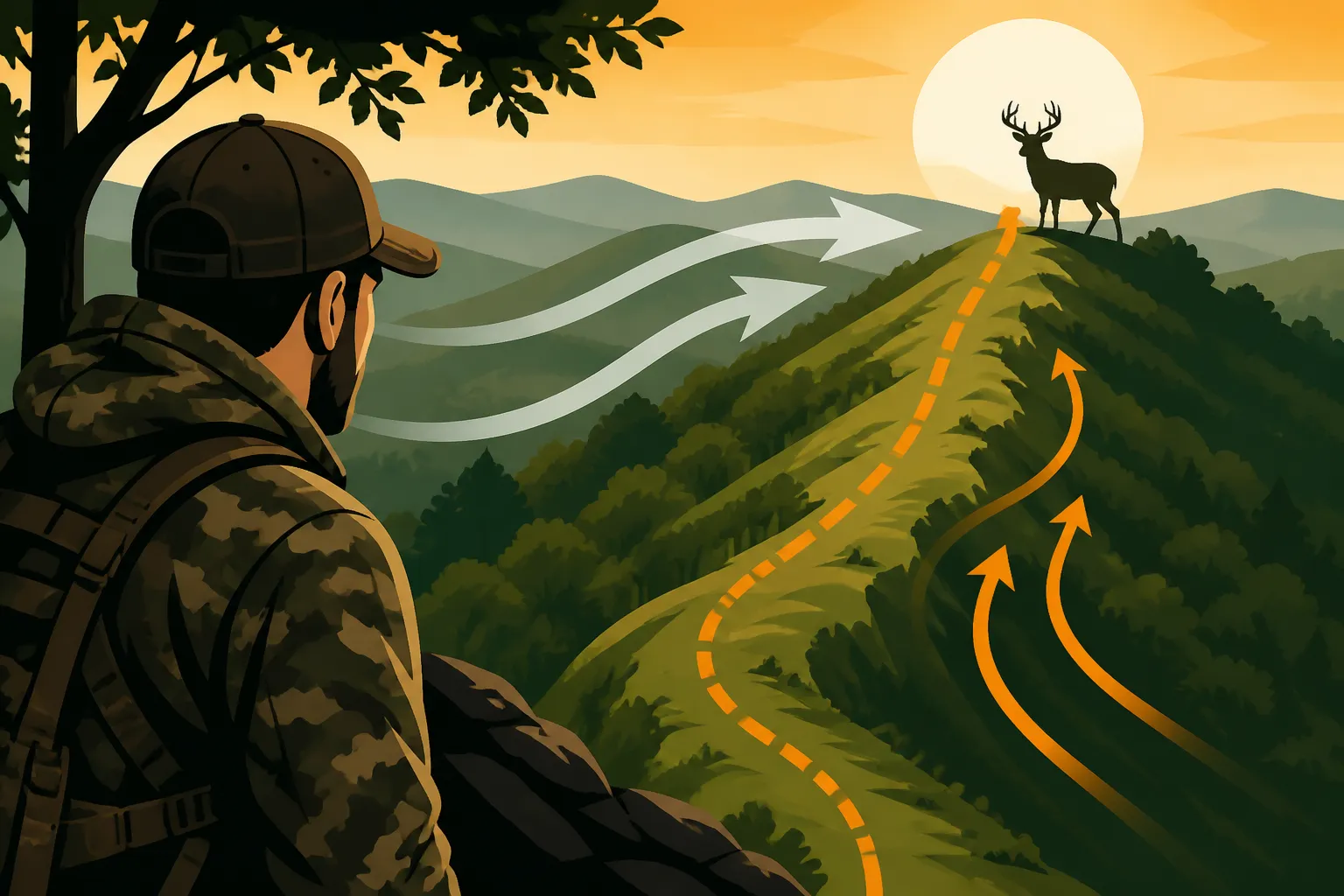
First, you have the main ridge top, which can be broad and flat or knife-edged and narrow. Deer will often travel these tops, especially when moving between different drainages or bedding areas, as it offers a vantage point and easier walking than pushing through thick bottoms. Then, you have secondary ridges or "fingers" that branch off the main ridge. These are often used as travel routes from lower elevations up to the main ridge or down into hollows. They act like natural highways.
Saddles are low spots or dips along a ridge line, whether main or secondary. These are critical funnels. Think of them as natural bottlenecks where deer tend to cross from one side of a ridge to the other, perhaps going from a bedding area to a food source. A deer will almost always take the path of least resistance, and a saddle provides exactly that. This makes them prime locations for setting up a stand. You can learn more about finding and exploiting these areas in Hanging a Stand on a Mountain Saddle.
Benches are flat or gently sloping sections along a steep hillside. These aren't always obvious but are goldmines for hunters. Deer love to bed on benches because they offer a relatively flat, secure spot with good visibility and scent control from ascending thermals in the morning. They also serve as natural highways around steep terrain. If you find a series of benches, you've likely found a major travel corridor.
Lastly, points are protrusions that stick out from the main ridge line, often offering a commanding view down into a valley. Bucks frequently use these points as observation posts, bedding just below the crest where they can watch their backtrail and survey the terrain in front of them. These areas, particularly those with dense cover, can be fantastic spots for mature deer during the rut.
How Thermals and Wind Affect Ridge Movement
Hunting North Georgia ridges without a solid understanding of wind and thermals is like trying to navigate a dense fog – you're mostly guessing. Thermals are air currents that rise and fall with temperature changes, and they are paramount in mountain hunting. In the morning, as the sun warms the earth, thermals rise. This means your scent will be carried up the mountain. As evening approaches and temperatures drop, thermals fall, carrying your scent down into the valleys. Deer intuitively understand and exploit this phenomenon. You can dive deeper into this topic with Wind and Thermals on a Mountain Ridge.
Wind, of course, is a different beast. It's the horizontal movement of air, often influenced by the terrain itself. A prevailing west wind might be perfectly consistent in open country, but on a North Georgia ridge, it can swirl unpredictably, especially in deep hollows or around saddles. This is where a robust digital mapping tool like GoHunt becomes invaluable. You can analyze topographic maps, noting prevailing wind directions and how they might interact with the terrain you plan to hunt. A smart hunter will always try to approach a hunting area with the wind in their face or crossing, keeping their scent out of the deer's primary travel routes. Understanding this interplay between thermals and wind is crucial for planning your approach and stand location.
Key Deer Sign on Ridgelines
Once you understand the physical layout of North Georgia ridges, the next step is learning to read the language of deer sign. Deer leave clues everywhere, but on a ridge, these signs tell a specific story about how they use these elevated pathways.
Interpreting Tracks and Trails
Tracks and trails are the most obvious signs of deer movement. On a ridge, you'll often find well-worn trails running along the crest, cutting across saddles, or traversing benches. These are not random paths; they are highways. Look for trails that connect different features – a trail leading from a bedding bench through a saddle and down into a feeding area in a bottomland. The freshness of tracks, especially after a rain, will tell you how recently deer have used these routes. Large, splayed tracks can indicate a heavy buck, while smaller, daintier prints are likely does or fawns.
Pay close attention to secondary trails that branch off main ones. These might lead to secluded bedding spots just off the beaten path or to preferred foraging areas. A tool like GoHunt can help you mark these observations on your map, creating a comprehensive picture of deer activity. When you find multiple, interlocking trails in a specific area, especially around a saddle or bench, you've located a high-traffic zone. Remember, deer are creatures of habit, and they will use the most efficient and safest routes repeatedly. Following these trails will often lead you to their bedding areas, feeding zones, or preferred escape routes. For tips on how to effectively scout these areas, check out Scouting Georgia Public Land Before Season.
Identifying Scrapes and Rubs
While tracks show general movement, scrapes and rubs provide even more specific insights into buck activity, especially as the rut approaches. On ridgelines, rubs – where a buck has scraped his antlers against a tree – often line travel corridors. These can be along the main ridge, on a secondary finger, or just off a bedding bench.
Look for rubs on smaller trees (1-4 inches in diameter) that are fresh, with wood still showing light color. A series of rubs leading in a specific direction indicates a buck's travel path. Larger rubs on bigger trees (4-6+ inches) are usually made by more mature bucks and often signify a "signpost" or boundary marker. These can be particularly telling if found on a prominent point or near a key saddle.
Scrapes, areas where a buck paws away leaves to expose bare earth, then urinates and works an overhead licking branch, are communication hubs. While you might find scrapes in feeding areas, scrapes on ridgelines often mark travel routes or areas where bucks are actively searching for does. A "line" of scrapes along a ridge or a heavily used scrape in a saddle means bucks are actively patrolling and checking for receptive does. The size and freshness of these scrapes can give you an idea of the buck activity in the area. Pay extra attention to licking branches, as these are repeatedly used year after year. Knowing how to interpret these signals can be key, especially when Hunting the Rut in Mid-October.
Hunting Strategies for North Georgia Ridgelines
Now that we've covered the lay of the land and the signs deer leave, it's time to talk tactics. Hunting ridges isn't just about finding sign; it's about positioning yourself advantageously without spooking the deer you're after.
Scouting Before the Season
Effective ridge hunting starts long before opening day. Pre-season scouting is absolutely essential. Don't wait until the season is open to explore. Spend time in the woods during late winter or early spring after the leaves have fallen. This allows for much better visibility of terrain features like benches, saddles, and subtle trails that are hidden by summer foliage. It also gives you a clear view of old rubs and scrapes from the previous season, which can indicate historical buck activity.
Use digital mapping tools like GoHunt to analyze topography. Look for those hidden benches, the tightest saddles, and the steepest drop-offs that might funnel deer. Identify potential bedding areas (often dense cover just below a ridge crest) and connecting travel corridors. This is also the time to locate potential food sources, even if they aren't directly on the ridge itself, as deer will travel from bedding on the ridge to feed in the bottoms. Walk the trails, listen to how sound carries, and understand how wind and thermals behave in different areas. The more time you spend on the ground, the better you'll understand the deer's preferred movements. Consider scouting strategies outlined in Scouting Georgia Public Land Before Season for a comprehensive approach.
Stand Placement on Saddles and Funnels
When it comes to stand placement on a North Georgia ridge, saddles and funnels are your bread and butter. As mentioned, saddles are natural low points that deer use to cross from one drainage to another. Placing a treestand or even a ground blind in a strategic spot near a saddle can intercept deer moving between bedding and feeding areas, or bucks cruising for does.
Consider the prevailing wind and thermals when selecting your exact tree. You want to be positioned so your scent is carried away from the deer's likely approach. Often, this means being slightly downwind of the saddle itself, or on the leeward side of the ridge where the wind is more consistent. Benches also offer fantastic stand opportunities. If you find a well-used bench trail, especially one connecting two saddles or leading to a bedding area, setting up along it can be highly effective. The key is to find a tree that offers good cover and a clear shooting lane along the deer trail without silhouetting yourself. For detailed advice on stand setups, consult Treestand Setups in North Georgia Mountains. Remember, deer on a ridge are often moving with purpose, so being in the right place at the right time is paramount.
Still-Hunting Ridge Points and Benches
Still-hunting is an art form, and it's particularly effective in North Georgia's ridge country, especially on points and benches. This method involves moving very slowly, taking a few steps, then stopping for extended periods to observe and listen. It's about blending into the environment and letting the woods come alive around you.
When still-hunting a ridge point, slowly work your way along just below the crest, using the topography to break up your silhouette. Bucks often bed on these points, looking out, and by moving slowly, you increase your chances of spotting them before they spot you. Benches are also ideal for still-hunting. Deer often move deliberately along these flatter sections, browsing as they go. By pausing frequently and scanning ahead, you might catch a deer easing along a bench, unaware of your presence.
The key to successful still-hunting is patience, excellent optics (Binocular Choice for Georgia Whitetails is a great resource), and a keen awareness of your scent and sound. Move against the wind or with a consistent crosswind, taking advantage of thermals. This method requires a significant investment of time, but the reward of sneaking up on a wary North Georgia buck in his natural habitat is incredibly satisfying. It's also a great way to cover ground and learn more about deer patterns when you don't have a fixed stand location.
Overcoming Common Ridge Hunting Challenges
Hunting North Georgia ridges is immensely rewarding, but it comes with its own set of challenges that can test even the most experienced hunter. Being prepared for these obstacles is key to maintaining a positive attitude and staying effective afield.
Dealing with Hunting Pressure
Public land in North Georgia, especially during peak season, can see significant hunting pressure. This pressure can dramatically alter deer behavior, making them more nocturnal or pushing them into thicker, harder-to-reach cover. When everyone else is hunting the easy-to-access saddles or the first bench off a road, you need a different strategy. Learn more about navigating these challenges in Hunting Pressure on Georgia Public Land.
To combat pressure, start by going deeper. Most hunters won't venture more than a mile or two from a road or parking area. If you're willing to put in the effort to hike further, utilizing a good pack like those discussed in Packs Built for a Chattahoochee Day Hunt, you'll often find less pressured deer. Look for obscure access points, or plan routes that involve strenuous climbs away from obvious trails. Another tactic is to hunt mid-week when crowds are thinner, or after a major weather event when many fair-weather hunters have stayed home. Remember, pressured deer will often seek the steepest, thickest, most overlooked areas for bedding, making these challenging spots potential goldmines for a determined hunter. Use your GoHunt app to identify remote areas with difficult access and scout those hidden pockets.
Adapting to Weather Changes
North Georgia weather can be fickle. A warm, sunny morning can quickly turn into a cold, driving rain or even snow in the higher elevations. These weather changes, especially cold fronts, significantly impact deer movement. Deer often become more active just before a major cold front moves in, feeding heavily. After the front passes, they might lay low for a day or two before resuming normal activity.
During sustained cold weather, deer will seek out thermal cover, which can include thick stands of pines or sheltered leeward slopes of ridges that offer protection from the wind. Conversely, during warm spells, they might gravitate towards shaded creek bottoms or higher elevations where temperatures are cooler. Keeping an eye on weather forecasts and understanding how different conditions affect deer behavior is crucial. This might mean shifting your hunting location from an open ridge top to a sheltered draw, or from a morning hunt to an afternoon sit based on expected thermal shifts. Dressing in layers and having good rain gear is essential. Being adaptable and willing to change your strategy with the weather can turn a slow day into a successful one.
Ridge Feature and Deer Activity Overview
| Ridge Feature | Typical Deer Behavior | Prime Hunting Strategy | Key Sign to Look For |
|---|---|---|---|
| Main Ridge Top | Travel corridor between drainages; often used for cruising | Still-hunting, mobile stand setup; intercepting cruising bucks | Well-worn trails, scattered rubs |
| Secondary Fingers | Routes to access main ridge or descend into hollows; bedding | Stand placement at base or midway up | Connecting trails, rubs, tracks |
| Saddles | Primary crossing points, funnels for movement | Treestand or ground blind placement directly in or near | Heavy trails, fresh tracks, scrapes, rubs |
| Benches | Bedding areas, secondary travel corridors along contours | Still-hunting, stand placement along main bench trails | Bedding depressions, browse, tracks, rubs |
| Points | Observation posts, strategic bedding for mature bucks | Still-hunting just below the crest, cautious approach | Large rubs, secluded bedding areas, vantage points |
| Draws/Hollows | Feeding areas, escape routes, sheltered travel | Stand placement at mouth, still-hunting upwards or across | Browse, droppings, trails leading up to ridges, feeding sign |
Disclaimer
Hunting is an inherently dangerous activity. Always prioritize safety, wear appropriate gear, and be aware of your surroundings. Regulations and seasons can change, so always consult the Georgia Department of Natural Resources (DNR) official guidelines before heading afield. This guide is for informational purposes only and should not replace proper hunter education and adherence to all local, state, and federal laws.