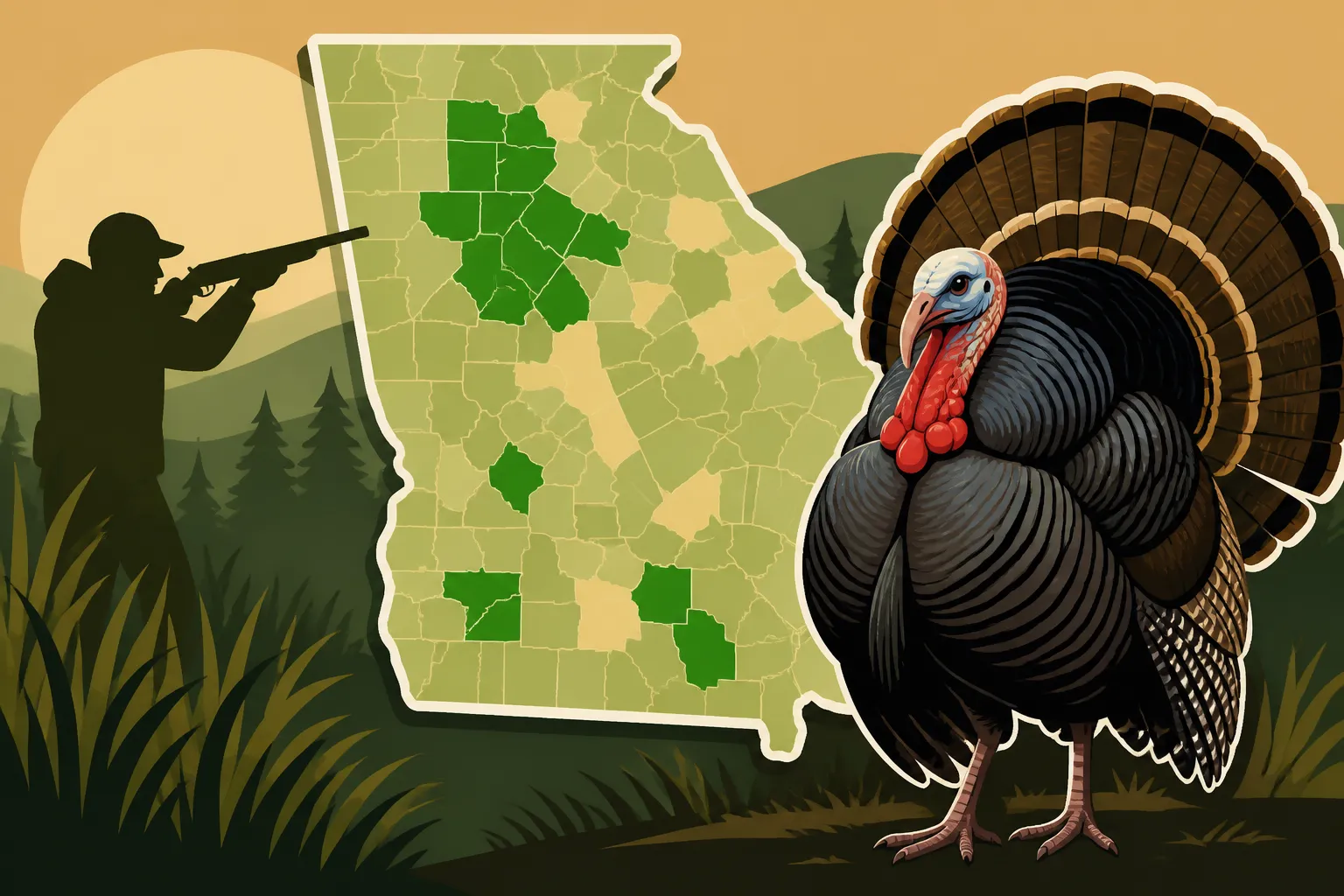
Best Georgia Counties for Turkeys
Ever feel like you're playing hide-and-seek with Georgia gobblers? Finding consistent turkey action isn't always easy, especially when you're trying to figure out which corner of our diverse state offers the best odds for a successful spring hunt. This guide is all about helping you pinpoint those prime Georgia counties where the wild turkey population thrives, offering insights into the factors that make these areas so productive, and how you can leverage that knowledge to fill your spring tags.
Understanding Georgia's Wild Turkey Landscape
Georgia is a beautiful state, stretching from the rugged Appalachian foothills down to the coastal plain and into the Okefenokee Swamp. This vast diversity in habitat means our wild turkey populations aren't uniformly distributed. While you can find turkeys in nearly every county, some areas simply offer more consistent opportunities and higher densities of birds. It's not just about the number of birds, though; it's also about the quality of the habitat, the access available to hunters, and often, the hunting pressure these birds experience.
Population Trends and Habitat Health
Our turkey populations, like any wild game, fluctuate based on a multitude of environmental factors. Long-term trends show that while turkeys have made a remarkable comeback across the state over the decades, there have been some more recent dips in certain regions. This can be attributed to everything from habitat fragmentation and increased predation on nests and poults to disease. Knowing these broader trends can help inform where you focus your scouting efforts. Healthy, diverse habitat is always the cornerstone of a thriving turkey population, and Georgia offers some fantastic examples of this.
Think about areas with a good mix of mature hardwoods for roosting, open fields for strutting and bugging, and dense understory for nesting cover. If you're seeing a lot of timber clear-cuts without much replanting, or if large tracts of forest are being converted to residential developments, you can bet the local turkey population will feel the squeeze. Conversely, areas with active timber management that favors wildlife, such as prescribed burns in longleaf pine forests, tend to support robust turkey numbers. These practices create the kind of mosaic habitat that gobblers and hens absolutely adore. For more details on the statewide picture, you might want to read up on Georgia Turkey Population Trends.
The Role of Public vs. Private Land
When we talk about the "best" counties, it's crucial to distinguish between public and private land. Many of Georgia's absolute best turkey hunting experiences occur on well-managed private properties, often large tracts with dedicated habitat work, minimal pressure, and extensive food plots. These properties can produce exceptional birds year after year. However, the vast majority of hunters rely on public land or smaller private tracts.
For public land hunters, the challenge isn't just finding birds, but finding birds that haven't been "educated" by constant pressure. Counties with extensive public hunting opportunities, such as those within the Chattahoochee-Oconee National Forest or large Wildlife Management Areas (WMAs), can be excellent, but they require a different strategy. You might have to walk further, scout harder, and be more patient. On the flip side, some counties with less overall public land might have smaller, overlooked parcels that hold unpressured birds. Tools like GoHunt can be incredibly useful for pinpointing these overlooked public land boundaries and understanding land ownership, giving you an edge in your scouting.
Key Factors That Create Prime Turkey Habitat
Wild turkeys are creatures of specific needs, and the areas that consistently produce the best hunting opportunities often tick all the boxes for prime turkey habitat. It’s not just about a single factor but a synergistic combination of elements that allow turkeys to thrive, reproduce, and grow into those magnificent longbeards we all pursue.
Food Sources and Forage Availability
Just like us, turkeys need to eat, and a steady, diverse food supply is paramount to their survival and proliferation. In Georgia, this means a mix of mast-producing trees, agricultural fields, and insect-rich foraging grounds. Hardwood forests, especially those with mature oaks and hickories, are goldmines when acorns and nuts begin to drop in the fall and persist through the winter. These crucial food sources help turkeys build up energy reserves, which is vital for surviving the colder months and heading into the demanding spring breeding season strong.
Beyond natural mast, agricultural fields can be massive attractants. Plantings of corn, soybeans, or peanuts, especially after harvest, offer turkeys a bounty of waste grain to pick through. Even active fields, if they provide good cover along the edges, will draw birds. Clover, chufa, and various seed mixes specifically planted for wildlife are also major draws, providing high-protein forage and bugging areas. Counties with a good balance of natural hardwood bottoms and diverse agriculture are often turkey magnets. Consider what you might find when hunting after a poor acorn year, and how that shifts turkey movements.
Roosting and Nesting Cover
Turkeys, especially big gobblers, are particular about their roost sites. They prefer tall, sturdy trees with strong horizontal limbs that offer security from ground predators, typically located near water or over open areas, providing a clear view of their surroundings. Mature pines, towering hardwoods along creek bottoms, or even solitary trees on a field edge can serve as ideal roosts. Finding these roosting hubs is often the first step in locating birds in the morning.
Nesting cover is equally vital for the hens, directly impacting the success of a given year's hatch. Hens prefer dense, often thorny, low-lying vegetation like briar patches, honeysuckle thickets, or young pine plantations where they can safely lay their eggs and raise their poults. These areas offer concealment from predators like coyotes, bobcats, and even feral hogs. Counties with large, contiguous tracts of this kind of secure, dense cover, often interspersed with food sources, tend to have better Georgia Turkey Brood Survey Results and thus more birds to hunt the following spring. Good nesting habitat directly correlates to healthy poult-to-hen ratios and ultimately, robust turkey populations.
Water Access and Thermal Regulation
While not always as obvious a factor as food or cover, readily available water sources are essential for turkeys. They need water for hydration, especially during hot Georgia springs and summers, and also for bugging in damp soils. Creek bottoms, river drainages, and even small ponds can concentrate birds, particularly when other water sources dry up. These areas often provide not only water but also rich insect populations, which are a critical protein source for growing poults.
Furthermore, these low-lying, riparian areas often offer different thermal regulation benefits. On a scorching spring day, the cooler, shadier confines of a creek bottom can be a sanctuary for birds seeking relief from the heat. Conversely, sun-drenched field edges can offer warmth on chilly mornings. The interplay of these microclimates and readily available water creates preferred zones for turkeys throughout the day. Using mapping tools, like the satellite imagery found on GoHunt, can help you identify these critical water sources and associated cover before you even step foot in the woods.
Spotlight on Georgia's Top Turkey Regions and Counties
Georgia is a big state, and while turkeys are widespread, some regions and specific counties consistently stand out as exceptional turkey hunting destinations. These areas typically combine vast habitat, lower human population density, and often, a history of good game management.
The Piedmont Region: Diverse Landscapes and Strongholds
The Piedmont region, stretching across the middle of Georgia, offers a fantastic blend of agriculture and timberland. Here, you'll find rolling hills, hardwood creek bottoms, and numerous smaller farms. This diverse landscape creates an ideal mosaic of food, cover, and water for turkeys. Counties like Putnam, Hancock, Jones, Monroe, and Greene often come up in discussions about strong turkey populations in this region. They feature excellent hardwood stands, especially along the Oconee and Ocmulgee river corridors, mixed with open fields that provide ample bugging and strutting areas.
Hunting here often involves setting up on Turkey Tactics for Piedmont Field Edges in the morning, or working creek bottoms to locate birds. Public land opportunities exist within parts of the Oconee National Forest and various WMAs, but many of the top-producing areas are on private land. Hunters often find success by focusing on the transition zones between mature timber and planted fields. The birds here can be callable but also wise, requiring good woodsmanship.
The Coastal Plain: Big Woods and Fewer Hunters
As you move south into Georgia's vast Coastal Plain, the landscape flattens out, giving way to extensive pine forests, bottomland hardwoods, and massive agricultural operations. This region holds some of Georgia's largest contiguous blocks of timber and rural land, which translates to less hunting pressure in many areas compared to the Piedmont or mountains. Counties such as Early, Miller, Seminole, Dougherty, Worth, and Colquitt in Southwest Georgia are renowned for their turkey populations. The birds here benefit from extensive longleaf and loblolly pine plantations managed with prescribed fire, creating open understories perfect for strutting and foraging.
The massive scale of agriculture, particularly peanuts and corn, provides an endless food supply. River systems like the Flint, Chattahoochee, and Ochlockonee also create crucial corridors of hardwood timber for roosting and travel. These counties can offer some incredible hunting, especially if you can gain access to private land. Even on public land within this region, the sheer scale of the landscape means you can often find areas where birds are less pressured. When scouting, focus on the edges of agricultural fields, and listen for those booming gobblers in the vast pine flats. Still-Hunting South Georgia Pine Flats can be a productive method here.
Mountain and Ridge Country: Challenging Terrain, Rewarding Hunts
Up in North Georgia's rugged mountain counties, turkey hunting takes on a different flavor. The terrain is more challenging, with steep ridges, dense timber, and fewer open fields. However, counties like Habersham, Rabun, White, Union, and Fannin can offer some incredible and uniquely rewarding turkey hunts. The birds here are often tougher to access, meaning less overall pressure, and when you do connect, it feels like a hard-earned victory.
The turkeys in these mountain areas rely heavily on mast crops from the extensive hardwood forests. They’ll often roost in the tallest pines or oaks along prominent ridgetops, using these vantage points to survey the valleys below. Calling strategies might need to be adapted for the acoustics of the mountains, with gobblers sounding much closer than they actually are due to echoes. Understanding Wind and Thermals on a Mountain Ridge is critical for success in this environment. While the overall turkey density might be lower than in the Piedmont or Coastal Plain, the quality of the hunting experience and the challenge make these counties highly sought after by those who love mountain hunting.
Comparison of Georgia's Turkey Regions
Let's break down some of the general characteristics that define turkey hunting across Georgia's main regions:
| Region | Typical Habitat | Turkey Density (General) | Hunting Pressure (General) | Common Tactics | Key Considerations |
|---|---|---|---|---|---|
| North Georgia | Steep hardwoods, pine ridges, limited agriculture | Moderate | Low to Moderate | Roosting, calling ridges, spot & stalk | Challenging terrain, variable weather, thermal winds |
| Piedmont | Mixed hardwoods, agriculture, rolling hills | High | Moderate to High | Field edge setups, creek bottom calling | Educated birds, public land crowds, access to private |
| Coastal Plain | Pine plantations, vast agriculture, river swamps | High | Low to Moderate | Scouting fields, timber calling, run & gun | Large tracts, private land access, hot weather, bugs |
| Southeast Swamps | Cypress swamps, mixed pines, dense thickets | Moderate | Low | Boat access, tight cover calling | Challenging access, snakes, humidity, limited roosts |
Note: Turkey density and hunting pressure are general observations and can vary greatly by specific county, WMA, or private property.
Maximizing Your Chances in High-Potential Areas
Finding a county with a reputation for good turkey hunting is only the first step. To consistently harvest gobblers, you need to put in the work—scouting, understanding turkey behavior, and employing smart hunting strategies tailored to the specific environment.
Pre-Season Scouting and Using Technology
Before opening day, hit the woods. Early spring is the perfect time to scout for fresh turkey sign: tracks in soft dirt, scratchings in leaves, droppings, and especially strut marks in fields or along logging roads. Listen for gobbling at dawn to pinpoint roost locations. This pre-season work is invaluable. Don't just rely on your boots on the ground; leverage technology. Online mapping tools are game-changers. Applications like GoHunt provide detailed aerial and topographic maps that can help you identify potential roost sites, water sources, field edges, and access points without ever stepping foot in the woods initially. You can use these to plan your routes, identify pinch points, and even find overlooked public land parcels.
Look for areas with mature trees near open fields or water for potential roosts. Identify dense cover nearby for hens to nest. Mark these locations on your map. This digital scouting, combined with physical visits, will build a comprehensive understanding of the turkey activity in your chosen county. Remember, the birds don't always use the same roosts year after year, so recent observations are key. Consider what you might learn by Reading a Ridge for North Georgia Deer – many of those same principles for finding game apply to turkeys, too.
Effective Calling Strategies and Setup Locations
Calling is an art form when it comes to turkey hunting, and the best strategy often depends on the pressure the birds are facing and the terrain. In heavily hunted counties, aggressive calling can sometimes spook birds. A softer, more subtle approach might be more effective. Start with locator calls like owl hoots or crow calls at dawn to get a gobbler to shock gobble from the roost. Once located, decide whether to move in close or try to call him to your position. For birds on the roost, a soft tree yelp can sometimes be all it takes to get them interested. For an in-depth look at this, check out Calling a Georgia Gobbler Off the Roost.
When setting up, always consider your background and visibility. A common mistake is to set up in the open. Find a wide tree or dense brush to break up your outline. Ensure you have a clear shooting lane in the direction you expect the bird to approach. Decoy placement can also be crucial; a single hen or a jake and hen setup can sometimes draw in a dominant gobbler. Pay attention to the wind and sun—you want the bird to be looking into the sun, making it harder for him to spot you, and the wind should be in your favor. Knowing how to adjust your Decoy Placement for Pressured Georgia Birds can make all the difference.
Adapting to Pressure and Weather Conditions
Hunting in a popular county, especially on public land, means you're going to encounter other hunters. This pressure can make birds exceptionally wary. When birds are "educated," they might hang up just out of range, or simply refuse to commit. In these scenarios, Run-and-Gun Turkey Tactics on Public Land can be effective, allowing you to cover more ground and find less-pressured birds. Don't be afraid to leave a bird that's not responding and move to a new location. Sometimes, a change of scenery is all it takes. You'll also want to consider Hunting the Georgia Public-Land Turkey Opener and how crowds might impact your strategy.
Weather also plays a significant role. Cold fronts can make gobblers less vocal, while warm, sunny days often bring them out strutting. Rain can dampen their enthusiasm and make them harder to locate. Be prepared to adapt. On rainy days, turkeys might head for open fields or high ground to dry off. On windy days, their gobbling might not carry as far, so you might need to get closer. Understanding these variables and adjusting your tactics accordingly is a hallmark of a successful turkey hunter, no matter which Georgia county you're in.
Disclaimer
This article is for general informational purposes only and does not constitute professional advice. Laws, prices and regulations vary by location and change over time. Consult a qualified professional for guidance on your specific situation.