Nest Predation and Georgia Turkey Hatches
It's a tough pill to swallow when you know how much effort goes into wildlife management and still see wild turkey populations struggle, especially when it comes to those precious poults making it to adulthood. Many Georgia hunters and conservationists alike are keenly aware of the frustrating reality that nest predation plays a significant role in limiting our state's turkey hatches. This guide is dedicated to shedding light on the critical issue of nest predation, exploring the common culprits, understanding its impact on turkey numbers, and discussing strategies to help improve the survival odds for future generations of Georgia gobblers and hens.
The Silent Threat: Understanding Nest Predation on Georgia Turkeys
Imagine a hen turkey, having diligently chosen a secluded spot, laid her clutch of eggs, and settled in for weeks of incubation. This is a critical period, one where her vulnerability and that of her future brood are at their peak. It's during this time, and shortly after hatching, that the silent, relentless pressure of nest predation truly makes its mark on Georgia's wild turkey populations. It's not just a single predator; it's a diverse cast of characters, all looking for an easy meal, making the hen's job incredibly difficult.
Who's Raiding the Nest? Common Suspects
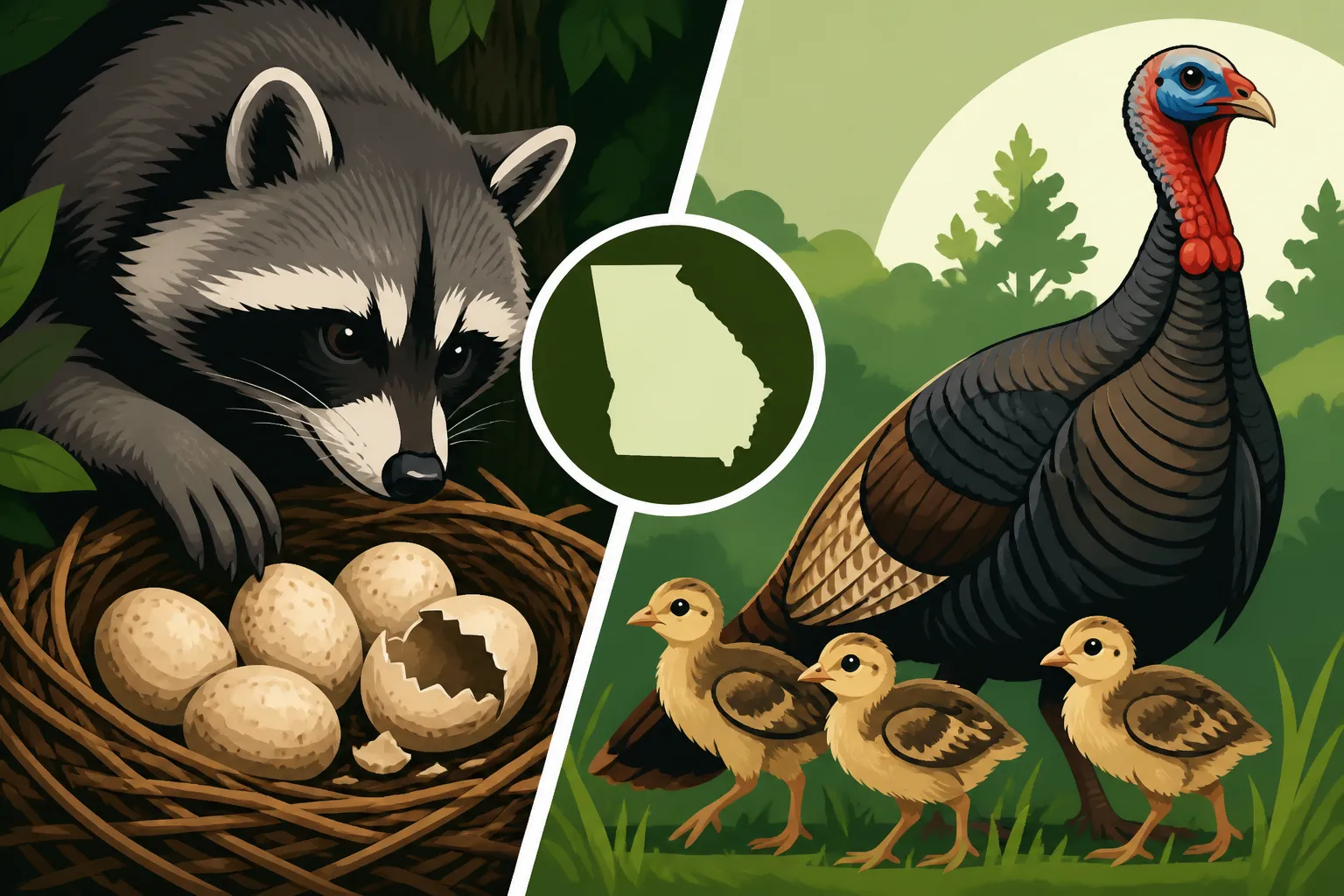
When we talk about nest predation in Georgia, we're looking at a lineup of cunning and opportunistic animals. The most notorious culprits are often the ones you see scurrying through the woods or hear vocalizing at night. Raccoons, opossums, and skunks are classic nest raiders, adept at sniffing out and devouring eggs. These nocturnal foragers have a knack for finding nests hidden ever so carefully by a hen. Their presence is almost universal across Georgia, from the northern mountains to the coastal plains, making them a consistent threat wherever turkeys nest.
Then you have the more elusive, yet equally devastating, predators like snakes, particularly rat snakes and black racers, who will swallow eggs whole. Even some birds, like crows and blue jays, can become egg predators if given the chance. But the impact doesn't stop at the eggs. Once poults hatch, the threat intensifies. Coyotes, bobcats, and even foxes, while capable of finding nests, become even more dangerous to young poults that are still clumsy and learning to navigate their world. Feral hogs, a pervasive issue across Georgia, are also incredibly destructive. They're not just egg eaters; they'll root up entire nesting sites, consume poults, and even displace hens from prime nesting habitat. It’s a relentless cycle, and understanding the specific threats in your hunting area is the first step toward effective management. You can get a good overview of the challenges these animals present by exploring topics like Feral Hog Hunting Year-Round in Georgia or Coyote Calling in Georgia Farm Country.
The Vulnerable Nest: Why Turkey Nests Are Easy Targets
A hen turkey puts a lot of faith in her camouflage and stillness during incubation. She often chooses a spot in dense undergrowth, near the base of a tree, or in thick brush that provides some overhead cover. However, even the best hidden nest is still a stationary target for several weeks. Predators, especially those with a keen sense of smell, don't need to see the nest; they can often scent it out. The hen herself, sitting still for so long, can sometimes be a giveaway.
The vulnerability isn't just about discovery; it's about the sheer odds. A typical hen lays around 10-12 eggs. If even one predator finds that nest, the entire clutch can be wiped out in a single incident. Unlike deer, where fawns are mobile shortly after birth and can be scattered, turkey eggs are all in one basket. If a nest is destroyed, the hen might re-nest, but subsequent clutches are often smaller, and the later hatch dates mean poults face increased summer heat and potentially fewer insects for food. This constant pressure on these crucial early stages of life is a major reason why Georgia Turkey Population Trends have been a concern for many years.
The Numbers Game: How Predation Affects Turkey Populations
When wildlife biologists talk about the health of a turkey population, they often refer to certain key metrics. These numbers aren't just abstract figures; they tell a story about how well turkeys are reproducing and surviving. Nest predation directly hits one of the most important of these metrics, providing a clear window into the challenges Georgia's wild turkeys face.
Poult-to-Hen Ratios: Georgia's Vital Health Check
Perhaps the most critical indicator of reproductive success in wild turkeys is the poult-to-hen ratio. This ratio, often determined by summer brood surveys, simply measures how many poults are observed per hen. If you see a hen with a large brood, that's a good sign. If you see many hens with no poults, or very few, that's a red flag. A high poult-to-hen ratio suggests successful nesting and good poult survival, indicating a healthy, growing population. Conversely, consistently low ratios point to problems, and nest predation is almost always a major contributing factor. Biologists aim for a certain number, often around 2.0 or higher, to indicate a stable or growing population. When these numbers drop below that threshold, it's a sign that fewer poults are making it past those critical early weeks, and often, predators are to blame. You can dive deeper into this topic by reading Poult-to-Hen Ratios and What They Mean.
For example, if DNR surveys reveal that the average poult-to-hen ratio in a specific region of the Piedmont is consistently 1.5, it means that for every hen observed, only 1.5 poults are surviving. This is far below the ideal, suggesting that many nests failed or poults died very young. A significant portion of these failures can be attributed to nest predators. The cumulative effect of low poult survival year after year directly impacts the number of adult birds available for hunting seasons down the line. It's why hunters often lament seeing fewer jakes and young gobblers; those birds simply didn't make it past their first few weeks. Even using resources like GoHunt to scout specific areas can help you identify regions that might have better habitat and therefore potentially better poult survival, though direct poult-to-hen data isn't always granular enough for every parcel.
The Ripple Effect: Long-Term Impacts on Turkey Hunting
The direct consequence of widespread nest predation is a reduction in recruitment – fewer young birds entering the population. Over time, this means fewer overall turkeys. For hunters, this translates to tougher hunting conditions, lower success rates, and potentially more restrictive regulations. It's a large part of the conversation around Why Georgia Dropped the Turkey Limit to Two. When the population isn't replacing itself adequately, wildlife agencies must make tough decisions to ensure the long-term sustainability of the species.
| Predator Type | Primary Targets | Impact on Nest/Poults | Management Implications |
|---|---|---|---|
| Raccoon | Eggs, Young Poults | High | Trapping, exclusion from food sources |
| Opossum | Eggs, Young Poults | Medium | Trapping, habitat reduction for den sites |
| Skunk | Eggs, Young Poults | Medium | Trapping, habitat reduction |
| Coyote | Poults, Adult Turkeys | High | Trapping, calling, hunting, habitat alteration |
| Bobcat | Poults, Adult Turkeys | Medium | Trapping, hunting (limited), habitat alteration |
| Fox (Red/Gray) | Poults, Adult Turkeys | Medium | Trapping, hunting, den destruction |
| Feral Hog | Eggs, Poults, Habitat | Very High | Trapping, hunting (year-round), exclusion fencing, habitat restoration |
| Snake | Eggs | Low-Medium | Limited direct management, habitat modification to deter |
| Crow/Jay | Eggs | Low | Habitat modification (cover), reducing opportunistic feeding |
This table illustrates the varied threats. Imagine a scenario where a particularly wet spring, combined with high predator numbers, leads to an abysmal hatch. The following year, the scarcity of jakes makes for frustrating hunts. This cumulative effect is why understanding and addressing nest predation isn't just about saving a few nests; it's about safeguarding the future of turkey hunting in Georgia. It shapes everything from hunter expectations to the Georgia Spring Turkey Bag Limit, as agencies try to balance opportunity with conservation needs.
Fighting Back: Strategies for Enhancing Nest Success
While nest predation is a natural part of the ecosystem, its elevated impact in certain areas can be a symptom of an imbalance. For landowners and hunters who are serious about helping Georgia's wild turkey populations thrive, there are proactive steps that can be taken. These strategies typically fall into two main categories: improving the habitat to give turkeys a better chance, and actively managing predator numbers where they are causing disproportionate harm.
Habitat Improvement as Your First Line of Defense
One of the most effective long-term solutions for bolstering turkey populations against predation is through robust habitat management. Think about it: a healthy, diverse habitat provides more nesting cover, better escape routes for poults, and more food sources, which can indirectly help distribute predator pressure. For nesting hens, diverse cover is key. This means areas with dense, low-growing vegetation, such as native grasses, briar thickets, and pine plantations that have recently undergone thinning or prescribed burns. These types of areas offer the critical concealment a hen needs to hide her nest from prying eyes and noses.
Prescribed burning, when done correctly and on a rotation, is a fantastic tool in the Georgia landscape. It clears out dense understory that can harbor too many small predators, promotes new growth that attracts insects (a vital food source for poults), and creates varied cover types. Simply creating more "edge habitat" where different types of cover meet can also be beneficial, providing both nesting sites and easy access to feeding areas. Working with GoHunt map layers, for instance, could help you identify areas on your property or public lands with suitable cover or potential for improvement. For public land hunters, understanding how to read the landscape for these conditions is part of Scouting Georgia Public Land Before Season. Ultimately, a hen that has plenty of secure, diverse cover options is more likely to successfully hatch her brood, even with predators present.
Targeted Predator Management: A Controversial but Necessary Tool
This is where discussions can get a little heated, but the reality is, sometimes direct predator management is a necessary component of turkey conservation, especially on private lands or specific public land initiatives. The goal isn't to eradicate predators entirely, but to reduce their numbers in localized areas and during critical nesting periods to give turkey nests and poults a fighting chance. Common methods include trapping for raccoons, opossums, and skunks, often done in late winter or early spring before nesting season begins.
Coyote and feral hog control are also major components. Coyotes are incredibly adaptable and efficient predators, and their numbers have exploded across Georgia. Strategic trapping, snaring, and calling can help reduce their localized impact. Feral hogs are perhaps the most destructive, and year-round trapping and hunting efforts, as outlined in guides like Hunting Feral Hogs Over Bait at Night, are crucial. It's not about eliminating every coyote or hog, but about creating a temporary reprieve in areas where turkeys are nesting. Any predator management program must be carried out legally and ethically, adhering to all state regulations. Hunter education courses, which are a Georgia Hunter Education Requirements, cover these ethical considerations and legal aspects of trapping and hunting.
A Balanced Approach: Predators, Prey, and the Georgia Ecosystem
Understanding the intricate dance between predators and prey is essential for any comprehensive wildlife management strategy. It’s rarely as simple as "less predators equals more turkeys." Instead, it's about striking a delicate balance within a complex ecosystem, where every species plays a role.
The Complex Web: Understanding Predator-Prey Dynamics
Predators are a natural and necessary part of a healthy ecosystem. They keep prey populations in check, culling the sick and weak, and preventing overpopulation that could lead to habitat degradation and disease. However, sometimes the balance shifts. Factors like habitat fragmentation, changing land use practices, or the introduction of new, highly efficient predators (like coyotes in areas where they weren't historically dominant) can skew the predator-prey dynamic. When this happens, a once-balanced system can tip, leading to unsustainable pressure on certain prey species, like wild turkeys.
Consider how an abundance of easily accessible suburban trash or pet food can artificially inflate populations of raccoons and opossums in areas adjacent to prime turkey habitat. These unnaturally high predator numbers can then exert overwhelming pressure on turkey nests, beyond what a wild population would typically experience. It's a reminder that human activity, both direct and indirect, often plays a significant role in these dynamics. Understanding these nuances helps us realize that predator control isn't about hatred for an animal, but about trying to restore a natural equilibrium. Even tools like the GoHunt app can help identify specific habitat features that might concentrate predators or prey, aiding in a more informed approach.
Ethical Considerations and Long-Term Conservation
The discussion around predator management often comes with ethical considerations, and rightly so. Our responsibility as hunters and conservationists extends to all wildlife. Any predator control efforts must be targeted, humane, and based on sound biological principles. It should be part of a broader conservation plan that prioritizes habitat health and long-term sustainability. The goal is not to eradicate species, but to ensure the overall health and biodiversity of Georgia's wild places.
Effective turkey conservation means more than just focusing on one piece of the puzzle. It means considering the full picture: habitat quality, food availability, disease, human disturbance, and, yes, predator impact. By adopting a balanced, science-backed approach that combines habitat improvement with responsible, targeted predator management when necessary, we can work towards a future where Georgia's wild turkey populations thrive, and the thrill of hearing a gobbler sound off on a spring morning remains a vibrant tradition for generations to come. This kind of comprehensive thinking is key to ensuring the future of our hunting heritage in Georgia.
Disclaimer
This article is for general informational purposes only and does not constitute professional advice. Laws, prices and regulations vary by location and change over time. Consult a qualified professional for guidance on your specific situation.