Decoy Placement for Pressured Georgia Birds
There's nothing quite like the frustration of spending hours meticulously setting up your decoys, only to watch a wise old gobbler hang up 70 yards out, or a flock of mallards flare violently at the last second, never committing. You put in the work, you bought the best gear, but those birds, especially in Georgia where hunting pressure can be significant, seem to have a sixth sense for anything unnatural. This guide is all about overcoming that specific challenge, diving deep into advanced decoy placement strategies that will help you outsmart even the most pressured Georgia birds, turning those close calls into successful hunts.
Understanding Pressured Birds
When you're dealing with game animals, especially birds, that have seen their fair share of hunters, you're not just up against their natural instincts; you're up against learned caution. These aren't the naive turkeys or ducks of a secluded, untouched wilderness. These are survivors, and they’ve developed an uncanny ability to spot a setup that’s even slightly off.
The Psychology of Wary Game
Pressured birds are, simply put, educated. They’ve encountered hunters, heard countless calls, and witnessed other birds fall to similar setups. This consistent exposure shapes their behavior dramatically. Think about a gobbler on a public land WMA like Piedmont National Wildlife Refuge; by late season, he's probably heard every box call, mouth call, and slate call in existence. He’s seen strutter decoys from afar and maybe even had a close call himself. This makes him incredibly skittish, and he'll often approach silently, using terrain and cover to scrutinize the situation from a distance. He's looking for any red flags: an unnatural shine on a decoy, a decoy set in an impossible pose, or too many decoys clustered unnaturally.
For waterfowl, especially on popular spots like Lake Seminole or the Altamaha River, flocks of ducks and geese flying overhead have likely run a gauntlet of blinds and decoy spreads all season. They've learned to identify a true "safe zone" from a setup that screams "ambush." This manifests as them circling higher, making wider passes, and often refusing to drop their feet, even if your calling is impeccable. They observe from a distance, looking for any sign of danger before committing. This is why standard, aggressive decoy setups that might work on opening day often fail spectacularly a few weeks into the season.
Key Environmental Factors
The environment plays a huge role in how pressured birds behave and how you should adapt your decoy placement. An open peanut field in South Georgia demands a different approach than a thick pine flat or a swampy river bottom.
In wide-open fields, wary birds have an unobstructed view for hundreds of yards, making them incredibly difficult to fool with anything less than a perfect setup. Every detail matters, from decoy spacing to the sheen on the plastic. On the other hand, in dense cover, like the North Georgia mountains or thick Piedmont hardwoods, birds rely more on sound and short-range visual cues. They might approach closer, but they expect to see a very natural, subtle scene, and any anomaly will send them packing.
Weather conditions also dramatically impact decoy effectiveness. Bright, sunny days can make decoys appear shiny or unnatural, especially if they’re older or painted poorly. Fog or low light can sometimes be your friend, obscuring minor flaws but also reducing visibility for both you and the birds. Wind is crucial, particularly for waterfowl; birds always land and take off into the wind, so your decoy spread must account for this to guide them into your shooting lane. Heavy rain or strong winds can also reduce the range at which birds can hear your calls or see your decoys, requiring tighter spreads or more aggressive calling. Understanding these factors and adapting your decoy placement to them is paramount.
Advanced Decoy Strategies for Turkeys
Dealing with pressured gobblers requires a finesse that goes beyond simply throwing out a strutter and a couple of hens. These birds have seen it all, and a generic setup will often lead to frustrating hang-ups or birds skirting your position.
Less is More: Minimalist Setups
When you're hunting educated gobblers, especially on heavily hunted public land or in areas with consistent pressure, sometimes the best decoy strategy is to scale back significantly. Forget the full-strut tom and a harem of hens; that can be intimidating or simply look too good to be true. Instead, consider a minimalist approach.
A single hen decoy, perhaps in a feeding or contented pose, can be incredibly effective. This doesn't challenge an dominant tom, and it portrays a natural, non-threatening scene. A lone hen is a common sight in Georgia's spring woods, whether she's scratching in a patch of fresh green-up or just milling around. Positioning this single hen subtly, perhaps at the edge of a field or a small clearing, can draw in a wary gobbler who might otherwise avoid a larger, more obvious setup.
Another effective minimalist setup is a single jake decoy. This works particularly well for attracting dominant gobblers who see a jake as a challenge to their pecking order. However, be cautious with jakes; a highly aggressive, full-strut jake might spook a less dominant tom. A submissive or half-strut jake can be a better choice for pressured birds, offering just enough challenge to draw in a mature gobbler without outright scaring off younger ones. The key here is presenting a scenario that looks natural, easy to approach, and not an obvious ambush. If you're employing Run-and-Gun Turkey Tactics on Public Land, a minimalist setup is also far more portable and quicker to deploy, giving you flexibility.
Realistic Poses and Positioning
The way your decoys are posed and positioned relative to each other and your calling setup is critical. Pressured birds analyze these details for any inconsistencies.
For hens, feeding or breeding poses are generally the most effective. A feeding hen looks relaxed and at ease, sending a clear signal of safety to incoming gobblers. A breeding hen, especially if paired with a jake or a submissive tom, can be an irresistible draw for a dominant gobbler looking to assert his authority. Avoid overly alert or unnatural poses. The goal is to make your decoys look like live birds acting naturally.
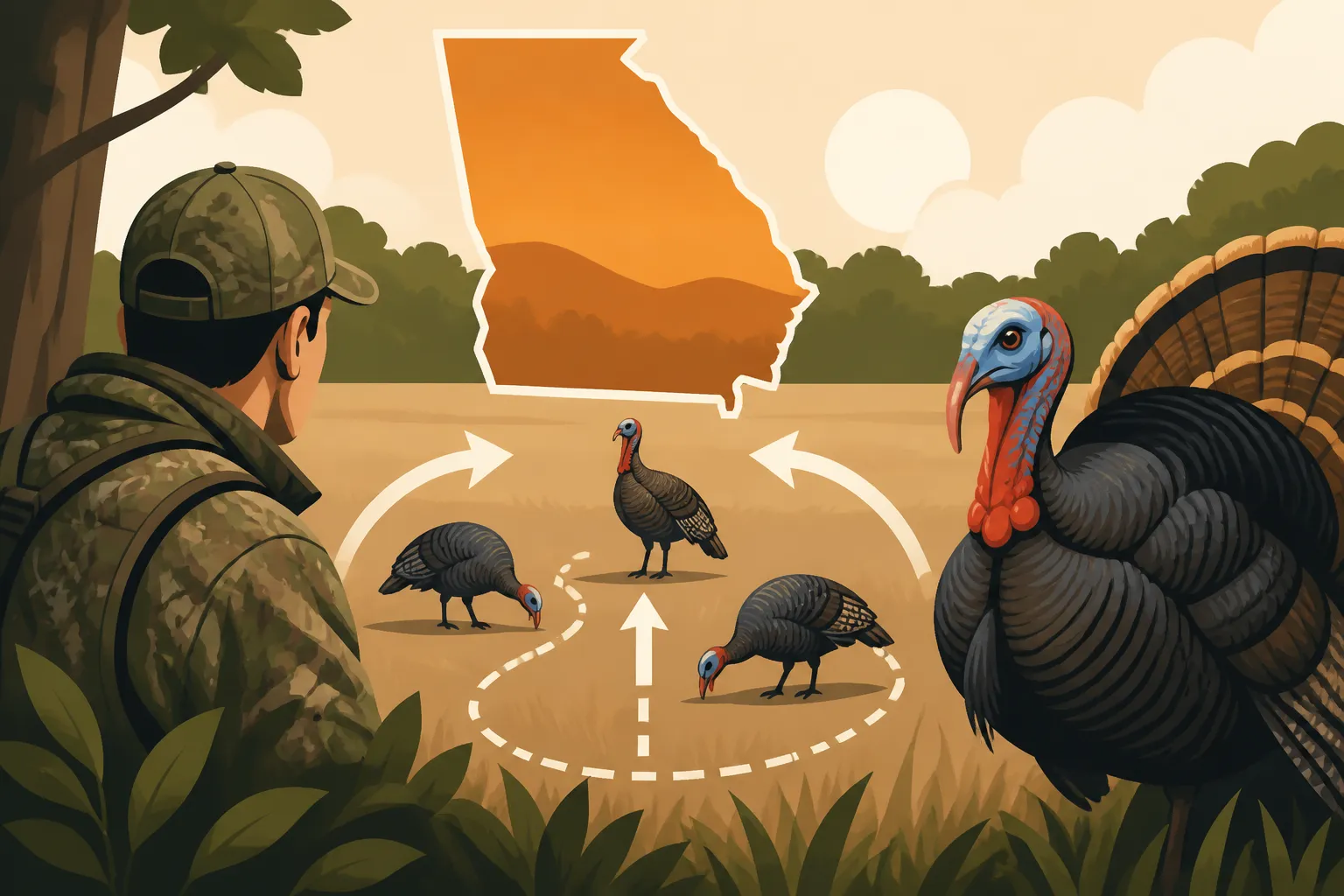
Spacing is also key. Don't crowd your decoys. Real turkeys don't huddle together in a tight ball unless they're roosting. Give them space, mirroring how you'd expect to see a small group of birds naturally spread out as they feed or move. Orienting your decoys is another subtle but crucial detail. Many hunters instinctively face their decoys directly toward their calling position, thinking it will draw the gobbler straight in. However, it's often more effective to have your decoys facing slightly away from your position, perhaps at a 45-degree angle. This allows the gobbler to approach the decoys and present a broadside or slightly quartering-away shot before he's looking directly into your setup. It also makes your decoys appear more natural, as if they're focused on their own business and not signaling danger. Think about the specific terrain; if you're hunting Turkey Tactics for Piedmont Field Edges, you might place your decoy just inside the timber line, facing out, rather than in the middle of the field.
A tactic for particularly wary birds is the "go-away" setup. Instead of trying to pull the gobbler directly to your position, place your decoys slightly beyond your shooting lane. The idea is that the gobbler will approach the decoys, presenting a shot as he passes your concealed position, or as he circles around to get a better look. This can be especially useful when birds are prone to hanging up out of range, as it gives them a reason to keep moving past their comfort zone. Always try to set your decoys where the gobbler will see them as he approaches, but then feel compelled to move past them to investigate further. This might involve placing them near a natural funnel or subtly in a slightly higher position where they are easily visible.
The "Go-Away" or Hide Decoy
This strategy is an extension of using realistic positioning to your advantage, especially for those incredibly smart gobblers that seem to know exactly where you're hiding. Instead of placing your decoys directly in front of your blind or tree, consider setting them up slightly off to the side, or even a bit behind your primary calling position, but still in a visible area. The aim here isn't for the gobbler to walk directly to the decoys and then present a shot, but rather for him to circle wide, looking for the source of the calls, and passing by your shooting lane in the process.
For instance, if you're set up against a large pine with your back to the sun, you might place a single hen decoy 20-25 yards to your left, facing away from your position, as if she's slowly walking off. The gobbler, hearing your calls, will often try to get in front of this "walking away" hen. As he circles to do so, he'll ideally step into your shooting lane. This method relies on the gobbler's desire to intercept what he perceives as a hen moving away, rather than approaching one that's standing still and possibly waiting for him.
Another variation is to place a "hide" decoy at the very edge of your desired shooting lane, slightly past where you want the bird to stop. This decoy acts as a visual target, drawing the gobbler's attention and encouraging him to commit further, allowing you to take a shot as he approaches or passes. This is a subtle psychological trick that works well on pressured birds who are suspicious of anything too obvious or too close. Always ensure your own concealment is absolute when using these techniques, as the gobbler's focus will be on the decoy and the area around it, making any movement or glare from your position easily detectable. Check out specific Turkey Decoys That Work on Pressured Birds for options that lend themselves to these nuanced setups.
Strategic Decoy Placement for Waterfowl
Waterfowl, especially ducks and geese, have an incredible ability to spot an unnatural spread from hundreds of feet up. When they're pressured, they become even more discerning, requiring spreads that look inviting and safe, not like a trap.
The Importance of a Landing Zone
Perhaps the most critical element for success with pressured waterfowl is creating a clear, obvious, and inviting landing zone. Ducks and geese want to land safely, and they prefer to do so into the wind. Your decoy spread should be designed to funnel them directly into this safe zone, which should ideally be within your optimal shooting range.
Common spread patterns like the J-hook, U-shape, or "W" pattern are excellent for this purpose. The "hook" or "U" creates an open pocket of water in front of your blind, guiding birds to land right in the sweet spot. The decoys act as a visual boundary, signaling where other birds are comfortable feeding and resting. For extremely wary birds, resist the urge to pack decoys too densely in the landing zone; instead, leave it truly open. Overcrowding can look unnatural or even threatening to incoming birds.
Consider incorporating "confidence decoys" into your spread. These are decoys of species that aren't typically hunted in that particular spot, or even a few full-bodied goose decoys mixed into a duck spread (if geese are present in the area and not pressured). These can make the area seem more attractive and safe to wary birds. Placing a few sentry decoys, or heads-up feeders, further out from your main spread can also signal safety and act as additional visual cues for approaching flocks. If you're setting up for Pass-Shooting Georgia Wood Ducks in a beaver pond, leaving a clear opening for them to drop into is essential, as they're often fast and erratic flyers.
Natural Movement and Species Specifics
Stale, static decoy spreads often fail with pressured birds. Incorporating natural movement is vital, but with a caveat: sometimes, less is more, especially with motion decoys.
Spinning-wing decoys (SWDs) can be incredibly effective, but wary birds can become "educated" to them, recognizing them as an immediate red flag. On heavily pressured days or areas, scale back on SWDs, or use them sparingly. Instead, consider subtler forms of motion like jerk strings, which create ripples and natural head-nods in your floating decoys. These mimic feeding birds and provide lifelike movement without the often-obvious mechanical look of an SWD. For puddle ducks like mallards or wood ducks, subtle ripples from a jerk string can be much more convincing.
GoHunt mapping tools can be invaluable here, helping you understand contour lines and water depths to place your decoys effectively where water movement might enhance their realism.
Species-specific spreads are also paramount. A mallard spread won't necessarily attract teal, and a diver spread is different from a puddle duck setup. If you're targeting teal, use teal decoys, possibly in smaller, tighter clusters. For mallards, a mix of feeders and uprights spread out a bit more is often effective. If you're Hunting Coastal Georgia Marsh Waterfowl, understanding the specific species that utilize that marsh (such as pintails, gadwalls, or wigeon) and matching your decoys to them is a game-changer. High-quality decoys with realistic paint schemes and anatomical accuracy will always outperform cheap, shiny decoys when dealing with wary birds. A few realistic, well-placed decoys are far superior to a hundred plastic blobs that look nothing like actual birds.
Concealment and Approach Angles
No matter how perfect your decoy spread, if your blind is easily spotted or your movement gives you away, the hunt is over. Concealment for waterfowl hunting is not just important; it's non-negotiable, especially with pressured birds.
Your blind, whether it's a layout blind in a cut field or a permanent structure on the edge of a pond, must blend seamlessly into the environment. Brush it in thoroughly with natural vegetation from the area. If you're hunting cornfields, use corn stalks. If you're in a marsh, use marsh grass. Break up any hard lines or unnatural shapes. Make sure there’s no sky showing through your blind from the birds' perspective.
Crucially, position your decoys so they draw birds into your optimal shooting range, which for most waterfowl hunters is between 20-35 yards. Don't place decoys too close to the blind, as incoming birds will be looking down at your position, increasing the chance of them spotting you. Conversely, don't place them so far out that you're takingHail Mary shots. The landing zone should be a comfortable range.
Always be mindful of the sun's position. Try to set up with the sun at your back or to your side. This illuminates your decoys for incoming birds, making them more visible and natural-looking, while keeping you silhouetted or in shadow. Remember that birds will typically land into the wind, so your decoy spread should guide them to a landing spot that allows for a shot as they turn into the wind in front of your blind. This often means placing your blind at the downwind side of your spread.
General Principles for All Pressured Birds
Whether you're after spring gobblers or wintering ducks, some core principles of decoy placement and hunting strategy apply universally when dealing with pressured game in Georgia.
Scouting is Paramount
You simply cannot overstate the importance of thorough scouting when targeting pressured birds. You need to know what they're doing, when they're doing it, and where. This isn't just about finding birds; it's about understanding their habits, their travel routes, and what makes them wary in a particular area.
Before the season, and even during it, spend time observing. For turkeys, this means locating roost trees, identifying strut zones, and pinpointing feeding areas. Watch how gobblers approach different areas. Do they always skirt the edge of a field? Do they hang up on a specific ridge? This information is gold. Similarly, for waterfowl, you need to know which fields they're feeding in, which ponds they're loafing on, and their flight paths between these locations. Observing actual bird behavior before you set a single decoy is crucial. You might find that a certain area on public land sees so much pressure that the birds have completely altered their natural patterns.
Tools like GoHunt can be incredibly helpful for digital scouting. You can use aerial photos to identify potential roosting areas, field edges, water sources, and travel corridors. Layering in property lines (especially on the fringes of public land where Hunting Pressure on Georgia Public Land can spill over) can also help you identify less-pressured pockets. Combining this digital reconnaissance with boots-on-the-ground scouting to Scouting Georgia Public Land Before Season will give you the most accurate picture of where and how birds are moving. Pay attention to subtle signs like Reading Georgia Mud for Fresh Deer Movement, as deer often use similar travel corridors to turkeys and other game.
Adaptability and Experimentation
One of the biggest mistakes hunters make with pressured birds is sticking to a single, static decoy setup even when it's clearly not working. Pressured birds are dynamic; their behavior can change day-to-day, hour-to-hour, and even flock-to-flock based on countless variables. What worked yesterday might not work today, and what works for one group of birds might not work for the next.
Be prepared to adjust. If birds are flaring from your waterfowl spread, try reducing the number of decoys, changing the pattern, or moving them closer or further from your blind. If gobblers are hanging up, try removing your jake decoy, or moving your single hen to a different spot. This might mean getting out of your blind or tree to make quick adjustments, so ensure your movements are swift and you remain concealed as much as possible.
Don't be afraid to experiment with decoy types. If soft-sided, collapsible decoys look more natural than hard plastics, use them. If a particular call isn't eliciting a response, try a different one. The goal is to constantly learn from the birds' reactions. Successful hunters are not just skilled; they are also highly adaptable, willing to try new tactics until they find something that resonates with the current behavior of the game. This means being okay with failure sometimes, and treating each "failure" as a learning opportunity.
Decoy Maintenance and Realism
It might seem like a minor detail, but the condition of your decoys can make a huge difference with wary birds. A scratched, faded, or unnaturally shiny decoy can be a dead giveaway, especially in bright sunlight.
Regularly clean your decoys. Mud, dust, and algae can build up, altering their color and making them look unrealistic. Inspect them for damage – chipped paint, broken wings, or unnatural creases can instantly spook a sharp-eyed bird. If a decoy is too shiny, you might consider scuffing it slightly or applying a non-glossy, UV-protective spray to reduce glare. Some companies, like Avian-X, specifically design their decoys with ultra-realistic paint schemes and anti-glare finishes to fool the wariest birds.
For turkeys, scent is also a factor. While birds don't have the same sense of smell as deer, human scent can still be a deterrent, especially around decoys that birds might approach closely. Use scent eliminators on your decoys and carry bags, and try to handle them as little as possible with bare hands. Store them in scent-free containers when not in use.
Ultimately, every detail contributes to the overall illusion you're trying to create. With pressured birds, any inconsistency can be enough to send them packing. The more realistic and natural your setup appears, the higher your chances of success.
| Aspect | Standard Decoy Setup (Less Pressured Birds) | Pressured Bird Decoy Setup (Wary Game) |
|---|---|---|
| Turkey Decoys | 2-3 hens, 1 aggressive full-strut tom/jake | 1 single hen (feeding/submissive) OR 1 submissive jake |
| Turkey Spacing | Tighter grouping, closer to hunter | Wider, more natural spread, often slightly past hunter |
| Turkey Poses | Dominant/aggressive, breeding | Feeding, submissive, natural, non-threatening |
| Waterfowl Decoys | Large numbers, mixed species | Fewer, high-quality, species-specific |
| Waterfowl Spacing | Dense concentrations | Open "landing zone," natural gaps, J-hook/U-shape |
| Waterfowl Motion | Aggressive spinning wings, multiple | Subtle jerk strings, natural ripples, minimal SWDs |
| Hunter Position | Often directly in front of decoys | Off to side, downwind, "go-away" setup |
| Concealment | Adequate | Absolute, no sky showing, perfectly brushed in |
Disclaimer
Hunting involves inherent risks. Always prioritize safety, adhere to all Georgia hunting regulations, and ensure you have the proper licenses and permits before heading into the field. This guide offers advice, but individual results may vary.