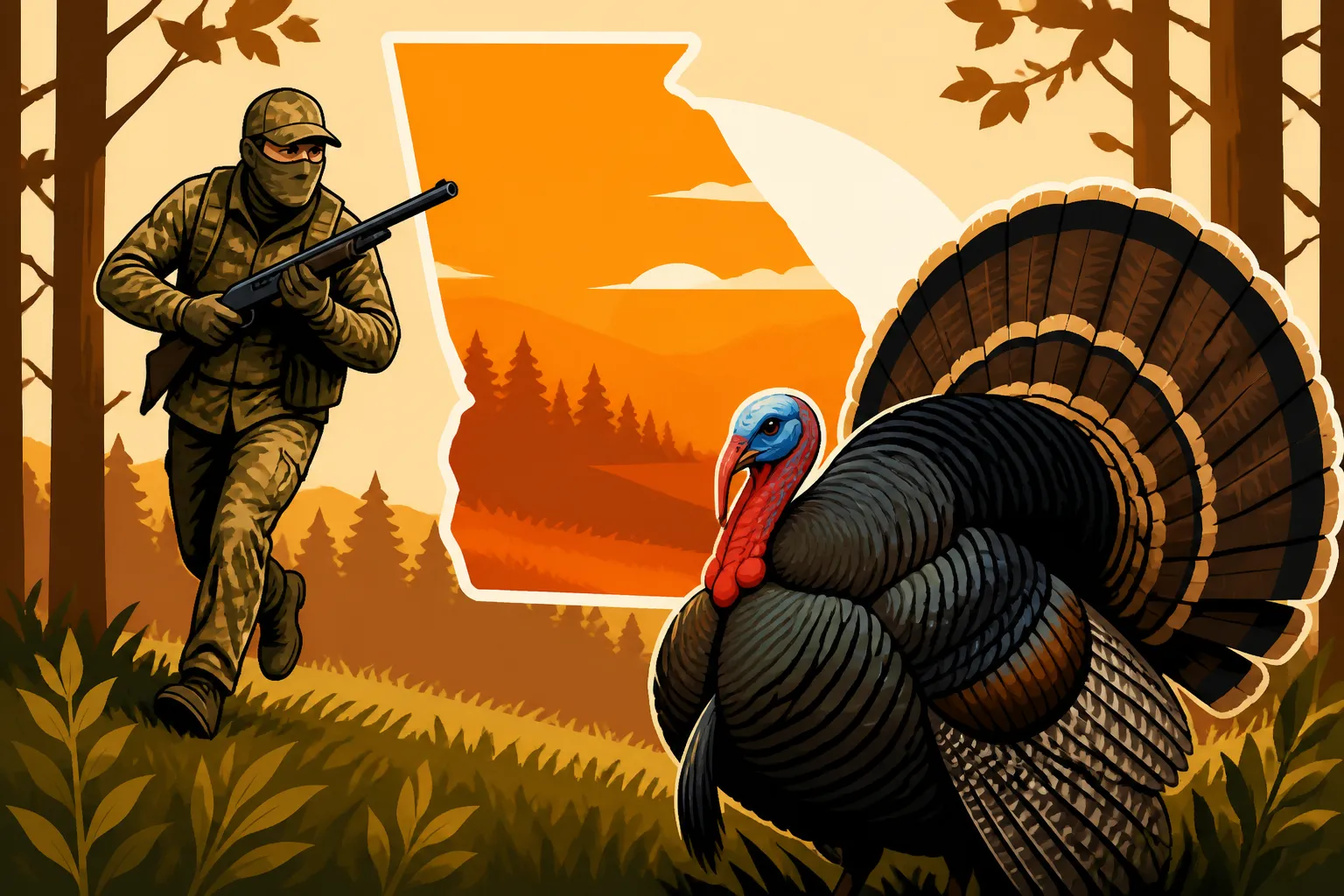
Run-and-Gun Turkey Tactics on Public Land
There's nothing quite like the sound of a gobbler thundering in the Georgia woods, but if you've spent any time chasing those elusive birds on public land, you know the frustration that often comes with it. Public land turkeys can be notoriously tight-lipped, skittish, and downright frustrating. They've heard it all, seen it all, and often go silent as soon as they sense a human presence. This guide is all about equipping you with the run-and-gun tactics you need to outsmart those pressured Georgia gobblers and find success where others might give up.
The Public Land Turkey Conundrum in Georgia
Hunting wild turkeys on Georgia's public lands presents a unique set of challenges that can leave even seasoned hunters scratching their heads. Unlike birds on private, lightly hunted tracts, public land gobblers face consistent pressure from opening day until the season's close. This pressure molds their behavior, making them warier, less vocal, and often more difficult to pattern. It’s a constant chess match where persistence and adaptability are your most powerful pieces.
Why Public Land Birds are Different
Imagine being bombarded with every turkey call known to man, seeing dozens of decoys, and having a new hunter trek through your roosting area almost daily. That's essentially the life of a public land gobbler in Georgia, particularly during the peak of the season. These birds quickly learn that human interaction often means danger. As a result, they develop distinct behavioral traits. They might gobble robustly on the roost, giving away their location, only to clam up and slip off silently the moment their feet hit the ground. They'll often respond to a call with a single gobble or two, just enough to let you know they're there, but then refuse to commit, forcing you to play their game. Their roosting locations might change frequently, and their daytime travel routes will likely be far from obvious trails or roads.
Another significant factor is the sheer volume of other hunters. On public land, you're not just competing with the turkeys' wariness; you're also navigating around or through the areas that other hunters are working. This can lead to birds being "spooked" before you even get a chance, or even encountering another hunter making a setup. Understanding that you're operating in a shared space is critical, and it directly influences how you approach a setup, move through the woods, and call. The birds might be henned up more often, ignoring your calls in favor of their real-life counterparts, or they might simply be in an area that gets little pressure due to its remoteness, requiring a willingness to cover significant ground.
The Need for Adaptability and Persistence
To consistently tag a public land gobbler in Georgia, rigid plans often fall flat. These birds demand a fluid, responsive approach. You might start the morning with a specific area in mind, only to find another hunter already there or hear a gobbler going silent after a single call. This is where adaptability shines. Instead of getting discouraged and retreating, a successful public land hunter pivots. They might quickly move to a different ridge, circle wide to get ahead of a moving bird, or switch up their calling sequence entirely. The ability to read the situation on the fly – listening not just for gobblers, but also for other hunters or subtle changes in the woods – is paramount.
Persistence goes hand-in-hand with adaptability. These aren't always easy hunts, and success rarely comes from one quick setup. It often involves hours of walking, listening, and adjusting. You might strike out in three or four spots before finally locating a bird that's willing to talk and work. Sometimes, it means dedicating an entire day to one general area, slowly inching your way through, hoping to catch a lone gobbler making his rounds. Don't be afraid to keep moving, covering ground, and trying new angles, especially if your initial attempts are met with silence. The payoff, when you finally call in a wily public land tom, is incredibly rewarding because you know you truly earned it.
Essential Kit for the Mobile Turkey Hunter
When you're constantly on the move, covering significant mileage across various types of terrain in Georgia, your gear choices become critical. Every ounce matters, and every item needs to serve a purpose that supports your run-and-gun strategy. You're aiming for efficiency, stealth, and versatility.
Stripping Down Your Gear for Speed
The core principle of run-and-gun is mobility. This means leaving anything non-essential at home. Your turkey vest shouldn't be overloaded with gadgets you rarely use. Think minimalist: a good, comfortable vest that distributes weight evenly, maybe one with a built-in kickstand seat like some options from GoHunt's accessory line, is a game-changer. You'll want enough pockets for your calls, a compass or GPS device, water, a snack, and your tags, but nothing extra. A lightweight shotgun, perhaps a 20-gauge for easier carrying, is often preferred over a heavier 12-gauge, especially if you're navigating steep ridges or dense swamps. For insight into what other hunters are carrying, you can check out popular discussion forums or articles like Turkey Vests With a Kickstand Seat for practical advice.
Footwear is another critical component. You'll be walking miles, often through varied and sometimes rough terrain. Comfortable, well-broken-in boots that offer good ankle support are non-negotiable. Snake boots are a wise choice in Georgia, given the prevalence of venomous snakes, particularly in the warmer early season. Dress in layers with breathable, moisture-wicking fabrics, even if it starts cool in the morning. Georgia spring days can heat up quickly, and you'll be exerting a lot of energy. Blaze orange isn't typically required for turkey hunting, but wearing subdued camo patterns that blend into the local environment is crucial for stealth. Remember, your silhouette against a ridge or a tree line is what a wary gobbler will pick up first.
Calls and Decoys for Aggressive Encounters
For run-and-gun hunting, you need a versatile array of calls that can produce loud, attention-grabbing sounds to locate distant birds, as well as softer, more seductive clucks and purrs to close the deal. Don't carry every call you own, but select a few go-to's that you're proficient with. A diaphragm call is essential because it allows for hands-free calling, which is vital when a gobbler is coming in hot and you need to keep your gun up. Learn to make a variety of sounds – yelps, cutts, clucks, and purrs – with a few different reeds to change the tone.
Additionally, a slate or glass call offers a different range of tones and can be excellent for more realistic hen sounds once you've located a bird. Locator calls – such as an owl hooter, crow call, or coyote howler – are indispensable for striking a gobble without sounding like a hen. They provoke a shock gobble, revealing a bird's position. You can learn more about these indispensable tools in articles like Locator Calls for Georgia Gobblers. When it comes to decoys, simplicity is key for mobility. A single hen decoy, or even just a fan, is usually sufficient. Something lightweight and easy to deploy quickly is what you're after. A full strut tom decoy might be too cumbersome to carry long distances and can sometimes intimidate pressured public land birds more than attract them.
Table: Popular Turkey Calls for Run-and-Gun Tactics
| Call Type | Pros | Cons | Best Use |
|---|---|---|---|
| Diaphragm | Hands-free, versatile, wide range of sounds | Requires practice, can be finicky in cold/dry weather | Close-range calling, aggressive cutting, soft purrs |
| Slate/Glass | Realistic hen sounds, good volume control | Requires two hands, can get wet/muddy | Mid-range calling, subtle yelps, clucks |
| Box Call | Easy to use, loud, good for locating birds | Requires two hands, less subtle | Locating distant birds, aggressive yelps |
| Locator | Elicits shock gobble, non-committal | Doesn't directly call turkeys in | Identifying roost locations, pinpointing gobblers |
Mastering Aggressive Calling and Locating Strategies
Success in run-and-gun turkey hunting often boils down to your ability to aggressively locate birds and then swiftly adapt your calling to their mood and movement. It's a dynamic process that demands confidence and keen observation skills. You can't be afraid to make some noise, but you also need to know when to pull back and listen.
Shock Calling to Strike a Gobble
The beauty of run-and-gun is that you're not waiting for the birds to come to you; you're actively seeking them out. This strategy begins with aggressive locator calling, especially in the early morning hours. As you move through promising terrain – ridge tops, saddles, creek bottoms, or field edges – stop frequently and unleash a loud, distinct locator call. An owl hooter used just before dawn can often get a gobbler to shock gobble from the roost. As the day progresses, a crow call or even a coyote howl can be highly effective. The key is to make a sudden, loud, non-turkey sound that might annoy or startle a gobbler into responding, giving away his position without revealing your identity as a hen.
Once you get a response, mark that location mentally or on your GPS. Now, the real work begins. Your goal isn't just to make him gobble, but to close the distance quickly and quietly without spooking him. If you hear a gobble off in the distance, use the terrain to your advantage. Try to get on the same ridge or in a position where the sound travels better and you have a clear line of sight. Don't immediately start hen calling. Often, a gobbler will respond more readily to a locator call if he hasn't been pressured. Only when you've closed a significant portion of the distance, or if he's actively moving your way, should you transition to hen sounds. This tactic is especially effective on public land where birds are often scattered and covering a lot of ground is necessary to find them.
Reading a Gobbler's Mood and Adjusting Your Approach
Once you've located a gobbler and started to move toward him, your calling strategy needs to become more nuanced. Public land birds are experts at stringing hunters along. They might gobble every time you call but refuse to get any closer. This is where reading their mood and adjusting your approach becomes critical. If he's gobbling aggressively back at every call, he might be hot and ready to commit. In this scenario, you can continue with confident, excited yelps and cuts, mimicking an eager hen. However, if he starts gobbling less frequently, sounds more distant, or simply won't close the gap, it's time to change tactics.
Sometimes, a gobbler will hang up just out of sight, expecting the hen to come to him. This is a classic public land move. In such cases, try decreasing the volume and frequency of your calls. Switch to softer clucks and purrs, acting like a hen that's losing interest or simply going about her business. Occasionally, going silent for a period, maybe 10-15 minutes, can pique his curiosity and make him come looking for the hen he just heard. You can even try a "decoy and retreat" maneuver: set up a single hen decoy, then back off a short distance (20-30 yards) and call softly. The visual of the decoy might be enough to draw him into range. For advice on placing your visual attractants, check out Decoy Placement for Pressured Georgia Birds. Always pay attention to his gobble; a softer, closer gobble means he's getting closer, while a booming, distant gobble means he might be moving away or staying put.
Strategic Movement and Setting Up on Pressured Toms
The "run" in run-and-gun is just as important as the "gun." How you move through the woods and how quickly and effectively you set up can make or break your hunt, especially when dealing with wise public land turkeys. These birds have a keen sense of their surroundings and will often pick up on subtle disturbances.
Covering Ground Efficiently and Stealthily
Effective run-and-gun hunting demands covering a lot of territory, but doing so quietly and intelligently. This means moving with purpose, scanning your surroundings constantly, and using natural terrain features to mask your movement. Rather than walking in a straight line, try to stick to the edges of clearings, follow the contours of ridges, or use thick cover as a screen. Walk slowly, lifting your feet rather than shuffling, and avoid stepping on crunchy leaves or breaking sticks whenever possible. If you know a general area holds birds, consider using mapping apps like GoHunt to identify potential travel corridors, pinch points, or roosting areas before you even step foot in the woods. This can help you plan your route more efficiently and minimize wasted steps.
When you're actively trying to close the distance on a gobbler, stealth becomes paramount. If a bird gobbles, freeze. Wait for him to gobble again or for a moment when his attention is elsewhere (like a flyover plane or another animal's noise) to advance. Always try to approach from a direction that gives you a natural barrier or an advantage, such as a slight rise or a dense patch of timber. Avoid skylining yourself on ridge tops. If you need to cross an open area, do so quickly and efficiently, perhaps using a temporary natural blind like a fallen log or a clump of bushes. The goal is to get into a calling position where you can see the bird before he sees you. Remember, a gobbler's eyesight is legendary, and even a slight movement can send him packing. You might even find insights into this via articles like Scouting Georgia Public Land Before Season.
Setting Up Fast and Knowing When to Move
Once you've located a gobbler and determined your approach, you need to set up quickly and effectively. This means identifying a good tree or blind location that offers ample concealment, a clear shooting lane, and a good backdrop to break up your silhouette. A big pine or a cluster of hardwoods makes an ideal backdrop, as discussed in posts like Setting Up Against a Big Pine. Always aim to have your back against a tree that's wider than your shoulders to prevent being silhouetted and to offer protection if the bird comes from an unexpected direction. Once you're positioned, quickly get your gun up and in a comfortable shooting position. You want to be ready the moment that gobbler steps into range. Minimize any unnecessary movement, and stay as still as possible.
Knowing when to move is just as important as knowing when to set up. If you've been calling to a bird for a while and he's not getting closer, or if he's moved significantly to your left or right, it's often best to reposition. Don't be afraid to break off a setup if it's not working. Staying put in a bad spot only wastes valuable hunting time. Sometimes, quietly circling around a hung-up bird and getting ahead of him, or even taking a wide, silent loop to come in from a different angle, can be the key to success. This requires confidence in your woodsmanship and an understanding of the terrain. If you're on public land, be extra cautious about moving directly toward a gobble if you suspect another hunter might be in between you and the bird. Safety is always the top priority.
Run-and-Gun Tactics Across Georgia's Diverse Terrains
Georgia is a state of incredible topographical diversity, from the steep mountains of the north to the flat pine plantations and swamps of the south. Successful run-and-gun tactics often need to be tailored to the specific terrain you're hunting. What works on a flat field edge in the Piedmont might be useless in the Appalachian foothills.
Navigating Mountainous Public Lands
Hunting turkeys in the North Georgia mountains, particularly within the Chattahoochee-Oconee National Forest, presents its own set of challenges and opportunities. The steep topography, dense timber, and vastness of the land can be daunting. Gobblers here often prefer to roost and travel along ridge tops and saddles, where visibility is better, and the terrain is easier to navigate. Your run-and-gun strategy in these areas should focus on covering ground along these high points. Use locator calls to strike a gobble from afar, then swiftly move to get on the same contour or above the bird. Articles like Wind and Thermals on a Mountain Ridge can provide valuable insights into how these natural phenomena affect turkey movement and your calling strategy.
Thermals play a huge role in the mountains. In the morning, thermals rise, carrying sound and scent uphill. In the afternoon, they reverse, pulling everything downhill. Use this to your advantage: in the morning, try to approach from below a gobbler to keep your scent from spooking him and allow your calls to carry up. In the afternoon, be mindful that your scent will drift down. Setting up on a ridge that allows you to see down into a hollow, or working saddles between two ridges, can be highly effective. These natural funnels concentrate turkey movement, making them prime spots for ambushing a bird on the move. Don't be afraid to climb; the more remote, rugged areas often hold less pressured birds. Just make sure your gear is suitable for the strenuous effort.
Flatwoods and River Bottom Strategies
Moving south into Georgia's Piedmont and Coastal Plain, the landscape changes dramatically, and so must your tactics. Here, you'll encounter extensive pine plantations, agricultural fields, and sprawling river bottoms. While the terrain is generally flatter, the cover can be incredibly dense, making visibility limited and movement noisy. On public land WMAs in these regions, turkeys might utilize the field edges in the early morning or late afternoon. For detailed advice on these setups, see Turkey Tactics for Piedmont Field Edges. During the day, they'll often retreat into thick cover or patrol the mature hardwoods found along creek and river bottoms.
In pine flatwoods, focus your run-and-gun efforts on identifying areas with varying habitat: clear-cuts bordering mature timber, fire lanes, or areas with recent prescribed burns. These transitional zones are where turkeys often feed and travel. Use loud, aggressive calls to cut through the dense pine stands. In river bottoms and swamps, turkeys will often travel along higher ground or natural levees. These areas can be fantastic, but also challenging due to water, mud, and thick undergrowth. It's crucial to understand how to move through these environments quietly. Consider glassing powerline cuts or large agricultural fields from a distance in the early morning to locate birds before attempting an approach. The vastness of some of these areas, like those found around the Altamaha River Wildlife Management Area, means covering serious ground, but the reward can be finding a less-pressured tom.
Disclaimer
Hunting is an inherently dangerous activity. Always prioritize safety, understand and follow all Georgia hunting regulations, and be aware of your surroundings and other hunters. This guide provides general information and tactics; individual results may vary.