Which Georgia Counties Have the Most Hogs
Feral hogs are a persistent and growing problem across Georgia, turning agricultural fields into minefields and tearing up vital wildlife habitat. It can be incredibly frustrating for hunters to spend precious time afield only to find minimal sign, when other areas are absolutely overrun. This guide is here to help you pinpoint the Georgia counties experiencing the highest concentrations of these notoriously destructive animals, so you can focus your hunting efforts where they'll make the biggest difference and lead to more success.
The Relentless Spread of Feral Hogs in Georgia
Before we dive into specific locations, it's crucial to understand why feral hogs are such a pervasive issue in our state. These aren't just wild pigs; they're an invasive species, often a mix of domestic swine that escaped or were intentionally released, breeding with true Eurasian wild boar. They are incredibly prolific, reproducing at an alarming rate, and can adapt to almost any environment Georgia throws at them, from dense swamps to suburban fringes. Their impact is profound, causing millions of dollars in agricultural damage annually, destroying sensitive ecosystems, and even competing directly with native wildlife for food sources. It's a battle on multiple fronts, and as hunters, we play a vital role in managing their numbers.
Why Feral Hogs Thrive in Georgia
Georgia's diverse landscape offers an ideal environment for feral hogs to flourish, often leading to massive population booms in certain areas. They're omnivores, meaning they'll eat just about anything, from acorns and agricultural crops like corn and peanuts to roots, tubers, insects, and even small animals. This flexible diet means they can thrive even when one food source is scarce. Our mild winters mean less mortality for piglets, allowing more of them to survive to breeding age. Furthermore, the extensive tracts of forested land, especially those with dense undergrowth and proximity to water, provide perfect cover and refuge for these intelligent animals. They also take advantage of our vast network of swamps and river bottoms, which offer both food and escape routes when pressured. This constant availability of food, water, and cover creates a perfect storm for rapid population growth.
The Impact of High Hog Densities
When feral hog populations reach high densities, the landscape truly suffers. Imagine walking into a field that looks like it's been rototilled, with huge swaths of earth turned over in search of roots and grubs. That's typical hog damage. This rooting destroys crops, pastures, and delicate wetlands. Beyond agriculture, they impact native plant communities and can spread diseases to livestock and even humans. For other game animals, the impact is severe; hogs compete with deer and turkeys for vital food sources like acorns, and they are notorious predators of fawns and turkey nests. Reducing hog numbers isn't just about bagging a trophy; it's a critical conservation effort to protect Georgia's natural resources and support healthier populations of other game species.
Pinpointing Georgia's Feral Hog Hotbeds
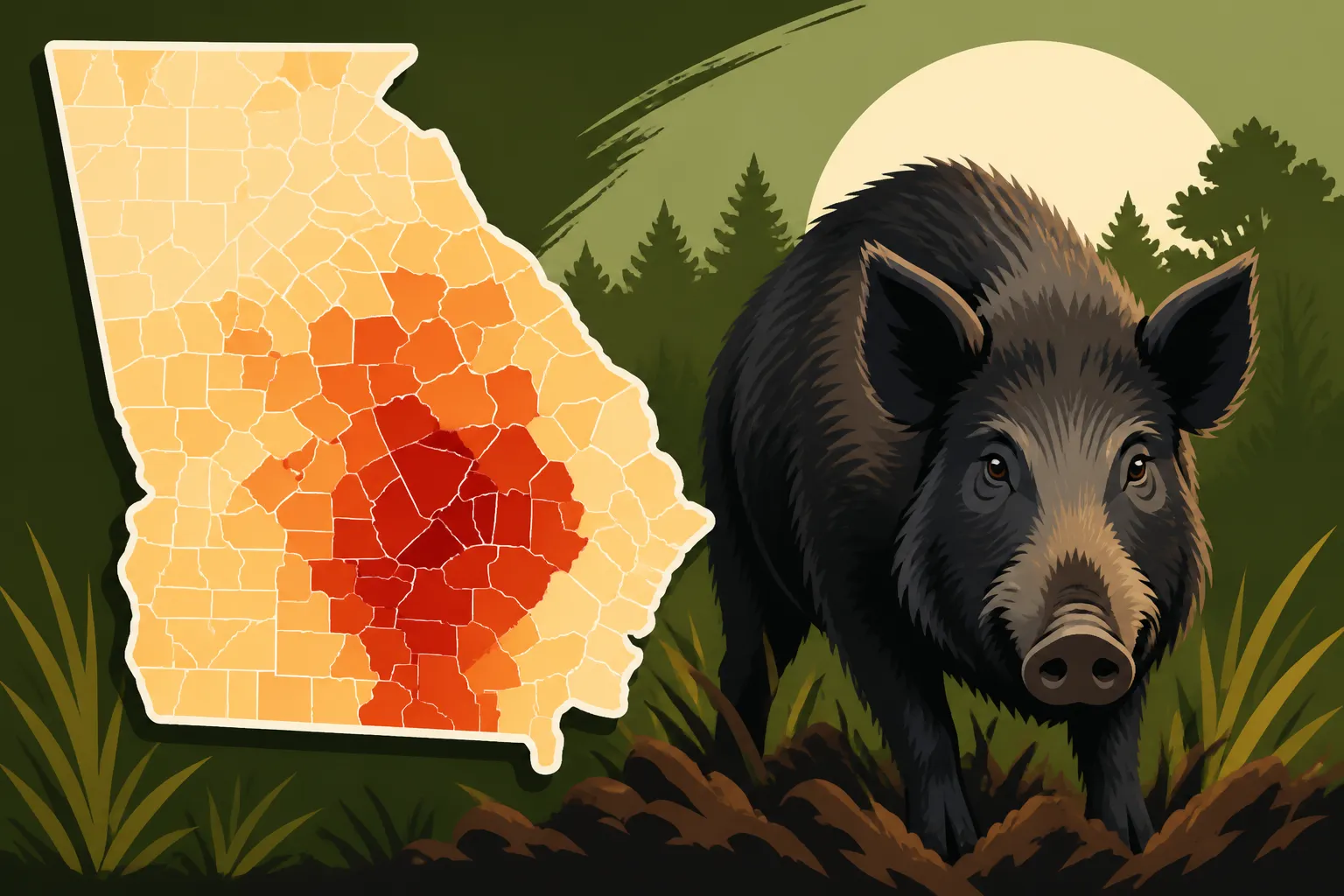
While feral hogs can be found in all 159 counties to some extent, their populations are not evenly distributed. Historically, the highest concentrations have been found in the Coastal Plain and Piedmont regions, particularly along major river systems. These areas offer the ideal mix of dense cover, water, and abundant food sources, often including agricultural lands.
Southwest Georgia's Abundant Hog Populations
If you're looking for hog hunting opportunities, Southwest Georgia is often considered prime territory. Counties like Early, Miller, Seminole, Calhoun, and Terrell consistently report high numbers of feral hogs. This region is characterized by extensive agricultural operations – think vast fields of peanuts, corn, and pecans – which provide an endless buffet for wild pigs. The flat topography, interspersed with large river systems like the Flint and the Chattahoochee, creates incredible cover in the form of thick bottomlands, cypress swamps, and dense pine plantations. These river corridors act as superhighways for hogs, allowing them to move between food sources and secure bedding areas with ease. A mapping tool like GoHunt can really help here, allowing you to identify these river systems and adjacent agricultural fields, which are classic hog magnets. Hunters in this area often find themselves Hunting into the Extended Southwest Georgia Season for deer, and frequently encounter hogs as a bonus.
The Ocmulgee and Altamaha River Basins
Moving further east into Central and Southeast Georgia, the Ocmulgee and Altamaha River basins also harbor incredibly dense hog populations. Counties such as Telfair, Jeff Davis, Appling, Wayne, and Long, which are bisected by these expansive river systems, are known hotbeds. The river swamps, with their dense canopies and intricate networks of sloughs and oxbows, provide ideal refuge from hunting pressure. Adjacent to these swamps are often large tracts of timberland, including managed pine forests, and agricultural fields. Hogs exploit these diverse habitats, moving from the security of the swamps to feed in fields under the cover of darkness. This mix of habitats provides everything a hog needs to thrive and evade hunters. Understanding how to Recovering a Deer From a Cypress Swamp will often put you in prime hog country as well.
Piedmont and Northern Georgia Encounters
While perhaps not as consistently dense as the Coastal Plain, Georgia's Piedmont region, particularly along major river drainages like the Ocmulgee, Oconee, and Flint, also experiences significant hog activity. Counties like Twiggs, Houston, and Pulaski, which straddle the Fall Line where the Piedmont meets the Coastal Plain, can be excellent hog hunting grounds. Here, the landscape transitions from rolling hills to flatter terrain, often featuring a patchwork of hardwoods, pine timber, and agricultural fields. Hog populations in these areas are often linked to creek bottoms and river corridors, where they find sanctuary and consistent water sources.
Even in North Georgia, where the terrain is more mountainous and the habitat less traditionally "hoggy," sightings and populations are increasing. While not as high-density as the southern parts of the state, areas along the Coosa and Etowah river systems, and even some remote parts of the Chattahoochee National Forest, are seeing more Feral Swine Sightings in North Georgia. These populations tend to be more localized but are still a concern. Public land hunters in the mountains should still be vigilant for hog sign, especially near creek beds and fertile bottomlands.
Here's a quick overview of some top hog-producing regions and example counties:
| Region | Characteristic Counties | Typical Habitat | Population Density | Hunting Strategies |
|---|---|---|---|---|
| Southwest GA | Early, Miller, Seminole, Calhoun, Terrell | Large Ag Fields, River Bottoms, Pine | Very High | Stalking field edges, Thermal Hunting Georgia Hogs at Night, trapping |
| Ocmulgee Basin | Telfair, Jeff Davis, Appling, Pulaski | River Swamps, Bottomland Hardwoods, Ag | High | Spot-and-stalk, Running Dogs on Georgia Feral Hogs, trapping |
| Altamaha Basin | Wayne, Long, McIntosh, Glynn | Extensive River Swamps, Coastal Plain | High | Still-hunting, Hunting Hogs Alongside Any Other Georgia Season, trapping |
| Central Piedmont | Twiggs, Houston, Bleckley, Wilkinson | Mixed Pine/Hardwood, Creek Bottoms, Ag | Moderate to High | Targeting transition zones, Baiting a Feral Hog Trap Site |
| Northwest GA | Floyd, Polk, Bartow | Mountain Foothills, River Valleys | Moderate | Scouting creek drainages, opportunistic encounters |
How Hunters Can Identify and Target High-Density Areas
Finding these high-density hog areas isn't always about driving to a specific county line and hoping for the best. It requires scouting, understanding hog behavior, and sometimes using modern tools to your advantage.
Reading the Landscape for Hog Sign
Feral hogs leave distinct signs that can indicate their presence and density. The most obvious is rooting, where they've used their powerful snouts to dig up soil in search of food. This can range from small disturbed patches to acres of churned-up earth. Look for fresh rooting, especially after rain, to gauge recent activity. Wallows – muddy depressions where hogs roll to cool down and remove parasites – are another clear indicator, particularly near water sources. Rubs, where hogs scratch themselves against trees or fence posts, often leaving mud or hair behind, can also be found. Tracks are distinct, often blunt and rounded compared to deer tracks, and you might see large groups of them. Reading Georgia Mud for Fresh Deer Movement can also reveal hog activity if you know what to look for.
Always pay close attention to water sources. Hogs need water daily, so creek beds, river banks, ponds, and even temporary puddles are good places to start your search. During hotter months, they'll often bed down in the thickest, coolest cover they can find, which typically means dense swamps or almost impenetrable briar patches. In cooler weather, they might range further into open woods or fields.
Utilizing Technology and Local Knowledge
Modern hunting apps and mapping services can be incredibly useful for identifying potential hog hot spots. Platforms like GoHunt allow you to overlay property lines, topographic maps, and satellite imagery, helping you visualize river corridors, dense cover, and agricultural fields that could attract hogs. You can mark areas of observed hog sign, track movements, and plan your approach, even when you're scouting from home. This is especially helpful when looking at larger tracts of public land or gaining permission on new private land.
Don't underestimate the power of local knowledge. Talk to farmers, landowners, and other hunters in the counties you're interested in. They are often the first to notice increases in hog activity or specific fields getting torn up. Wildlife biologists or local game wardens might also be able to provide general insights into regional hog populations, though they won't typically disclose specific private land locations. Online forums and local social media groups dedicated to Georgia hunting can also be a valuable resource for current conditions and anecdotal evidence of hog activity.
Effective Hog Hunting Strategies in High-Density Areas
Once you've identified a high-density hog area, it's time to put a plan into action. Given their intelligence and adaptability, a multifaceted approach is often the most successful way to make an impact on their numbers.
Hunting Tactics for Overrun Landscapes
In counties with significant hog populations, you have several effective hunting tactics at your disposal. Still-hunting, moving slowly and quietly through known hog travel corridors, especially during low-light conditions, can be very productive. Focus on the transition zones between bedding cover and feeding areas. Ambush hunting from a ground blind or treestand, set up over a travel route, water source, or active feeding area, is another common and effective method.
Trapping is often considered the most effective way to remove large numbers of hogs, especially on private land. This involves setting up large, sturdy traps (often corral-style) and consistently baiting them with corn or other attractants. Thermal and night vision optics have revolutionized hog hunting, allowing hunters to operate under the cloak of darkness when hogs are most active. Thermal Hunting Georgia Hogs at Night is particularly effective in agricultural settings where hogs feed under the stars. Remember to check Georgia Night Hog Hunting Light Rules before heading out after dark.
Year-Round Opportunities and Regulatory Considerations
One of the most appealing aspects of hog hunting in Georgia is that there is generally no closed season and no bag limit on private land, and very liberal seasons on public lands. This means you can pursue hogs year-round, making it an excellent activity to fill the "off-season" or to integrate into other hunting endeavors. Many hunters combine hog hunting with deer or turkey seasons, as hogs are often found in similar habitats and can be taken opportunistically. Hunting Hogs Alongside Any Other Georgia Season is a popular approach.
However, always double-check the specific regulations for the land you intend to hunt. While private land rules are very open, Wildlife Management Areas (WMAs) and National Forests may have specific seasons, weapon restrictions, or other requirements for hog hunting, especially if it overlaps with other game seasons. Familiarize yourself with Georgia Feral Hog Regulations to ensure you're always in compliance. The goal is responsible, ethical hunting that contributes to the overall management of these challenging animals.
Disclaimer
This article is for general informational purposes only and does not constitute professional advice. Laws, prices and regulations vary by location and change over time. Consult a qualified professional for guidance on your specific situation.