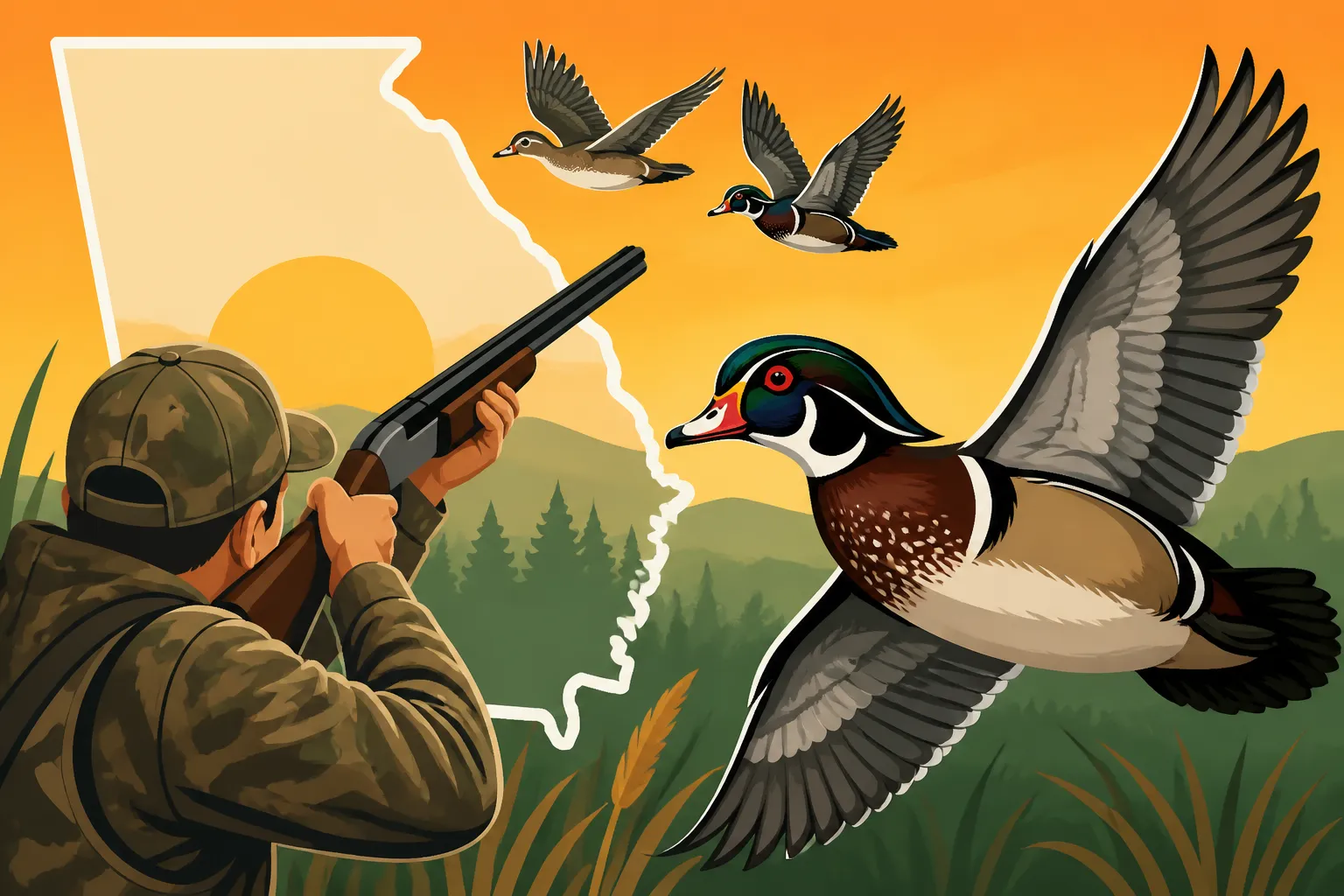
Pass-Shooting Georgia Wood Ducks
The unmistakable whistle of wood duck wings cutting through the pre-dawn air is a sound that gets any Georgia waterfowler's heart pumping. But let's be honest, trying to set up a full decoy spread and hide a boat in some of those tight, flooded timber pockets or overgrown beaver ponds where these beautiful birds love to hang out? It can be a real headache, not to mention a back-breaking effort. That's where the art of pass-shooting comes in, offering a simpler, often more effective way to intercept these fast-flying timber rockets. This guide will walk you through everything you need to know to successfully pass-shoot Georgia wood ducks, from understanding their habits to finding the perfect ambush point.
Understanding Wood Duck Behavior in Georgia
Before you can effectively intercept wood ducks, you've got to think like one. These aren't your typical big-water puddle ducks; they have specific habits and preferences that, once understood, can be exploited for a successful hunt. Georgia's diverse landscapes, from the sprawling swamps of the Altamaha to the Piedmont's creek bottoms, offer a variety of wood duck habitats.
Roosting and Feeding Patterns
Wood ducks are creatures of routine, largely operating on a crepuscular schedule, meaning they are most active during the low light of dawn and dusk. This is your prime time for pass-shooting. As the first hint of light cracks over the eastern horizon, woodies will leave their secure roosting spots, often heading towards feeding grounds. Conversely, in the last hour or so before dark, they'll make the return journey to those same roosts.
Their preferred roosting sites are typically dense, undisturbed timber, especially over shallow water that provides cover from predators. Think of those thick stands of cypress, gum, or even pine that grow right out of a flooded bottomland or the tangle of branches surrounding a beaver pond. These spots offer safety in numbers and a place to preen and rest. For feeding, they are huge fans of mast crops, particularly acorns. Flooded oak flats are an absolute magnet for wood ducks in the fall and early winter. They'll also dabble in shallow water, sifting through muck for seeds, aquatic invertebrates, and other plant matter. Keeping an eye out for Wood Ducks Nesting in Georgia Swamps during the spring and summer can give you clues to good areas come hunting season, as they often stick to familiar territories.
Flight Paths and Habitat Preferences
Wood ducks are often referred to as "timber ducks" for a good reason. They possess an incredible agility in flight, allowing them to navigate the tightest tree lines and most cluttered swamps with ease. This means their flight paths are often tight and direct, following natural corridors. These corridors can be anything from the winding path of a creek or river, the edge of a dense block of flooded timber, or even a subtle break in the canopy leading to a secluded pond.
Unlike mallards or gadwall that might prefer large open bodies of water, wood ducks absolutely thrive in smaller, more intimate water bodies. Beaver ponds, isolated pockets of flooded hardwoods, slow-moving creek bottoms, and the fringes of larger swamps are their bread and butter. The more secluded and sheltered the spot, the more attractive it is to them. In these areas, they can feed and rest away from strong winds and heavy hunting pressure. Focusing your efforts on scouting these specific habitat types will be far more productive than hunting vast, open water. Understanding these preferences, especially where you find Wood Ducks in Georgia Swamps, is paramount to successful pass-shooting.
Scouting for Prime Pass-Shooting Locations
You can't just pick a random spot and expect wood ducks to fly past. Successful pass-shooting is 90% scouting. It's about putting in the legwork (or paddle-work) to understand exactly where those birds are moving and why. This often means early mornings and late evenings spent observing, not shooting.
Identifying Key Flight Corridors
The goal of scouting for pass-shooting is to find the "choke points"—areas where wood ducks are funneled into predictable flight paths. This could be a narrow section of a creek that opens into a larger swamp, a gap in a treeline over a field, or a specific bend in a river that birds consistently follow. Start by using aerial maps. Tools like GoHunt are incredibly useful for identifying these features from your couch. Look for bodies of water connected by creeks, or areas of dense woods adjacent to open water.
Once you have some potential spots on the map, it's time for boots on the ground, or better yet, a kayak or canoe. Visit these areas at dawn and dusk during the pre-season or on non-hunting days. Don't take a gun; just observe. Watch where the ducks fly when they leave their roosts and when they return. Do they follow the riverbank? Do they cut across a corner of a field? Are they coming in low or high? Pay attention to the altitude of their flight. A spot where they consistently fly lower is generally better for pass-shooting. Remember, effective Scouting Georgia Public Land Before Season isn't just for deer; it's critical for waterfowl too.
Locating Roosting and Feeding Areas
Finding the actual roosting and feeding areas isn't always necessary for pass-shooting, but it definitely helps you confirm your flight corridor theories. If you can pinpoint a major roost, you know ducks will be departing from it at dawn and heading back to it at dusk. This gives you a clear "source" and "destination" for their daily commute.
Roosts are usually characterized by dense, flooded timber, often with signs of heavy duck use like droppings on logs or broken branches. Approach these areas very quietly at dusk, listening for the distinctive squealing and whistling calls of wood ducks as they settle in. Feeding areas, particularly those flooded oak flats rich with acorns, are also good indicators of consistent duck activity. If you find a feeding area, look for an adjacent creek or timber line that ducks might use as a travel route to and from that spot. Sometimes, simply observing ducks flying into and out of these areas will confirm the corridors you've identified on your map, allowing you to fine-tune your ambush location for maximum effectiveness.
Essential Gear and Setup for Pass-Shooting
Pass-shooting wood ducks requires a slightly different gear philosophy than setting up a full spread for other waterfowl. It's more about mobility, concealment, and quick reflexes. You want to be effective without being burdened by excessive equipment.
Shotgun and Ammunition Choices
When it comes to pass-shooting, speed and maneuverability are your friends. A semi-automatic or over-and-under shotgun is generally preferred over a pump-action because it allows for quicker follow-up shots on fast-moving, often erratic wood ducks. A 12-gauge is the most common choice, offering a good balance of pellet count and pattern density, but a 20-gauge can also be very effective, especially for hunters who prefer a lighter, faster-swinging gun.
For ammunition, you'll need non-toxic shot for waterfowl hunting. Steel shot is the most common and economical option, but bismuth or tungsten-matrix alternatives offer better density and knockdown power, albeit at a higher cost. Shot sizes #4, #5, or #6 are excellent choices for wood ducks. #6 provides a very dense pattern at closer ranges, ideal for woodies, while #4 offers a bit more punch for slightly longer shots. As for choke, a modified or improved cylinder constriction will give you a wider, more forgiving pattern on those zipping birds, which is often what you need in the timber. Remember, the goal is to break the duck, not just pepper it. Get more details on appropriate loads in Waterfowl Loads for Coastal Georgia Divers.
Camouflage and Concealment
Concealment is absolutely paramount when pass-shooting. Wood ducks are sharp-eyed, and you'll often be set up along a flight path where they're flying high or through relatively open areas, making them keenly aware of anything out of place. Your camouflage should blend perfectly with the environment you're hunting. For river bottoms and flooded timber, choose patterns that mimic tree bark, dead leaves, or marsh grasses.
Position yourself with a solid backdrop, like a thick stand of trees or a brush pile, to break up your outline. Avoid silhouetting yourself against the sky at all costs, as this is the quickest way to flare incoming birds. Sometimes, a simple natural blind made from fallen branches and reeds is all you need. You might even use a lightweight, portable ground blind and brush it in meticulously with local vegetation. Even if you're adapting techniques like those described for Layout Blind Hunting a Cut Cornfield, remember to blend in thoroughly with the timber and dense undergrowth found in prime wood duck habitat. Face yourself in the direction the birds are coming from, but keep your head down and movement to a minimum until it's time to shoot. Even a subtle head turn can be enough to spook a wary wood duck.
Waders and Water Safety
Given that wood ducks almost exclusively inhabit wet environments, a good pair of waders is an absolute necessity for pass-shooting in Georgia. Chest waders are the most versatile, allowing you to traverse flooded timber, wade across shallow creeks, and stand comfortably in knee-deep water. Choose a pair that is appropriate for the expected temperatures; neoprene for colder weather, and breathable materials for Georgia's often mild to warm hunting days.
Beyond just staying dry, consider water safety. Always be aware of the depth of the water you're wading into, especially in unfamiliar territory. Submerged logs, sudden drop-offs, and strong currents can pose significant hazards. It's a good practice to use a wading staff or carry a sturdy stick to probe the bottom ahead of you. If you're hunting with a partner, always know each other's locations. And as a general rule, never hunt alone in a remote or treacherous swamp. It’s always better to be safe than sorry, and this is even more critical when navigating Waders for Georgia Tidal Marsh Hunting or deep swamp.
Strategic Approach to Pass-Shooting Wood Ducks
With your scouting done and your gear ready, it’s time to talk strategy. Pass-shooting isn't just about waiting for birds; it's about anticipating their movements and positioning yourself for the best possible shot.
Timing Your Hunt for Peak Activity
As mentioned earlier, wood ducks are creatures of low light. This means your hunting efforts should be concentrated during the first hour or so after legal shooting light at dawn, and the last hour or two before legal shooting light ends at dusk. These are the periods when ducks are actively flying between roosting and feeding areas, making them most vulnerable to pass-shooting. Don't oversleep for the morning flight, and be prepared to stay until the absolute last minute in the evening.
Weather can also play a significant role. While wood ducks don't move around as much as divers or larger puddle ducks in response to major cold fronts, a significant dip in temperature or the passage of a front can sometimes push more birds into an area or make them more active. Pay attention to local weather forecasts, but more importantly, keep scouting. What was true for flight patterns last week might change slightly this week, so staying current on where birds are moving is key to consistent success. Understanding Duck Migration Timing Through Georgia can also give you a broader picture of when numbers might increase in your area.
Positioning for the Shot
Your setup location is critical. Based on your scouting, you should have a good idea of the general flight path. Try to position yourself downwind of the expected flight path, if possible. Ducks, like airplanes, typically land into the wind, so they'll often approach a pond or river with the wind in their face, providing a slightly slower, more predictable target as they prepare to drop down. However, don't sacrifice concealment for wind advantage. The best spot is always one where you are hidden.
When positioning, consider your background and avoid standing in a spot where you'll be silhouetted against the sky. Utilize natural cover such as large trees, dense brush, or even a slight rise in the terrain. Anticipate the birds' flight path and aim to get a clear, unobstructed shot. Wood ducks are incredibly fast and agile, so you'll need to lead them generously. Practice your swing on imaginary targets, picturing how the birds will come in. Much like Pass-Shooting Doves Over a Water Hole, the ability to quickly track and swing through your target is what makes or breaks the shot. Always know your surroundings and have a plan for retrieving downed birds, especially if you're hunting over water or in thick vegetation.
Ethical Shooting and Retrieval
Ethical hunting isn't just a suggestion; it's a responsibility. With wood ducks being such fast and acrobatic flyers, it's easy to get excited and take a "sky-bust" shot that's beyond your effective range, leading to wounded birds and ethical concerns. Only take shots that you are confident you can make cleanly. This means knowing your effective range for your shotgun and chosen ammunition. Focus on hitting vital areas for a quick, humane kill.
Once you shoot, immediately mark where the bird falls. Wood ducks, especially when hit, can often sail a surprising distance, and their small size combined with dense cover can make retrieval challenging. If hunting with a partner, both of you should watch the downed bird. If you have a retrieving dog, this is where they truly shine. A well-trained retriever can save countless hours of searching and prevent lost birds, particularly in the thick swamps and beaver ponds where wood ducks love to hide. Make sure your dog is well-equipped for the environment, potentially with gear like Dog Vests for Warm Water Retrieves to protect them from snags and cold water. Every effort should be made to recover every bird you shoot.
Public and Private Land Opportunities in Georgia
Georgia offers a wealth of diverse landscapes, providing numerous opportunities for pass-shooting wood ducks on both public and private lands. Knowing where to look and how to access these areas is key to filling your limit.
Hunting Georgia Waterfowl on WMAs and National Forests
Georgia's public lands are a treasure trove for waterfowl hunters, and wood ducks are often found in good numbers on many of them. The Georgia Department of Natural Resources (DNR) manages numerous Wildlife Management Areas (WMAs) across the state that include suitable wood duck habitat. Areas like the Altamaha River WMA, lying along one of Georgia's largest rivers, offer vast tracts of flooded timber and river bottom that are prime wood duck territory. Other WMAs with extensive creek systems or beaver pond complexes can also be excellent. The Oconee WMA, for instance, provides extensive bottomland hardwood habitat that wood ducks frequent.
Beyond WMAs, portions of the Chattahoochee-Oconee National Forest, particularly along smaller creeks and rivers in the Piedmont and mountain regions, can hold surprisingly good numbers of wood ducks. While these areas might not be managed specifically for waterfowl, the natural hydrology often creates perfect conditions. Always consult the specific WMA regulations or National Forest rules before hunting, as special restrictions, such as sign-in requirements or specific hunting dates, may apply. These public lands are critical for Georgia Waterfowl Hunting on Coast and Swamp, offering varied experiences depending on the region. When targeting specific areas like Altamaha River Wildlife Management Area, be sure to understand seasonal flooding patterns that can impact access and duck distribution.
Gaining Access to Private Land
While public lands offer great opportunities, private land often holds less-pressured birds and can be incredibly productive for wood duck pass-shooting. Small creeks that wind through farms, isolated beaver ponds tucked away on timber company tracts, or flooded hardwoods on private hunting clubs can be absolute honey holes. The challenge, of course, is gaining permission.
Networking is crucial. Talk to local farmers, timber managers, or even just friends and acquaintances who might own land. Offer to help with chores or share some of your harvest in exchange for access. Many landowners, especially those who don't hunt waterfowl themselves, might be more receptive than you think, especially if wood ducks are causing issues in their fields or ponds. Tools like GoHunt, along with county GIS maps, can help you identify land ownership, allowing you to approach landowners directly. When asking for permission, always be respectful, clear about your intentions, and offer to leave the property better than you found it. A simple, polite request can open doors to incredible hunting experiences. More tips on this can be found in Getting Private Land Permission in Georgia. Remember to always secure permission before stepping foot on private property.
Non-Toxic Shot Options for Georgia Wood Ducks
When hunting waterfowl in Georgia, federal and state regulations mandate the use of non-toxic shot. This is a critical point for ethical hunting and environmental conservation. Here's a quick overview of your main options:
| Shot Type | Pros | Cons | Typical Cost (per box) | Best for Wood Ducks |
|---|---|---|---|---|
| Steel Shot | Widely available, most affordable, environmentally friendly. | Lighter than lead, requires larger shot sizes for comparable energy, can pattern less tightly. | Low | Good choice; use #4 or #3 for best energy retention. |
| Bismuth Shot | Denser than steel, close to lead in performance, patterns well, safer for older shotguns. | More expensive than steel. | Mid-High | Excellent choice; #5 or #4 provide great penetration and pattern. |
| Tungsten-Matrix Shot | Very dense, excellent energy, patterns tightly, good for longer shots. | Most expensive option. | High | Premium choice for maximum effectiveness; #6 or #5 for dense patterns. |
Note: Costs are approximate and can vary widely by brand and retailer.
Each shot type has its advantages and disadvantages, but for wood ducks, which are typically shot at closer ranges and are not exceptionally large birds, steel #4 or #6 often does the trick. However, if you're looking for superior performance, especially in gusty conditions or for slightly longer shots through thick cover, bismuth or tungsten-matrix shot can certainly improve your odds. Always ensure your shotgun is rated for the type of non-toxic shot you choose.
Disclaimer
Hunting regulations and seasons can change. Always consult the most current Georgia Department of Natural Resources (DNR) hunting regulations before heading afield. It is your responsibility to understand and adhere to all applicable laws. This guide is for informational purposes only and does not constitute legal advice.