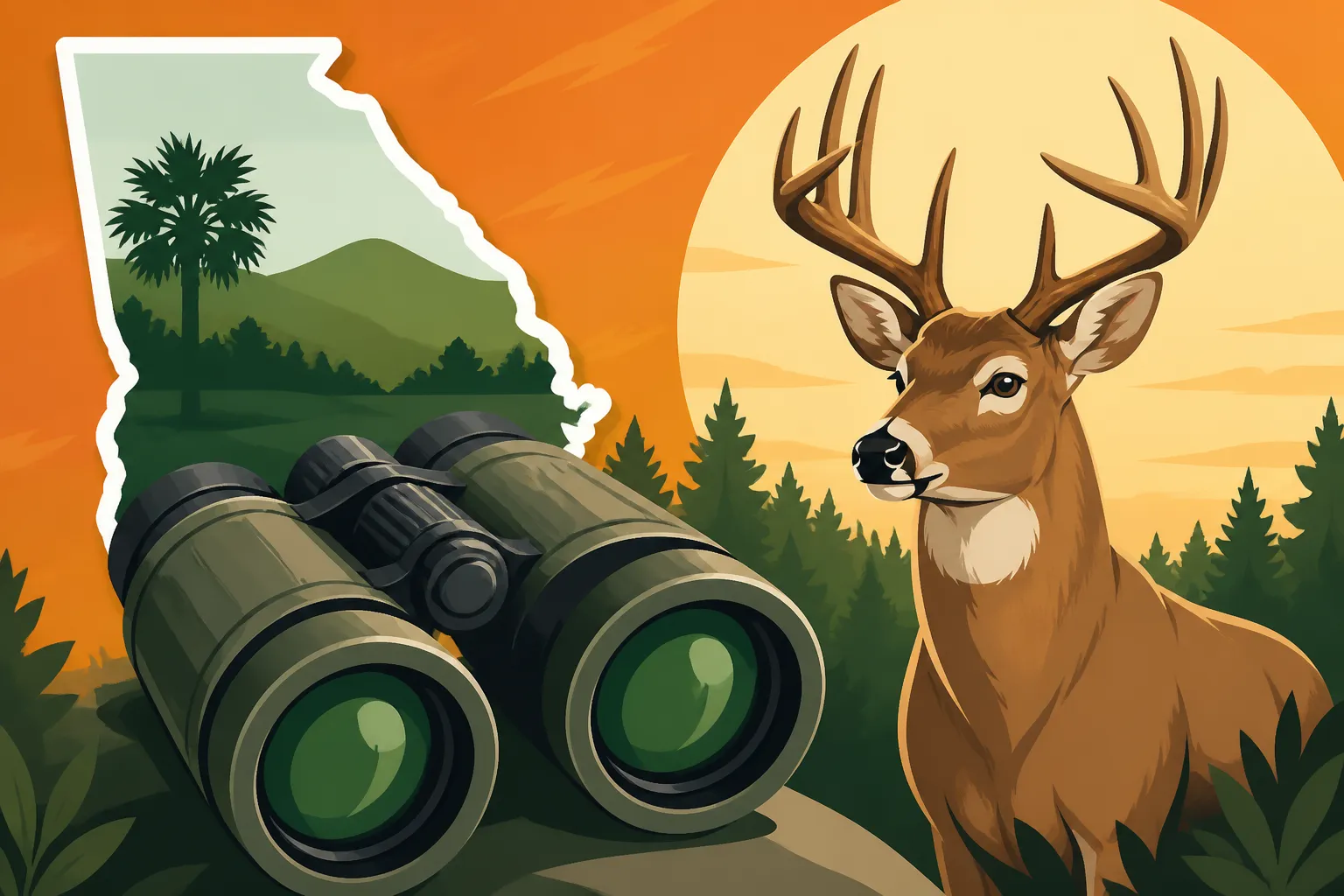
Binocular Choice for Georgia Whitetails
You're standing on the edge of a pine thicket, the pre-dawn mist hanging heavy, or perhaps peering into a dense North Georgia hollow. In either scenario, you know that spotting that flicker of an ear or the subtle shift of a deer's tail before it spots you is absolutely critical. But let's be honest, Georgia's diverse landscapes—from the sprawling open pines to the incredibly dense creek bottoms and mountain hardwoods—make choosing the right pair of binoculars feel like a guessing game. This guide is here to cut through the confusion and help you pick the perfect glass to get a clearer view of those elusive Georgia whitetails.
Understanding Georgia's Diverse Hunting Environments and Their Impact on Optics
Georgia is a state of incredible contrasts when it comes to hunting terrain, and what works beautifully in one region might leave you frustrated in another. The binoculars you choose really need to be suited to where you spend most of your time hunting, or versatile enough to handle a range of conditions if you travel across the state.
The Dense Canopy of North Georgia Mountains
Up in the Chattahoochee National Forest, you’re often dealing with steep, broken terrain, thick undergrowth, and a dense tree canopy that limits visibility. Sunlight struggles to penetrate, making for perpetually dim conditions, even in the middle of the day. You might be still-hunting along a ridge line, trying to pick apart shadows for deer movement, or sitting overlooking a steep hollow.
Here, long-range glassing is less common, and quick, efficient scanning for deer in relatively close quarters is paramount. Your sight lines are often restricted to 50-150 yards, sometimes even less. The frustration of trying to spot a bedded deer in a laurel thicket, only for it to melt away before you can get a positive identification, is real. You need optics that excel at gathering what little light is available and provide a wide field of view to scan effectively without constantly moving your head. Being able to quickly acquire your target and identify antlers amidst the branches is key.
South Georgia's Pine Plantations and Field Edges
Head south, and the landscape shifts dramatically. You'll find vast stretches of managed pine plantations, often with clear understories, interspersed with open fields of peanuts, corn, or soybeans. Here, your hunting might involve glassing long powerline cuts or agricultural fields from a distance, where spotting a deer at 300-500 yards is a real possibility. But then, just a few steps away, you could be peering into a dense clear-cut or a brushy field edge, where visibility quickly drops to 50 yards or less.
This presents a unique challenge: you need binoculars that can reach out and identify game across open spaces, but also perform when that big buck slips into the dense cover just off the field. The bright sun reflecting off open fields can also create mirage and glare, demanding good lens coatings. Whether you're scouting new areas or trying to locate deer feeding at last light, having the right blend of magnification and clarity is crucial. It’s a completely different ballgame than the mountains, where wide-open vistas are rare. When you’re trying to read movement along a distant field edge or pick apart a stand of longleaf pine, Glassing a Powerline Cut at Last Light becomes a common task that demands performance from your binoculars.
Humid Swamps and River Bottoms
Ah, the Georgia swamp. Picture yourself deep in a cypress slough, or walking a winding river bottom, where the air is thick with humidity, mosquitoes hum, and the light is always, always low. These environments are notorious for their challenging conditions for both hunter and gear. Fogging is a constant threat, and any piece of equipment that isn't fully waterproof is just asking for trouble.
In these dense, often dark habitats, your shots are likely to be up close and personal, and your primary goal with binoculars is to pick out deer in the gloom, through dripping foliage, and often against a busy background of shadows and water. It's not about spotting a deer a mile away; it's about discerning if that dark blob under the palmetto clump is a deer or just another stump. Durability and environmental resistance are paramount here, as your optics will be subjected to moisture, mud, and possibly accidental bumps against trees or waders. You need binoculars that can stand up to the elements and continue to perform without a hiccup, because when a deer suddenly appears in a small opening, you won’t have time for your lenses to clear. Often, these areas form natural travel corridors, making Hunting a Funnel Between Two Swamps a productive, yet optically challenging, endeavor.
Key Binocular Specifications for the Georgia Hunter
When you start looking at binoculars, you’ll quickly see a lot of numbers and terms thrown around. Don't let them overwhelm you! For Georgia hunting, a few core specifications really matter.
Magnification and Objective Lens Diameter
This is usually the first thing you see: two numbers, like 8×42 or 10×42. The first number (8x or 10x) is the magnification—how many times closer an object appears. The second number (42) is the diameter of the objective lens in millimeters, which dictates how much light the binoculars can gather. More light generally means a brighter, clearer image, especially in low-light conditions.
For most Georgia deer hunting, an 8x or 10x magnification is ideal. An 8x magnification offers a wider field of view, which is fantastic for quickly scanning dense timber or tracking a moving deer. It also tends to be more stable, with less noticeable hand shake, making it easier to hold steady. Many hunters feel an 8x is perfectly sufficient for the typical shorter distances encountered in Georgia's woodlands and can offer a significant advantage in low light due to its larger exit pupil (objective lens divided by magnification).
A 10x magnification, on the other hand, brings objects a bit closer, which can be a real benefit in more open country like South Georgia pine flats or across large food plots. The trade-off is a narrower field of view and a slightly dimmer image in low light, as well as more pronounced hand shake. If you do a lot of long-range glassing, a 10x might be your preference. It really boils down to your primary hunting style and the terrain you frequent most. For a more in-depth look, consider the discussion around 8×42 Versus 10×42 in the Woods.
Field of View and Eye Relief
Field of view (FOV) refers to the width of the area you can see through your binoculars at a specific distance, usually expressed in feet at 1,000 yards. A wider FOV is a huge advantage in Georgia's thick cover. Imagine trying to follow a running deer through dense woods with a narrow field of view; it's like looking through a straw! A wider FOV allows you to scan larger areas quickly and acquire targets faster, which is invaluable when a deer suddenly appears or moves through heavy brush. This is often tied to magnification; generally, lower magnification binoculars will have a wider field of view.
Eye relief is the distance your eye can be from the eyepiece and still see the full, unvignetted image. This is particularly important for hunters who wear eyeglasses or sunglasses. If the eye relief is too short, you’ll have to press your glasses against the eyepieces, which can be uncomfortable and inconvenient. Good eye relief, typically 15mm or more, allows you to comfortably use your binoculars while wearing your corrective lenses, preventing that annoying "tunnel vision" effect. Many binoculars feature adjustable eyecups that twist up or down, allowing you to customize the eye relief for your needs.
Prism Type and Lens Coatings
The prism system inside your binoculars is responsible for turning the image right-side up and magnifying it. The two main types are Porro prisms and Roof prisms. Porro prism binoculars have that classic, wider shape, where the objective lenses are offset from the eyepieces. They tend to offer a slightly brighter image and a wider field of view for their cost. However, they are generally bulkier and less robust.
Roof prism binoculars are more compact and streamlined, with the objective lenses and eyepieces aligning in a straight line. This design makes them more durable and easier to handle, but they typically require more advanced optical coatings to achieve comparable image quality to Porros. For the rough-and-tumble nature of Georgia hunting, many prefer the sleeker, tougher design of roof prisms.
Lens coatings are critically important. They reduce glare and light loss, ensuring maximum light transmission through the lenses, which results in a brighter, sharper image with better contrast. Look for terms like "fully multi-coated." This means all air-to-glass surfaces have multiple layers of anti-reflective coatings. These coatings are what make the difference between a hazy, dull image and a crisp, vibrant one, especially when you're trying to pick out deer in the dark timber of a swamp or at the very edges of legal shooting light. They also help combat Fogging Optics in Georgia Humidity by preventing moisture build-up on the lens surface.
Durability, Ergonomics, and Other Essential Features
Beyond the core optical performance, how your binoculars feel in your hands, how well they withstand the abuse of the elements, and their practical features can make or break your hunting experience in Georgia.
Waterproofing and Fog Proofing
Let's be real: Georgia weather is unpredictable. One minute it's sunny and humid, the next a pop-up thunderstorm rolls through, or you find yourself slogging through a creek. This isn't just an annoyance; it's a real threat to your optics. Condensation can form inside binoculars that aren't properly sealed, making them unusable. That's why true waterproofing and fog proofing are non-negotiable for Georgia hunters.
Look for binoculars that are "O-ring sealed" and "nitrogen or argon purged." O-ring seals prevent moisture, dust, and debris from entering the housing, while purging with an inert gas like nitrogen or argon prevents internal fogging as temperatures change. This means you can drop them in a puddle (within reason, of course!), get caught in a downpour, or move from a warm truck to the cold morning air, and your view will remain crystal clear. Never settle for "water-resistant" in Georgia; demand fully waterproof and fog-proof optics.
Weight and Ergonomics for All-Day Carrying
A pair of binoculars is only useful if you actually carry them and use them. If they're too heavy or uncomfortable, they'll end up rattling around in your pack instead of being around your neck or chest where they belong. Consider the terrain you'll be covering. If you're going to be putting in serious miles hiking deep into public land, or navigating tough swamp terrain, every ounce counts. Lighter binoculars are a blessing on long treks.
Ergonomics also play a huge role. Do they fit comfortably in your hands? Can you easily reach the focus wheel with one hand? Are the diopter adjustment and eyecups easy to manipulate? Good ergonomics mean less fatigue and more effective glassing. Many hunters opt for a binocular chest harness over a traditional neck strap. A good chest harness distributes the weight across your shoulders and chest, keeping the binoculars secure and preventing them from swinging around, while also keeping them instantly accessible. It’s a game-changer for comfort, especially when you’re carrying other gear or traversing challenging terrain, like when using Packs Built for a Chattahoochee Day Hunt.
Close Focus and Diopter Adjustment
While we often think of binoculars for long-range glassing, a good close focus distance can be surprisingly useful in Georgia's tight quarters. Sometimes, a deer might pop up much closer than you expect, or you might want to examine a rub, scrape, or track at arm's length. A close focus of 6-8 feet or even less allows you to get a sharp image of objects nearby, which adds to the versatility of your optics.
The diopter adjustment is a small, often overlooked, but crucial feature. It's usually a small ring on one of the eyepieces (typically the right one) that allows you to compensate for differences in vision between your two eyes. Most people have slight variations in their eyesight, and without a proper diopter adjustment, your binoculars won't be perfectly in focus for both eyes simultaneously, leading to eye strain and a less clear image. To set it, cover the objective lens of the eye with the diopter (e.g., the right lens), focus on a distant object using only your left eye and the main focus wheel. Then, switch, cover the left objective lens, and adjust the diopter ring (right eyepiece) until the image is sharp for your right eye. Once set, you only use the main focus wheel for both eyes.
Matching Binoculars to Your Georgia Hunting Style
There's no single "best" binocular for every Georgia hunter, but there's definitely a "best" one for your specific hunting style and the places you tend to hunt.
Still-Hunting and Stalking in Thick Cover
If your preferred method is to move slowly and deliberately through the woods, stopping frequently to scan and listen—what we often call still-hunting—then you'll want binoculars that prioritize a wide field of view and excellent low-light performance. In dense areas, you're constantly scanning for subtle movement, a horizontal line in a vertical world, or a patch of hide. High magnification isn't as critical because your shot opportunities are likely to be closer, and a narrow field of view will only hinder your ability to pick up movement quickly.
An 8×42 binocular is often the perfect choice for this style. The 8x magnification provides a generous field of view, making it easier to scan broad swaths of timber and quickly locate animals that might only be partially visible. The 42mm objective lens ensures plenty of light-gathering capability, which is essential when you're working through shadowed creek bottoms or deep pine stands. It also tends to be lighter and more compact, which is a blessing when you're carrying it all day. When you're Still-Hunting South Georgia Pine Flats, you'll appreciate the quick scanning ability and broad view.
Stand Hunting Over Food Plots or Clear-Cuts
For hunters who spend a lot of time in a treestand or ground blind overlooking larger areas like food plots, agricultural fields, or extensive clear-cuts, the priorities shift slightly. Here, you often have the luxury of sitting stationary for extended periods, and your objective might be to identify a buck at considerable distance. You want to be able to study an animal, determine antler size, and assess its movement patterns across a broader landscape before it gets into shooting range.
In these scenarios, a 10×42 binocular can offer a significant advantage. The increased magnification helps you pull distant objects closer, allowing for better antler identification and assessment. While the field of view is slightly narrower, you're typically not constantly scanning and moving as much as a still-hunter, so the trade-off is often acceptable. The 42mm objective lens still provides ample light-gathering, which is important for those crucial first and last minutes of daylight. It’s also worth considering image stability; if you're in a fixed position, you can often brace your elbows or use a tripod adapter to minimize hand shake. If you’re patiently waiting for deer on a Hunting a Green Field Planted for Deer, that extra magnification will really help.
Public Land Considerations and Budgeting
Hunting Georgia's public lands, whether it's a WMA or the National Forest, presents its own unique set of challenges. These areas often see higher hunting pressure, and deer can be notoriously cagey. Finding those hidden pockets and identifying quality animals often requires extensive scouting and careful observation. For hunters working within a budget, the price of quality optics can sometimes feel overwhelming, but investing in good glass is truly investing in your success and enjoyment.
When choosing binoculars for public land, prioritize durability and optical clarity within your price range. You'll likely be covering more ground, encountering rougher conditions, and relying heavily on your optics for identifying game at varied distances. While top-tier binoculars can be expensive, many reputable brands offer excellent mid-range options that provide fantastic performance without breaking the bank. Platforms like GoHunt can be great resources for researching different models and reading reviews from other hunters who use them in similar terrain. Don't be afraid to read up and learn about what features truly matter for your specific needs, especially when you're Scouting Georgia Public Land Before Season. This investment will pay dividends in identifying game that others might miss, giving you an edge on pressured land. Understanding the typical Hunting Pressure on Georgia Public Land helps inform your gear choices, pushing you to maximize every advantage.
Maintenance and Care for Longevity in Georgia's Climate
You've invested in a good pair of binoculars, but in Georgia's sometimes harsh environment, that investment won't last without proper care. Our unique blend of humidity, dust, and unpredictable weather can be tough on optics.
Cleaning Your Optics in the Field and at Home
It's going to happen: dust, pollen, fingerprints, even mud splatter will end up on your lenses. The worst thing you can do is wipe them with your shirt or a rough cloth, which can scratch the delicate lens coatings. Always carry a lens pen, a soft microfiber cloth, and a small blower brush in your pack.
In the field, use the blower brush to gently remove any loose dust or debris. Then, use the lens pen's brush end, followed by the soft cleaning tip, with gentle circular motions. For stubborn smudges or water spots, a small drop of lens cleaning solution specifically designed for optics on your microfiber cloth (never directly on the lens) can work wonders. At home, give them a more thorough cleaning after a particularly dirty or wet hunt. Make sure to clean the eyecups and housing as well, wiping off any mud or grime before storage.
Storage and Preventing Mildew
Georgia's high humidity is a prime culprit for mildew growth and can wreak havoc on any gear stored improperly. After a hunt, never, ever put your binoculars away wet or even damp. Take them out of your pack or harness, wipe them down, and let them air dry thoroughly, preferably in a dry, well-ventilated area, before putting them back in their case or storage spot.
Consider using desiccant packs (like silica gel packets) in your binocular case, especially if you store them for extended periods in a closet or shed where humidity might be high. Replacing these packs periodically, or reactivating them by baking them at a low temperature, can help absorb excess moisture and prevent mildew from forming on the housing or, worse, inside the lenses. Proper storage is crucial for the long-term health and clarity of your optics.
Warranty and Customer Service
Let's face it, accidents happen. You might drop your binoculars, or they might take an unexpected tumble from a treestand. Even the most durable optics can suffer damage. That's why a robust warranty and reliable customer service are just as important as the optical quality itself. Before you make a purchase, research the manufacturer's warranty policy.
Some companies offer lifetime warranties, even covering accidental damage, while others have more limited terms. Understanding what's covered (and what's not) can save you a lot of headache and money down the road. Read reviews not just about the product, but also about the company's customer service experience. A company that stands behind its products and offers prompt, helpful service is invaluable. Given the investment in quality glass, knowing that you're covered if something goes wrong provides immense peace of mind, allowing you to focus on the hunt rather than worrying about your gear.
Disclaimer
This article is for general informational purposes only and does not constitute professional advice. Laws, prices and regulations vary by location and change over time. Consult a qualified professional for guidance on your specific situation.