Hunting a Green Field Planted for Deer
We've all been there: staring at dense Georgia woods, wondering where the deer are and why they aren't where you expected them to be. Deer movement can feel like a complete mystery sometimes, especially when natural food sources are abundant or scarce. But what if you could create a consistent, irresistible draw right where you want them? That's exactly the promise of a green field planted specifically for deer, and this guide will walk you through how to hunt them effectively in the Peach State.
The Allure of Green Fields for Georgia Deer Hunters
There's something incredibly satisfying about watching deer pour into a lush green field you've helped cultivate. It's not just about providing food; it's about creating a predictable pattern in an otherwise unpredictable environment. In Georgia, where natural forage can vary wildly from one year to the next due to weather, timbering, or acorn crops, a well-maintained green field can be an absolute game-changer.
Why Deer Gravitate to Planted Forages
Deer are creatures of habit, driven by their stomachs and their need for security. Green fields offer a concentrated, highly palatable food source that's often more nutritious than much of the native browse, especially during certain times of the year. Think about it: a deer doesn't have to wander far, expending precious energy, to find a belly full of tender clover or tasty winter wheat. This efficiency draws them in, often multiple times a day.
Beyond just the nutritional value, these planted areas can serve as crucial staging points before deer head to bedding areas, or as a final pit stop before they move off to more secure cover after a morning graze. In many parts of Georgia, especially where timber operations have created vast clear-cuts or where mature hardwoods have seen a poor mast crop, these planted fields can be the only consistent, high-quality food available. This makes them particularly potent during the late-season January rut lull when other food sources have dwindled.
Understanding Different Green Field Types
Not all green fields are created equal, and understanding the different types can greatly impact your hunting strategy. The climate and soil in Georgia allow for a wide variety of plantings, each with its own benefits and peak attractiveness to deer.
- Cereal Grains: Wheat, oats, and rye are incredibly popular because they're relatively easy to grow, establish quickly, and are highly attractive to deer throughout the fall and winter. They can withstand heavy browsing and grow in a wide range of soil conditions, making them a staple for many hunters. These are often the go-to for hunters looking to provide a reliable food source from early archery season right through to the end of the firearms season.
- Clovers and Chicory: These perennial options are fantastic for long-term food plots. They offer high protein content, are drought-tolerant once established, and can last for several years, reducing the need for annual replanting. Deer absolutely love the palatability of clover and chicory, making them a hot spot, especially during the earlier, warmer parts of the season. Brands like Tecomate and Mossy Oak BioLogic offer excellent perennial blends that can thrive in Georgia.
- Brassicas: Think radishes, turnips, and kale. These plants provide excellent forage, especially as temperatures drop. The leaves are attractive, but the real draw often comes after the first hard frost, when the plant's starches convert to sugars, making the bulbs and leaves incredibly sweet and irresistible to deer. These are powerhouse plots for the late season when other food sources are scarce.
- Legume/Grain Mixes: Many hunters opt for mixes that combine the best of both worlds – fast-growing grains for early attraction and slower-growing legumes or brassicas for sustained appeal into the colder months. This diversification ensures a food source is available for a longer period, making your plot more consistent.
Each of these types of forage will attract deer differently depending on the time of year and available natural food sources. A good strategy often involves having a variety of smaller plots with different plantings to offer deer a buffet throughout the season.
Scouting and Preparing Your Green Field Hunt
You can plant the most perfect green field, but if you don't scout it properly and prepare your hunt meticulously, you might as well be hunting an empty cornfield. Deer are smart, and they'll quickly pattern human intrusion. The goal is to maximize your chances while minimizing your impact.
Reading Deer Sign Around the Edges
The green field itself is only part of the puzzle. The real story lies in the edges – where the planted forage meets the timber, thickets, or other cover. This transition zone is where deer feel most secure as they move into and out of the open. When you're Scouting Georgia Public Land Before Season, pay close attention to fresh tracks leading into the field, worn trails, droppings, and rubs or scrapes along the treeline.
Look for entry and exit points. Are deer entering from a particular thicket on the north side, or do they prefer the creek bottom that runs along the west? These preferred pathways are gold mines for stand placement. A good tool like GoHunt can help you overlay aerial maps with topographical data to identify these natural funnels and pinch points where deer are likely to travel as they approach the field. Don't just look for sign in the field; focus on the trails leading to it and the small pockets of cover just inside the timber that deer might use to stage before stepping out.
Optimal Stand and Blind Placement
Once you've identified key entry and exit points and preferred feeding zones within the field, it's time to think about where you'll set up. This is arguably the most critical step. Your stand or blind needs to offer a clear shot at expected deer movement while keeping you hidden and scent-controlled.
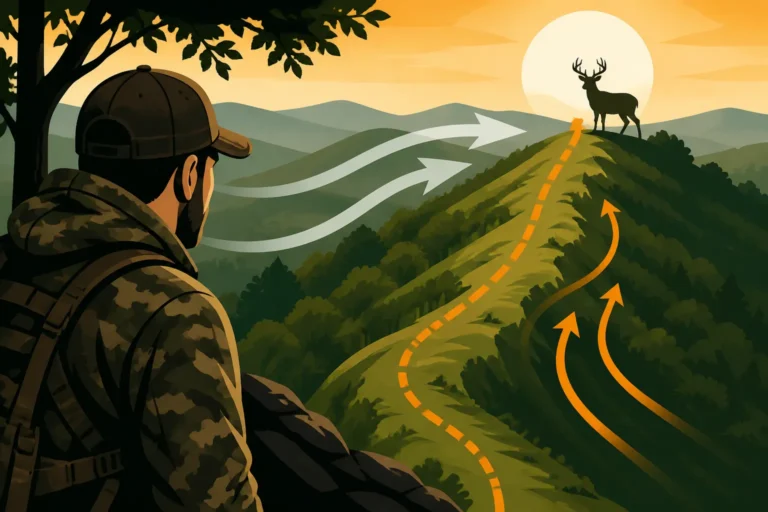
For elevated stands, focus on dominant trees along the downwind side of the primary entry trails. Remember, the wind is your enemy, so always try to hunt with the wind blowing your scent away from where you expect deer to approach and feed. Consider the sun's position: an evening hunt means the setting sun won't be in your eyes, but it might be in the deer's, giving you an advantage. For more open field edges, a Setting Up on a Piedmont Field Edge approach will differ from a swamp edge.
If you're opting for a ground blind, brush it in thoroughly several weeks before you plan to hunt it. This gives deer time to get accustomed to its presence and helps break up its outline. Position ground blinds facing away from the rising or setting sun to avoid glare. Always ensure you have shooting lanes clear for your chosen weapon.
Managing Your Entry and Exit Routes
This is where many hunts go wrong. You can have the perfect stand in the perfect spot, but if you spook deer on your way in or out, you've essentially educated them and ruined the spot for future hunts. Your entry and exit routes must be as stealthy as possible.
Plan to approach your stand from a direction that keeps the wind in your face or crosswind, carrying your scent away from the field. Use natural terrain features like creek beds, ditches, or dense timber to shield your movement. If possible, avoid walking directly through the green field itself, especially when there's dew or frost that can leave a visual trail or carry your scent further.
When leaving, wait until it's completely dark or until the field is empty of deer. If you bump deer on your way out, they'll associate that field with danger. Sometimes, it's better to wait an extra 30 minutes in the stand than to blow out a hot spot. Think like a deer: where would you feel safest entering and exiting this area without being detected? GoHunt's mapping features can be incredibly helpful for meticulously planning these routes, allowing you to mark obstacles, prevailing winds, and potential deer staging areas.
Effective Hunting Strategies for Green Fields
Hunting over a green field isn't just about showing up and sitting down. It requires strategic timing, adaptability, and an understanding of deer behavior.
Timing Your Hunts for Peak Activity
Deer, especially mature bucks, are most active during low-light conditions – dawn and dusk. This is particularly true in open areas like green fields where they feel exposed. Aim to be in your stand or blind well before first light in the morning and stay until after legal shooting light in the evening.
During the early archery season, or even during the Georgia's Long Firearms Deer Season, deer might feed in green fields at any time if hunting pressure is low or during inclement weather. However, for consistent success, those prime low-light hours are your best bet. If you're hunting during the peak of the rut, say Hunting the Rut in Mid-October, bucks might cruise the edges of green fields at any time of day, scent-checking for does, adding another layer of complexity and opportunity. Keep an eye on local deer harvest reports, as they can sometimes indicate peak movement times for specific regions.
Adapting to Weather and Wind Conditions
Weather plays a huge role in deer movement, and green fields are no exception. A cold front sweeping through Georgia often triggers increased feeding activity as deer try to pack on calories. Similarly, a drizzly, overcast day can encourage deer to move earlier and stay out longer than on a bright, sunny day.
The wind, however, is your absolute biggest concern. As discussed earlier, always hunt with the wind in your favor. If the wind direction changes unexpectedly, or if it's consistently blowing your scent towards the primary deer entry points, it's often better to pack up and hunt another spot or wait for a different day. You're better off not hunting a prime spot than to hunt it incorrectly and educate the deer. Use weather apps with wind forecasts, and even carry a small bottle of powder or milkweed seeds to check swirling winds while on stand, especially when hunting around varied terrain like a "Wind and Thermals on a Mountain Ridge" scenario, which might affect nearby fields.
Ethical Shot Placement in Open Settings
Green fields often present longer shot opportunities, which is both a blessing and a curse. It's a blessing because you might have more time to assess the deer and make a clean shot. It's a curse because it can tempt you to take a shot beyond your comfortable range.
Know your limits and the limits of your weapon. Whether you're bowhunting or using a rifle, practice at realistic field distances. Aim for the vitals – the lungs and heart – for a quick, ethical kill. If a deer is quartering away, aim for the opposite shoulder. If it's broadside, aim just behind the shoulder, slightly low. Avoid neck or head shots unless you are an expert marksman at that exact distance; these often result in wounded, unrecoverable animals.
Always use a rangefinder to confirm the exact distance before you draw your bow or raise your rifle. What looks like 40 yards might be 60, and that can make all the difference. Remember, a quick, clean kill is always the priority.
Common Pitfalls and Advanced Tips for Green Fields
Even with the best intentions and preparation, hunting green fields can have its challenges. Knowing what to look out for and how to adapt can turn a frustrating hunt into a successful one.
Over-Pressuring Your Hunting Spot
This is perhaps the biggest mistake hunters make with green fields, especially on smaller private tracts or easily accessible public land parcels. It's tempting to hunt a hot green field every chance you get, but deer are incredibly sensitive to pressure. Frequent human presence, especially if you're bumping deer, will quickly turn a prime feeding area into a nocturnal zone.
The solution is restraint. If you have multiple green fields, rotate your hunting spots. If you only have one, limit your hunts to once or twice a week, or only when conditions (wind, weather, deer activity) are absolutely perfect. Think about it: if you hunt a field every evening for a week, you're essentially training deer to avoid it during daylight hours.
Sometimes, it's better to observe from a distance using good optics or trail cameras than to physically be in the stand. This allows you to gather intelligence without introducing pressure. When combined with other food sources, like a Late-Season Food Sources for Georgia Whitetails plot nearby, you can spread out your pressure effectively.
Combining Green Fields with Other Food Sources
While green fields are powerful attractants, they rarely exist in a vacuum. The most successful hunting strategies integrate green fields with other food sources and cover types. For instance, a green field might be the primary evening destination, but deer might bed in an adjacent thicket or browse acorns in a nearby hardwood bottom during the day.
Consider the time of year and what natural food sources are available. During a bumper acorn crop year, deer might spend less time in green fields in early fall. However, Hunting After a Poor Acorn Year makes green fields even more vital. By understanding the full spectrum of food sources in your hunting area, you can better predict deer movement patterns and position yourself strategically. Use aerial imagery, perhaps through a GoHunt app, to identify these diverse habitats and how they connect to your green fields.
A strategic approach could involve setting up a "transition stand" between a green field and a bedding area, or near a water source. This allows you to catch deer moving during daylight hours when they might be hesitant to step out into the open field.
Green Field Planting and Usage Calendar
To maximize your success, it's helpful to plan your green field plantings to provide food throughout the season. Here's a general guide for Georgia:
| Planting Type | Ideal Planting Window | Primary Attractiveness Period | Key Benefits |
|---|---|---|---|
| Winter Wheat/Oats/Rye | Late August – Early October | Mid-Fall through Winter (September – February) | Easy to establish, grows quickly, high carbohydrate, very hardy |
| Clover/Chicory | Early Spring or Late Summer/Early Fall | Year-round, especially Spring/Summer and Early Fall | Perennial (multi-year), high protein, drought tolerant |
| Brassicas (Turnips, Radishes) | Late July – Early September | Late Fall through Winter (October – March, post-frost) | Highly palatable after frost, excellent late-season energy source |
| Annual Forage Mixes | Late August – Early October | Early Fall through Winter (September – February, varied appeal) | Provides diverse forage, covers longer periods, balances nutrients |
Remember, soil tests are crucial before planting to ensure optimal growth and attraction. A healthy, vigorous green field is far more effective than a struggling one.
Disclaimer
Hunting is an inherently dangerous activity. Always follow all local, state, and federal hunting regulations. Prioritize safety by using appropriate gear, understanding your weapon, and maintaining awareness of your surroundings. Consider taking a hunter education course, and if hunting with an apprentice license, ensure your mentor is always present as per Georgia law. Always ensure you have the proper licenses and permits before heading into the field.