Choosing a Boat for Night Alligator Hunts
Venturing out onto Georgia's waterways under the cloak of night to pursue alligators is an experience unlike any other, thrilling and challenging in equal measure. But before you even think about spotting those tell-tale red eyes, one of the most critical decisions you'll face is choosing the right boat. This isn't just about getting from point A to point B; your vessel is your hunting platform, your recovery vehicle, and your lifeline in unfamiliar, often treacherous, nighttime environments. This guide will walk you through the essential considerations for selecting a boat that can stand up to the unique demands of a Georgia night alligator hunt.
Understanding the Unique Demands of Night Alligator Hunting in Georgia
Night alligator hunting in Georgia isn't your average fishing trip or a casual cruise. It's an intense, specialized pursuit that places very specific demands on your equipment, and especially on your boat. You're operating in low light, often in areas that are tricky even during the day, and you're dealing with a powerful, potentially dangerous animal. The wrong boat can turn an exciting adventure into a frustrating, or even perilous, ordeal.
Navigating Shallow Water and Dense Vegetation
Georgia's alligator habitats are incredibly diverse, ranging from wide-open rivers to dense cypress swamps and shallow marshlands. Many of the most productive hunting areas for alligators are not deep, navigable channels. Instead, you'll find yourself pushing through thick stands of reeds, weaving around cypress knees, and crossing vast stretches of water barely deep enough to float a boat. This makes a shallow draft absolutely essential.
Imagine trying to navigate a standard V-hull bass boat through a dense field of lily pads or over a sandbar that only has six inches of water covering it. You'd be constantly getting stuck, chewing up your propeller, or worse, damaging your hull. A good alligator boat needs to be able to skim over obstacles, draw minimal water, and be tough enough to withstand occasional impacts with submerged timber or oyster beds. This ability to get into those hard-to-reach, shallow pockets is often the difference between success and coming home empty-handed.
Stability and Space for Handling a Harvested Gator
Once you've located and secured an alligator, the real challenge often begins: bringing it into the boat. This is not a task for a flimsy or cramped vessel. Alligators, even when dispatched, are heavy, powerful animals that require significant effort to manage. You need a boat that offers exceptional stability, minimizing rocking and swaying as you and your hunting partners work together.
Think about the dynamics: one person might be using a snatch hook, another managing a harpoon, and a third preparing the restraint gear. All of this requires ample, clear deck space where you can move freely and safely without tripping over equipment or feeling confined. Moreover, once the alligator is onboard, it will occupy a substantial amount of room. The boat must have enough length and width to accommodate a large reptile, allowing it to be secured properly for the journey back to the ramp. Having designated areas for all your specialized gear, from harpoons and ropes to coolers for smaller game, is also crucial to maintain a clear and safe working environment. The last thing you want is a crowded boat when you're wrestling with a powerful animal. You'll want to review resources like Landing an Alligator From a Small Boat to understand the space requirements more fully.
Noise Considerations and Stealth
Alligators are incredibly sensitive to vibrations and sound, especially at night. A noisy boat can spook them long before you get within range, ruining your chances of a successful stalk. This means your choice of engine, hull material, and even how you store your gear, all play a role in your stealth. Loud engines, clanging equipment, or a hull that amplifies every bump and scrape can make alligator hunting significantly more difficult.
Many experienced hunters prioritize quiet operation above almost everything else. This might mean opting for a surface-drive mud motor that can throttle down to a barely audible idle, or choosing a hull design that minimizes wave slap. Some even use electric trolling motors for the final approach to minimize disturbance. The ability to glide silently through the water, allowing you to get close without alerting your quarry, is a massive advantage in night hunting. This silent approach is even more important when you're trying to spot them with a spotlight, as sudden noise can send them diving before you get a clear look.
Common Boat Types for Georgia Alligator Hunts
When it comes to picking a boat for chasing gators after dark in Georgia, you've got a few main contenders, each with its own set of pros and cons. Understanding these differences will help you align your vessel with your hunting style and the specific habitats you plan to explore. There's no single "best" boat, but there's definitely a "best for you" boat.
Jon Boats: The Workhorse of the Swamps
Jon boats are, without a doubt, one of the most popular choices for alligator hunting in Georgia, and for good reason. These flat-bottomed, open boats are the true workhorses of the swamps and shallow rivers. Their flat bottom design allows for an incredibly shallow draft, letting you glide over submerged logs and through skinny water where other boats would quickly get hung up. This is absolutely critical when you're trying to access those secluded pockets where the big gators often lurk.
Their simple, open layout provides a spacious, uncluttered deck, which is invaluable when you're trying to manage ropes, harpoons, and, eventually, a large alligator. The stability offered by their wide, flat bottoms is also a huge advantage; you need a solid platform when you're working with a powerful animal onboard. Many hunters opt for an all-welded aluminum jon boat for its durability against impacts from stumps and rocks. When paired with a reliable outboard or a surface-drive mud motor, a jon boat becomes an incredibly versatile and tough hunting machine. Just remember, while great in shallow water, they can be a bit bumpy in choppy conditions on larger lakes or rivers, which isn't always a primary concern for typical gator hunting grounds but something to be aware of.
Airboats: Powering Through the Impassable
If you're looking to literally fly over obstacles that would stop any other vessel dead in its tracks, an airboat is your answer. These incredible machines are designed for extreme shallow water and dense vegetation, capable of traversing mudflats, marsh grass, and even dry ground for short distances. In certain remote, thick areas of the Okefenokee Swamp or other impenetrable marshlands, an airboat isn't just an advantage, it's often the only way to effectively hunt alligators.
The propeller-driven engine mounted high on the stern keeps all propulsion components completely out of the water, eliminating concerns about prop damage from submerged debris. This means you can pursue alligators in habitats that are simply inaccessible to any other boat type. However, airboats come with significant drawbacks. They are incredibly loud, which requires careful planning for stealthy approaches, often involving shutting down the main engine and using trolling motors or poling for the final approach. They are also considerably more expensive to purchase and maintain, and they have a steeper learning curve for safe operation. Fuel consumption can be substantial, and their size can make trailering and launching a bigger chore. Despite these factors, for those tackling the most extreme environments, an airboat is king.
Smaller Skiffs and Canoes: Niche Applications
While not as common for general alligator hunting, smaller skiffs and canoes can have their place in very specific scenarios. A small, stable skiff might be suitable for an individual hunter targeting smaller alligators in a very limited, easily accessible pond or backwater. Their maneuverability in tight spaces and relatively quiet operation can be an asset. Similarly, a heavy-duty canoe or kayak, particularly those designed for fishing or hunting, could be used for extremely stealthy approaches in very shallow, narrow waterways where even a jon boat might struggle.
However, the limitations here are significant. The lack of stability and limited deck space make handling a large alligator an extremely risky proposition. Recovery of a significant-sized gator would be difficult and dangerous, if not impossible, from such a small craft. They also lack the power to cover large areas or fight strong currents. These options are generally reserved for highly specialized, small-scale operations by very experienced individuals who fully understand the inherent risks and limitations. If you’re considering Bowfishing Tactics for Georgia Alligators in a tight spot, a smaller craft might seem appealing, but always prioritize safety and capability.
Key Features and Considerations When Choosing Your Gator Boat
Once you've got a general idea of the type of boat you're leaning towards, it's time to drill down into the specific features that will make or break your night alligator hunting experience. These aren't just minor details; they are fundamental aspects that impact safety, efficiency, and ultimately, your success on the water.
Hull Material and Durability
The environment you'll be hunting in is often unforgiving. Submerged logs, cypress knees, sandbars, and even oyster rakes are common hazards that can wreak havoc on an unprotected hull. This is why hull material and construction are paramount. Most dedicated alligator boats are made from either aluminum or fiberglass.
Aluminum hulls, especially those that are all-welded, are highly favored for their durability and impact resistance. They can take a serious beating from stumps and rocks without compromising integrity. They're also generally lighter than fiberglass, which contributes to a shallower draft and easier trailering. However, aluminum can be noisy; sounds echo through the hull, and it can dent if struck hard enough. Fiberglass hulls, while offering a smoother, quieter ride and often more refined interior finishes, are typically heavier and more prone to catastrophic damage from sharp impacts. A puncture in fiberglass is a much bigger problem than a dent in aluminum. For the rough-and-tumble world of alligator hunting, a robust, thick-gauge, all-welded aluminum jon boat often strikes the best balance of toughness, practicality, and longevity. You might use an app like GoHunt to scout the terrain and identify potential underwater hazards, which can help inform your hull material choice.
Engine Type and Propulsion
Your engine choice is as critical as your hull, determining how you navigate those challenging waters. The two primary categories for alligator boats are outboards and surface-drive mud motors.
Outboard motors are common, but for true shallow-water performance, you'll want to consider a jet drive outboard. Instead of a propeller, these engines suck water into an impeller and force it out the back, allowing you to run in incredibly shallow water (often just a few inches deep) without fear of prop damage. They are excellent for sandy or rocky bottoms but can struggle in heavy vegetation where the intake might clog. The downside is typically a loss of horsepower compared to a prop-driven counterpart, and they are generally less fuel-efficient.
Surface-drive mud motors (like those from brands such as Gator-Tail or Pro-Drive) are a game-changer for thick vegetation and extremely shallow, muddy conditions. These engines are designed to push the boat by having the propeller run partially submerged behind the transom, essentially chewing through mud, weeds, and stumps. They offer incredible traction and can navigate areas where even a jet drive would bog down. They are robust, built for abuse, and many models offer instant reverse, which is invaluable for maneuvering in tight spots. While they can be louder than traditional outboards, their ability to get you into the heart of gator country is unmatched. When considering which engine, think about the specific waters where you'll be pursuing American Alligators in Georgia.
Lighting, Storage, and Safety Gear
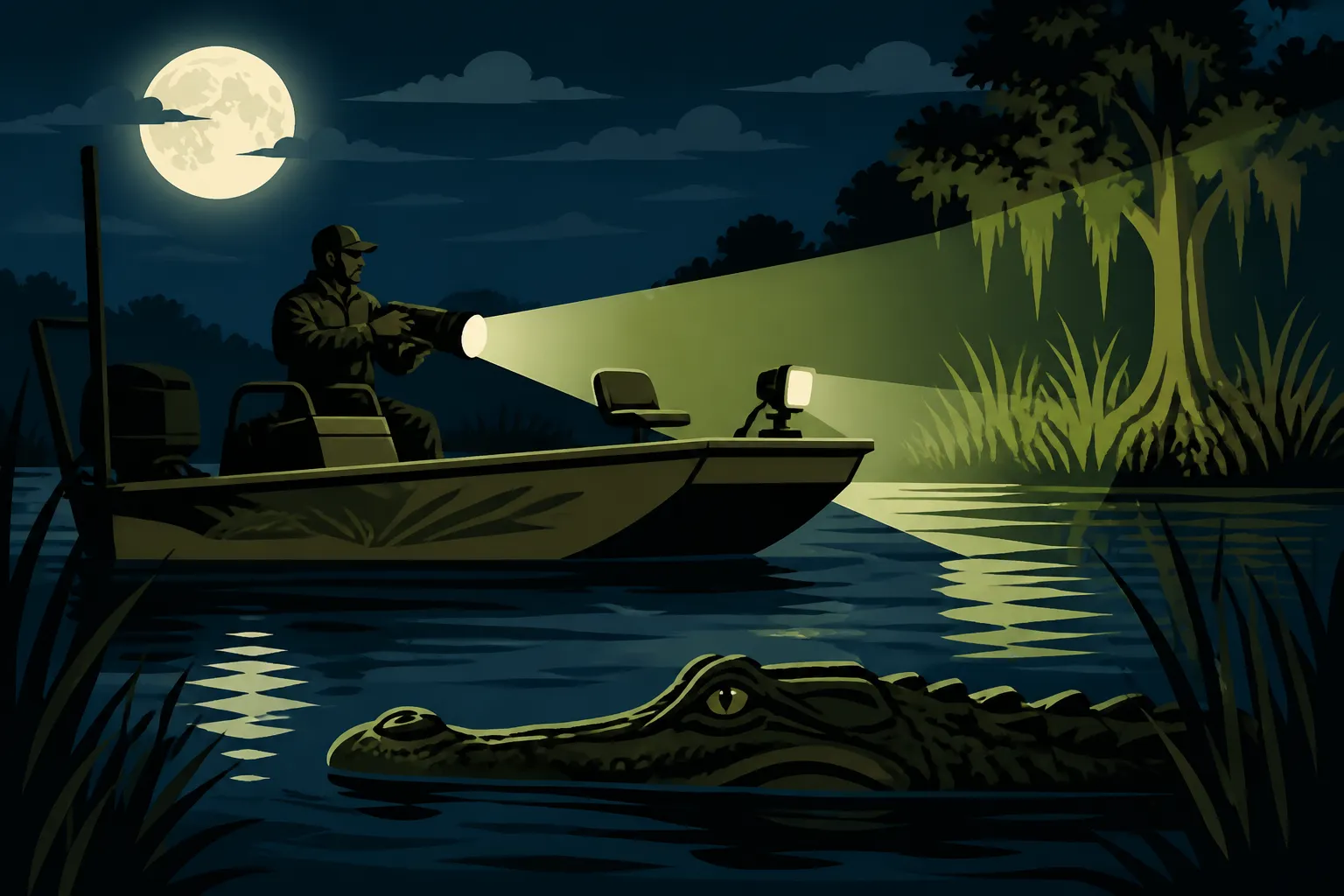
Night hunting is inherently more dangerous than day hunting, and adequate lighting is non-negotiable. You'll need a powerful, robust spotlight mounted on the bow for spotting alligator eyes, as well as dependable navigation lights. Beyond that, consider auxiliary LED light bars for general deck illumination when handling gear or an alligator. Red or green LED strips can also be useful for ambient light that preserves your night vision.
Storage is another key element. You'll be carrying specialized tools like harpoons, snatch hooks, ropes, gaffs, and firearms. All of these need secure, easily accessible storage that keeps them out of the way but ready for instant use. Dry storage compartments for electronics, extra clothing, and first-aid kits are also vital, given the humid, often wet environment.
Finally, safety gear must be top-tier. Personal flotation devices (PFDs) for everyone on board are an absolute must. A comprehensive first-aid kit, a marine radio or satellite communicator (cell service can be spotty in remote areas), fire extinguisher, air horn, and spare kill switches are all critical. A well-maintained boat with all the right safety equipment dramatically reduces risk and improves the overall experience of Alligator Hunting in Georgia.
| Boat Type | Primary Habitat Suitability | Shallow Water Performance | Maneuverability in Tight Spots | Stability for Handling Gator | Noise Level | Cost (Initial/Maintenance) |
|---|---|---|---|---|---|---|
| Jon Boat | Rivers, lakes, swamps, open marsh | Excellent | Good | Excellent | Moderate | Moderate |
| Airboat | Dense vegetation, mudflats, extreme shallow | Superior | Good | Good | Very High | High |
| Small Skiff | Small ponds, very narrow waterways | Very Good | Excellent | Fair to Poor | Low | Low to Moderate |
| Canoe/Kayak | Extremely narrow, pristine waterways | Excellent | Superior | Poor to Fair | Very Low | Low |
Practical Tips for Outfitting Your Chosen Vessel
Once you've selected your ideal boat for night alligator hunts, the job isn't over. Outfitting it correctly is just as crucial as the initial choice. Think of it as tailoring a suit – it has to fit the specific needs of the job perfectly. Smart customizations and diligent maintenance will significantly enhance your hunting success and, more importantly, your safety.
Customizations for Gator Hunting Success
Most boats, even those purpose-built for shallow water, will benefit from some specialized modifications to optimize them for alligator hunting. One common and incredibly useful addition is a raised platform or casting deck on the bow. This elevates the spotter and harpooner, providing a better vantage point for scanning the water with a spotlight and for making accurate throws. Ensure this platform is stable, non-slip, and has secure handholds.
Another vital customization involves storage solutions for your specialized gear. Dedicated racks or secure bins for harpoons, snatch hooks, and gaffs keep them organized, prevent them from becoming tripping hazards, and ensure they are immediately accessible when needed. Many hunters also install robust tie-down points or cleats along the gunwales and deck to secure a harvested alligator. A powerful electric trolling motor, perhaps with GPS anchoring capabilities, is an excellent addition for making silent, precise approaches once an alligator has been spotted, minimizing the need to constantly use the noisy main engine. You can use platforms like GoHunt to research how other hunters in similar regions outfit their boats, getting ideas and insights from their experiences navigating Georgia's Three Bear Hunting Zones or even just general scouting tools that show terrain where gators might live.
Maintenance and Pre-Hunt Checks
Your boat is your most important piece of gear, and diligent maintenance is absolutely non-negotiable, especially when operating in challenging nighttime conditions. Before every hunt, conduct a thorough pre-check of your entire vessel. This includes inspecting the hull for any new dings, cracks, or leaks, and checking the integrity of all welds if you have an aluminum boat. Ensure your trailer's lights and tires are in perfect working order, as you'll often be launching and retrieving in the dark.
Engine maintenance is paramount. Check oil levels, fuel lines, spark plugs, and prop or jet drive impeller for any damage or debris. Carry spare parts like shear pins, extra spark plugs, and a basic tool kit. Test all your lights – navigation lights, spotlight, and any auxiliary deck lighting – to ensure they are fully functional and that you have spare bulbs or a backup power source. Fully charge all batteries, including those for your trolling motor and any secondary lighting systems. Finally, double-check that all your safety gear (PFDs, first-aid kit, communication devices, fire extinguisher) is onboard, in good condition, and easily accessible. A well-maintained boat is a reliable boat, and reliability is key to a safe and successful night out chasing gators. When you're dealing with Harpoons and Snatch Hooks for Alligators and other heavy equipment, you want to be sure your boat is in top condition to handle the stress.
Disclaimer
This article is for general informational purposes only and does not constitute professional advice. Laws, prices and regulations vary by location and change over time. Consult a qualified professional for guidance on your specific situation.