Bowfishing Tactics for Georgia Alligators
Trying to navigate the unique challenges of bowfishing for alligators in Georgia can feel like stepping into a whole different world of hunting. It's not like deer hunting from a stand or calling a turkey from the edge of a field; the game is different, the environment is different, and the tactics demand a specialized approach. This guide is here to break down the specific strategies, gear, and knowledge you'll need to successfully pursue and harvest these formidable reptiles with a bow and arrow in the Peach State.
Understanding Georgia Alligator Behavior for Bowfishing Success
To consistently put yourself in a position to take an alligator with a bow, you first need to understand where they live, what they do, and when they do it. Alligators aren't exactly subtle creatures, but knowing their habits makes all the difference when you're slipping through the water at night.
Prime Time and Locations for Spotting Gators
Georgia's alligator population is robust, with an estimated Georgia Alligator Population Estimate that offers exciting opportunities for hunters. These reptiles are most active when the water temperatures are warm, typically from late spring through early fall. This coincides perfectly with Georgia's alligator hunting season. The real prime time for bowfishing them, however, is at night. Under the cover of darkness, alligators are often more relaxed and move into shallower water to feed or bask in residual heat, making them more accessible.
When it comes to locations, think shallow, marshy edges, coves, and areas with dense aquatic vegetation. While they do inhabit deeper main river channels, you'll often find them cruising closer to the banks, especially where there's cover or potential prey. The vast cypress swamps and blackwater rivers of South Georgia are classic alligator country. The Okefenokee Swamp Region, the Altamaha River system, and the Ocmulgee River basin are prime examples of where Georgia's alligators concentrate. During the day, they might be sunning on a log or bank, but at night, their eyes glow red or orange in the beam of a spotlight, giving away their presence.
Reading the Water and Alligator Signs
Spotting an alligator isn't just about scanning the water with a light; it's about interpreting the subtle clues they leave behind. You might see a faint wake cutting across still water, indicating a gator on the move. Sometimes, a series of bubbles rising to the surface can mean a gator just submerged in that spot. In thick vegetation, you'll notice "gator trails" – pathways cleared through the grass where they frequently travel.
The biggest challenge, and perhaps the most crucial skill, is accurately estimating the alligator's size. Georgia has a minimum legal length of 48 inches from snout to tail. You can't just shoot at any glowing eyes you see. Experienced hunters learn to judge length by the distance between the eyes and the tip of the snout. Generally, for every inch between the eyes, you can estimate roughly a foot of overall body length. A large, mature gator will have widely spaced, prominent eyes and a broad, distinct snout. It takes practice and a keen eye to confidently spot a legal forty-eight-inch alligator, especially in varying water conditions and distances.
Essential Gear for Georgia Alligator Bowfishing
Gator bowfishing requires a specialized gear setup that can handle the power and tenacity of these ancient reptiles. You can't just grab your deer bow and a few arrows and expect to be successful or, more importantly, safe.
Bowfishing Setups and Arrow Selection
When it comes to the bow itself, most alligator bowfishers opt for a compound bow due to its power and ease of holding at full draw. While traditional bows can work, the ability to hold a heavier draw weight for an extended period, which often happens during the stalk, is a huge advantage. You'll want a heavy-duty bowfishing reel attached to your bow. These typically come in two main types:
- Spincast Reels: These are similar to spinning reels but designed for heavier line and use. They're generally easy to use and retrieve quickly.
- Drum Reels: These are simpler, more robust reels where the line is manually wound in. They hold a massive amount of line, which is great for powerful gators, but retrieval is slower.
Regardless of the reel type, you'll need a braided line with a high test weight, usually 200-300 pounds, to withstand the alligator's initial death rolls and powerful surges.
Now, let's talk about the business end: the arrows. Alligator-specific arrows are designed to penetrate tough hide and hold securely. They are typically solid fiberglass or carbon, much heavier than standard hunting arrows, and equipped with specialized points. The most common are barbed points, like Muzzy Gator Getter or AMS Bowfishing points, which deploy barbs after penetration to prevent the arrow from pulling out. A critical safety component is the "safety slide" system, which ensures the line trails behind the arrow, preventing it from snapping back at the shooter. Choosing the right Bowfishing Arrows for Forty-Eight-Inch Gators is paramount for a clean shot and secure retrieval.
Boat, Lighting, and Retrieval Tools
Your choice of vessel is incredibly important for night hunting Georgia alligators from a boat. A stable, flat-bottomed boat, like a jon boat or an airboat, is ideal. Stability is key for safely shooting and maneuvering, especially when dealing with a thrashing gator. Airboats are fantastic for shallow, vegetated areas, offering speed and maneuverability where traditional outboards might struggle. However, a well-equipped jon boat with a quiet trolling motor can be just as effective in many scenarios. Consider Choosing a Boat for Night Alligator Hunts carefully based on the specific waterways you plan to hunt.
For lighting, you'll want powerful illumination. Generator-powered halogen or LED lights are common, often mounted on tall stands to cut through glare and penetrate the water. Many hunters also use high-intensity LED light bars. Beyond the main boat lights, a powerful headlamp is crucial for individual spotting and hands-on tasks once a gator is arrowed.
Finally, retrieval tools are non-negotiable. After you've got an arrow in a gator, the fight truly begins. You'll need harpoons, snatch hooks, and plenty of heavy-duty rope with buoys. Harpoons are used to get a secondary line into the gator, providing more control and redundancy. Snatch hooks can be employed to get another connection if needed, especially if the gator is only lightly pinned by the arrow. Large, sturdy buoys tied to your lines help mark the gator's location if it dives and can eventually tire it out. The GoHunt app can be a great resource for scouting different areas, understanding water depths, and even marking prime spots where you've seen gators during daylight reconnaissance.
| Gear Item | Purpose | Key Features |
|---|---|---|
| Bow | Projectile delivery | Compound (preferred), heavy draw weight, durable |
| Reel | Line storage and retrieval | Spincast (fast, easy), Drum (high capacity, robust) |
| Line | Connecting arrow to reel | 200-300 lb braided, high abrasion resistance |
| Arrows | Penetration and holding | Fiberglass/carbon, barbed/Muzzy-style points, safety slide |
| Boat | Mobility and stability | Jon boat, airboat, flat-bottom, stable platform |
| Lights | Spotting at night | Generator-powered, LED light bars, headlamps |
| Harpoon | Secondary connection, control | Heavy shaft, detachable head, strong rope attachment |
| Snatch Hook | Additional control/retrieval | Heavy-duty, long handle, sharp hook |
| Rope/Buoys | Tiring out gator, marking location | Strong braided rope, large floats, enough length to handle deep dives |
On-the-Water Bowfishing Tactics
Once you're geared up and on the water, the actual bowfishing tactics come into play. This is where patience, precision, and quick thinking are your best friends.
Approaching and Shot Placement
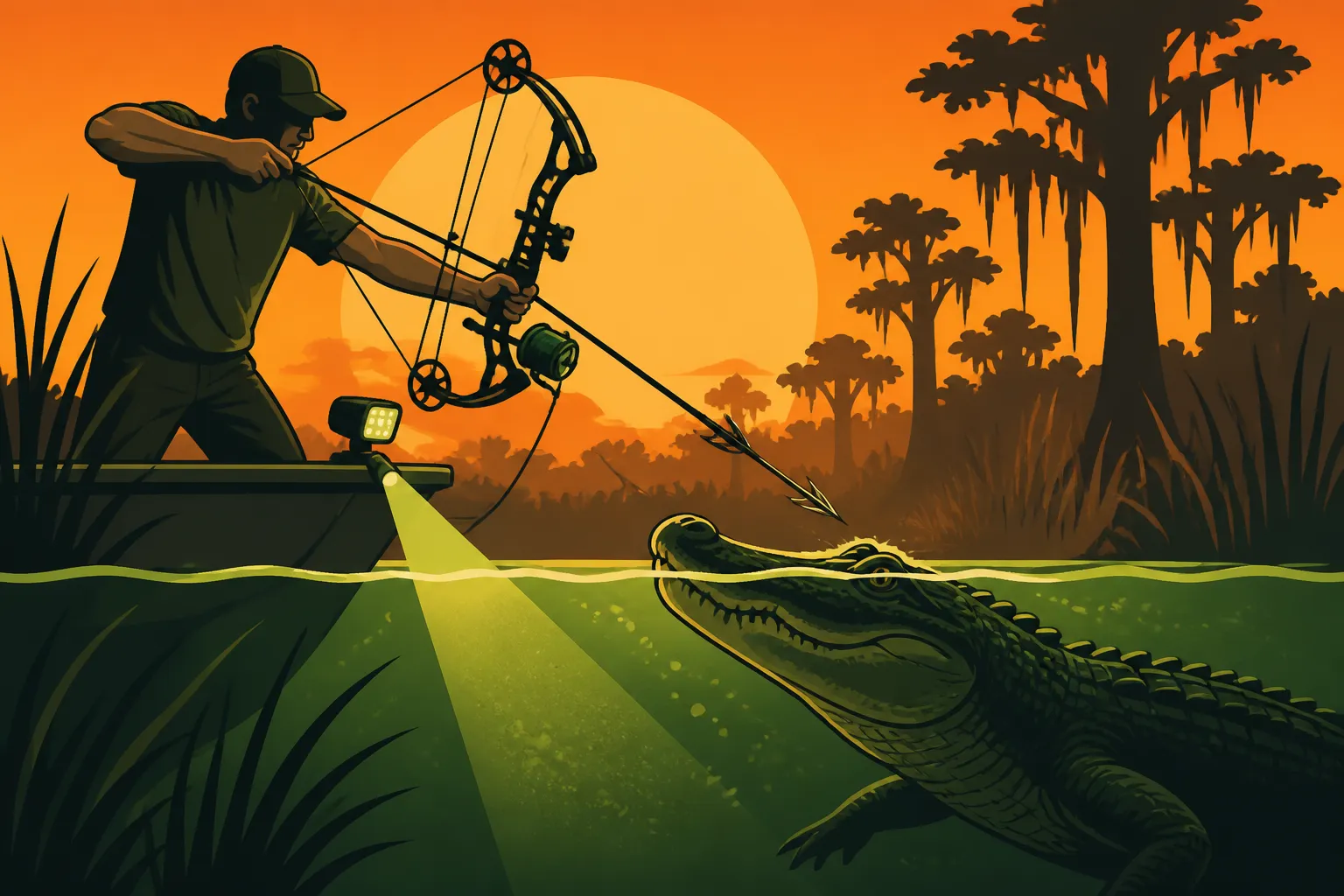
The approach is everything in gator bowfishing. You need to be as stealthy as possible. Utilize a quiet trolling motor or, even better, a push pole to slowly close the distance to your spotted gator. Avoid splashing or making sudden movements that could spook the animal. Keep your main lights focused on the gator, but be ready to dim them slightly if it seems agitated.
Shot placement is absolutely critical, both for an ethical harvest and for securing the animal. Due to water refraction, a gator will appear shallower than it actually is. You'll need to aim low to compensate for this optical illusion. The ideal shot placement is in the head, especially the brain, or along the spinal column in the neck or upper body. A shot to these areas will immobilize or dispatch the gator quickly, preventing a prolonged fight or loss. Avoid shooting in the belly or tail, as these areas are less effective for anchoring the animal and can damage valuable hide and meat. When the moment comes, a steady hand and a confident shot are key.
The Fight and Retrieval Process
The moment your arrow strikes, be prepared for an explosive reaction. Alligators are incredibly powerful, and their first instinct is often a violent death roll or a powerful dive into deep water or thick cover. This is where your heavy line and secure arrow become vital. Maintain constant tension on the line, but be ready to feed out line if the gator makes a strong run. Never try to stop a big gator by hand-lining; let the reel and the boat do the work. The goal is to tire the gator out.
This is also the time to deploy your secondary harpoon. As soon as the gator surfaces or slows, try to get a harpoon into its body, preferably in a solid muscle area, to create a second point of contact. This significantly increases your chances of Landing an Alligator From a Small Boat and gives you much more control. Once the gator is sufficiently tired and boat-side, the next step is dispatch. This must be done safely and humanely. A bang stick or a .22 pistol to the brain is the common method. Once dispatched, immediately tape the gator's mouth shut for safety. Remember, even a "dead" gator can have reflexive movements, and an untaped mouth is a serious hazard. Always handle the animal with extreme caution.
Post-Harvest and Regulatory Considerations
Harvesting an alligator is just one part of the equation. There are important steps to ensure you're compliant with regulations and that you properly care for your hard-earned harvest.
Securing Your Harvest and Game Care
After securing the alligator and taping its mouth, the next step is to get it measured. Remember, Georgia's minimum legal alligator length in Georgia is 48 inches. Once measured, you'll need to tag it according to Georgia Department of Natural Resources (DNR) rules. The permit tag must be immediately attached to the animal.
Proper game care begins immediately. Alligator meat is delicious, but like any wild game, it needs to be cooled quickly to preserve quality. Get the gator into a cooler with ice as soon as possible. Field dressing can be done at the boat ramp or back at camp, but the sooner, the better, especially in Georgia's warm climate. Removing the hide and processing the meat quickly will yield the best results. The tail meat is a prime cut, but don't overlook the jowl and leg meat.
Georgia Regulations and Best Practices
Alligator hunting in Georgia is a highly regulated activity, and it's essential to know the rules inside and out. It operates strictly on a quota hunt system, meaning you must apply for and draw a permit to participate. You can find detailed information on Applying for a Georgia Alligator Quota Hunt and the specific Georgia Alligator Quota Hunt Rules on the Georgia DNR website. The application window is typically in the summer, and successful applicants are assigned to specific zones and given a tag.
It's crucial to understand your assigned zone and its specific regulations. Georgia Alligator Zone Preferences can vary slightly in terms of season dates and harvest limits. Be mindful of the Georgia Alligator Season Opening Date and closing dates for your particular zone. After harvesting, you must report your kill through Georgia Game Check within a specified timeframe, providing details like length, sex, and harvest location. The GoHunt app, beyond helping with scouting, can also be used to quickly access regulations and ensure you're always hunting within the law. Responsible hunting means understanding and respecting these rules, which help ensure the sustainability of Georgia's alligator population for future generations.
Disclaimer
Please note: Hunting regulations and laws can change. Always consult the most current Georgia Department of Natural Resources (DNR) regulations and guidelines before planning any hunting trip. This guide is for informational purposes only and does not supersede official legal requirements.