Hanging a Stand on a Mountain Saddle
Hunting Georgia's vast mountain regions for deer can feel like an impossible puzzle. You trek for miles, climb steep inclines, and often feel like you're just wandering through endless timber, hoping to stumble upon a deer. The frustration of covering so much ground with little to show for it is real, but understanding how deer use specific terrain features, like mountain saddles, can drastically improve your chances. This guide will walk you through the nuances of identifying, scouting, and effectively hanging a treestand in these prime locations, turning your mountain hunting efforts into a strategic pursuit.
Understanding Mountain Saddles as Deer Magnets
Mountain saddles are those dips or low points along a ridge line, almost like a natural pass that connects two higher elevations. For deer, and many other forms of wildlife, these aren't just random topographical features; they're superhighways, safe havens, and essential travel corridors. If you've ever felt overwhelmed by the sheer scale of the North Georgia Mountains, learning to read these terrain features will bring clarity to an otherwise confusing landscape.
What Makes a Saddle Special?
Imagine having to climb over a tall fence versus walking through a gate. That's essentially what a mountain saddle represents to a deer. Instead of expending precious energy to go over the highest points of a ridge, deer instinctively gravitate towards these lower, easier-to-traverse sections. These natural depressions provide the path of least resistance when moving between bedding areas on one side of a ridge and feeding grounds or water sources on the other. It's a critical shortcut in their daily patterns, making them incredibly predictable ambush points for hunters. They often offer a bit more cover than the exposed ridgetops, providing a sense of security as deer move through.
Beyond simple travel, saddles also tend to funnel wind currents. Deer rely heavily on their nose, and a consistent wind current through a saddle allows them to detect danger from multiple directions as they pass through, adding another layer of security for them. This creates predictable wind patterns that you, as a hunter, can use to your advantage. Knowing how to read these subtle shifts is key to successful Wind and Thermals on a Mountain Ridge hunting.
Reading Topographic Maps for Saddle Identification
Before you even lace up your boots, your most powerful scouting tool is a good topographic map, whether it's a paper map or a digital one on your phone or computer. When you look at contour lines on a map, imagine them as elevation lines; the closer they are together, the steeper the terrain. A mountain saddle will show up as a "U" or "V" shape in the contour lines, where the lines dip down from both sides of the ridge, indicating a lower elevation. This dip is usually flanked by higher ground on either side.
I personally rely heavily on digital mapping applications like GoHunt when I'm scouting new public land or planning a hunt in the Chattahoochee National Forest. These apps allow you to toggle between different map layers, including topo, satellite imagery, and even public/private land boundaries. By zooming in and carefully tracing ridge lines, you can easily spot these tell-tale "hourglass" pinches in the contour lines that signify a saddle. Mark these potential spots on your map and create a game plan for a physical scouting trip. It takes practice, but once you start recognizing them, you'll see them everywhere. For deeper insights into navigating these digital tools, you might find a guide on Using the Georgia Outdoors App or onX Layers for Georgia Land Status helpful, as these principles apply broadly to different mapping platforms.
Deer Movement Patterns Through Saddles
Deer movement through saddles isn't random; it's often dictated by their basic needs and the time of day. During the early morning and late evening, you're most likely to catch deer moving through saddles as they transition between their bedding and feeding areas. A buck might bed on a steep, thick hillside overlooking a valley, and then use a saddle to cross to a distant oak flat for acorns or a planted green field.
During the rut, these saddles become even more critical. Bucks will cruise these high-traffic areas, scent-checking for does. It's an efficient way for them to cover ground and find receptive females without expending too much energy. Younger bucks might use them as staging areas, waiting for an opportunity to challenge an older buck or slip into a feeding area. Even during the middle of the day, a mature buck might use a saddle to silently relocate from one bedding area to another, especially if pressured. Understanding this nuanced behavior is essential for planning effective setups, particularly during Hunting the Georgia Rut in Mid-October.
| Saddle Usage Factor | Early Season (September-October) | Peak Rut (Late October-November) | Late Season (December-January) |
|---|---|---|---|
| Primary Use | Bedding-to-Feed transitions | Cruising for Does, Rub/Scrape lines | Secondary Feed/Bed transitions |
| Traffic Time | Dawn/Dusk, Mid-day (cooler) | All day, especially mid-day | Mid-day (warmer periods) |
| Wind Importance | High (for scent checking) | Very High (for scent checking) | High (for thermal advantage) |
| Sign to Look For | Trails, some rubs, tracks | Heavy rubs/scrapes, deep trails | Less obvious, focus on food |
| Stand Placement | Along distinct trails | Near rubs/scrapes in the funnel | Overlooking connected food |
Optimal Stand Placement within a Mountain Saddle
Once you've identified a promising mountain saddle, the real work begins: deciding exactly where to hang your stand. This isn't just about finding a good tree; it's about meticulous planning that considers every variable from wind direction to deer entry points. You're trying to outsmart an animal that lives and breathes in this environment, so attention to detail is paramount.
Considering Wind and Thermals
Wind and thermals are arguably the most critical factors in mountain hunting. Unlike flat ground, mountains create complex air currents that can swirl unpredictably. In a saddle, this effect is often magnified. Generally, in the mornings, cold air sinks, causing thermals to pull your scent downhill. In the evenings, as the sun warms the earth, warm air rises, and thermals will pull your scent uphill.
However, saddles act as funnels, often creating a more consistent wind tunnel through them. Your goal is always to position yourself downwind of where you expect deer to approach and travel. This means understanding the prevailing wind direction, but also recognizing how thermals will influence that. A perfect setup might have you on the side of the saddle where the deer are traveling into the wind, but your scent is being carried perpendicular to their path or away from them by the thermal draft. Always check the wind before you hunt, and if it's not right, be disciplined enough to stay out or move to an alternative spot. No amount of good deer sign can overcome a bad wind. For a deeper dive into this, check out Wind and Thermals on a Mountain Ridge.
Identifying Key Funnel Points and Pinch Points
Within a saddle, deer don't just wander aimlessly; they still follow the path of least resistance, which often means subtle funnels and pinch points. A large, open saddle might not have a single, obvious trail. Instead, look for thicker cover, rock formations, or even slight changes in elevation that naturally constrict deer movement. These become your pinch points.
For instance, a cluster of dense mountain laurel or a fallen log that's hard for deer to navigate might create a narrow corridor they must use. A mature buck, especially, will often skirt the edges of these thicker areas, using them for cover while still leveraging the saddle's easy travel. Pay close attention to rub lines and scrape activity, especially during the pre-rut and rut. These "signposts" are clear indicators of a buck's preferred travel routes through the saddle. Often, you'll find a concentrated rub line running right through the heart of a productive saddle. The key is finding that one small area where deer activity is naturally funneled and focusing your stand placement there. This kind of detailed scouting ties in well with concepts discussed in Reading a Ridge for North Georgia Deer.
Entry and Exit Strategies for Undetected Access
This is where many hunts are won or lost. Even the best stand placement in the world is useless if deer bust you on your way in or out. In mountainous terrain, this challenge is amplified by sound traveling further and elevation changes impacting scent. Your entry and exit routes must be meticulously planned to keep you out of sight, out of hearing, and out of scent of deer you intend to hunt.
When approaching your saddle stand, try to use terrain features like depressions, thick creek bottoms, or the backside of smaller ridges to mask your approach. Always factor in the wind and thermals for your entry and exit, just as you would for your sit. If morning thermals are pulling scent downhill, ensure your path doesn't take you directly below a bedding area. Similarly, evening thermals pulling scent uphill mean you shouldn't be walking directly up from a feeding area towards bedded deer. Many seasoned hunters will go the extra mile, literally, to loop around and approach their stand from a non-obvious direction, often utilizing less-traveled areas or even creek beds to minimize disturbance. Once you’re in your stand, stay put. The temptation to move or call might be strong, but minimizing movement is key to remaining undetected for the long haul. Remember, a deer's senses are far superior to ours, so every rustle, every scent, and every silhouette counts.
Choosing and Hanging Your Treestand in Mountain Terrain
The right gear and a safe, efficient setup are non-negotiable when hunting steep, rugged mountain country. You're not just dealing with the challenges of deer behavior, but also the physical demands of the terrain itself. It's a different beast than hunting flat pine plantations or Piedmont field edges.
Selecting the Right Stand Type for Saddles
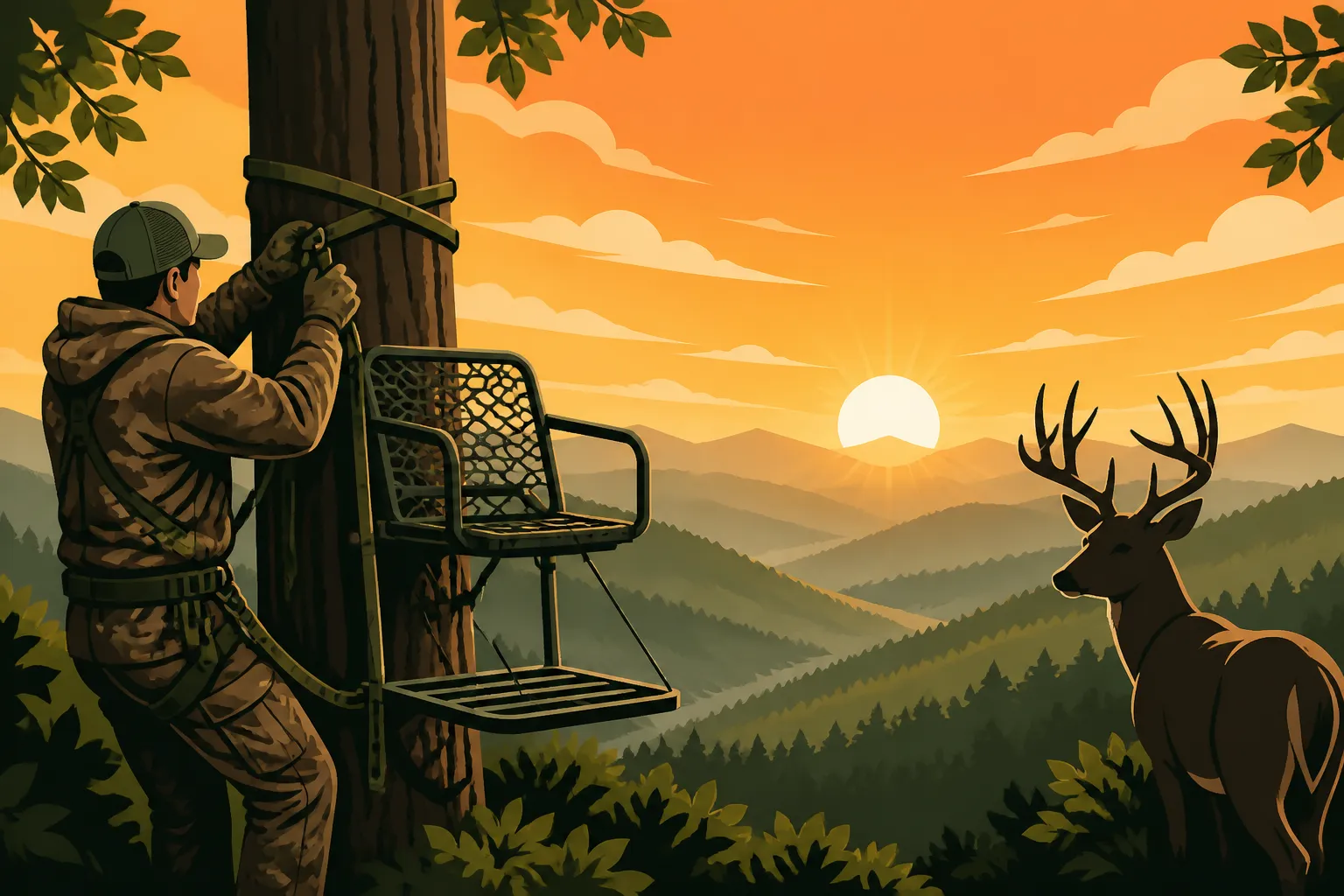
When it comes to mountain saddles, portability and adaptability are key. You're often hiking significant distances over uneven ground, so a heavy, cumbersome stand isn't practical. Lightweight climbing stands, hang-on stands with climbing sticks, or even saddle hunting setups are excellent choices.
- Climbing Stands: These are fantastic if you find a suitable, straight tree with no lower limbs. They offer mobility and quick setup, which is great for scouting on the fly. However, finding that perfect tree in the Chattahoochee can be tough; often, the best cover comes from gnarly, limby hardwoods.
- Hang-On Stands with Sticks: This is my personal go-to for most mountain hunting. They allow you to get into just about any tree, regardless of limbs, and you can place your climbing sticks strategically around difficult sections of the trunk. Brands like Lone Wolf or XOP are popular choices for their lightweight yet sturdy designs. The downside is carrying both the stand and multiple sticks, but the versatility often outweighs the extra weight. Check out Climbing Sticks for Mountain Hardwoods for more detailed advice on selecting and using them.
- Saddle Hunting: This method has gained immense popularity for mountain hunters due to its ultimate portability and 360-degree shooting lanes. A saddle hunter essentially climbs a tree with sticks or an aider, then 'sits' in a comfortable harness, facing the tree. It allows for incredible stealth and maneuverability. While there's a learning curve, the ability to quickly set up and hunt from almost any tree in thick cover makes it a game-changer for many, as discussed in Saddle Hunting in Georgia Hardwoods.
Regardless of your choice, prioritize safety, lightweight construction, and quiet operation. Squeaky stands or rattling sticks will spook deer faster than anything.
Safety Considerations for Steep Terrain
Safety is paramount, especially when working on steep or uneven ground. The last thing you want is a preventable accident. Always use a full-body harness when climbing and while in your stand. Attach yourself to the tree before you leave the ground, and stay attached until your feet are back on solid earth. This includes using a lineman's belt when hanging your stand and a safety rope or lifeline while you're in it.
Inspect your stand and climbing sticks regularly for wear and tear, especially after being exposed to the elements. Ropes can fray, straps can degrade, and metal components can fatigue. Carrying a small first-aid kit is also a good idea, as help can be a long way off in the mountains. Always tell someone where you're going and when you expect to return. The uneven terrain, slippery leaves, and hidden roots in mountain country significantly increase the risk of falls, so proper footwear with good ankle support is also critical. These precautions are even more vital for Treestand Setups in North Georgia Mountains.
Executing the Setup: Tips and Tricks
When you're ready to hang your stand, move deliberately and quietly. Noise carries surprisingly far in the still mountain air. If possible, hang your stand during the off-season or in the middle of the day when deer activity is typically lower. Clear a quiet path to your chosen tree, removing any crunchy leaves or fallen branches that could announce your arrival later.
Aim to hang your stand 15-20 feet high, or even higher if the terrain allows for it and the tree offers good cover. The higher you are, the better your scent dispersion and the less likely deer are to pick up your movement. However, don't sacrifice concealment for height; ensure you have enough background cover to break up your silhouette. Trim only what's absolutely necessary for clear shooting lanes, and do it stealthily. Excessive cutting can alert deer to your presence. Utilize the GoHunt app to mark your stand location precisely, and note any key landmarks or approach routes you've identified. This can be a lifesaver when trying to find your way in the dark. Bring all your gear in a good pack like those useful for a Packs Built for a Chattahoochee Day Hunt, making sure everything is secured and won't clank around.
Seasonal Considerations and Adapting Your Strategy
Deer behavior isn't static; it changes dramatically with the seasons, influenced by food sources, breeding cycles, and hunting pressure. Your mountain saddle strategy needs to adapt accordingly to stay effective.
Early Season vs. Rutting Period Tactics
In the early archery season (think September and early October), deer movement is primarily focused on food, water, and bedding. Saddles are key travel routes between these resources. During this time, look for saddles that connect thick bedding cover to areas with early-season food, such as white oaks dropping acorns, persimmons, or even small clearcuts with succulent browse. Focus on primary trails within the saddle. Deer will often stick to predictable patterns, moving at dawn and dusk. Due to the warmer weather, thermals will be a strong influence, so plan your approach and exit accordingly. You'll likely need to wear Lightweight Layering for Warm-Weather Sits to stay comfortable and scent-free.
As the rutting period approaches and hits its peak (mid-October through November in much of Georgia), buck behavior shifts dramatically. Their focus becomes finding does. Saddles transform into major cruising corridors where bucks travel extensively, scent-checking for receptive females. Rubs and scrapes will become much more prevalent and active. During the rut, deer, especially bucks, are much more likely to move throughout the day, not just at dawn and dusk. This means an all-day sit in a well-chosen saddle during the peak rut can be incredibly productive. Bucks will often use these saddles to get from one ridge to another without dropping all the way down into the valley, making them natural interception points for Hunting the Rut in Mid-October. You might even consider trying rattling or grunting, as bucks are more responsive during this time, but always be aware of your surroundings and wind direction.
Late Season Food Source Connections
Once the rut winds down and the colder weather of late season (December and January) sets in, deer revert to a primary focus on food and thermal cover. Their activity will revolve around finding sufficient calories to sustain them through winter. The most productive saddles in late season will be those that directly connect bedding areas to reliable, persistent food sources. This could be standing crops on nearby private land, hard mast like red oak acorns that drop later, or even specific types of browse in thick clearcuts.
Deer may move less frequently during the day, especially during harsh weather, so you might see concentrated activity during midday sunny periods when they are moving to feed or bask in the sun. Identifying these specific food sources through scouting is critical. Use your GoHunt app or other mapping tools to pinpoint potential late-season food, then look for saddles that provide easy, secure access to those areas from bedding. Consider using warmer gear, such as Insulated Boots for a Georgia January, to ensure you can sit comfortably for extended periods, especially during cold fronts. The deer will be seeking efficiency and calories, and a well-placed stand in a saddle connecting these resources will put you in a prime position.
Disclaimer
Hunting is an inherently dangerous activity. Always prioritize safety, adhere to all local and state regulations, and ensure you have the proper training and licensing before heading afield. The information provided here is for educational purposes only and should not replace professional guidance or personal judgment.