Zeroing a Rifle for Mixed Distances
There’s nothing quite like the feeling of having that perfect shot opportunity present itself in the Georgia woods, only to be thrown into a panic trying to remember your exact bullet drop for that weird 175-yard angle. We've all been there, wondering if we should hold high, low, or right on the money. This guide is all about taking the guesswork out of those critical moments, teaching you how to zero your rifle not just for one static distance, but for the dynamic, mixed-distance shooting scenarios that Georgia's diverse landscapes consistently present.
Understanding the Challenge of Mixed Distances in Georgia
Hunting in Georgia is rarely a one-size-fits-all endeavor. Our terrain shifts dramatically from one region to the next, and with it, the typical shot distances you'll encounter. Trying to make a single zero work perfectly for every situation can lead to frustration and, worse, missed opportunities.
The Diverse Georgia Landscape and Its Impact on Shooting
Think about it: North Georgia's mountains are a world apart from the flat pine plantations of the Coastal Plain. Up in the higher elevations, you might find yourself glassing a clear-cut across a valley, needing to make a precise shot at 250 or even 300 yards. Those steep angles also introduce unique challenges to trajectory, where gravity plays a slightly different trick on your bullet than on flat ground.
Move down to the Piedmont, and you're often hunting a mix of dense hardwoods and open field edges. Here, a deer might step out at 75 yards, but another could be working its way down a distant powerline at 180. The shot could be short and quick, or it could require a bit more calculation. Then there's the Coastal Plain, with its thick palmetto patches, cypress swamps, and vast pine forests. Most shots here are often under 100 yards, sometimes even under 50, due to the sheer density of the cover. But then, a hog might cross a cut row in a peanut field, or a deer might pop out at the far end of a long, straight logging road, pushing that distance out to 150 or more. A standard 100-yard zero, while common, might leave you holding low for those close, quick shots or guessing high for the longer ones. It's a constant dance between close-quarters precision and open-country reach.
Common Scenarios Hunters Face
Let's paint a picture of just how varied these situations can be. Imagine you're perched in a Saddle Hunting in Georgia Hardwoods stand on a crisp October morning. A magnificent buck steps out of a thick bottomland, presenting a perfect broadside shot at a mere 40 yards. You breathe, you squeeze, and the shot connects. Twenty minutes later, as you're waiting for the perfect moment to track, another deer appears, this time skirting the far edge of a recently cut-over field, around 225 yards away. With a standard 100-yard zero, that first shot was practically point-and-shoot, but the second one demands a precise holdover, and you need to make that calculation quickly and confidently.
Or consider hunting Entry Routes Through a Standing Peanut Field. A hog might be rooting around 70 yards deep in the standing peanuts, an easy shot. But what if it bolts and makes it to the far end of the field, now 250 yards out, before pausing? Or you're trying to call in a coyote across a wide pasture – the first one hangs up at 300 yards, but a second circles in tight to your position at 80. These moments highlight the need for a versatile zero that minimizes guesswork and maximizes your effective range without constant dial twisting.
The Fundamentals of Rifle Zeroing
Before we dive into advanced strategies, it's crucial to understand the bedrock principles of zeroing. It's more than just hitting the center of a target at one distance; it's about understanding how your bullet flies and how your optic works in conjunction with that flight path.
What "Zeroing" Truly Means
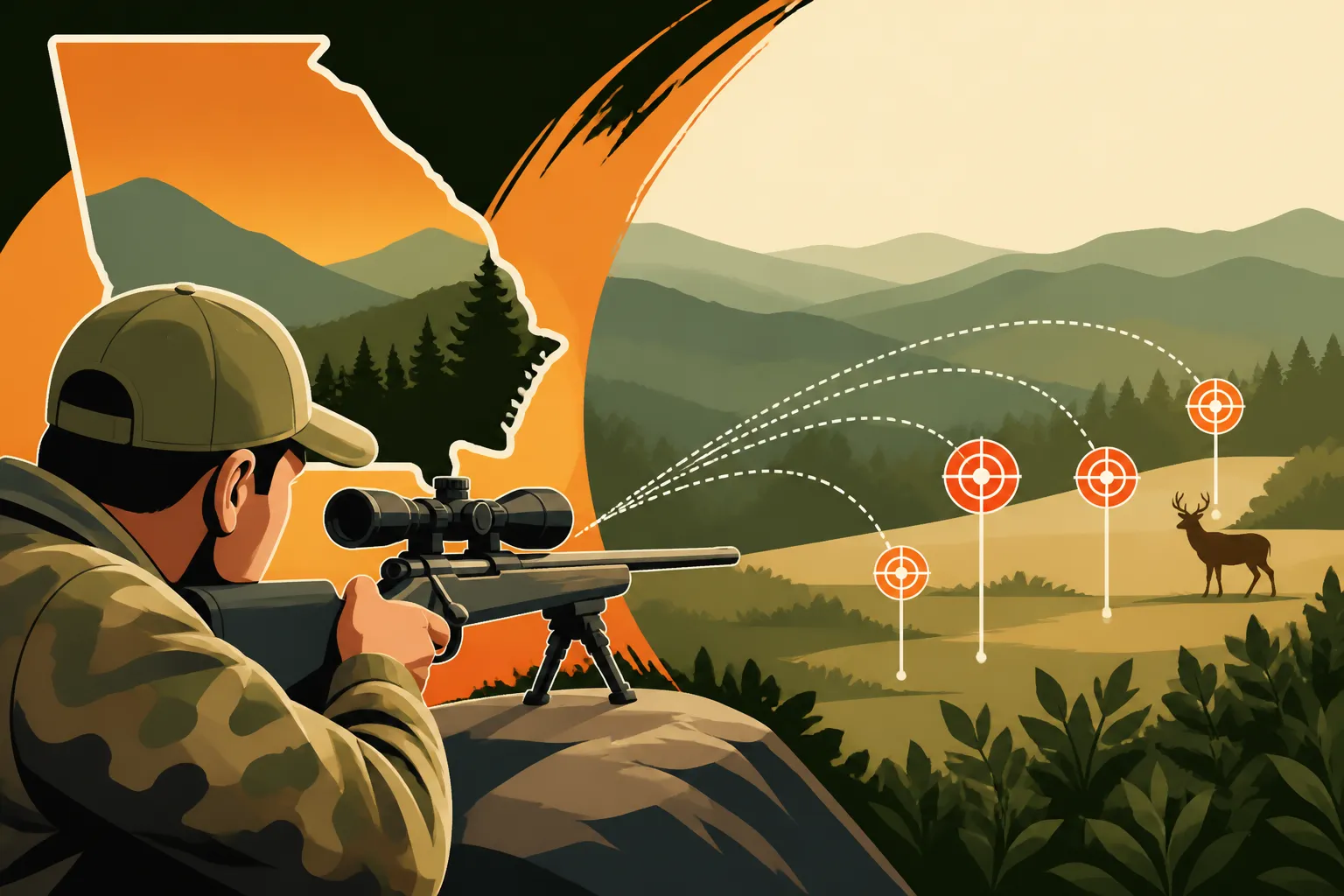
At its heart, zeroing means aligning your rifle's point of aim with its point of impact at a specific distance. When you "zero" your rifle at 100 yards, it means that if you aim dead center at a target 100 yards away, your bullet should hit dead center. However, a bullet doesn't fly in a straight line forever. Gravity starts pulling it down the moment it leaves the barrel, creating a parabolic (curved) trajectory. Your scope, being mounted above the bore, introduces another layer to this. When you aim, your line of sight (through the scope) crosses the bullet's path at two points: once relatively close to the muzzle (the "near zero") and again at your chosen zero distance (the "far zero").
Understanding this trajectory, including bullet drop, is paramount. If you're zeroed at 100 yards, your bullet will actually be slightly high at, say, 50 yards, because it's still rising to meet your line of sight at 100 yards. Beyond 100 yards, it begins to drop below your line of sight. The goal of an effective zero for mixed distances is to manage this ballistic arc so that your bullet stays within the vital zone of your target (typically a 6-inch circle for deer) across a wide range of common hunting distances.
Basic Zero Distances and Their Implications
Hunters often debate the "best" zero distance, and the truth is, it depends heavily on your typical hunting environment and caliber.
- 50-Yard Zero: This zero is excellent for very close-range hunting, common in incredibly thick brush where shots rarely extend beyond 75 yards. With a 50-yard zero, your bullet will usually be high at 100 yards (maybe 1.5-2 inches, depending on caliber and velocity) and then drop significantly past that. It simplifies very close shots, but demands significant holdover for anything beyond 125 yards, which might be common even in moderately dense Georgia woods.
- 100-Yard Zero: This is arguably the most common zero for deer hunters, and for good reason. It provides a solid benchmark. For many common hunting calibers, with a 100-yard zero, your bullet will be slightly high at 50 yards (maybe an inch or less), dead on at 100, and then start dropping. At 200 yards, you might be looking at a 4-8 inch drop, again, depending on your caliber and bullet. It's a good all-around zero for areas where most shots are within 150 yards, but it does require some thought for longer distances. In Georgia, where shots might range from 20 to 200 yards, a plain 100-yard zero can sometimes leave you wishing for a bit more flexibility.
- 200-Yard Zero: For flatter-shooting calibers or in more open terrain, a 200-yard zero can be very effective. With this zero, your bullet will typically rise above your line of sight, peaking around 100-125 yards (perhaps 2-4 inches high, depending on the cartridge), and then fall back to hit dead on at 200 yards. This keeps your bullet within the vital zone for a considerable range, often from the muzzle out to around 225-250 yards, before requiring significant holdover. This zero effectively extends your "point-and-shoot" range, making it a strong contender for Zeroing at 100 Yards for Field Edge Hunting or longer shots.
The concept we're aiming for, especially for mixed distances, is something called a "Maximum Point-Blank Range" (MPBR) zero. It's about optimizing your zero so that your bullet never rises or falls outside of a predetermined vital zone across the longest possible distance.
Strategies for a Versatile Mixed-Distance Zero
To truly master mixed-distance shooting in Georgia, you need a strategy that extends beyond a single zero point. This involves understanding ballistic principles, utilizing modern tools, and practicing calculated adjustments.
The MPBR (Maximum Point-Blank Range) Zero
The Maximum Point-Blank Range (MPBR) zero is a game-changer for hunters facing varied distances. Instead of picking a single zero distance and reacting to drop beyond that, you pick a maximum allowable deviation – typically the diameter of a deer's vital zone (about 6-8 inches). Your goal is to find a zero distance that ensures your bullet never goes above or below this vital zone from the muzzle out to the furthest possible range. This becomes your "point-and-shoot" distance.
Here's how it generally works: You choose a zero distance (often between 200 and 300 yards for most common calibers) that causes your bullet to rise a certain amount above your line of sight at its apex (usually around 100-150 yards). For a 6-inch vital zone, you'd aim to have your bullet's highest point no more than 3 inches above your line of sight, and then let it drop to 3 inches below your line of sight at the furthest point. This entire range, from muzzle to that furthest point, is your MPBR. Within this range, you can aim dead on the vitals, and your bullet will hit a deer's kill zone. Beyond this, you'll need to hold over. For a flat-shooting rifle, this can mean a point-and-shoot range out to 250 or even 300 yards, which covers a vast majority of Georgia hunting scenarios.
Calculating your MPBR requires knowing your specific bullet's ballistic coefficient, muzzle velocity, and the height of your scope above the bore. While exact formulas can be complex, many online ballistic calculators can help you determine the optimal zero for your setup and desired vital zone.
Using Ballistic Calculators and Apps (GoHunt mention)
In today's world, you don't need to be a math whiz to figure out complex ballistics. Ballistic calculators and smartphone apps have revolutionized how hunters approach mixed-distance shooting. These tools allow you to input detailed information about your specific rifle, scope, ammunition, and even local environmental conditions (temperature, altitude, humidity). They then generate precise trajectory data, showing you exactly how much your bullet will drop (or rise) at every conceivable distance.
Apps like GoHunt and others available on your phone can provide incredibly useful data for various cartridges and environmental conditions. You can create profiles for different rifles and ammunition types, saving your specific ballistic data. Imagine having a detailed drop chart for your favorite .270 load instantly accessible on your phone when you're perched in a stand. These apps help predict not just bullet drop, but also wind drift, which is a crucial factor, especially when hunting across open fields or long clear-cuts in the Piedmont or Coastal Plain. By inputting your precise data, you can see how a 10 mph crosswind will push your bullet at 200 yards, allowing you to make an informed hold-off. This information is invaluable for building confidence and making ethical shots at extended or mixed distances.
Understanding Holdovers and Holds-Under
Even with an optimal MPBR zero, there will be times when a shot falls outside that point-and-shoot range, requiring you to deliberately aim either above or below your target. This is where understanding holdovers and holds-under comes into play.
- Holdover: This is the most common adjustment for longer shots. If your target is beyond your MPBR, your bullet will be dropping below your line of sight. To compensate, you'll need to aim higher on the target. Many modern rifle scopes come equipped with either specific Bullet Drop Compensating (BDC) reticles or reticles with hash marks calibrated in Minutes of Angle (MOA) or Milliradians (MRAD). A BDC reticle will have etched lines corresponding to specific ranges (e.g., 200, 300, 400 yards), allowing you to place the appropriate line directly on the vital zone. MOA or MRAD reticles require you to know your bullet's drop in those units at a given range and then use the corresponding hash mark for your aim point. Practice is key here; knowing your drops and how to use your reticle under pressure is crucial for success, especially on those open Hunting a Green Field Planted for Deer opportunities.
- Holds-Under: While less common for hunting, holds-under can be necessary for very close shots if your chosen zero (like a 200-yard zero) causes your bullet to be significantly high at short ranges (e.g., 25-50 yards). If your bullet is consistently 2-3 inches high at 50 yards with your zero, you might need to aim 2-3 inches low on the target to ensure a precise hit. However, with a well-calculated MPBR zero for a 6-8 inch vital zone, holds-under should largely be eliminated, as your bullet's highest point should still remain within the acceptable vital zone for close shots.
Practicing these holds at various distances at the shooting range, especially from different field positions, is critical to building the muscle memory and confidence needed when a trophy buck or a wary gobbler steps out.
Practical Steps for Zeroing Your Rifle
Zeroing isn't a mystical art; it's a systematic process that, when followed carefully, ensures your rifle performs exactly as expected when it matters most.
Pre-Range Checklist: Gear and Setup
Before you even think about heading to the range, a little preparation goes a long way. This isn't just about bringing your rifle; it's about ensuring consistency and eliminating variables.
First, your rifle should be clean and in good working order. Check all screws on your scope mounts and rings to ensure they are torqued to the manufacturer's specifications. Loose mounts are a primary cause of inconsistent groups. Second, your ammunition is paramount. You absolutely must use the exact same brand, bullet weight, and type of ammunition for zeroing that you intend to hunt with. Different loads, even from the same manufacturer, can have drastically different points of impact. Bring at least a box or two to ensure you have enough for proper zeroing and verification.
Third, gather your range essentials:
- Quality targets: Preferably with a grid system to easily measure adjustments.
- Spotting scope or binoculars: To see your impacts without having to walk downrange after every shot.
- A stable shooting rest: Sandbags, a bipod, or a lead sled are crucial for eliminating human error and ensuring the rifle is consistently supported. Shooting Sticks From a Mountain Ridge can be useful at the range for practicing field positions, but start with a solid bench rest.
- Cleaning rod and supplies: For intermittent cleaning, especially if shooting many rounds.
- Tools: Small screwdriver or coin for scope adjustments, if needed.
- Eye and ear protection: Non-negotiable!
Finally, ensure you have a consistent shooting position. Whether prone, from a bench, or using a tripod, stability is key. Any wobble or inconsistency in how you hold the rifle will translate to inconsistent groups downrange, making it impossible to accurately zero.
The Step-by-Step Zeroing Process
Once at the range, take your time. Rushing leads to mistakes and wasted ammunition.
- Start Close to Get on Paper (25 Yards): Especially if you've just mounted a new scope or are unsure of your initial zero, start at 25 yards. This ensures your bullet will hit the target somewhere. Fire 1-3 shots, make adjustments to bring the group to the bullseye, then verify. At this distance, your bullet will typically be 1-2 inches low with a 100 or 200-yard zero, so adjust accordingly. The key is simply to get hits on paper quickly so you can move to longer distances.
- Move to Your Primary Zero Distance: Once you're on paper at 25 yards, move to your chosen zero distance. For mixed-distance hunting in Georgia, a 200-yard zero, or one optimized for your MPBR, is often ideal. Fire a three-shot group. Do not adjust after just one shot! A group tells you about the rifle's consistency; a single shot tells you nothing.
- Adjust and Re-Verify: Measure your group's center from the bullseye. Use your scope's adjustment values (e.g., 1/4 MOA per click). If your group is 2 inches low and 1 inch right at 200 yards, and your scope is 1/4 MOA per click (meaning 1 MOA is 2 inches at 200 yards), you'd dial 4 clicks up and 2 clicks left. Fire another three-shot group to verify your adjustments. Repeat until your groups are consistently centered.
- Verify at Intermediate and Extended Distances: This is where the "mixed-distance" part really comes into play. Once your primary zero is locked in, move your targets to other relevant distances you might encounter. For example, if you're 200-yard zeroed, shoot groups at 100 yards to see how high it truly shoots. Then, if your range allows, push it out to 250 or 300 yards. This confirms your ballistic data and shows you the actual bullet drop you'll experience. This verification is crucial for understanding your rifle's true performance across various ranges. Remember, Rifle Scopes for Low-Light Swamp Edges will perform differently than a high-power long-range scope, so know your limitations.
Documenting Your Zero and Ballistics (GoHunt mention)
Once you've zeroed and verified your rifle across multiple distances, you've got invaluable information. Don't let it be forgotten! Create a range card. This is a small, laminated card you can attach to your sling or the stock of your rifle, or keep in your pack.
Your range card should include:
| Distance (Yards) | Bullet Drop/Rise (Inches) | Windage (Inches @ 10mph crosswind) |
|---|---|---|
| 50 | ||
| 100 | ||
| 150 | ||
| 200 (Zero) | 0 | |
| 225 | ||
| 250 | ||
| 300 |
Fill in the "Bullet Drop/Rise" based on your actual range verification. The "Windage" can be derived from ballistic calculators or apps. Services like GoHunt can store all this ballistic data digitally for multiple rifle setups, making it easy to access. This personalized chart is your go-to reference in the field, eliminating any doubt about holdovers for that crucial shot. You might even note important information like the rifle, caliber, specific ammunition, and the zero conditions (temperature, altitude if significantly different from sea level). This documentation empowers you to make confident, ethical shots, no matter the range.
Caliber and Ammunition Considerations for Georgia's Mixed Terrain
Your choice of rifle caliber and ammunition plays a significant role in how easily you can achieve an effective mixed-distance zero. Some cartridges inherently lend themselves better to versatility across varying ranges.
Flatter-Shooting Calibers for Open Areas
When you're dealing with open fields, powerline cuts, or long vistas in the North Georgia mountains, a flatter-shooting caliber minimizes bullet drop and makes holdover calculations less critical. These calibers maintain a more consistent trajectory over longer distances, which means your point-blank range can be significantly extended.
Consider cartridges like the .270 Winchester, the 6.5 Creedmoor, or the .30-06 Springfield.
- The .270 Versus .308 for Whitetails is a classic debate, but the .270 often gets the nod for its flatter trajectory at extended ranges. It's renowned for its relatively mild recoil and excellent downrange energy retention, making it a superb choice for deer across varied terrain.
- The 6.5 Creedmoor has surged in popularity, particularly for its ballistic efficiency. It offers a very flat trajectory and impressive accuracy, making it easy to achieve an effective MPBR. It's an excellent choice for 6.5 Creedmoor for Piedmont Field Edges where you might be shooting across a wide-open pasture one moment and into thick timber the next.
- The .30-06 Springfield is another fantastic all-around option. While it might have a bit more arc than a 6.5 Creedmoor at extreme ranges, it still shoots plenty flat for most hunting scenarios out to 300 yards and beyond, especially with modern bullet designs. Its versatility also extends to larger game, should the opportunity arise.
With these calibers, you can often achieve an MPBR zero that keeps your bullet within a 6-inch vital zone out to 250-300 yards, giving you a huge margin for error and reducing the need for on-the-fly holdover adjustments for typical Georgia deer.
Heavier, Slower Projectiles for Thick Cover
While flatter-shooting calibers excel in open country, there are situations, particularly in Georgia's densest cover, where different characteristics might be prioritized. For very short-range, heavy brush hunting, a caliber that delivers a substantial punch without worrying about long-range ballistics can be effective.
Consider the .30-30 Winchester or even some straight-wall cartridges.
- The .30-30 in Thick Coastal Plain Cover is a legendary brush gun, known for its effectiveness at close ranges. It fires a heavier, slower bullet that tends to shed energy quickly, but within 150 yards, it's a proven deer stopper. For hunters whose shots are almost exclusively under 100 yards in exceptionally dense terrain, the .30-30's simplicity and quick handling can be an advantage. However, trying to zero a .30-30 for mixed distances beyond 150 yards means significant bullet drop, requiring much more pronounced holdovers.
- For some specific applications, or in states with straight-wall cartridge regulations (not as common in Georgia's general deer season, but worth noting the principle), you might see options like the .45-70 Gov't. These deliver enormous energy up close but have a rainbow-like trajectory at longer ranges.
The trade-off here is usually trajectory flatness versus raw close-range power. For true mixed-distance hunting, most Georgia hunters will find the flatter-shooting calibers more versatile, even in moderately dense woods, due to the occasional longer shot across a creek bottom or Hunting a Clear-Cut Regrowth Edge. Understanding the Practical Range in Georgia Swamp Timber for your chosen caliber is paramount.
Consistency is Key: Ammunition Selection
This cannot be stressed enough: your rifle's zero is only valid for the specific ammunition you used to establish it. Even subtle differences between ammunition batches, bullet manufacturers, bullet weights, or bullet designs can result in a significant shift in your point of impact.
Imagine spending hours at the range meticulously zeroing your rifle with Brand X, 150-grain soft points, only to switch to Brand Y, 150-grain boat-tails, for hunting season. You might find your bullets hitting 3-4 inches away from your point of aim at 100 yards, completely throwing off your carefully planned MPBR.
Therefore:
- Buy in bulk (if possible): Purchase enough of your chosen hunting ammunition to zero your rifle, practice, and hunt for the entire season. Ideally, try to get ammunition from the same manufacturing lot number.
- Avoid mixing and matching: Do not zero with cheap target ammunition and then hunt with premium hunting rounds. The ballistics will almost certainly be different.
- Test new loads: If you decide to switch ammunition types, you must re-zero and re-verify your rifle's performance across all relevant distances.
Treat your hunting ammunition as an integral part of your rifle system. Consistency in ammunition selection is a cornerstone of accurate, ethical shooting in any hunting scenario, especially when trying to manage mixed distances.
Advanced Tips and Real-World Application
Getting your rifle zeroed is a great start, but truly mastering mixed-distance shooting involves understanding environmental factors, committing to regular practice, and leveraging modern tools.
Accounting for Environmental Factors
The perfect zero established on a calm, cool day at the range might not be quite as perfect in the field. Environmental factors can subtly, and sometimes not so subtly, alter your bullet's flight path.
- Temperature and Humidity: Changes in air density (which is affected by temperature, humidity, and altitude) can influence bullet velocity and, consequently, trajectory. While Georgia doesn't have extreme altitude variations across most hunting grounds, the swing from a cool, dry fall day to a hot, humid late-season afternoon can have a minor effect. Most hunters won't need to re-zero for every temperature change, but understanding that colder, denser air can slightly increase velocity (and vice-versa) is good knowledge to have.
- Wind Drift: This is arguably the most significant environmental factor for mixed-distance shooting in Georgia. A seemingly light 5-10 mph crosswind can push your bullet several inches off target at 200 yards, and even more at greater distances. Learning to read the wind is an art form. Observe swaying tree branches, rustling leaves, and grass movement. Carry a small wind indicator if legal and practical. Ballistic apps (like GoHunt) will give you precise windage adjustments, but you must be able to estimate the wind speed and direction accurately. For example, understanding Wind and Thermals on a Mountain Ridge is crucial, as wind can be highly unpredictable in broken terrain.
- Angle Compensation (Uphill/Downhill): When shooting significantly uphill or downhill, gravity acts differently on the bullet relative to your line of sight. Counterintuitively, you will always hold low (or aim for a closer distance) when shooting at an angle, whether up or down. A true horizontal distance matters for ballistic calculations. Many modern rangefinders now have a built-in angle compensation feature that gives you the "shoot-to" distance, simplifying this calculation dramatically.
Regular Practice and Verification
A rifle zeroed once and then put in the safe until opening day is an accident waiting to happen. Rifles can get bumped, scopes can shift, and even ammunition stored improperly can change.
- Pre-Season Check: Always verify your zero before the hunting season begins. Fire a few shots at your primary zero distance (e.g., 200 yards) and at a shorter distance (e.g., 100 yards) to confirm everything is still hitting where it should.
- Post-Travel Check: If your rifle has been transported long distances, especially in rough conditions, verify its zero. It only takes a minor bump to throw things off.
- Practice Field Positions: Don't just practice from a bench. Practice shooting from kneeling, sitting, prone, and off improvised rests (like a backpack or the side of a tree). Many Georgia hunting shots aren't from a perfectly stable bench. Practice holding over or under at various distances from these less stable positions. This is critical for translating range skills to real-world success. You might be Hunting the Rut in Mid-October and a shot presents itself quickly from an awkward position.
- Dry Firing: Even without live ammunition, dry firing helps you practice breath control, trigger squeeze, and maintaining your sight picture. It's a free and effective way to reinforce good shooting habits.
The more you interact with your rifle and practice, the more intuitive those mixed-distance shots will become.
The Role of Rangefinders and Experience (GoHunt mention)
Modern hunting is significantly aided by technology, and the rangefinder is a prime example. In mixed-distance scenarios, a reliable rangefinder is almost as crucial as your rifle itself.
- Eliminating Guesswork: A rangefinder instantly provides you with an accurate distance to your target. This eliminates all the "Is that 150 or 200 yards?" guesswork, which is invaluable when combined with your established zero and ballistic data. You range the target, consult your range card (or your GoHunt app), and make the appropriate hold.
- Combining Data: Many rangefinders now integrate with ballistic apps via Bluetooth, meaning your ranged distance is automatically sent to your app, which then tells you the exact holdover. This streamlines the process and reduces the chance of human error under pressure.
- Building Intuition: While technology is amazing, it's no substitute for experience. Consistently ranging targets in the field, even when you're not shooting, helps you develop a better intuitive understanding of distances. Over time, you'll get better at estimating range, which helps you react more quickly when a shot suddenly presents itself. Using a rangefinder during Rattling Volume in Thick Pine Cover can tell you if that buck is just at the edge of your effective range, or if you need to let him get closer.
Ultimately, zeroing a rifle for mixed distances in Georgia is about building a comprehensive system: a well-maintained rifle, consistent ammunition, a carefully chosen zero, documented ballistics, and diligent practice. By putting these elements together, you'll be ready for whatever distance the wild woods of Georgia throw your way.
Disclaimer
This article is for general informational purposes only and does not constitute professional advice. Laws, prices and regulations vary by location and change over time. Consult a qualified professional for guidance on your specific situation.