Rifle Ranges Realistic in Piedmont Woods
If you're like many Georgia hunters, you probably spend hours dreaming of those perfect, long-range shots across a sprawling food plot or open field. But let's be real for a moment: if you're hunting the rolling, pine-and-hardwood mix of Georgia's Piedmont region, those wide-open opportunities are often the exception, not the rule. The dense woods, undulating terrain, and thick undergrowth mean that most deer encounters, especially with a rifle, happen at surprisingly intimate distances, often catching us off guard. This guide is here to ground those expectations, helping you understand the actual rifle ranges you'll realistically encounter in the Piedmont, how to best prepare for them, and how to set up your gear for consistent success in this distinct Georgia landscape.
Understanding the Piedmont Terrain and Its Impact on Shooting
The Piedmont region of Georgia is a beautiful, diverse landscape, but it presents some unique challenges for rifle hunters. It’s not the vast, open plains of the Midwest, nor is it the truly rugged, mountainous terrain of our northernmost counties. Instead, you get a mix of gently rolling hills, mature hardwoods, dense pine plantations, and winding creek bottoms, all conspiring to limit your effective line of sight.
The Green Tunnel Effect: Visibility Challenges
When you step into a typical patch of Piedmont woods, especially during the early firearms season when foliage is still thick, you're entering what many hunters affectionately (or perhaps frustratingly) call "the green tunnel." It's an environment where visibility is often measured in tens of yards, not hundreds. Imagine standing in a stand of mixed oak and pine, with a dense understory of muscadine vines, privet, and young saplings. You might have a clear lane for 30 yards, then hit a wall of green, or see glimpses of movement beyond, but with no ethical shot window. This isn't just about trees; it's about the layers of vegetation that absorb light and break up outlines. A buck might appear suddenly, perfectly framed in a tiny window, and be gone just as quickly. This reality forces hunters to react fast and make accurate assessments of range and shot placement under pressure. It's a far cry from practicing on a static target at a known distance.
Rolling Hills and Elevation Changes: Managing Shot Angles
Unlike the flat expanses of the Coastal Plain or the steep grades of the mountains, the Piedmont offers a constant, subtle dance of elevation. You'll find yourself hunting on gentle ridges, slipping down into shallow draws, or setting up on a bench that overlooks a small valley. These rolling hills mean that even if you have a clear line of sight, your shot might be slightly uphill or downhill. While not as extreme as a mountain shot, these angles still require consideration, especially if you're not accustomed to them. A deer moving along a contour line below you presents a different challenge than one crossing a flat field. Missing high or low can be the difference between a clean kill and a long, difficult tracking job through unforgiving terrain. You also have to consider what's behind your target when shooting at an angle; the ground often slopes away, meaning your bullet might travel further than expected after impact or completely miss a solid backstop. This is crucial for safety, especially on crowded public lands.
Creek Bottoms and Swamps: Low Light and Dense Cover
Ah, the creek bottoms and swampy areas – classic funnels for deer in the Piedmont. These low-lying areas often hold the thickest cover, providing sanctuary for deer, and they can be absolute goldmines for hunter success. However, they also present the most challenging shooting conditions. The dense canopy overhead, combined with evergreens and thick undergrowth, creates a perpetual low-light environment, even in the middle of a sunny day. Light-gathering optics become a real asset here. Furthermore, visibility is often at its absolute lowest, with winding creek beds, fallen timber, and briar patches creating a maze that limits any consistent line of sight. A shot might open up for just a second as a deer navigates an opening, requiring instantaneous decision-making. You're often looking at shots that are within bowhunting range, maybe 10 to 40 yards, but with the added complexity of uneven footing, obstructions, and rapidly changing light conditions. For tips on navigating these tricky areas, check out Hunting Piedmont Creek Bottom Funnels.
Average Shot Distances in Piedmont Deer Hunting
When we talk about "average" shot distances, it's easy to fall into the trap of thinking about those ideal, perfectly ranged scenarios. But the truth in the Piedmont often paints a different picture, one that prioritizes quick, ethical shots at closer ranges.
Real-World Data vs. Hunter Expectations
Many hunters, especially those new to Georgia, come to the woods with an expectation shaped by hunting shows or advertising campaigns that feature precision shots at 300, 400, or even 500 yards. While those shots are certainly possible in certain regions and specific setups, they are exceedingly rare in the dense, broken terrain of the Piedmont. The reality is that the vast majority of deer taken with a rifle in these woods are at ranges often below 100 yards, and a significant portion are much closer – sometimes even within 50 yards. When I talk to successful local hunters, they consistently report that their actual shot opportunities are far shorter than what they practice for at the range. This isn't to say you shouldn't be proficient at longer distances, but it means prioritizing proficiency at closer, more common ranges. Understanding this discrepancy is the first step toward preparing effectively.
Factors Influencing Shot Opportunities
Several factors dictate how far your typical shot will be in the Piedmont. First and foremost is the habitat density. Areas with mature, open hardwoods might offer 75-100 yard clearings, while a dense pine plantation or regenerated clear-cut could restrict shots to 20-30 yards. Second is your hunting method. Still-hunting or stalking through the woods generally results in closer, more reactive shots as you actively pursue game. Sitting in a strategically placed treestand overlooking a food plot or logging road, however, might give you longer, more controlled opportunities. But even then, those logging roads usually curve and disappear into cover within 100-150 yards. Third, pressure plays a huge role. Heavily hunted public lands often push deer into thicker cover, reducing average shot distances. Lastly, time of year affects foliage. Early season hunting in September and October often means maximum "green tunnel" effect, whereas late season in December and January, after leaves have dropped, can open up sight lines considerably.
Impact of Stand Placement and Hunting Style
Your choice of stand placement is critical in determining your potential shot distances. If you're perched in a climbing stand 20 feet up a white oak overlooking a creek bottom, your longest shot might be across the creek at 60 yards, with closer shots being the most likely. If you've placed a ground blind along the edge of a small, privately managed food plot that's only 50 yards wide, your shots are inherently limited to that distance. Hunters who prefer still-hunting or stalking through the timber will find themselves making quick, often off-hand shots at very close ranges, sometimes 20-40 yards, as deer bolt from thickets. Still-Hunting South Georgia Pine Flats offers some great insights into still-hunting, even if the terrain is slightly different. The key is to match your hunting style and stand placement to the realistic shot opportunities that terrain provides, rather than trying to force a 200-yard shot where none exists. A mapping tool like GoHunt can be invaluable here, helping you identify potential pinch points, travel corridors, and clearings within the dense timber before you even step foot in the woods. You can use it to pinpoint those small field edges or creek crossings where deer are likely to appear within a reasonable rifle range.
Table: Typical Piedmont Shot Distances by Habitat Type
Understanding these variations can help you better prepare your rifle and your mindset for different areas.
| Habitat Type | Typical Visibility / Shot Range (Yards) | Primary Challenges | Notes |
|---|---|---|---|
| Dense Pine Plantation | 10 – 40 | Extreme cover, limited lanes, low light | Short, quick shots; often reactive. |
| Regenerating Clear-cut | 20 – 50 | Thick brush, uneven terrain, movement detection | Deer often appear abruptly; difficult tracking. |
| Mature Hardwoods (Open) | 50 – 100+ (seasonal) | Rolling terrain, less cover, bullet path | Longer opportunities, especially after leaf drop. |
| Hardwood Creek Bottoms | 20 – 60 | Low light, dense understory, obstructions | Prime travel corridors; short, fast shots. |
| Field Edges / Food Plots | 75 – 150+ | Variable edge cover, open exposure | Offers longer shots, but deer often skirt edges in low light. |
| Logging Roads / Trails | 30 – 120 (curving) | Defined lanes, but rarely straight and long | Good for quick encounters; watch for cross-road opportunities. |
Choosing the Right Caliber for Realistic Piedmont Ranges
Given the shorter, often obstructed shot opportunities in Georgia's Piedmont, your choice of rifle caliber and ammunition takes on a different emphasis compared to long-range hunting. It's less about flat trajectories at extreme distances and more about reliable terminal performance.
Prioritizing Terminal Performance Over Flat Trajectory
When your average shot is under 100 yards, and many are closer to 50 yards, the "flat-shooting" capability of a magnum cartridge becomes less of a factor. At these distances, virtually any common deer cartridge will shoot flat enough to hit your mark without significant holdover. What does matter immensely is how the bullet performs upon impact. You want a bullet that expands reliably and transfers its energy efficiently to quickly dispatch the animal, even if it hits a rib on entry or passes through some light brush before reaching its target. A bullet that fragments too quickly or fails to expand can lead to wounded game and frustrating, often unsuccessful, tracking jobs in thick cover. Choosing a bullet designed for controlled expansion at moderate velocities, rather than ultra-high speeds, can be a smarter play. For a deeper dive into caliber considerations, explore Choosing a Rifle Caliber for Georgia Deer.
Brush-Busting Myths and Bullet Construction
There's a persistent myth that some bullets are "brush-busters" – meaning they can plow through twigs and small branches without deflecting. Let me tell you, as someone who has seen the unpredictable nature of bullets hitting even small obstructions: there's no such thing as a true brush-buster. Any bullet, regardless of its design, can and will deflect when it hits an obstruction, even a small twig. The key takeaway here isn't to find a magic bullet, but to avoid shooting through brush at all costs. You owe it to the animal to take only clear, unobstructed shots. That said, choosing a bullet with good sectional density and a robust jacket can offer some minimal resistance to minor deflections compared to very light, frangible bullets, but it's never a guarantee. Focus on patient shot selection and impeccable bullet placement within a clear lane.
Straight-Wall Cartridges and Their Role
For hunters in Georgia, especially those who might also hunt in states with specific straight-wall cartridge restrictions, these calibers are becoming increasingly popular and effective in the Piedmont. Cartridges like the .45-70 Government, .350 Legend, or .450 Bushmaster deliver heavy bullets at moderate velocities, creating substantial energy transfer on impact. While their trajectory isn't as flat as a high-velocity bottleneck cartridge, at typical Piedmont ranges (under 150 yards), they are perfectly adequate and incredibly potent. Many hunters appreciate the robust performance and the clean, definitive kills these rounds provide, often with less meat damage than extremely high-velocity rounds. If you're looking for a caliber that excels at closer distances, provides reliable knockdown power, and potentially offers versatility across different state regulations, a straight-wall option could be an excellent choice for your Piedmont deer rifle.
Optics and Sighting Systems for Close to Mid-Range Shots
Your choice of optics is just as important as your rifle and caliber, particularly in the varied light and cover conditions of the Piedmont. It's about finding clarity, quick acquisition, and the right magnification for the task at hand.
Variable Power Scopes: Finding the Sweet Spot
For the majority of Piedmont hunting, a variable power scope in the 1-4x, 1.5-5x, 2-7x, or 3-9x range is often ideal. On the lowest magnification setting (1x, 1.5x, or 2x), these scopes allow for incredibly fast target acquisition in thick cover, almost like a red dot sight, and provide a wide field of view to track moving deer. This is crucial when a deer pops out at 20 yards and you have a split second to react. When a shot opportunity opens up a bit more, say 70-100 yards across a small clearing or down a logging road, you can dial up to 4x, 5x, or 7x for a more precise aim. The lower end of the magnification spectrum is arguably more important here than the higher end. You'll rarely, if ever, need 12x or 14x magnification in most Piedmont scenarios, and anything higher can actually be a hindrance, making it harder to find your target quickly in dense woods. For some great options that perform well in challenging conditions, consider models designed for low-light performance. You can read more about Rifle Scopes for Low-Light Swamp Edges, which offers relevant insights for the Piedmont's dark creek bottoms.
Red Dots and Low Magnification Options
For hunters who primarily hunt extremely dense cover or are comfortable with very close-range shots, red dot sights are an increasingly popular and highly effective option. A quality red dot offers unparalleled speed in target acquisition and is incredibly forgiving of head position, making it perfect for those fleeting opportunities in thick woods. There's no magnification, so what you see with your eye is what you see through the optic, but with a bright, crisp aiming point superimposed on your target. Some hunters combine a red dot with a separate magnifier that can be flipped into place for slightly longer shots, offering a versatile setup. Another excellent choice is a low-power variable optic (LPVO), typically 1-4x or 1-6x. These scopes offer the best of both worlds: a true 1x setting for close-quarters speed, and enough magnification for those 100-yard opportunities. They provide a clear sight picture even in the dense "green tunnel" and often have illuminated reticles, which are a huge advantage in low light conditions common in Piedmont creek bottoms.
Binoculars and Rangefinders for Quick Acquisition
Even with a well-chosen scope, good binoculars are indispensable in the Piedmont. You'll use them constantly to pick apart dense cover, identify deer at the edge of visibility, and confirm antlers before raising your rifle. A good 8x or 10x binocular with decent light-gathering capability will serve you well. More crucial for rifle hunters, however, is a reliable rangefinder. In an environment where every 10 yards can look similar and where a clear shot can open and close rapidly, quickly and accurately ranging your target is paramount. You might have a shot that looks like 70 yards, but it's actually 100. Or what seems like 50 yards is only 30. Knowing the exact distance allows you to make precise holdovers (even if minimal at closer ranges) and ensures ethical shot placement. Practice using your rangefinder quickly and quietly, identifying key landmarks around your stand that you can pre-range. Some hunters even carry rangefinding binoculars to streamline the process. You can also utilize apps like GoHunt which often include mapping tools that allow you to measure distances from your stand location to various points of interest, giving you a baseline understanding of your potential shooting lanes before deer even appear. This preparation saves precious seconds when a deer finally steps out.
Practice and Preparation for Piedmont Hunting Scenarios
Success in the Piedmont isn't just about having the right gear; it's about being proficient with that gear in conditions that mimic actual hunting scenarios. Range practice that focuses solely on bench shooting at 100 yards won't fully prepare you.
Simulating Real-World Shooting Positions
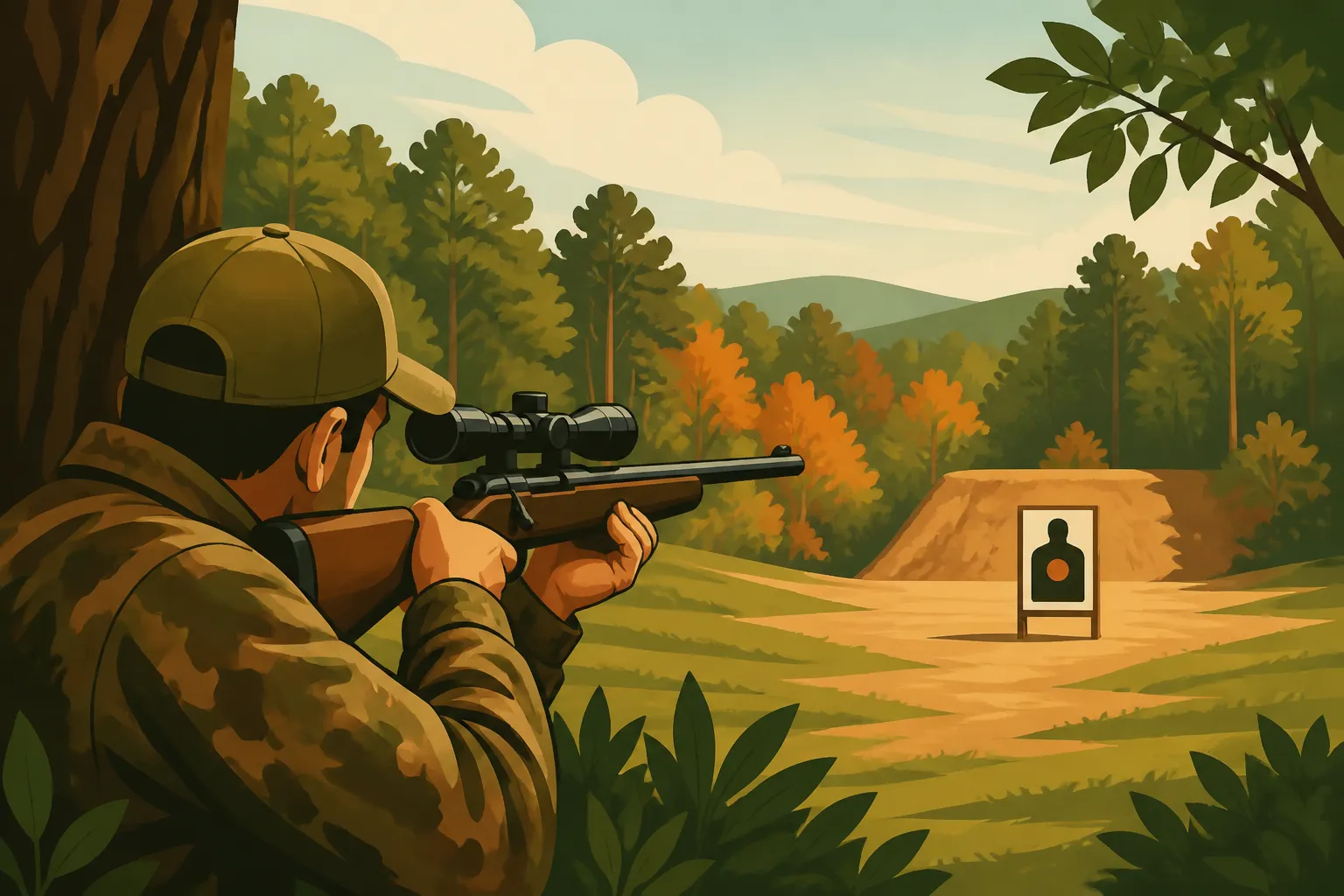
Think about how you typically shoot a deer in the woods. Is it always from a perfectly stable bench rest? Probably not. More often, you're standing, kneeling, sitting on a bucket, or leaning against a tree. You might be shooting off-hand, or using shooting sticks. Your practice should reflect this. Set up targets at varying, unknown distances (25, 50, 75, 100 yards) and practice shooting from different field positions. Get out of the bench rest and practice from a kneeling stance, sitting on a stool, or leaning against a wobbly tripod. Practice quickly getting into position and acquiring your target. Consider incorporating obstacles into your practice range – not to shoot through them, but to practice finding clear lanes around them, just as you would in the woods. This builds muscle memory and confidence for those less-than-ideal, real-world situations.
Quick Target Acquisition and Follow-Up Shots
Deer in the Piedmont rarely loiter. They often appear suddenly, pause briefly, and then move on. This means quick target acquisition is paramount. Practice should focus on getting your rifle shouldered, finding the target in your scope, and making an ethical shot rapidly. This isn't about rushing, but about efficiency. Practice what I call "ready-up drills." Start with your rifle at a low ready, spot a target, shoulder the rifle, acquire the target, and take a "shot" (dry firing or with snap caps if safe). Time yourself. How long does it take you to go from spotting to aiming? The faster and smoother you can do this, the better your chances of capitalizing on those fleeting opportunities. Additionally, practice follow-up shots. Sometimes, even a perfectly placed shot doesn't drop a deer instantly, or you might need to take another shot at a second deer if permitted. Being able to cycle your action and re-acquire your target quickly is a valuable skill in the woods.
Understanding Ballistics at Closer Ranges
While we often obsess over bullet drop at 300 yards, it's equally important to understand how your bullet performs at 25, 50, and 75 yards. Many hunters zero their rifles at 100 or 150 yards. While this is a good general practice, it's worth remembering that your bullet will actually be high at certain closer ranges. For example, if you zero at 100 yards, your bullet might be an inch or two high at 50 yards, depending on your caliber and muzzle velocity. This isn't a problem for a deer's vitals, but being aware of it prevents any second-guessing. Knowing your rifle's trajectory at common Piedmont distances means you can confidently place your shot without overthinking holdover or holdunder. Most ballistic calculators or even a simple zeroing target will show you these figures. It’s also important to understand the bullet's impact energy at these closer ranges – many modern bullets are designed to perform well at a broad spectrum of velocities, but some might be optimized for longer ranges and behave differently when impacting at high velocity from a short shot. Always verify your ammunition's performance at your expected hunting ranges. For advice on fine-tuning your zero, consider Zeroing at 100 Yards for Field Edge Hunting.
Safety Considerations for Hunting in Densely Wooded Areas
Hunting in the dense, often crowded woods of the Piedmont requires an elevated level of safety awareness. Limited visibility and undulating terrain amplify the importance of fundamental safety practices.
Identifying Your Target and Backstop Clearly
This is, without a doubt, the most critical safety rule in any hunting scenario, but it takes on even greater significance in dense Piedmont woods. With limited visibility, it's incredibly easy to mistake a rustle in the leaves for a deer, or to see a partial outline and assume it's your target. Never, ever take a shot until you have positively identified your target beyond any doubt and are absolutely certain that it is a legal animal. Furthermore, you must always be aware of what is beyond your target. In rolling terrain, your bullet could pass through your deer and continue on, potentially traveling hundreds of yards. Make sure you have a solid backstop – a hill, a thick stand of timber, or the earth – behind your target. Avoid shooting towards skylines or where you cannot clearly see what lies beyond. This is not just about ethical hunting; it's about protecting yourself, other hunters, and landowners in the vicinity.
Understanding Bullet Travel and Ricochet Risks
Bullets, especially those traveling at high velocities, can do unexpected things after impact or after striking an obstruction. As mentioned earlier, the "brush-buster" is a myth, and any bullet can deflect off a twig or branch. But beyond that, bullets can ricochet off hard surfaces like rocks, frozen ground, or even tree trunks. In the mixed terrain of the Piedmont, with its rocky outcrops, varied soils, and abundant timber, the risk of a ricochet, while low for a responsible shot, is always present. Always consider where your bullet will go if it misses or passes through your target. If you're on a slight ridge shooting down into a draw, understand that your bullet could pass through the deer and continue travelling along the angle of the terrain. The goal is always to have your bullet safely dissipate into the ground or dense timber after striking your target, minimizing any risk of it traveling errantly.
Communicating in Group Hunts
While many deer hunters prefer to go solo, group hunts, particularly deer drives, are a common and effective tactic in the Piedmont for pushing deer out of thick cover. These hunts, however, require impeccable communication and adherence to strict safety protocols. Everyone involved needs to be aware of each other's positions at all times. blaze orange clothing, like those required by Georgia law (learn more about How Much Blaze Orange Georgia Requires), is absolutely mandatory, and even then, visual contact can be difficult in thick cover. Establish clear communication methods, whether through radios or agreed-upon signals, and stick to assigned lanes of fire. Never shoot towards another hunter's position, even if you see a deer heading that way. The risks associated with group hunts are higher, but with proper planning, clear communication, and unwavering discipline, they can be safe and productive. Remember, safety always comes first, and no deer is worth compromising the well-being of yourself or others.
Disclaimer
This article is for general informational purposes only and does not constitute professional advice. Laws, prices and regulations vary by location and change over time. Consult a qualified professional for guidance on your specific situation.