Two-Way Radios on a Deer Drive
There’s nothing quite like the excitement and camaraderie of a well-executed deer drive in Georgia, but let's be honest, trying to coordinate multiple hunters in thick woods or sprawling swamps with nothing but shouts or unreliable cell service can quickly turn exhilarating into frustrating. This guide is all about cutting through that communication chaos, showing you how two-way radios can transform your deer drives into safer, more efficient, and ultimately more successful ventures across Georgia's diverse hunting landscapes.
Why Two-Way Radios Are Essential for Deer Drives in Georgia
Deer drives are a time-honored tradition in Georgia, especially when targeting deer that have become accustomed to human pressure or are holed up in thick cover. However, the effectiveness and safety of a drive hinge entirely on seamless communication. Without it, you’re often left yelling into the wind, hoping a buddy hears you, or worse, losing track of where everyone is, which can be downright dangerous. This isn’t just about making the hunt easier; it’s fundamentally about making it smarter and safer for everyone involved.
The Communication Gap in Georgia's Varied Terrain
Georgia is a state of incredible topographical diversity, from the steep, rugged mountains of the north to the sprawling pine plantations and cypress swamps of the south. Each of these unique environments presents its own set of communication challenges. In the mountainous terrain, cell signals often drop out in deep hollows or behind ridges, making traditional phone calls unreliable. The thick canopy of mature hardwoods or dense pine stands can absorb radio waves, limiting range, and the vast, open spaces of cutovers or agricultural fields might seem ideal but can still suffer from line-of-sight issues and sheer distance.
Imagine you're trying to push deer through a sprawling tract of public land in the Chattahoochee National Forest. One hunter might be on a high ridge, another in a creek bottom, and a third trying to navigate a dense rhododendron thicket. Relying on shouting is futile, and if your phone doesn't have service, you're effectively isolated. This isolation can lead to misdirected deer, missed opportunities, or even worse, safety concerns if someone takes a wrong turn or encounters an unexpected obstacle. Two-way radios bridge these gaps, offering instant, reliable communication that simply isn't possible with other methods.
Enhancing Safety and Efficiency
The primary benefit of two-way radios during a deer drive isn't just about calling out deer; it's about establishing a robust safety net and maximizing the efficiency of your hunting party. When you have multiple people pushing game and others strategically positioned on stand, knowing everyone's exact location and status is paramount. A driver might encounter unforeseen hazards, like a deep ravine or a fallen tree, and needs to relay that information immediately. Similarly, standers need to know if the drive is slowing down, speeding up, or changing direction to properly anticipate where deer might emerge.
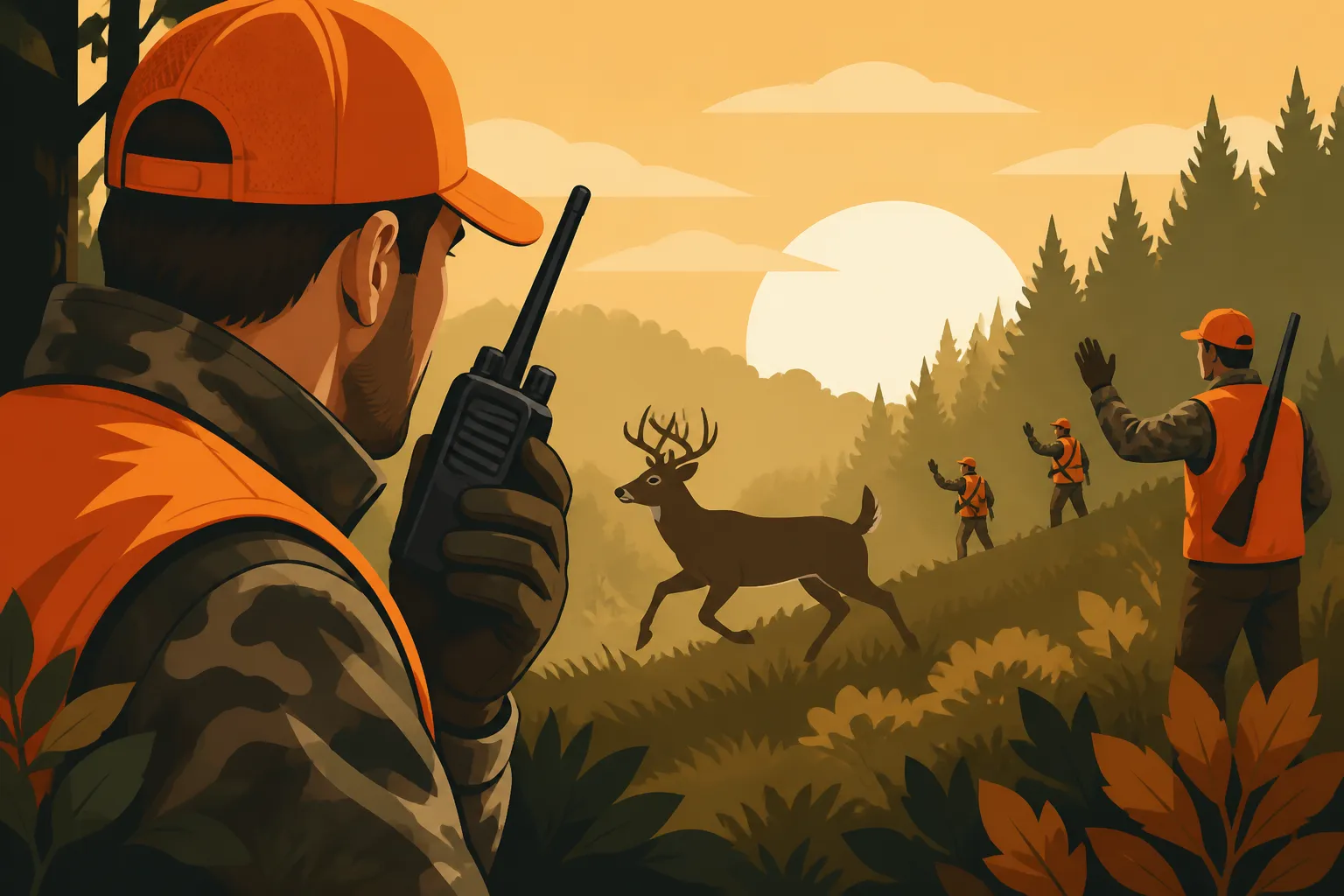
Consider a scenario where a deer is spotted breaking cover, but it's heading towards a stander who isn't aware of its approach. With radios, the driver can call out, "Deer moving left towards Stand 3!" giving that hunter crucial seconds to prepare. This real-time information flow allows for dynamic adjustments to the drive, ensuring that deer are pushed towards waiting guns rather than simply scattering. This level of coordination is especially critical on larger properties or when you're doing Deer Drives on Georgia Public Land, where knowing exactly where each member of your party is at all times is not just helpful but essential for avoiding accidents. Without radios, drives can devolve into disorganized pushes, often resulting in deer slipping through gaps or even, tragically, hunters getting too close to the line of fire.
Choosing the Right Two-Way Radios for Georgia Deer Drives
Selecting the right communication tool is crucial for a successful and safe deer drive. Not all two-way radios are created equal, and what works for a quick chat across the yard won't necessarily cut it in the vast, wild places we hunt here in Georgia. You need gear that can stand up to the elements, provide clear communication, and have the range to connect your team across varied terrain.
Key Features to Look For
When you're out in the Georgia woods, your equipment needs to be as rugged and reliable as you are. For two-way radios, this means focusing on a few critical features. First, range and power are paramount. Look for radios with higher wattage, often 2-5 watts for handheld units, which provides better signal penetration through dense timber and over rolling hills. While manufacturers might advertise incredible maximum ranges, remember that actual usable range in varied terrain will be significantly less, so always aim for more power than you think you need. Consider brands that prioritize clear signal transmission even in challenging environments. For hunters who rely on precise location data and communication, integrating a solid radio with a robust mapping app like those offered by GoHunt can make a huge difference in plotting your drive and maintaining contact.
Battery life is another non-negotiable feature. A dead radio in the middle of a drive is useless. Look for radios with rechargeable lithium-ion batteries and consider carrying spares or a portable power bank, especially for longer days afield. Durability and weather resistance are also critical; Georgia weather can be unpredictable, from humid downpours to unexpected cold snaps. Radios with an IP (Ingress Protection) rating indicate their resistance to dust and water, which is a must-have for hunting gear. Beyond that, features like privacy codes (DCS/CTCSS tones) allow you to share a channel with your group without picking up chatter from other parties, and hands-free operation (VOX) can be incredibly useful when you're carrying a firearm and need to communicate quickly without fumbling with buttons.
FRS vs. GMRS Radios in the Field
When you start looking at two-way radios, you'll quickly encounter the terms FRS and GMRS. Understanding the difference is key to choosing the right tool for your Georgia deer drives.
FRS (Family Radio Service) radios are perhaps the most common and accessible option. They operate on specific channels, are license-free, and generally have lower power output (up to 2 watts). This means their range is more limited, often topping out at a mile or two in ideal conditions, and significantly less in dense woods. They're great for smaller, tighter drives where your group is staying relatively close together, perhaps Deer Drives With Three or Four Hunters on a smaller private tract or a very localized push through a dense thicket. They are user-friendly, inexpensive, and readily available, making them a good entry-level choice for many hunting groups.
GMRS (General Mobile Radio Service) radios, on the other hand, offer more power (up to 50 watts for mobile units, though handhelds are typically 5 watts) and, consequently, much better range and signal penetration. To use GMRS radios, you need a license from the FCC, which covers your entire immediate family for multiple years. The license process might sound daunting, but it's a relatively simple online application and a modest fee; no test is required. GMRS radios are ideal for larger properties, widespread drives, or when hunting in challenging terrain where maximum range is necessary. They often allow for external antennas, which can further boost signal strength, and are typically more rugged. While the upfront cost might be a bit higher and the license an extra step, the enhanced communication capability and safety benefits often make GMRS the superior choice for serious deer drivers in Georgia, especially when coordinating across several hundred acres or more.
Here’s a quick comparison to help you weigh your options:
| Feature | FRS (Family Radio Service) | GMRS (General Mobile Radio Service) |
|---|---|---|
| License | No license required | FCC license required (covers family) |
| Power Output | Up to 2 watts (handhelds) | Up to 5 watts (handhelds), up to 50 watts (mobile/base) |
| Range (Typical) | 0.5 – 2 miles in real-world conditions (less in dense cover) | 1 – 5+ miles in real-world conditions (better in dense cover) |
| Channels | Shared FRS/GMRS channels, lower power access | Dedicated GMRS channels, repeater-capable, higher power access |
| Cost | Generally lower | Generally higher (plus license fee) |
| Antenna | Integrated, non-removable | Often removable/upgradeable for better performance |
| Best For | Small, close-knit drives, light recreational use | Larger properties, challenging terrain, serious hunting groups |
Practical Application and Etiquette on the Drive
Having the best radios in the world won't do you much good if you don't know how to use them effectively and courteously during a deer drive. Communication on a drive isn't just about transmitting information; it's about intelligent, disciplined communication that enhances everyone's experience and, most importantly, keeps everyone safe.
Setting Up for a Successful Drive with Radios
Before a single hunter steps into the woods for a drive, your radio setup needs to be ironclad. The first step is channel selection. Choose a clear channel that is unlikely to be used by other parties in the area. If you're using GMRS radios, you'll have more options, and using privacy codes (DCS/CTCSS) is highly recommended to minimize interference. Always do a battery check before leaving camp; nothing sours a drive faster than a radio dying ten minutes in. Fully charge all units, and consider having spares or power banks on hand, especially for those longer pushes or if you're hunting in cold weather, which can drain batteries faster.
Next, clearly communicate roles for the drive. Who are the drivers? Who are the standers? What are the boundaries of the drive? What is the expected pace? Designate a communication lead – typically the person organizing the drive – who will be the primary point of contact for important messages. This prevents multiple people from talking over each other or giving conflicting information. Before the drive begins, conduct pre-drive checks and signal tests. Have everyone spread out to their initial positions and do a radio check. "Radio check, Stand 1, over." "Loud and clear, Stand 1, over." This confirms everyone's radio is working and that they're on the correct channel. Sometimes, a quick glance at a mapping app like the one from GoHunt can help you visualize the drive route and identify potential dead zones where communication might be spotty, allowing you to plan for those challenges.
Communication Protocols and Etiquette
Once the drive starts, disciplined communication becomes the backbone of safety and success. The golden rule is to keep transmissions clear and concise. Avoid rambling or unnecessary chatter. Use clear, simple language. Instead of saying, "I think I see something moving about a hundred yards ahead, looks like a deer, might be a buck, hard to tell," try, "Deer moving slowly ahead of Drive 1, possible buck, over." This delivers the essential information quickly and without confusion.
Consider establishing code words or shorthand for common phrases. For example, "Green light" could mean drivers are advancing, "Red light" means hold position, and "Contact" could indicate a deer spotted. This speeds up communication and reduces ambiguity. Always prioritize safety messages above all else. If there's a safety concern, like a hunter crossing a boundary or an unexpected obstacle, that message takes precedence over all other communications. Remember to always use "over" to indicate you've finished speaking and "clear" when ending a conversation or acknowledging a command. This clear back-and-forth communication is absolutely vital, particularly when trying to coordinate Deer Drives With Three or Four Hunters in challenging cover or on unfamiliar terrain.
Maximizing Performance and Longevity of Your Radios
Your two-way radios are an investment in safer, more effective hunting. Like any piece of essential gear, they perform best and last longest with proper care and understanding of their capabilities. Neglecting them in Georgia's sometimes harsh hunting environment can lead to frustrating failures when you need them most.
Extending Battery Life and Range
The best radio in the world is useless with a dead battery. To extend battery life, always start with a full charge. During the drive, instruct your team to use lower power settings when short-range communication is sufficient. Most radios have a low/high power setting, and low power can significantly prolong battery life without sacrificing communication on shorter distances. For longer days, especially if you're out from dawn till dusk or in the depths of a Cold-Weather Sitting Strategy in a Georgia January, carrying spare, fully charged batteries or a portable USB power bank is a smart move.
Understanding terrain limitations is also crucial for maximizing range. Two-way radios primarily rely on line-of-sight communication. In thick forests, deep ravines, or behind large hills, the signal will be attenuated or blocked. Try to communicate from higher ground if possible, or anticipate these dead zones when planning your drive. For standers, positioning your antenna vertically and as high as comfortably possible can make a difference. While no radio can completely defy physics, smart use and preparation can greatly enhance your effective communication range across Georgia's varied landscapes.
Care and Maintenance in Georgia's Environment
Georgia's hunting seasons often mean dealing with humidity, rain, dust, and sometimes extreme temperatures. Proper care and maintenance will ensure your radios are ready for action whenever you are. Protection from moisture and dust is paramount. Even if your radio boasts a good IP rating, it's wise to keep it in a waterproof pouch or a zippered pocket, especially during unexpected rain showers or if you're navigating through dense, wet brush in a Hunting a Funnel Between Two Swamps. Dust and grime can also work their way into buttons and ports, affecting performance. Regularly wipe down your radios with a damp cloth to keep them clean.
Proper charging practices are vital for battery longevity. Avoid overcharging or completely draining the battery repeatedly, as this can degrade its overall capacity over time. Always use the manufacturer-recommended charger. When storing your radios during the off-season, ensure the batteries are partially charged (around 50-60%) and store them in a cool, dry place. Extreme heat in a truck cab during the summer or prolonged exposure to freezing temperatures can reduce battery life and even damage the internal components of the radio. By taking these simple steps, your two-way radios will serve you reliably for many seasons to come, ensuring that your communication remains crystal clear whether you're planning Opening Weekend Tactics for Georgia Firearms Season or just doing a quiet late-season push.
Disclaimer
This article is for general informational purposes only and does not constitute professional advice. Laws, prices and regulations vary by location and change over time. Consult a qualified professional for guidance on your specific situation.