Georgia Cottonmouth Range in Swamp Country
For many Georgia hunters, the rich, vibrant ecosystems of our state's swamps and river bottoms offer unparalleled opportunities for pursuing deer, hogs, and turkeys. But these same fertile grounds are also home to the fascinating, yet often misunderstood, cottonmouth, a venomous snake that can be a real concern for anyone navigating its domain. This guide will help you understand where these snakes are found in Georgia's watery landscapes, how to identify them, and most importantly, how to stay safe while enjoying your time afield.
Understanding the Georgia Cottonmouth
The cottonmouth, Agkistrodon piscivorus, also commonly known as a water moccasin, is a pit viper that thrives in aquatic environments. Its presence is a natural, integral part of Georgia's swamp country ecosystem, serving as both predator and prey. For hunters, knowing this snake means respecting its habitat and understanding its behavior, rather than fearing every rustle in the undergrowth.
Physical Characteristics and Identification
Cottonmouths possess several key features that help distinguish them from other water snakes. They are relatively stout-bodied snakes, often growing to lengths between 2 to 4 feet, though some larger individuals have been found. Their coloration can vary widely depending on age and region, ranging from dark brown or black to olive, tan, or even yellowish with darker crossbands. Young cottonmouths often have more distinct, bright crossbands, sometimes with a sulfur-yellow tail tip, which they use to lure prey. As they mature, these patterns tend to darken and obscure.
One of the most defining characteristics, and the origin of their name, is the stark white, cotton-like interior of their mouth, which they display prominently when threatened. They also have a distinctly triangular, blocky head, noticeably wider than their neck, and elliptical (cat-like) pupils, though observing pupils can be dangerous and is not a recommended primary identification method in the field. Non-venomous water snakes, by contrast, usually have round pupils and heads that are not much wider than their necks. Another clue is their stout, heavy body and often a dark line running from their eye back to their jaw.
Behavior and Temperament
Cottonmouths are often portrayed as aggressive, but in reality, they prefer to avoid confrontation. When approached, their first instinct is typically to retreat or remain still and camouflaged. If cornered or feeling threatened, they will often coil their body, vibrating their tail (like a rattlesnake, but silently), and open their mouth wide to display that characteristic white interior—a clear warning sign. They may also emit a musk. Striking is usually a last resort.
They are semi-aquatic, meaning they spend significant time both in and out of water. You'll often see them basking on logs, rocks, or branches overhanging water, or swimming through ponds, streams, and ditches. Unlike non-venomous water snakes, which tend to swim with only their head visible, cottonmouths often swim with most of their body floating on the surface of the water, which can be another helpful (though not foolproof) identifier. Their diet consists mainly of fish, amphibians, other snakes, and small mammals, making them apex predators in their chosen habitat.
Where Cottonmouths Range in Georgia's Swamps
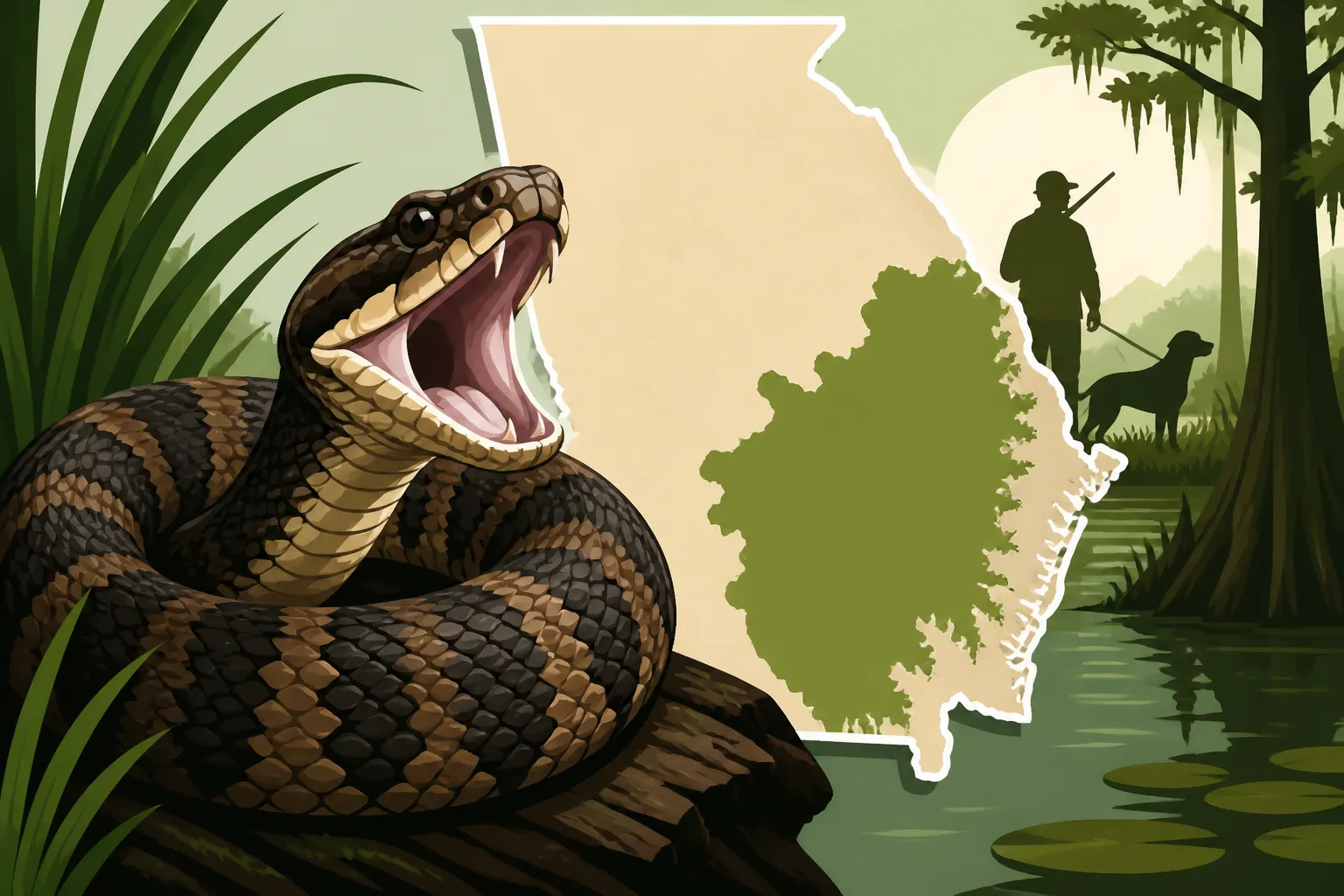
In Georgia, cottonmouths are predominantly found throughout the Coastal Plain and Piedmont regions, particularly in areas with abundant wetlands, swamps, rivers, and slow-moving water bodies. These habitats provide the perfect combination of water, cover, and prey that these snakes need to thrive. While less common, they can occasionally be found in the southernmost parts of the Appalachian foothills where suitable aquatic habitats exist.
Key Habitat Regions
The vast, interconnected waterways of South Georgia are prime cottonmouth territory. This includes the sprawling cypress swamps of the Okefenokee, the blackwater rivers like the Altamaha, Suwannee, and Satilla, and the countless smaller creeks, ponds, and drainage ditches that crisscross the landscape. If you're hunting in these areas, especially during warmer months, you should always assume cottonmouths are present. Hunting Georgia Swamp and River Bottom Deer is a great read if you plan on navigating these challenging but rewarding environments.
Even in the Piedmont, where elevations are higher and water bodies sometimes more defined, any area with consistent water—creek bottoms, beaver ponds, slow-moving streams, and marshy field edges—can hold cottonmouths. Hunters often encounter them when setting up a stand near a creek crossing or tracking a deer through dense, wet cover. Understanding these specific microhabitats within the broader regions is crucial. For instance, when using a tool like GoHunt to scout public or private lands, pay close attention to the topographic maps and satellite imagery for those tell-tale blue lines and low-lying green areas that indicate wet, swampy conditions.
Seasonal Activity and Preferred Hangouts
Cottonmouth activity is highly dependent on temperature. They are most active during the warmer months, roughly from April through October, when temperatures are ideal for them to forage and bask. During the hottest parts of summer, they may become more nocturnal, seeking out cooler temperatures to hunt. As fall progresses and temperatures drop, they become less active and will eventually seek out secure places to brumate (a reptilian form of hibernation) for the winter. This often involves burrowing into logs, under rocks, or in mammal burrows near water.
Within their habitat, they have their preferred spots. Think about where a snake might find cover, warmth, and food. This includes:
- Along water edges: Basking on banks, fallen logs, or cypress knees.
- In dense vegetation: Hiding among tall grasses, reeds, and bushes at the water's edge.
- Under debris: Piles of leaves, rotting logs, or discarded construction materials.
- Around beaver dams and lodges: These structures create ideal habitat and hunting grounds.
- Shallow water: Hunting for fish and amphibians.
When scouting with your GoHunt app, mark potential bedding areas or travel corridors for game that might also coincide with these prime snake habitats. Knowing where you might run into one can help you plan your approach and remain vigilant. Recovering a Deer From a Cypress Swamp will undoubtedly involve navigating some of these prime cottonmouth haunts.
Staying Safe While Hunting in Cottonmouth Country
Encountering a cottonmouth in the wild is certainly an experience that can get your heart pounding, but with proper precautions and knowledge, you can mitigate the risks and enjoy your hunt. It's all about awareness and respect for the creatures that call these places home.
Essential Safety Gear and Practices
Your gear can be your first line of defense. The single most important piece of equipment for hunting in swampy, snake-prone areas are snake boots or gaiters. These offer crucial protection for your lower legs, preventing fangs from penetrating your skin. Look for models specifically designed for snake protection. Don't cheap out on this—it's an investment in your safety. Snake Boots for Georgia Swamp Ground details what to look for.
Beyond boots, carry a sturdy walking stick or trekking poles. This isn't just for balance; it allows you to probe ahead of you in dense brush, rustle leaves, or move fallen branches without putting your hands or feet directly into potential snake territory. It gives them a chance to move away before you're too close. Always wear long pants, even in warm weather, as another layer of protection. When you’re putting together your hunting pack, consider what to bring. A good first aid kit, especially one equipped for remote areas, is non-negotiable. First Aid Kits for Remote Swamp Ground is a must-read for anyone heading into the wilderness.
Safety Practices to Adopt:
- Watch your step: Always look where you are placing your feet and hands. If climbing over a log, step on it first, then over it, rather than blindly stepping onto the other side.
- Avoid reaching into blind spots: Never put your hand into brush piles, hollow logs, or under rocks without first probing the area with a stick.
- Be especially careful near water: Cottonmouths are aquatic. Areas around ponds, creeks, swamp edges, and even shallow puddles are high-risk zones.
- Hunt with a buddy: Having another person along means help is available if an emergency occurs. This is particularly true when hunting in remote swamp areas where cell service might be spotty.
- Stay calm: If you encounter a cottonmouth, give it a wide berth. Do not try to harass, capture, or kill the snake. Most bites occur when people try to interact with them. Simply back away slowly and let it go on its way.
- Be aware of your surroundings: Constantly scan the ground ahead of you, and check tree limbs overhead if you're in an area where they might be basking.
What to Do in Case of a Bite
While rare, a cottonmouth bite is a serious medical emergency. Knowing what to do (and what not to do) can make a critical difference.
If someone is bitten:
- Stay calm and move away from the snake.
- Call 911 immediately. Provide your exact location. If you’re in a remote area, use your GoHunt app or a GPS device to pinpoint your coordinates. Using Georgia Outdoors Without Cell Service is a good resource for preparing for such scenarios.
- Keep the bitten limb immobilized and below the level of the heart.
- Remove any tight clothing or jewelry from the affected area, as swelling will occur.
- Clean the wound gently with soap and water if available.
- Cover the wound with a clean, dry dressing.
What NOT to do:
- Do NOT try to suck out the venom. This is ineffective and can introduce more bacteria.
- Do NOT apply a tourniquet. This can do more harm than good by concentrating venom and cutting off blood flow.
- Do NOT apply ice or heat.
- Do NOT cut the wound.
- Do NOT drink alcohol or caffeine, or take pain medication.
- Do NOT try to capture or kill the snake. This risks another bite and wastes precious time. Describing the snake to medical professionals can be helpful, but your priority is getting help.
Distinguishing Cottonmouths from Harmless Look-Alikes
Georgia is home to many non-venomous water snakes that are often mistaken for cottonmouths. Misidentifying a harmless snake as dangerous can lead to unnecessary fear or, worse, harm to a beneficial creature. Learning the differences is key to peaceful coexistence in the field.
Common Mimics in Georgia Waters
Several species of non-venomous water snakes (genus Nerodia) are frequently confused with cottonmouths because they share similar aquatic habitats and can exhibit defensive behaviors.
Common Misidentified Species:
- Northern Water Snake (Nerodia sipedon): Widespread throughout Georgia. Often brownish or grayish with dark blotches. Can be aggressive when cornered, flattening its head to appear triangular and biting repeatedly.
- Brown Water Snake (Nerodia taxispilota): A large, heavy-bodied snake found in slow-moving water, often with square-shaped dark blotches alternating on its sides and back. Frequently basks on overhanging branches.
- Banded Water Snake (Nerodia fasciata): Common in the Coastal Plain. Distinct dark bands across a lighter body. Like other Nerodia, it can be feisty when handled.
The main challenge for hunters is that when threatened, these non-venomous water snakes will often flatten their heads, making them appear triangular, much like a cottonmouth. They will also strike and bite, though their bite is not venomous. They don't typically display a white mouth, but can open it defensively.
Key Distinguishing Features Table
To help you quickly differentiate, here's a table summarizing the key visual differences between cottonmouths and typical non-venomous water snakes you might encounter in Georgia's swamp country.
| Feature | Cottonmouth (Venomous) | Non-Venomous Water Snakes (Nerodia spp.) |
|---|---|---|
| Head Shape | Distinctly triangular, broad, much wider than neck | More slender, head not much wider than neck (can flatten) |
| Pupils | Elliptical (vertical slit, like a cat's eye) | Round |
| Body Shape | Stout, heavy-bodied, muscular | More slender, though some can be thick |
| Snout | Blunter, often with a pit (heat-sensing) below eye | More pointed, no pit |
| Swimming Style | Often swims with most of its body floating on surface | Usually swims with only head visible above water |
| Defensive Display | Coils, mouth wide open (white interior), vibrating tail | May flatten head, bite repeatedly, musk, vibrating tail |
| Coloration/Pattern | Highly variable; often dark, distinct crossbands (young), or uniform dark (adults). Dark line from eye to jaw. | Variable; blotches or bands, typically not solid dark as adults |
Remember, these are general guidelines. If you are ever unsure, err on the side of caution. Give the snake a wide berth, and assume it is venomous. It's better to be safe than sorry. Observing their swimming style can sometimes be a quick indicator when hunting Georgia Waterfowl Hunting on Coast and Swamp, but always maintain a safe distance.
Navigating Georgia's swamps and river bottoms is an incredible experience for any hunter. By understanding the cottonmouth's habits, recognizing its characteristics, and practicing smart safety protocols, you can confidently explore these wild spaces. Keep your eyes open, your boots on, and your respect for nature at the forefront of every hunting trip.
Disclaimer
This article is for general informational purposes only and does not constitute professional advice. Laws, prices and regulations vary by location and change over time. Consult a qualified professional for guidance on your specific situation.