Georgia Coastal Marsh Teal Numbers
Many waterfowlers in Georgia dream of fast-paced action in the coastal marshes, but pinning down consistent teal numbers can feel like chasing ghosts. The elusive nature of these migratory birds, coupled with the vast, dynamic marsh environment, often leaves hunters wondering where to even begin their search. This comprehensive guide aims to demystify the presence of green-winged and blue-winged teal in Georgia's stunning coastal marshes, helping you understand their patterns, the factors influencing their numbers, and ultimately improve your hunting strategy.
Understanding Georgia's Coastal Marsh Ecosystem for Teal
Georgia's coastline is a unique and vibrant tapestry of salt marshes, tidal creeks, and river deltas, making it an incredibly important stopover and wintering ground for a variety of migratory waterfowl, including teal. To effectively hunt these quick, agile ducks, it's crucial to first grasp the intricacies of the environment they inhabit. It's not just a big, wet area; it's a dynamic system with specific features that draw these birds in.
The Unique Environment of Georgia's Tidal Marshes
Imagine miles of Spartina alterniflora grasses stretching as far as the eye can see, intersected by an intricate network of tidal creeks and sloughs that wind their way through the mud flats. This is the heart of Georgia's coastal marsh. The constant ebb and flow of the tide dictates everything here, from the salinity levels in different areas to the exposure of mud flats teeming with invertebrates and plant seeds. Teal, particularly blue-winged teal during the early season, thrive in these shallow, brackish environments where food is abundant and cover is dense.
These marshes are especially productive where major river systems like the Altamaha, Satilla, and St. Marys meet the Atlantic. The influx of freshwater creates a gradient, leading to areas of lower salinity that often hold richer food sources for dabbling ducks like teal. Understanding these transitions, where brackish water meets fresher influences, can be a game-changer. These areas act as natural highways and feeding grounds, concentrating birds in specific pockets rather than being spread thinly across the entire vast marsh. When you're scouting, look for those transitions – the subtle changes in vegetation or water clarity that signal a shift in habitat type. For a broader look at the region, consider the unique aspects of Coastal Georgia Barrier Island Hunts which, while focused on deer, highlights the geographical features of the coast.
The Two Main Species: Blue-winged and Green-winged Teal
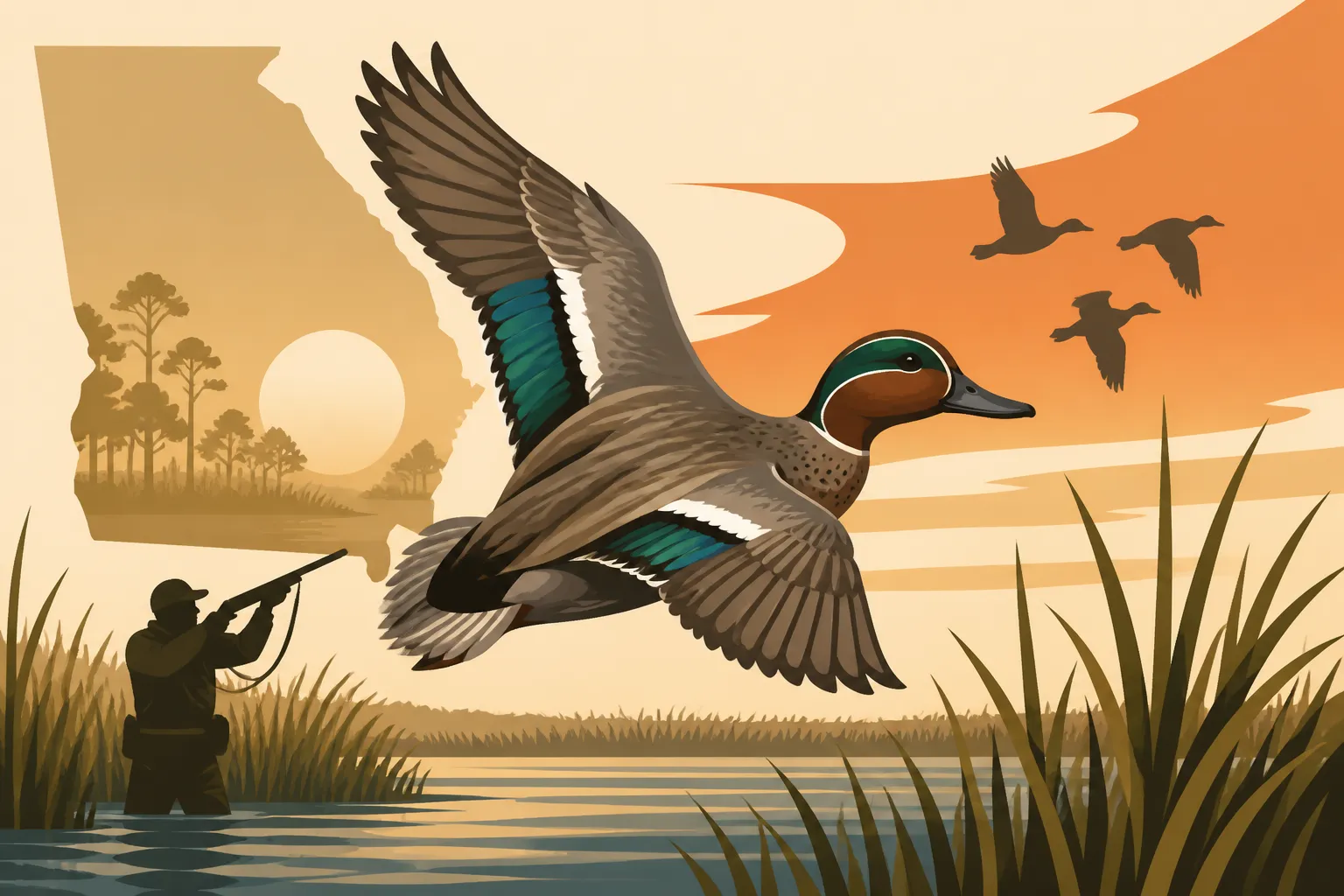
When we talk about teal in Georgia's coastal marshes, we're primarily referring to two distinct species: the blue-winged teal and the green-winged teal. While both are small, fast-flying ducks, they have different migratory habits and often utilize the marsh slightly differently.
Blue-winged teal are typically the early birds of the duck migration. They're often the first species to push south with the earliest cold fronts of late summer and early fall, sometimes arriving in Georgia's marshes by early September. This makes them the primary target during Georgia's special early teal season. They prefer shallower, more open mud flats and brackish ponds within the marsh where they can easily dabble for seeds and aquatic invertebrates. Their diet in the marsh is heavily influenced by what's available, feasting on seeds from plants like widgeongrass, smartweed, and millet that thrive in these fluctuating water conditions.
Green-winged teal tend to migrate a bit later in the fall, becoming more prevalent in the coastal marshes from October through January. While they also favor shallow waters, they might gravitate more towards areas with slightly fresher influences or pockets of thicker emergent vegetation. Both species are opportunistic feeders, but green-wings might tolerate slightly more open water if there's an abundance of submerged aquatic vegetation. Recognizing which species is more likely to be present based on the calendar can help tailor your expectations and tactics. Both species exhibit incredibly swift and erratic flight patterns, making them a challenging and rewarding target.
Factors Influencing Teal Numbers and Distribution
Teal numbers in Georgia's coastal marshes aren't static; they fluctuate significantly based on a confluence of environmental factors. It's not just about if they're here, but how many and where they've decided to settle. As hunters, understanding these influences can help us predict good hunting days and productive locations. It feels like solving a puzzle sometimes, trying to piece together where the birds are going to be next.
The Role of Weather and Migration Patterns
One of the most significant drivers of teal numbers in Georgia's coastal marshes is the weather, particularly conditions further north along the Atlantic Flyway. Early season blue-winged teal movements are often triggered by the first real cold fronts pushing down from Canada and the northern states. These fronts bring cooler temperatures and strong northerly winds, prompting birds to begin their southward journey. If the weather remains mild up north, blue-wings might linger, resulting in fewer birds arriving in Georgia during the early teal season.
Conversely, a strong, sustained cold snap can push a wave of birds into our marshes. Similarly, for green-winged teal arriving later, severe winter weather in states like the Carolinas or Virginia can drive them further south into Georgia's relatively milder climate. Wind direction also plays a crucial role in local distribution. Strong winds can make certain marsh areas too choppy for feeding or resting, forcing birds into more sheltered creeks or ponds. Paying attention to these weather patterns – not just locally, but up the flyway – can give you a real edge in predicting bird movements. To truly grasp the bigger picture, it's worth reviewing how broader Duck Migration Timing Through Georgia impacts all waterfowl species.
Habitat Health and Food Availability
The health and productivity of the coastal marsh habitat are absolutely critical to attracting and holding teal. These birds are highly dependent on specific food sources, primarily the seeds of emergent and submerged aquatic vegetation. Factors that affect the growth of these plants directly impact teal numbers.
For instance, prolonged drought conditions can increase marsh salinity, stress freshwater-dependent plants, and expose mud flats to drying, reducing overall food availability. On the other hand, excessive rainfall can reduce salinity, potentially altering the plant communities. Human activities also play a part. Coastal development, dredging, and alteration of natural hydrology can degrade or fragment important marsh habitats. Areas with abundant widgeongrass, smartweed, wild millet, and other favored forage are magnets for teal. If a particular marsh section experienced a poor growing season for these plants, birds might bypass it for more productive areas. Hunters who scout not just for birds, but for healthy food beds, often find more consistent success. For a deep dive into how habitat affects hunting, check out Hunting Coastal Georgia Marsh Waterfowl.
Hunting Pressure and Refuge Areas
Teal, like most waterfowl, are incredibly sensitive to hunting pressure. A marsh that sees heavy hunting activity day after day will quickly become less attractive to birds looking for a place to feed and rest. These ducks are smart; they'll quickly learn to avoid areas where they are consistently disturbed. This often means they'll move to less accessible areas, deeper into the marsh, or seek refuge in areas where hunting is restricted or difficult.
Many larger marsh systems have natural refuge areas – remote ponds, large expanses of undeveloped land, or areas difficult to reach by boat – that serve as critical safe zones. Birds will often feed in accessible areas at dawn and dusk, then retreat to these sanctuaries during the day. Understanding where these unpressured zones exist can help you predict flight patterns and identify choke points where birds might funnel as they move between feeding and resting grounds. Sometimes, finding success means venturing farther than most, or targeting days when fewer hunters are out, to catch the birds before they become too wary.
Monitoring Teal Populations and Harvest Data
As hunters, we're naturally curious about how many birds are out there. While you can't get an exact, real-time count of every teal in the marsh, various efforts help us understand population trends and overall health. Knowing where to look for this information, and how to interpret it, can give you a better grasp of what to expect when you head out.
Georgia DNR's Role in Waterfowl Management
The Georgia Department of Natural Resources (DNR) plays a vital role in monitoring and managing waterfowl populations across the state, including teal. This involves conducting aerial surveys during migration periods and wintering months, often in collaboration with federal agencies and other states along the Atlantic Flyway. These surveys help estimate population sizes and track long-term trends, informing season dates and bag limits.
Additionally, banding efforts provide valuable data on migration routes, survival rates, and harvest rates. When a hunter reports a banded bird, that data point contributes to a larger picture that helps wildlife managers make informed decisions. While these broad surveys don't tell you exactly how many birds are in your favorite creek on any given Saturday, they provide the ecological context that dictates the overall health of the flyway and, by extension, the number of birds that could potentially pass through or winter in Georgia. For a broader perspective on these efforts, read more about Georgia Waterfowl Hunting on Coast and Swamp.
Interpreting Harvest Reports and Local Observations
Beyond scientific surveys, harvest reports offer another window into teal numbers and hunter success. When hunters check their game, this data is collected and analyzed, providing insights into which species are being harvested, in what quantities, and from which general regions. While reporting rates can vary and the data reflects harvest rather than population, it can still highlight regional hotspots and years of strong or weak teal presence. For example, consistently high harvest numbers for blue-winged teal in coastal counties during the early season might indicate a strong migration that year.
However, harvest data should always be combined with your own local observations and, perhaps most importantly, conversations with other seasoned hunters. There's no substitute for getting out on the water, seeing birds, observing their patterns, and scouting specific areas. Local intel from guides or folks who spend a lot of time in the marsh can provide invaluable real-time insights that complement the broader, historical data. Looking at Georgia Duck Harvest Numbers can give you a general idea of past success, but current conditions always trump historical averages.
Understanding Georgia's Teal Season Dates
Georgia typically offers an early teal season, usually in September, specifically targeting the first wave of blue-winged teal migrating south. This season is distinct from the regular duck season and has its own specific dates and bag limits. The timing of this early season is carefully set based on migration patterns to maximize harvest opportunities for blue-wings while minimizing the take of other duck species that haven't yet arrived in significant numbers.
Later in the fall and winter, during the regular statewide duck season, both blue-winged and green-winged teal can be harvested. Green-winged teal tend to be more prevalent during these later dates. It's absolutely critical to be aware of the exact season dates, shooting hours, and bag limits, which can sometimes vary slightly from year to year. Remember, you'll also need to ensure you have all the necessary licenses, including a state hunting license, a Georgia migratory bird stamp, and a federal duck stamp. Getting your Georgia Migratory Bird Certification is a crucial step for any duck hunter. Additionally, understanding Georgia Duck Zone Boundaries can be important if there are specific regulations tied to geographical areas within the state.
Strategies for Hunting Coastal Marsh Teal
Okay, so we've talked about the marsh itself, what drives teal, and how we keep track of them. Now, let's get down to the brass tacks: how do you actually hunt these incredible little rockets in Georgia's coastal marshes? It's a different game than hunting big mallards on a flooded timber impoundment; it requires specific tactics and gear to succeed.
Scouting and Location Selection
The importance of scouting for teal in the coastal marsh cannot be overstated. Unlike a cornfield or a fixed pond, the marsh is vast and ever-changing with the tides. You need to identify key areas where birds are actively feeding and loafing. The best time to scout is often at low tide, as this reveals the exposed mud flats, channels, and submerged vegetation that teal key in on. Look for "feed sign" – areas where the mud has been worked over, or where specific seeds are abundant. Pay attention to bird activity: where are they flying? Where are they landing?
Identifying natural funnels, such as narrow creek intersections or bends, can also be highly productive. Teal often fly low along these waterways. When you find these spots, you can envision how birds will likely move. Using detailed mapping tools can be a huge asset here. Apps that show aerial photos and property lines can help you find remote pockets or understand the tidal flow. Always respect private property boundaries and ensure you have permission if you're not on public land. Learning how to effectively read the subtle cues of the marsh before the season even starts is key. For more on this, check out Reading a Tidal Marsh for a Morning Flight.
Decoy Spreads and Calling Tactics
When it comes to teal, less is often more with decoys. A small, realistic spread of 6-12 teal decoys is often sufficient, though mixing in a few mallard or pintail decoys can add realism. What's more important than sheer numbers is making the spread look active and natural. Teal are drawn to movement, so incorporating a jerk string or a spinning-wing decoy can be incredibly effective, especially in the typically calm waters of a tidal pond or creek at high tide. Place your decoys in shallow water, mimicking a flock feeding, with an open landing zone for incoming birds.
Calling for teal should be subtle and repetitive. Forget the loud, aggressive mallard calls; teal respond best to soft, rapid "peeps" and short, high-pitched quacks. A blue-winged teal often has a distinctive "spring" sound, while green-wings offer a high-pitched whistle. Practice these calls and use them sparingly to attract attention, then back off and let the decoys do the work as birds approach. Sometimes, a well-placed decoy and a few soft calls are all it takes. You might even adapt some general duck hunting strategies, like the concepts used in Jump-Shooting Georgia Beaver Ponds for Wood Ducks, for certain marsh scenarios.
Gear and Access for Marsh Hunting
Hunting Georgia's coastal marshes is an equipment-intensive endeavor, primarily because of the unique terrain and tidal challenges. First and foremost, a reliable boat is essential. A shallow-draft jon boat or a specialized marsh boat with a mud motor is often preferred, allowing you to navigate shallow creeks and mud flats. A good push pole is also invaluable for maneuvering in areas too shallow for the motor or when you need to be stealthy.
Waders are non-negotiable. Chest waders, preferably robust ones with good insulation and snake-proof features, will keep you dry and comfortable. The marsh bottom can be soft and uneven, so sturdy boots are a must. Don't forget your layered, waterproof camouflage clothing, as mornings can be chilly and the weather can change quickly. A robust bag for carrying decoys, shells, and snacks, along with a reliable headlamp for early morning or late evening treks, rounds out the essential gear. Having the right tools, like those mentioned in Marsh Boats and Push Poles and Waders for Tidal Marsh Hunting, makes the experience much safer and more enjoyable. While not every piece of gear applies to every situation, looking into Layout Blinds and Marsh Boats might also give you ideas for concealment.
| Feature | Blue-winged Teal | Green-winged Teal |
|---|---|---|
| Size | Small, slightly larger than green-winged | Smallest North American duck |
| Appearance (Drake) | Blue-gray head, distinct white crescent in front of eye, blue wing patch, speckled breast | Chestnut head, iridescent green ear patch, blue wing patch, vertically striped chest |
| Migration Timing | Earliest fall migrants to Georgia (Sept-Oct) | Later fall migrants, common Oct-Jan |
| Preferred Habitat | Shallow, emergent wetlands, brackish marshes, open mud flats, freshwater ponds | Shallow freshwater, brackish ponds, marsh edges, sheet water |
| Flight Speed | Very fast, agile, often erratic | Extremely fast, highly erratic, tight flocks |
| Vocalization | High-pitched "peep," soft quacks, often sounds like a spring toy | High-pitched whistle (drake), soft quack (hen), twittering flock sound |
Disclaimer
This article is for general informational purposes only and does not constitute professional advice. Laws, prices and regulations vary by location and change over time. Consult a qualified professional for guidance on your specific situation.