Georgia Deer Antler Growth Timeline
It's a question every hunter in Georgia has pondered: why do some bucks seem to carry impressive headgear even as youngsters, while others appear to struggle, only sporting spindly spikes year after year? Understanding the Georgia deer antler growth timeline is crucial for any hunter wanting to appreciate the incredible biology of our whitetails and make more informed decisions in the field, whether you're trying to manage your private land or simply curious about the bucks you encounter on public ground. This guide will walk you through the fascinating annual cycle of antler development, from tiny fuzz to hardened bone, and shed light on the multitude of factors that influence antler size throughout a buck's life in the Peach State.
The Earliest Stages: From Fawn to First Buttons
Antler growth is an amazing process, and its beginnings are often far earlier than most people realize. It’s not just about what happens in the spring and summer; it's a culmination of a deer's entire life story, starting almost from conception.
In the Womb: The Blueprint for Future Racks
Even before a fawn takes its first wobbly steps in the Georgia pines, the groundwork for its future antlers is being meticulously laid. Within the doe's womb, as the male fawn develops, tiny nubs begin to form on his skull. These are called pedicles, and they aren't antlers themselves, but rather the crucial bony platforms from which all future antlers will eventually erupt. Think of them as the permanent "bases" for antler growth, much like the foundation of a house that determines its overall footprint.
The health and nutritional status of the pregnant doe play a surprisingly significant role at this stage. A doe with access to abundant, high-quality forage – rich in protein, vitamins, and minerals – is more likely to give birth to fawns with well-developed pedicles. This early advantage can set the stage for better antler growth down the line, demonstrating that good herd health starts with the does. This is just one facet of understanding the overall Georgia Deer Herd Size and what it means for the individual animals within it.
The First Year: Button Bucks and Early Pedicle Growth
Once a male fawn is born, the pedicles continue to develop. By the time he’s about 4 to 6 months old, typically in his first autumn and winter, most male fawns will begin to develop what hunters affectionately call "buttons." These are small, bony projections that often feel like bumps just under the skin or might even break through slightly. Depending on their exact size and how much they protrude, these might not even be visible unless you’re up close.
Biologically, these buttons are the very first expressions of antler growth. They are crucial for establishing the vascular and bone structure necessary for the impressive racks that may come in subsequent years. A healthy button buck signals a deer that’s gotten off to a good start in life, with enough nutrients to begin this energy-intensive process. It’s a foundational step, and while not impressive to look at, it’s a vital part of the antler growth timeline.
The Yearling Leap: First Racks Appear
The next phase in antler development occurs as the buck enters his second year of life, commonly referred to as a "yearling" or "1.5-year-old" buck during the hunting season. This is where hunters often see the most dramatic and sometimes perplexing variations in antler size.
Variability at 1.5 Years Old: Spikes to Small Racks
The 1.5-year-old buck presents a fascinating snapshot of antler potential and environmental influence. This is when he grows his first true set of antlers, which will shed the following winter. The size and configuration of these first antlers can vary wildly across Georgia's diverse landscapes. In areas with exceptional nutrition and strong genetics, a yearling might sport a modest 6- or even 8-point rack, often with thin main beams and short tines. These bucks already look promising for their age.
However, it's just as common, if not more so, to see yearlings that carry only "spikes" – single, unbranched antlers. Sometimes these spikes are long and straight, other times they might be short and blunt. There's no single "normal" antler configuration for a 1.5-year-old buck in Georgia. This wide range often leads to discussions among hunters about whether a spike should be harvested or allowed to grow, highlighting the complexity of judging deer in the field. This stage is also often overlooked when considering the overall Georgia Buck Age Structure.
Environmental Impact on First Antlers
While genetics certainly provide the underlying blueprint for antler growth, at the yearling stage, environmental factors often play the dominant role in determining the size of that first rack. Nutrition, above all else, is paramount. A buck that had consistent access to abundant, high-quality forage – think lush green fields, mast crops, and nutritious browse – throughout his first spring and summer will simply have more energy and raw materials to allocate to antler development.
Conversely, a yearling buck that faced harsh conditions, such as drought, food scarcity, or high population density leading to competition for resources, will likely express a smaller, less developed first rack. This means that a spike in one area, suffering from poor nutrition, might have the same genetic potential as a small 8-point in a different, more fertile region. This variation is why tools like the GoHunt app, with its detailed mapping and habitat overlays, can be so valuable in understanding the potential of a specific hunting area. When considering Late-Season Food Sources for Georgia Whitetails, for example, you can see how consistent food availability throughout the year contributes to overall deer health and antler growth.
Reaching Potential: Mature Antler Development
As a buck successfully navigates each year, surviving hunting seasons, predators, and potential disease outbreaks, his body continues to mature, and with it, his antler-growing capabilities significantly increase.
The Growth Spurt: 2.5 to 4.5 Years Old
If a buck makes it past his yearling stage, his antler growth often undergoes a significant "growth spurt" as he reaches 2.5 and 3.5 years old. At 2.5 years old, he's still growing his body, building muscle mass and filling out. However, more resources are now being directed towards antler development compared to his first year. You'll typically see a noticeable increase in tine length and mass, and often a higher point count. A buck that was a spike at 1.5 might now be a respectable 6- or 8-point, sometimes with better mass than a bigger-racked yearling from a prime area.
By 3.5 years old, many Georgia bucks are truly starting to express their genetic potential. Their bodies are nearing full maturity, and the energy formerly used for body growth can now be channeled more extensively into antler production. You'll likely see thicker main beams, longer tines, and potentially a wider spread. This is often the age class where hunters start to get genuinely excited about the deer they're observing. It's a testament to the power of age management, as even average genetics can produce impressive racks if given enough time.
Peak Antler Expression: The Prime Years
For most white-tailed deer in Georgia, peak antler size is typically reached between 4.5 and 6.5 years of age. At this stage, a buck's skeletal and muscular growth is largely complete, meaning the vast majority of his available nutrients and energy can be channeled directly into growing the biggest rack his genetics and environment will allow. This is when you'll consistently see maximum main beam diameter, impressive tine length, substantial mass, and often the widest spreads. These are the bucks that frequently end up in the Georgia record books, showcasing years of good health and survival.
It's important to note that while 4.5-6.5 years old is the typical peak, some bucks, particularly those with exceptional genetics and living in prime habitat, might continue to increase in antler size into their 7.5 or even 8.5-year mark. However, beyond that, it's not uncommon to see a regression in antler quality. Older bucks might start to produce racks that are smaller, more asymmetrical, or develop atypical points. This natural decline is simply a part of aging, as their bodies begin to allocate resources differently. This understanding is key for hunters evaluating bucks for harvest, especially given regulations like Why Georgia Caps Antlered Bucks at Two, which aim to promote a healthier age structure.
The Annual Cycle: Shedding, Velvet, and Hardening
Antlers aren't permanent structures; they are a truly remarkable example of rapid annual bone growth. This cycle is driven primarily by hormonal changes within the buck's body, influenced by the changing length of daylight.
The Winter Drop: Shedding Old Antlers
Sometime between late December and early April, influenced by declining testosterone levels following the rut, bucks will shed their antlers. The exact timing varies based on the individual buck's health, nutritional state, and the severity of the winter. Often, you'll find single antlers, as bucks can rub one off and carry the other for days or even weeks before it, too, drops. For many, finding a shed antler is like finding buried treasure, a tangible reminder of a buck that made it through another year. Shed Hunting on Georgia Public Land has become a popular off-season activity, offering clues about the bucks that survived.
Once the antlers have shed, the pedicle at the base of the skull will heal over. Within days or weeks, the process of new antler growth begins almost immediately. It’s an incredibly efficient biological system, ready to restart the cycle for the coming year.
Rapid Spring Growth: The Velvet Stage
Throughout late winter, spring, and early summer, the new antlers grow rapidly. During this phase, they are covered in a soft, fuzzy skin known as velvet. This velvet is not just fuzzy; it's a living tissue rich with blood vessels and nerves, providing a constant supply of nutrients—protein, calcium, phosphorus, and other minerals—to the growing bone underneath. This is why good nutrition during the spring and summer is so critical; it directly fuels this rapid growth.
The velvet stage is a period of intense development. Bucks often appear reclusive during this time, preferring to stay in thicker cover as their antlers are soft, sensitive, and easily damaged. A hard knock could permanently deform a growing antler. Many hunters use trail cameras during this period to monitor antler progress and identify potential target bucks for the upcoming season. Understanding this growth period is crucial for setting expectations for the Georgia Deer Population Estimate you might encounter.
Summer to Fall: Hardening and Polishing
As late summer progresses into early autumn, typically from mid-August through early September in Georgia, the long hours of daylight trigger hormonal changes in the buck. Testosterone levels begin to rise, signaling the end of the antler growing phase. The blood flow to the velvet is cut off, causing it to dry up and become itchy. Bucks will then begin to rub their antlers vigorously on trees, saplings, and brush to remove the peeling velvet. This "polishing" process strips away the dead tissue, revealing the hardened, bony antlers beneath.
This is a significant time for hunters, as it marks the official end of antler growth for the year and the beginning of the breeding season, or rut. Bucks become much more active, their hardened antlers ready for sparring with rivals and impressing does. Rub lines and scrapes start to appear, signaling increased deer activity. Knowing when this process occurs helps hunters understand deer behavior leading into the When the Georgia Rut Peaks.
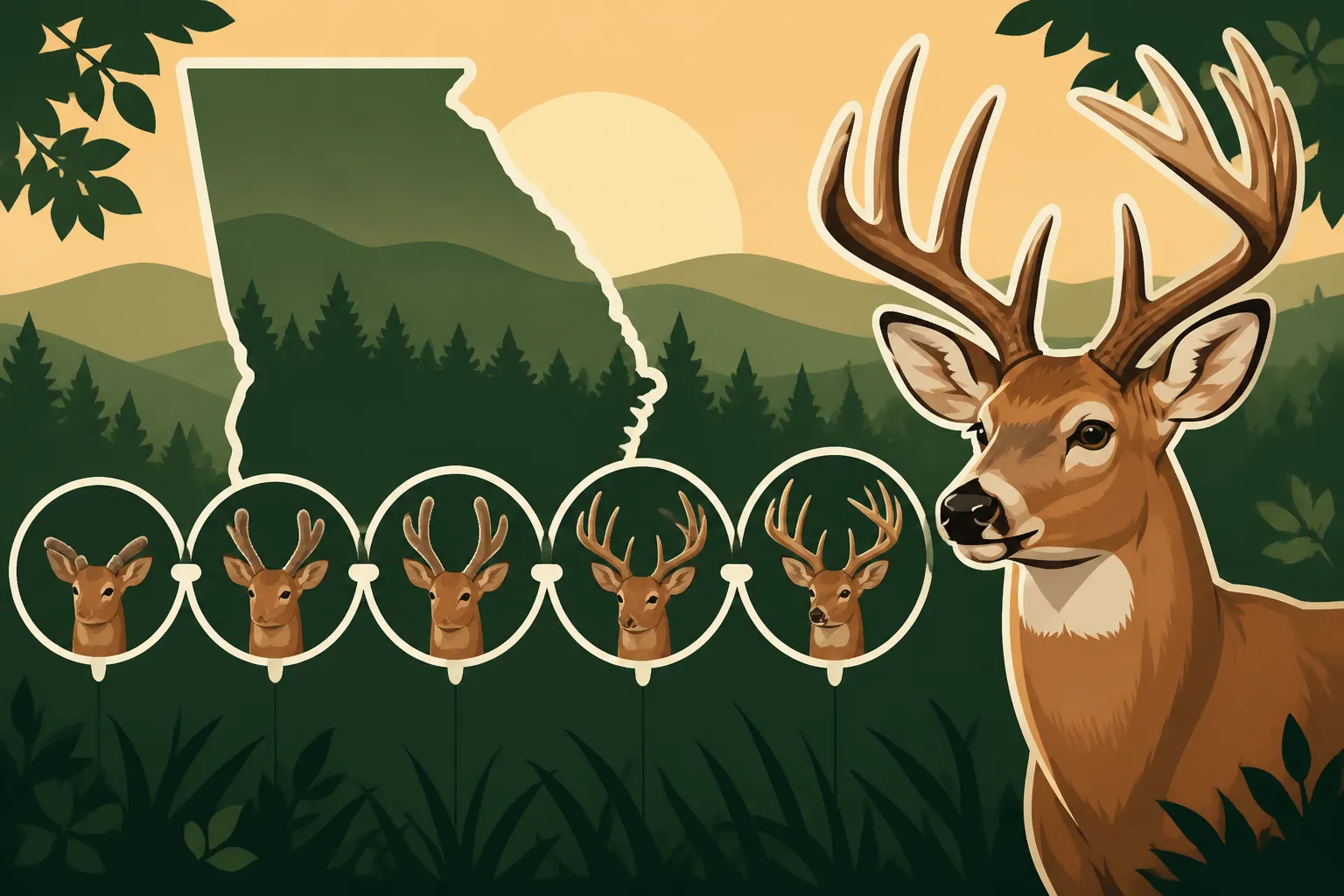
Here's a simplified look at the antler growth timeline by age:
| Age Class | Antler Characteristics (Typical Range) | Primary Influencers |
|---|---|---|
| Fawn (0.5 years) | Button bucks, pedicles visible/palpable under skin. | Maternal health, early fawn nutrition. |
| Yearling (1.5 years) | Spikes, small forks, or modest 6-8 points (thin beams, short tines). | Nutrition (dominant), genetics. |
| Young Adult (2.5 years) | Noticeable increase in mass and tine length, 6-8 points common. | Nutrition, genetics, age. |
| Adult (3.5 years) | Significant mass, length, and width; approaching full potential. | Age (dominant), nutrition, genetics. |
| Mature (4.5-6.5 years) | Peak antler size: maximum mass, length, spread, and tine development. | Age (critical), genetics, nutrition. |
| Senior (7.5+ years) | Potential for regression in size or development of atypical points. | Age (decline), health. |
Beyond Age: Other Influencers of Antler Size
While age is undoubtedly the most critical factor in determining a buck's antler size, it's not the only piece of the puzzle. A complex interplay of other elements contributes to whether a buck reaches its full genetic potential.
The Power of Nutrition: Fueling Growth
Nutrition is arguably the single most important factor after age. Antlers are composed of bone, which requires a substantial amount of protein, calcium, phosphorus, and a host of other trace minerals. If a buck's diet is deficient in any of these essential components, or if he simply doesn't get enough overall energy, his antler growth will be compromised, regardless of his age or genetic potential. Think of it like trying to build a brick house without enough bricks or mortar.
In Georgia, access to high-quality forage changes with the seasons and the habitat. Areas with diverse native plant communities, good soil quality, and supplemental food sources (like agricultural fields or well-managed food plots) tend to produce deer with superior antler development. Conversely, overpopulated areas or regions experiencing drought will often see smaller racks due to intense competition for limited food resources. This is why habitat management is so vital for growing bigger bucks. Utilizing mapping and analytical tools, such as those provided by GoHunt, can help landowners and hunters identify key nutritional areas and plan habitat improvements to support healthier deer.
Genetic Legacy: The Inherited Potential
While proper nutrition provides the building blocks, a buck's genetics provide the blueprint for his antler growth. Just like humans inherit certain physical traits from their parents, deer inherit genetic predispositions for antler characteristics such as tine length, main beam circumference, and overall symmetry. This is why you might see a young buck with impressive mass in an area, even if he's only 2.5 years old, simply because he has strong genetics for robust antler growth.
However, genetics and nutrition are intertwined. A buck with superior genetics will still not express his full antler potential if he doesn't have the necessary nutritional resources. Conversely, even a buck with "average" genetics can produce a surprisingly good rack if he lives in an area with outstanding nutrition and is allowed to reach maturity. Effective deer management often considers both factors, aiming to cultivate a herd where good genetics have the opportunity to flourish with adequate nutrition and age. Understanding Why Southwest Georgia Grows Big Bucks often points to a combination of excellent habitat and the benefit of age structure.
Health, Stress, and Habitat Quality
Beyond nutrition and genetics, a buck's general health and the level of stress he experiences throughout the year can significantly impact antler development. Antlers are a secondary sexual characteristic, meaning they are not essential for survival. Therefore, if a buck's body is under duress—from an injury, illness (like the devastating effects of EHD Die-Offs in Georgia Deer), chronic parasite load, or even excessive harassment from predators or human disturbance—resources will be diverted away from antler production towards more critical bodily functions.
A buck recovering from an injury or fighting off an illness might put all his energy into healing, resulting in a noticeably smaller or misshapen rack that year. Similarly, constant stress can keep a buck in a perpetual state of nutrient depletion. Quality habitat provides not only food but also secure cover, fresh water, and minimal disturbance, all of which contribute to a buck's overall health and his ability to maximize his antler growth each year. This holistic approach is why studying details about Deer Density by Georgia Region and knowing hunting pressure can be so useful. Ultimately, every hunter hopes to encounter a buck that has achieved its full potential, a true testament to the remarkable lifecycle of Georgia's white-tailed deer.
Disclaimer
This article is for general informational purposes only and does not constitute professional advice. Laws, prices and regulations vary by location and change over time. Consult a qualified professional for guidance on your specific situation.