Minimum Draw Weight for Georgia Deer
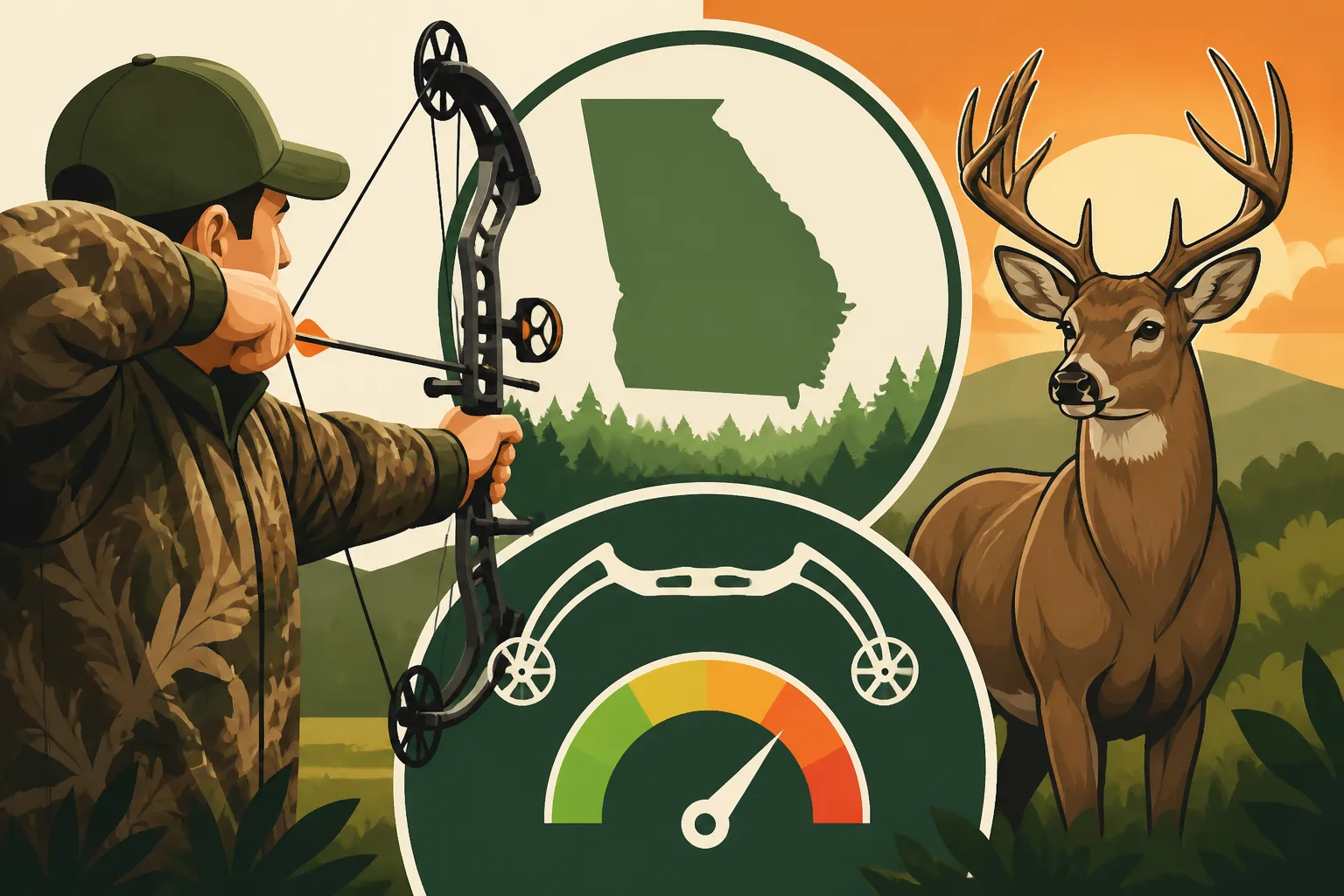
One of the most common questions I hear from new bowhunters, or even seasoned folks returning to the sport, is, "How much draw weight do I really need to hunt deer in Georgia?" It’s a completely valid concern, rooted in wanting to be effective and, more importantly, ethical. This guide will walk you through Georgia's regulations, the science behind draw weight, and what truly makes for an effective and humane bowhunting setup.
Georgia's Official Draw Weight Regulations
When you're preparing for deer season, it's natural to pore over the rulebook, looking for every little detail. Many states have very specific regulations on everything from broadhead diameter to arrow length, and yes, even minimum draw weights for bows. This can lead to a lot of head-scratching and worry if you’re trying to make sure your gear is up to snuff.
The Legal Minimum in Georgia
Here's where things might surprise some bowhunters: the Georgia Department of Natural Resources (DNR) doesn't actually specify a concrete minimum draw weight in pounds for bows used to hunt deer. Unlike some other states that might set a hard floor of, say, 40 pounds for compounds or 35 pounds for recurves, Georgia's regulations are more focused on the capability of your equipment. This means the onus is really on the hunter to ensure their setup is effective.
The regulations typically state that archery equipment must be "capable of harvesting deer." This broad statement gives hunters a bit of flexibility but also places a significant responsibility on them. It's not just about meeting a number; it's about understanding what that number, or lack thereof, truly implies for ethical hunting. You won't find a line item saying "must be 40# or more" in the official rulebook, which sometimes leads to confusion among those seeking a definitive answer.
This approach acknowledges that bow technology has advanced significantly. What might have been considered a "low" draw weight decades ago can, with modern cam systems, efficient limbs, and well-matched arrows, be perfectly adequate today. However, it also means that simply having a bow isn't enough; you need to understand the physics of penetration and the ethics of the shot. For comprehensive details on all archery requirements, it's always a good idea to review the official guides, or check out resources on sites like GoHunt when planning your season, especially for things like Georgia Archery Season Opening Day and Georgia Archery Season Dates.
What "Capable of Harvesting" Really Means
So, if there's no hard number, what exactly does "capable of harvesting" mean in the real world? It boils down to ensuring your arrow can achieve sufficient penetration to reliably strike vital organs and lead to a swift, humane kill. This isn't just about the peak weight you can pull back; it’s about the entire system working together: your bow, your arrow, and your broadhead.
Imagine standing in a treestand during Bowhunting Georgia's Early Archery Season, a mature Georgia buck steps out at 20 yards. You make a perfect shot. For your equipment to be "capable," that arrow needs to not just hit the deer, but pass through its hide, muscle, and potentially bone (like a rib) to penetrate the lungs or heart. An underpowered bow, a light arrow, or a dull broadhead could result in insufficient penetration, leading to a wounded animal that might suffer and never be recovered. This is the absolute worst outcome for any ethical hunter.
Ultimately, "capable of harvesting" implies a moral and practical standard. It’s about more than just sending an arrow downrange; it’s about ensuring that arrow carries enough energy and is equipped to do its job effectively. This holistic view emphasizes the hunter's skill, the quality of their equipment, and their commitment to making a lethal shot. Without a clear minimum draw weight, the burden of proof, so to speak, falls squarely on the individual hunter.
Understanding Draw Weight and Ethical Harvesting
Draw weight, in its simplest form, is the amount of force, measured in pounds, required to pull your bowstring back to its full draw length. For compound bows, this peak weight is then reduced by a percentage (let-off) when at full draw, making it easier to hold. For traditional bows like recurves and longbows, the draw weight increases steadily up to your full draw. But simply understanding the definition isn't enough; we need to grasp its critical role in ethical hunting.
Kinetic Energy and Penetration
The real power behind your arrow isn't just the draw weight, but the kinetic energy (KE) it generates. Kinetic energy is the energy of motion, and it's what drives your arrow through the animal. Higher draw weight generally translates to higher arrow speed, and when combined with arrow weight, this results in greater kinetic energy. This energy is absolutely vital for penetration.
Think about it: a deer's hide is tough, its muscles are dense, and its ribs are bone. To get a clean pass-through, especially on larger-bodied deer, your arrow needs enough "oomph" to overcome all that resistance. A bow set too low, even if you can comfortably draw it, might not impart enough kinetic energy to your arrow for reliable penetration, particularly if you encounter any bone. This becomes even more critical if your shot isn't perfectly broadside or if you hit a deer with a thicker hide or larger frame, like some of the robust bucks found in Georgia's productive agricultural regions.
While a general guideline for deer hunting is often cited around 40-45 ft-lbs of kinetic energy for compounds, and ensuring your traditional bow delivers a solid punch, these are just benchmarks. The key is to test your setup and ensure your arrows consistently achieve deep penetration on practice targets designed to simulate animal tissue. You can find excellent resources on various Bow and Crossbow Setups for Georgia that discuss kinetic energy in more detail.
The Ethical Imperative
As hunters, we hold a profound ethical responsibility to ensure the animals we pursue experience the quickest, most humane death possible. This isn't just a feel-good notion; it's a cornerstone of responsible hunting. When your bow setup is underpowered for the task, you run a significantly higher risk of merely wounding an animal.
A wounded deer might escape, suffer for days, and ultimately succumb to its injuries without being recovered. This is the antithesis of ethical hunting. An ethical shot isn't just about aiming well; it's about having the right tool for the job. Having sufficient draw weight, combined with the right arrow and broadhead, drastically increases your chances of a clean pass-through, which typically results in a better blood trail and a faster recovery. This is why discussions around Arrow Weight for Short Shots and broadhead types are so important. The last thing any hunter wants is to track an injured animal through thick Georgia pine straw or a murky swamp, knowing they might have prevented its suffering with better preparation. Using tools like those found on GoHunt can help you understand game behavior and improve your chances for a clean shot.
Factors Beyond Raw Poundage for Bowhunters
While draw weight is important, it's only one piece of a larger puzzle. A hunter who focuses solely on a high draw weight might actually be less effective if they can't shoot it accurately. The true measure of an ethical and effective bowhunting setup comes from how all its components work in harmony.
Arrow Weight and FOC
Believe it or not, a heavier arrow can sometimes compensate for a slightly lower draw weight by increasing momentum. Momentum is key for penetration, especially once the arrow hits resistance. While kinetic energy is primarily about speed, momentum is about mass moving forward. A heavier arrow carries more momentum, allowing it to "punch through" tougher material.
Furthermore, the Front of Center (FOC) balance of your arrow plays a crucial role. FOC refers to how much of an arrow's total weight is concentrated in the front half. A higher FOC (typically 10-15% for hunting arrows) helps the arrow fly more consistently and, critically, enhances its ability to penetrate. By putting more weight forward, the arrow acts like a tiny, focused battering ram. So, even if you're pulling, say, 50 pounds, a well-tuned, heavier arrow with a good FOC can outperform a lighter, less balanced arrow shot from a 60-pound bow in terms of penetration. It's a nuanced topic, and understanding these dynamics is part of truly optimizing your setup.
Broadhead Selection and Sharpness
This cannot be stressed enough: a razor-sharp broadhead is arguably more important than a few extra pounds of draw weight. A dull broadhead, regardless of your bow's power, will tear and push tissue, vastly reducing penetration. A surgically sharp broadhead slices through hide, muscle, and even bone more efficiently, requiring less force to do its job.
The choice between mechanical and fixed-blade broadheads also comes into play. Fixed-blade broadheads are known for their robust construction and often superior penetration, as they don't have moving parts that require energy to deploy. Mechanical broadheads, on the other hand, offer a larger cutting diameter once deployed, creating a wider wound channel. However, they can require more kinetic energy to open and penetrate effectively. Many bowhunters spend considerable time testing different broadheads with their specific setup. For a deeper dive into these options, check out Fixed Versus Mechanical Broadheads. Remember, even with the best broadhead, if it's not absolutely hair-popping sharp, you're not giving yourself or the animal a fair shake.
Shot Placement and Practice
Even with the most powerful bow, the heaviest arrow, and the sharpest broadhead, a poor shot means a poor outcome. Ethical bowhunting is fundamentally about precision. Understanding deer anatomy – specifically the location of the heart, lungs, and major arteries – is paramount. A well-placed arrow from a moderately powerful bow will achieve a clean kill far more reliably than a poorly placed arrow from the most potent setup.
This is where practice becomes non-negotiable. Consistent practice at various distances, from different angles (like from a treestand), and under varied conditions, builds muscle memory and confidence. You need to be able to execute your shot flawlessly under pressure, when that trophy buck steps into your shooting lane. Knowing your effective range – the maximum distance you can consistently hit a dinner plate-sized target – is crucial. Never push that limit in the field. Scouting tools like those available through GoHunt can help you identify optimal stand locations to maximize your chances for an ethical shot. For instance, knowing where deer funnel on public land can help you set up for close, high-percentage shots, especially when considering Hunting Pressure on Georgia Public Land.
Tips for Building Your Draw Weight Safely
So, you've decided you want to increase your draw weight. Maybe you’re new to bowhunting and starting with a very low poundage, or perhaps you just want a little more power to feel confident. Whatever your reason, it’s vital to approach this process smartly and safely to avoid injury and ensure you develop good shooting habits.
Gradual Increase and Proper Form
One of the biggest mistakes aspiring bowhunters make is trying to jump too many pounds too quickly. Your body needs time to adapt to the increased stress on your muscles, tendons, and joints. Most bows allow for draw weight adjustments, typically in 5 to 10-pound increments. Start by increasing your weight by just a few pounds at a time, or whatever the manufacturer recommends.
After each adjustment, spend time shooting. Pay close attention to your form. Can you still draw the bow smoothly without jerking or using excessive body English? Can you hold it steadily at full draw for 5-10 seconds? If you find yourself struggling, shaking, or having to "sky draw" (pointing the bow skyward to leverage gravity for the draw), then you've gone too far too fast. Drop the weight back down and continue building strength. Maintaining proper form is absolutely critical, not just for accuracy, but also for preventing injuries like rotator cuff issues, which can sideline you indefinitely.
Targeted Exercises and Consistency
Building the specific muscles used in archery requires more than just shooting your bow. Incorporating targeted exercises into your routine can significantly help increase your draw weight safely and efficiently. Focus on exercises that strengthen your back (rhomboids, lats), shoulders (rotator cuff, deltoids), and core.
Resistance bands are fantastic for simulating the drawing motion without the fatigue of actually shooting. Rows, pull-aparts, and external rotations can specifically target the muscles used in drawing and holding. Light free weights can also be beneficial for shoulder and back strength. The key, however, is consistency. A few minutes of dedicated strength training several times a week, combined with your regular shooting practice, will yield far better results than sporadic, intense sessions. Remember, it’s about slow and steady progress, protecting your body in the long run.
Consulting a Pro Shop
When in doubt, always turn to the experts. A reputable archery pro shop is an invaluable resource for bowhunters, especially when it comes to something as critical as draw weight. The technicians there can assess your current form, recommend appropriate draw weight increases for your physical capabilities, and ensure your bow is properly tuned for the adjustments.
They can also help you understand how increasing draw weight might affect other aspects of your setup, such as arrow spine. An arrow that was perfectly spined for 50 pounds might be too flexible if you jump to 60 pounds, leading to inconsistent flight and poor accuracy. A pro shop can also help you choose appropriate Arrow Weight for Short Shots or broadheads that complement your new setup. They often have advanced tuning equipment and a wealth of experience that can save you a lot of trial and error (and frustration) in the field. Don't be afraid to ask questions – that's what they're there for! They can also be a great resource for understanding Crossbow Versus Vertical Bow in Georgia if you're considering other options.
Draw Weight Guidelines for Deer Hunting
To help visualize potential draw weights and their general suitability, here's a basic table. Keep in mind these are general guidelines and individual hunter strength, arrow setup, and broadhead choice are paramount.
| Draw Weight (lbs) | Bow Type | General Suitability | Notes |
|---|---|---|---|
| 25-35 | Recurve/Longbow | Small game, target practice, youth hunting | Generally not recommended for deer due to insufficient penetration for ethical harvesting, though some very strong traditional archers may use it. |
| 35-40 | Compound | Youth/beginner deer hunting, smaller deer | Often considered a minimum for ethical deer hunting with modern compounds and heavy, well-matched arrows. |
| 40-50 | Compound | Most deer hunting scenarios, medium-sized game | A very common and effective range for many adult hunters, providing a good balance of power and shootability. |
| 50-60 | Compound | Larger deer, tougher shots, larger game | Excellent for deer, offers significant kinetic energy for pass-throughs. Requires good strength and form. |
| 60-70+ | Compound | Large game, highly experienced hunters | Max legal limit in some areas, offers maximum power but requires significant strength and consistent practice to maintain accuracy. |
Always prioritize accuracy and ethical shot placement over raw power. A comfortable draw weight that you can shoot consistently is always better than struggling with a heavy bow.
Disclaimer
This article is for general informational purposes only and does not constitute professional advice. Laws, prices and regulations vary by location and change over time. Consult a qualified professional for guidance on your specific situation.