Arrow Weight for Short Shots
It's a common scenario for many Georgia bowhunters: you've done your scouting, found that perfect pinch point in a creek bottom, or located a promising Hunting a Funnel Between Two Swamps, and you anticipate a shot at fairly close range. The deer is practically under your stand. You might think arrow weight doesn't matter as much when the shot is only 10, 15, or 20 yards. However, optimizing your arrow's weight, even for these "short shots," is crucial for maximizing penetration, achieving consistent accuracy, and ensuring an ethical harvest in Georgia's diverse hunting environments. This guide will delve into why arrow weight for close-range shots is more critical than you might think and how to build a setup that performs when it counts.
The Misconception of Arrow Weight for Short Shots
Many hunters, especially those new to bowhunting or those primarily focused on flat-land, open-field hunting, tend to prioritize speed over all else. The logic often goes: "If I'm only shooting 20 yards, a light, fast arrow will get there quicker, flatter, and still have plenty of energy." While speed certainly has its advantages, particularly for longer shots or when judging distance is a challenge, it can be a deceptive metric when you're hunting in tight quarters where every inch of penetration truly matters.
Why Speed Isn't Everything at Close Range
Imagine a whitetail buck quartering away at 15 yards in a dense patch of Georgia pines. Your arrow needs to travel through the initial hide, several layers of muscle, potentially a rib, and then pass through vitals on the other side. A super-light arrow, while fast, might shed energy quickly upon impact, especially if it encounters any resistance like bone or cartilage. The kinetic energy might look impressive on paper, but momentum is often the unsung hero for penetration, and heavier arrows carry more of it. Think of it like a feather versus a brick: the feather might be faster, but the brick will punch through far more.
Furthermore, extremely fast, light arrows can sometimes be less forgiving. They might show more erratic flight characteristics with certain broadhead designs or be more susceptible to wind drift, even over short distances, if not perfectly tuned. In the close confines of a treestand, where small movements can sometimes go unnoticed, a more stable, slightly heavier arrow can be a friendlier companion.
The Role of Momentum and FOC
For short shots, two factors often overshadow sheer speed: momentum and front-of-center (FOC) balance. Momentum, a product of mass and velocity, is what truly drives an arrow through an animal. A heavier arrow, even if it leaves the bow slightly slower, will retain more momentum upon impact, leading to superior penetration. This is particularly vital in Georgia, where deer can vary greatly in size, from the smaller coastal plain deer to the robust bucks in the fertile Piedmont regions.
Front-of-Center (FOC) refers to how much of an arrow's total weight is concentrated in the front half. A higher FOC (generally 10-15% for hunting arrows, though some hunters push it higher) significantly improves flight stability, especially with broadheads. For those quick, sometimes awkward shots that happen when a deer presents itself suddenly, a stable arrow with good FOC is more likely to stay on track and deliver the broadhead where it needs to go, even if your release isn't absolutely perfect. This stability helps reduce potential planing or erratic flight that can be exacerbated by fixed-blade broadheads or less-than-ideal form.
Understanding Arrow Components and Their Impact
Every single part of your arrow contributes to its overall weight, FOC, and ultimately, its performance. It's not just about picking an "heavy" shaft; it's about building a balanced system. For those hunting deer in Georgia's diverse terrain, from the thick Hunting Georgia Swamp and River Bottom Deer to the rolling hills where you might be Hunting Piedmont Farmland Deer, understanding these components is key.
Shaft Selection: The Backbone of Your Arrow
The arrow shaft itself is the biggest determinant of overall weight. Arrow shafts are typically measured in grains per inch (GPI). A common hunting arrow might range from 7 GPI to over 12 GPI. If you're building an arrow specifically for short-range penetration, starting with a heavier GPI shaft is a smart move.
For example, a standard 30-inch shaft at 8 GPI will weigh 240 grains before adding components. A heavier shaft at 10 GPI will already be 300 grains. This extra weight, distributed evenly along the shaft, provides a solid foundation for building a high-momentum arrow. Remember, too, that shaft spine (stiffness) is critical. A heavier arrow requires a stiffer spine to shoot accurately from your bow, especially with fixed-blade broadheads. You can easily find spine charts online, or use tools from brands like GoHunt, to make sure your shaft is appropriately spined for your draw weight and length.
Inserts and Outserts: Adding Weight Up Front
This is where you can really fine-tune your FOC. Standard aluminum inserts weigh around 12-15 grains. However, many manufacturers offer heavier brass or stainless steel inserts, often ranging from 50 to 100 grains, or even more. Some systems use outserts or half-outs, which are external sleeves that fit over the shaft, adding even more weight and durability to the front.
Adding weight to the front of your arrow drastically increases FOC. For short shots, where extreme accuracy at long distances isn't the primary concern, pushing FOC up to 15-20% can enhance penetration and broadhead stability. This is particularly beneficial when using Fixed Versus Mechanical Broadheads, as fixed blades can sometimes catch air and steer the arrow if the FOC isn't adequate. Imagine a scenario where a buck is facing away slightly, and you need to drive that broadhead through the hip bone to reach the vitals; a high FOC arrow has a better chance of pushing through.
Broadhead Choice: The Cutting Edge
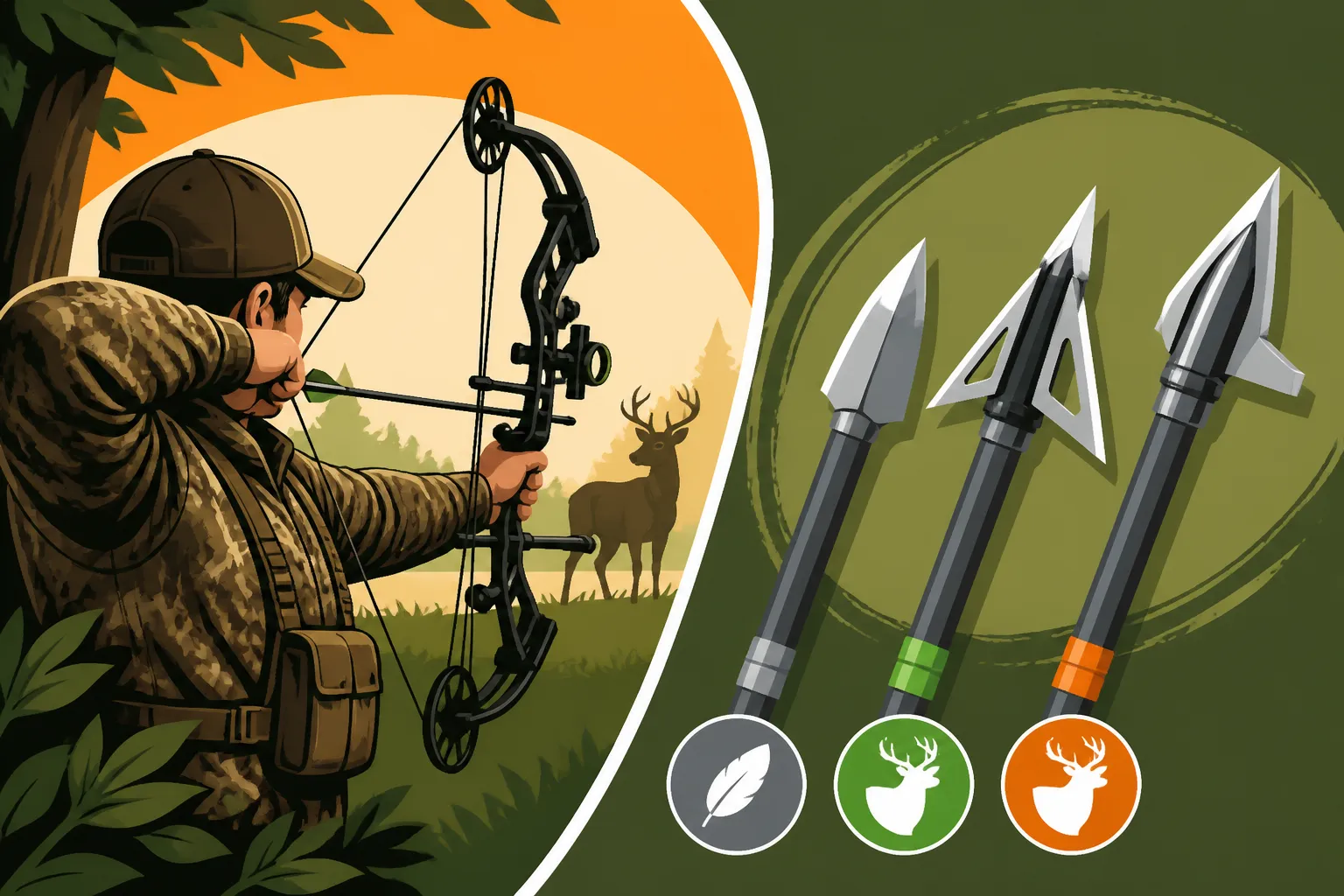
Broadheads contribute significantly to the front-end weight and are your terminal cutting instrument. While the debate between fixed and mechanical broadheads rages on, for penetration on short shots, a sturdy, well-designed fixed-blade broadhead often shines. Many fixed-blade broadheads weigh 100 grains, but 125-grain, 150-grain, and even 200-grain options are available. The heavier broadhead not only adds to your total arrow weight but also directly boosts your FOC.
When selecting a broadhead, especially for potentially bone-hitting shots at close range, look for strong, durable construction. Blades should be sharp and thick enough to withstand impact without bending or breaking. A two-blade or three-blade fixed head, with a minimal cutting angle, tends to be excellent for penetration.
Here's a quick look at how various components stack up in terms of weight:
| Component | Typical Weight Range (grains) | Impact on Total Weight | Impact on FOC |
|---|---|---|---|
| Arrow Shaft (GPI) | 7-12 grains/inch | Major | Moderate (even) |
| Insert | 12-100+ grains | Significant | High (front-weighted) |
| Broadhead | 100-200+ grains | Significant | High (front-weighted) |
| Fletching | 5-15 grains | Minor | Minor (rear-weighted) |
| Nock | 5-10 grains | Minor | Minor (rear-weighted) |
Fletching and Nock: Stabilizers and Minor Contributors
Fletchings and nocks are relatively light components, but they are crucial for arrow flight. While they add minor weight to the rear of the arrow (slightly reducing FOC), their primary function is stabilization. For hunting, especially with broadheads, larger fletchings (e.g., 3-inch or 4-inch vanes) provide more steering power, helping to correct any broadhead-induced yaw or wobble. Even at short distances, precise flight is paramount. Consider things like Bow Sights for Swamp Timber Shots where even a small error in arrow flight could mean the difference between a clean kill and a frustrating miss in dense cover.
Building a Heavy Arrow for Close-Range Performance
Crafting an arrow setup optimized for short shots isn't just about throwing on the heaviest components you can find. It's about balance and tuning. The goal is an arrow that flies true, hits hard, and penetrates deeply.
Calculating Your Total Arrow Weight (TAW)
Your total arrow weight is the sum of all its parts. A common hunting arrow typically falls between 400-500 grains. For a dedicated short-shot, high-penetration setup, many hunters aim for 500-600 grains, or even higher, especially those running a higher Minimum Draw Weight for Georgia Deer.
Let's do a hypothetical calculation:
- 30-inch arrow shaft @ 9 GPI = 270 grains
- Heavy insert (e.g., brass) = 75 grains
- Heavy fixed-blade broadhead = 125 grains
- Fletching (3 vanes) = 9 grains
- Nock = 7 grains
- Total Arrow Weight = 486 grains
This is a very respectable weight for a hard-hitting arrow, even at short distances. You could easily push this into the 500s or 600s by starting with a heavier GPI shaft or using an even heavier broadhead/insert combination.
Tuning for Accuracy
A heavy arrow, regardless of its components, must be properly tuned to your bow. This means ensuring your arrow rest, nocking point, and cam timing are all perfectly set to make that arrow fly straight and true. Paper tuning, bare shaft tuning, and walk-back tuning are all methods you can use. Don't skip this step! A poorly tuned heavy arrow is just a heavy arrow that flies inaccurately. Even a 10-yard shot can be missed if the arrow is porpoising or planing.
Consider the variables that can affect your tune. The string loop, the pressure on the arrow rest, the tiller of the bow, and even the type of release aid can impact how your arrow leaves the string. Many archers find that heavier arrows are often more forgiving to tune, especially with fixed-blade broadheads, but it's not a guarantee. You'll want to make sure your Bow and Crossbow Setups for Georgia are meticulously tuned.
Speed vs. Momentum Revisited: The Real-World Impact
While a heavier arrow will travel slower, the difference at 10-20 yards is negligible in terms of "drop" and "time to target." What is not negligible is the increased momentum. This translates directly to more reliable penetration.
Imagine a situation where a shot isn't perfectly clean, and your arrow hits a shoulder blade. A lighter, faster arrow might deflect more easily or not penetrate deeply enough to reach vitals. A heavier, high-momentum arrow, however, has a much better chance of breaking through that bone and continuing its path. This can be the difference between recovering your deer quickly and a long, difficult Tracking a Deer Through Georgia Pine Straw or Blood Trailing After Dark in Georgia in thick Georgia cover.
Practical Considerations for Georgia Hunters
Beyond the technical aspects of arrow building, there are practical hunting scenarios unique to Georgia that make a case for a heavier arrow, even for short shots.
Hunting in Dense Cover
Georgia is full of thick cover. From kudzu-choked creek bottoms to dense pine thickets where deer bed down, you're often hunting in close quarters. Shots rarely exceed 30 yards in these areas, and often they're much closer. In these environments, an arrow might clip a small twig or vine on its way to the target. A heavier, more stable arrow, especially one with a high FOC, can be less prone to deflection than a light, fast arrow. This doesn't mean it will bust through a branch, but it might glance off a small obstruction with less deviation. This is especially true when setting up a Treestand Setups in North Georgia Mountains where vegetation can be quite thick.
Dealing with Tough Hide and Bone
Georgia's whitetails, particularly mature bucks, can have surprisingly tough hides and thick bone structure. During the late season, when deer have grown their winter coats, penetration becomes even more critical. A heavy arrow provides that extra punch needed to reliably pass through a deer, creating two wound channels (entry and exit) and increasing blood trail visibility. This is a critical factor for quick recovery, especially when Field Dressing a Deer in Warm Weather is a concern.
Ethical Harvest
Ultimately, choosing the right arrow weight for short shots comes down to ethics. Our responsibility as hunters is to make the quickest, most humane kill possible. A heavier, high-momentum arrow, paired with a sharp, durable broadhead, maximizes your chances of achieving that. Don't underestimate the power of a well-placed, heavy arrow. It gives you a wider margin of error if you encounter unexpected resistance.
Final Thoughts on Your Arrow Setup
When considering your arrow setup for hunting in Georgia, especially when anticipating those tight, short-range encounters, don't just chase speed. Think about the entire system: your bow's draw weight, your chosen broadhead, the GPI of your shaft, and the weight of your inserts. Using resources like those available through GoHunt can help you research different component weights and their performance characteristics to find what suits your hunting style and conditions best.
Experimentation and practice are key. Build a few arrows with different weights and FOC percentages, and shoot them through paper, at targets, and even through some simulated brush to see how they perform. You might be surprised at the confidence a well-tuned, heavier arrow inspires, knowing it has the punch to get the job done when that big Georgia buck steps out at spitting distance.
Your goal isn't just to hit the deer; it's to hit the deer hard and decisively. And for those critical short shots in Georgia's diverse hunting landscape, a little extra arrow weight can make all the difference.
Disclaimer
This article is for general informational purposes only and does not constitute professional advice. Laws, prices and regulations vary by location and change over time. Consult a qualified professional for guidance on your specific situation.