First Focal Plane Versus Second
Choosing a rifle scope can feel like navigating a maze, especially when you start hearing terms like "first focal plane" and "second focal plane." For us hunters in Georgia, where shot distances can vary wildly from thick, choked-out timber to wide-open agriculture fields, understanding the difference between FFP and SFP scopes isn't just about optics jargon—it's about making sure your shot counts when it matters most. This guide is here to untangle that knot for you, helping you decide which scope design truly fits your specific Georgia hunting scenarios.
Understanding First Focal Plane FFP Scopes
When you dive into the world of modern rifle optics, especially those favored by long-range shooters or tactical enthusiasts, you'll inevitably encounter the term "First Focal Plane," or FFP. The core concept here is that the reticle—that's your crosshairs, dots, or elaborate Christmas tree pattern—is placed at the front of the magnification erector system inside the scope. What does that mean for you out in the pine flats or up in the mountains?
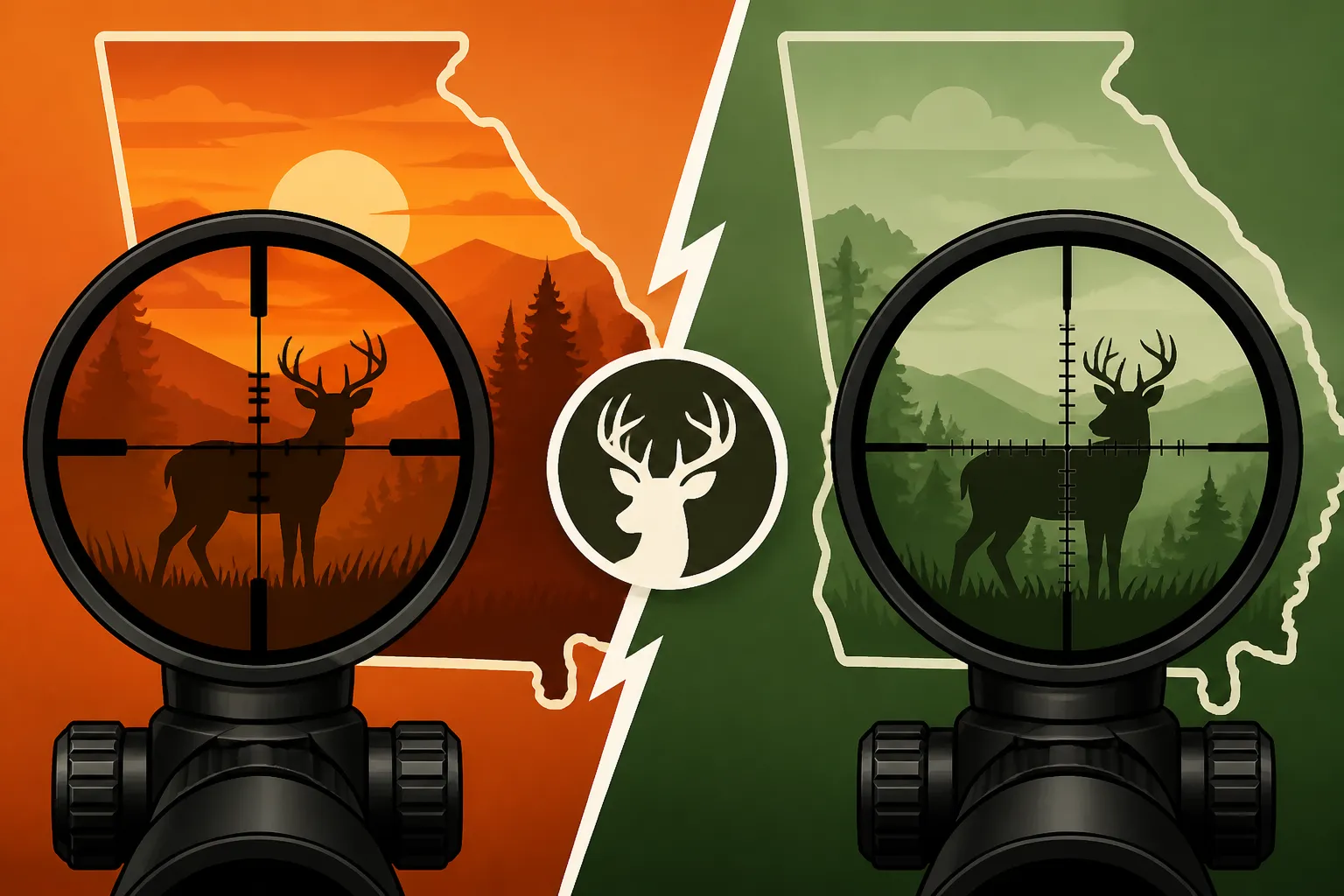
The big takeaway is this: with an FFP scope, the reticle actually changes size as you adjust the magnification. When you crank up the power, the reticle appears larger, and when you dial it down, it shrinks. This isn't just a visual trick; it's a fundamental design choice with some profound implications for hunting. The subtensions, or the measured distances between the markings on your reticle (like Mil-dots or MOA hashes), remain constant and true across all magnification settings. So, if a hash mark represents 1 Mil at 10x power, it still represents 1 Mil at 4x or 16x. This consistency is the FFP's superpower.
How FFP Works for Holdovers and Windage
Imagine you're hunting a deer in a large, open field down in South Georgia, perhaps an Entry Routes Through a Standing Peanut Field. The buck steps out at 300 yards, a distance that's certainly within ethical range for many modern rifle setups. With an FFP scope, if your reticle has holdover points for bullet drop, those points are accurate whether your scope is set to 8x, 12x, or the full 18x magnification. You don't have to remember to adjust your calculations or stick to a single, specific magnification setting for your reticle to be "true."
This feature is incredibly valuable for hunters who rely on their reticle for quick adjustments without dialing turrets. Let's say a gust of wind picks up suddenly. If you've practiced holding for wind using your reticle's windage marks, those holds will be exactly the same percentage of your target no matter what magnification you're on. This frees you up to choose the best magnification for target identification and shot placement, rather than being restricted by your reticle's accuracy. For someone tracking a coyote across a wide pasture or glassing a powerline cut for a distant buck, this flexibility can be a real game-changer. Companies like GoHunt often feature reviews and comparisons of FFP scopes, highlighting how different reticle designs maximize this constant subtension benefit.
Advantages and Disadvantages of FFP in Georgia
The primary advantage of FFP scopes for Georgia hunting, particularly in more open country or for longer shots, is that consistent reticle subtension. If you're hunting areas where longer shots are common, like over large food plots or cutovers, or if you're engaging predators at varying distances, an FFP scope allows for quick and precise holdovers at any magnification. This is especially useful for hunters who range their target, know their bullet drop, and prefer to use the reticle rather than dialing elevation and windage turrets for every shot. For a multi-day hunt where conditions and shot opportunities can change, this adaptability is a definite plus.
However, FFP scopes aren't without their drawbacks, especially in Georgia's diverse terrain. In dense, dark timber or thick creek bottoms—the kind of place where you might be Hunting a Funnel Between Two Swamps—shots are often close and fast. At very low magnifications, the reticle in an FFP scope can become extremely small and thin, sometimes almost disappearing against a dark background or in low light conditions, like early morning or late evening. This can make quick target acquisition difficult when a deer busts out at 25 yards. Conversely, at very high magnifications, the reticle can appear quite thick, potentially obscuring a small part of your target at long range, though this is less often an issue for typical deer-sized game. The cost of FFP scopes also tends to be higher due to the more complex manufacturing required for precise reticle placement.
Delving into Second Focal Plane SFP Scopes
Now, let's talk about the Second Focal Plane, or SFP, which is arguably what most hunters are familiar with, even if they didn't know the technical term. In an SFP scope, the reticle is placed at the rear of the magnification erector system. This means that unlike FFP, the reticle itself does not change size as you adjust the magnification. It always appears the same size to your eye, regardless of whether you're zoomed in or out.
This design has been the standard for decades, and for good reason: it’s simpler, often more affordable, and incredibly intuitive for many hunting applications. When you zoom in, the target gets larger, but your crosshairs stay the same thickness and size in your field of view. This creates a clear, consistent aiming point which can be very reassuring when a buck suddenly appears in front of your stand.
SFP Reticles and Magnification Specifics
The critical difference with an SFP reticle, especially if it has holdover or windage marks, is that those subtensions are only true at one specific magnification setting. This is almost always the highest magnification setting (e.g., 9x on a 3-9x scope, or 18x on a 4-18x scope), but it's crucial to check your scope's manual to confirm. If you use the reticle's hash marks for bullet drop compensation or windage holds at any other magnification, your calculations will be off.
For example, if you're hunting in the thick Piedmont woods, perhaps Setting Up on a Piedmont Field Edge, and your 3-9x SFP scope's reticle is designed for holdovers at 9x. If you spot a deer at 200 yards and have your scope cranked to 9x, your holdover points will be accurate. But if you have it dialed down to 4x because the woods are tight, those same holdover points will no longer be correct for the advertised values. You would need to dial your turrets for precise corrections, or have a very good understanding of how the reticle subtensions scale at different magnifications, which can get complicated and isn't ideal for quick field adjustments. This is why many SFP users prefer a simpler duplex reticle and rely on dialing their turrets for longer shots, or simply use the center crosshair for close-range point-and-shoot scenarios.
SFP Advantages for Close-Range Georgia Hunting
The biggest advantage of SFP scopes in Georgia is their sheer practicality for many common hunting situations. In areas like North Georgia's thick mountain hardwoods where shots might be 50-150 yards, or in dense river bottom swamps where visibility is limited to less than 100 yards, a consistent reticle size is a blessing. Hunting Georgia Swamp and River Bottom Deer often means quick, close-range encounters where you need to get on target fast without worrying about your reticle shrinking or growing.
Since the reticle stays the same size, it never becomes too thin to see at low power, nor too thick to obscure your target at high power. This is particularly beneficial in low light conditions, which are common at dawn and dusk. The reticle provides a clear, unwavering aiming point. Furthermore, SFP scopes are generally more affordable to produce, making high-quality optics more accessible. For a hunter primarily concerned with clear target acquisition and precise aiming at typical hunting distances, the SFP design is hard to beat. Many hunters using a simpler scope for Opening Weekend Tactics for Georgia Firearms Season will find an SFP scope perfectly adequate and dependable.
Making the Right Choice for Georgia Hunting
Deciding between FFP and SFP isn't about one being inherently "better" than the other. It's about which design best suits your specific hunting style, the terrain you frequent in Georgia, and the typical shot distances you expect. Our state is incredibly diverse, from the wide-open agriculture of the Coastal Plain to the dense, steep slopes of the North Georgia mountains. Your scope choice should reflect that reality.
FFP Versus SFP for Diverse Georgia Terrains
Let's look at a quick comparison to help you weigh the options:
| Feature | First Focal Plane (FFP) | Second Focal Plane (SFP) |
|---|---|---|
| Reticle Size | Changes with magnification | Stays constant with magnification |
| Reticle Subtensions | True at all magnifications (e.g., Mil/MOA marks accurate) | True at only one specific magnification (usually highest) |
| Visibility at Low Power | Can become very thin, hard to see | Always visible, maintains consistent thickness |
| Visibility at High Power | Can become thicker, potentially obscure small targets | Always maintains consistent thickness, clear at high power |
| Best For Georgia | Longer shots, open fields, variable range hunting | Close-range, thick cover, fast target acquisition |
| Holdover Use | Quick, accurate holdovers at any power | Best to dial turrets or holdovers only at specific power |
| Cost | Generally higher | Generally lower |
If your hunting takes you primarily to vast fields in the Southwest Georgia region, or places where you might be Hunting the Extended Southwest Georgia Season and regularly taking shots past 200-300 yards, and you prefer to use your reticle for holdovers rather than dialing turrets, then an FFP scope will likely be your preferred tool. It simplifies range estimation and bullet drop compensation across varied distances without having to adjust your scope's power to a specific setting. This could also be a great choice if you're engaging in Coyote Calling in Georgia Farm Country where shots can be long and dynamic.
On the other hand, if you primarily hunt in dense timber, thick brush, or swampy areas where shots are typically under 150 yards, like when Hunting Piedmont Creek Bottom Funnels, an SFP scope often makes more sense. The consistent reticle size ensures that at low magnification, which you'll use frequently in close quarters, your reticle remains bold and easy to see. This aids in fast target acquisition when a deer explodes from cover. For most hunters pursuing whitetails in the majority of Georgia's diverse habitats, an SFP scope will offer excellent performance without the added complexity or cost. Many reliable options are available that make aiming simple and effective, perfect for Georgia Deer Camp Traditions.
Considering Your Primary Game and Method
Your target game and hunting method also play a significant role.
- Whitetail Deer: For most deer hunting in Georgia, particularly in woods and mixed habitat, shots are under 150 yards. An SFP scope works wonderfully here, providing a clear reticle that doesn't disappear when you're zoomed out for a wide field of view in thick cover. If you primarily hunt deer from a fixed position, like a treestand, in areas with predictable, shorter shot distances, an SFP scope is very practical.
- Feral Hogs: Hogs can be taken at various ranges. If you're Thermal Hunting Georgia Hogs at Night and using a dedicated thermal optic, this FFP/SFP debate might not apply directly to that specific setup. However, if you're hunting hogs during the day, perhaps over bait or in fields, and anticipate varying shot distances, an FFP could offer versatility. But for close-range encounters in dense cover, SFP is perfectly suitable.
- Black Bear: Bear hunting in Georgia's mountain or swamp zones often involves thick cover and closer shots, similar to deer hunting. For these scenarios, a clear, consistently visible SFP reticle could be advantageous for quick target acquisition on a moving bear. When Hunting the North Georgia Mountain Bear Zone, you'll appreciate a reticle that doesn't vanish in the shadows at low power.
- Predators (Coyotes): This is where FFP scopes can really shine. Coyote hunting often involves calling and engaging targets that may appear at unpredictable distances, from 50 yards to 300+ yards. The ability to use your reticle for accurate holdovers at any magnification is a huge asset when a coyote suddenly appears and you need to react instantly.
Ultimately, spend some time in your local Georgia hunting store or browse resources like GoHunt to handle different scopes. See how the reticles appear at various magnifications. What feels most natural and efficient for your eyes and your anticipated hunting scenarios? That's your answer.
Practical Considerations Beyond FFP/SFP
While the choice between FFP and SFP is fundamental, it's not the only factor in selecting a rifle scope for hunting in Georgia. Several other practical considerations can make or break your hunting experience, regardless of where the reticle sits in the optical system.
Reticle Style and Illumination
Beyond focal plane, the actual design of your reticle matters. Do you prefer a simple duplex, a Mil-dot, an MOA Christmas tree, or something specifically designed for BDC (Bullet Drop Compensation)? For close-range hunting in thick cover, a simple, bold reticle is often best for quick target acquisition. Many SFP scopes feature these. For longer shots and detailed holdovers, a more complex reticle with numerous markings can be beneficial, and these are often found in FFP scopes where their subtensions are always true.
Furthermore, reticle illumination is a feature worth serious consideration, especially for hunting in Georgia's low-light conditions. Whether you choose FFP or SFP, an illuminated reticle can make a world of difference during those crucial minutes at dawn and dusk. Imagine a dark-colored hog stepping out into a shadowed field edge just before last legal light. An unilluminated black reticle can completely disappear. A red or green illuminated dot or partial reticle provides a clear aiming point that contrasts against your target and the dim background, allowing for a precise shot. However, ensure the illumination is adjustable, as too bright a reticle can create glare and impair your natural night vision. For Hunting After a Poor Acorn Year in dense woods, an illuminated reticle could give you the edge.
Parallax Adjustment and Eye Relief
Parallax is a phenomenon where the reticle appears to move relative to the target if your eye isn't perfectly centered behind the scope. Most hunting scopes designed for shorter ranges (under 150-200 yards) have fixed parallax settings, typically set around 100-150 yards, which is fine for most close-to-mid-range hunting. However, for longer-range shooting, especially with high-magnification FFP scopes, adjustable parallax (often via a side knob) becomes very important. This allows you to fine-tune the scope to eliminate parallax at your specific shooting distance, ensuring the reticle and target are on the same plane. While not as crucial for a 75-yard shot in a Georgia Swamp and River Bottom, it's vital for a 400-yard shot across a clear-cut.
Eye relief, the distance your eye needs to be from the ocular lens to see a full, clear picture, is another critical factor. Generous eye relief (typically 3.5 inches or more) is important for safety, preventing the scope from hitting you during recoil, especially with powerful calibers. It also provides more flexibility in head position, which can be a lifesa;saver when you're quickly shouldering your rifle in an awkward position in a cramped treestand or blinds.
Durability and Lens Quality
Georgia hunting can be tough on gear. From humid, rainy days in the early season to cold, frosty mornings in January, your scope needs to withstand the elements. Look for scopes that are waterproof, fogproof (nitrogen or argon purged), and shockproof. A scope that fogs up mid-hunt or can't handle a bump is utterly useless.
Lens quality directly impacts light transmission, clarity, and image brightness. Better glass and multi-coatings mean a brighter, clearer image, which is invaluable during those low-light periods when deer are most active. While high-end glass comes at a premium, it’s often one of the most worthwhile investments you can make in your optics. It's the difference between clearly seeing that branch in front of your buck's vitals or just guessing. When you're trying to make out details on a deer in a shadowy pine thicket, the quality of your scope's glass can make all the difference. Many hunters rely on resources like GoHunt to compare scope specifications and user reviews related to durability and lens performance before making a purchase.
Ultimately, the best scope for you in Georgia will be one that combines the appropriate focal plane design with a reticle you like, adequate illumination, comfortable eye relief, and the robust durability to stand up to our challenging hunting conditions. Take your time, consider your specific needs, and choose wisely.
Disclaimer
This article is for general informational purposes only and does not constitute professional advice. Laws, prices and regulations vary by location and change over time. Consult a qualified professional for guidance on your specific situation.