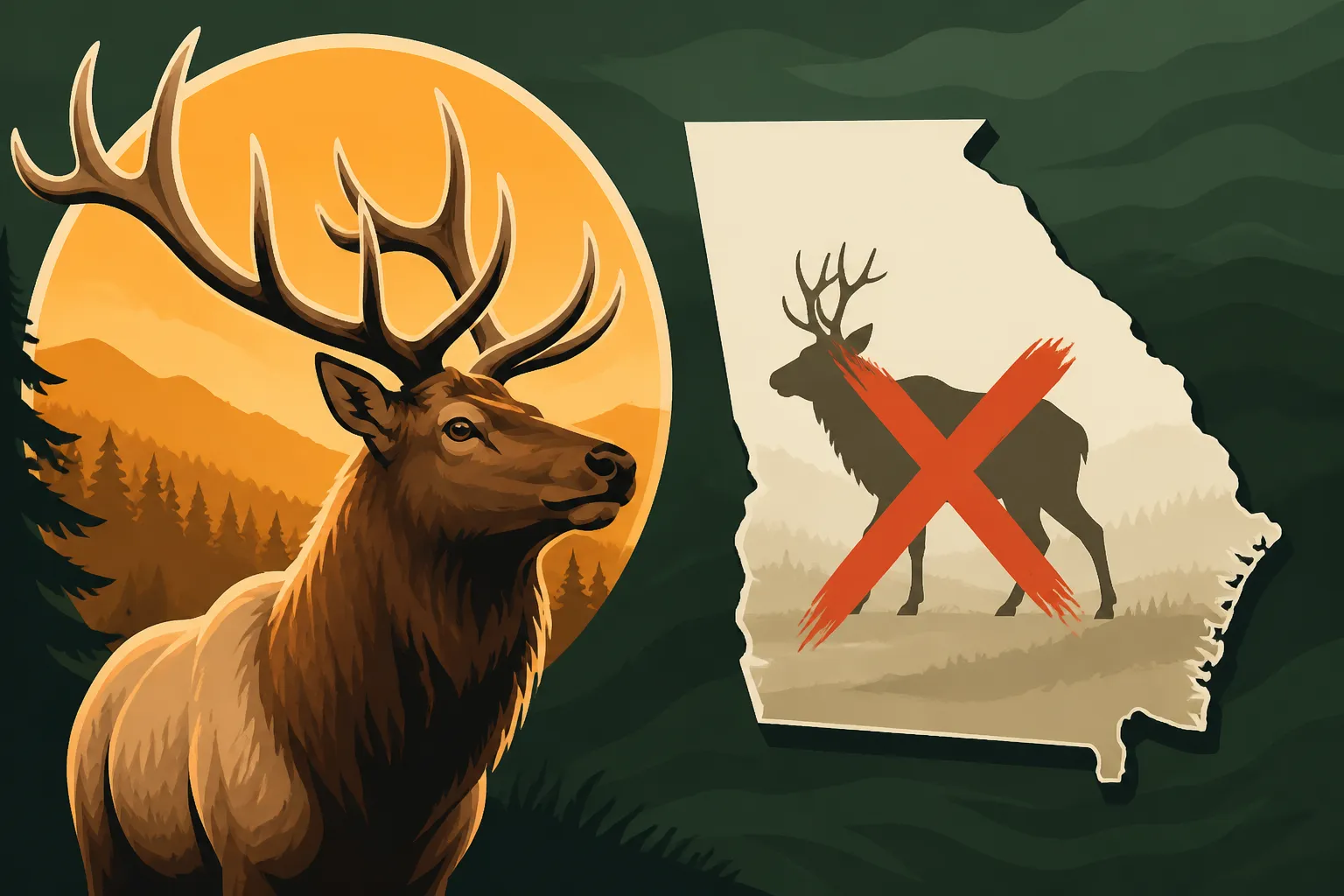
Georgia Elk History and Extirpation
It’s a thought that crosses many a Georgia hunter’s mind, especially when you’re out deep in the Chattahoochee National Forest or exploring some of our vast public lands: what other big game might have roamed these woods? We're so accustomed to our abundant whitetail deer, black bears, and even wild hogs, that it can be hard to imagine a time when another majestic giant graced our Georgia landscape. Yet, for thousands of years, North America's second-largest deer species, the elk, was a prominent resident here. The sad truth is, they're gone from Georgia, a casualty of a different era. This guide will take you on a journey through the compelling history of elk in our state, exploring why these magnificent animals vanished and why, despite successful reintroductions elsewhere, they haven't returned to the Peach State.
The Majestic Echo: Elk's Historical Presence in Georgia
Imagine walking through the lush hardwood forests of North Georgia centuries ago, and instead of deer tracks, you might have stumbled upon the distinctive hoof prints of an elk. These magnificent animals were once an integral part of Georgia's diverse wildlife, roaming much of the state, especially in the more mountainous and heavily wooded regions. It's a testament to how dramatically landscapes and wildlife populations can change over time.
Tracing the Ancestry: Eastern Elk in the Southeast
The elk species that once called Georgia home was specifically the Eastern elk (Cervus canadensis canadensis), a subspecies of the North American elk. These were truly impressive animals, larger than any whitetail, with mature bulls easily topping 700 to 800 pounds and standing five feet tall at the shoulder, crowned with imposing antlers that could span six feet or more. Their historical range covered much of the eastern United States, stretching from New England south through the Appalachian Mountains and into parts of the Southeast, including Georgia.
Archaeological evidence, such as skeletal remains found in various sites, confirms their presence here long before European settlement. Native American tribes across Georgia, like the Cherokee and Creek, undoubtedly relied on elk for sustenance, hides, and tools, respecting their strength and beauty. They were a significant food source and a revered animal in many indigenous cultures. The dense, mature hardwood forests, interspersed with natural clearings and canebrakes found throughout much of Georgia, particularly in the northern mountains and the Piedmont, provided ideal habitat for these grazing and browsing animals. They thrived on a diet of grasses, forbs, leaves, and bark, finding ample forage in the rich Southern ecosystems. When you consider the sheer scale of the Chattahoochee-Oconee National Forest Hunting land we have today, it gives you a sense of the vast, unbroken wilderness they once roamed.
A Landscape Transformed: Early European Settlement and Impact
With the arrival of European settlers in the 17th and 18th centuries, the fate of the Eastern elk began its tragic downturn. Initially, the settlers viewed the abundant wildlife, including elk, as an inexhaustible resource. They brought with them new technologies, such as firearms, and a different approach to land use that quickly clashed with the elk's needs. Settlements expanded, forests were cleared for agriculture, and roads were built, steadily fragmenting the continuous habitats that elk required for survival.
The practice of market hunting, where animals were killed not for subsistence but for commercial profit – meat for growing towns, hides for sale, and even antlers as trophies – put immense pressure on elk populations. Unlike the sustainable hunting practices of Native Americans, market hunting often lacked any conservation ethic. As towns grew, so did the demand for wild game, and elk, being large and providing substantial meat and hide, became prime targets. This relentless pursuit, coupled with the rapid transformation of the landscape, meant that the elk simply couldn't reproduce fast enough to keep pace with the losses. The sheer scale of the change was staggering; what was once an unbroken expanse of wilderness became a patchwork of farms, fields, and burgeoning communities.
The Vanishing Giants: Factors Leading to Extirpation
The disappearance of elk from Georgia wasn't a single event but a cumulative process driven by several interconnected factors. It's a stark reminder of how vulnerable even the largest, most resilient species can be when faced with overwhelming pressures from human activity. The story of their extirpation is a common one for many large game animals across the eastern United States.
Unregulated Hunting Pressure and Market Hunting
Without a doubt, unregulated hunting was the primary catalyst for the Eastern elk's decline, not just in Georgia but across its entire range. Early settlers and market hunters had no concept of bag limits, hunting seasons, or sustainable harvest. If you could find an elk, you could kill it, and often, you would kill as many as you could. The powerful rifles introduced by Europeans made large animals like elk relatively easy targets, even for inexperienced hunters.
Imagine the economic incentive for a market hunter: a single elk could provide hundreds of pounds of meat, a valuable hide, and tallow, all of which could be sold in emerging markets in Savannah, Augusta, or even further north. There were no wardens, no regulations on the number of animals taken, and no real understanding of population dynamics. This wasn't just subsistence hunting; it was commercial exploitation. The largest and most visible animals were often targeted first, leading to a rapid depletion of breeding stock. The impact was profound, decimating herds faster than they could possibly recover. This era stands in stark contrast to today's carefully managed Georgia Deer Season Structure Explained, which prioritizes sustainable populations.
Habitat Fragmentation and Loss
While hunting delivered the initial devastating blow, the relentless transformation of Georgia's natural landscape sealed the elk's fate. As European populations grew, so did the need for land. Vast tracts of old-growth forest, which provided critical cover and forage for elk, were clear-cut for timber, converted into agricultural fields for crops like cotton and corn, or developed for towns and roads. Elk are large animals that require extensive home ranges and connectivity between different habitat types. They need ample forage, secure cover for bedding, and undisturbed areas for calving.
The fragmentation of their habitat created isolated pockets of elk, making them even more vulnerable to hunting pressure and limiting their ability to find mates or relocate to better feeding grounds. Imagine an elk trying to navigate a landscape increasingly dotted with farms, fences, and human settlements. What was once a continuous forest became a patchwork, making movement dangerous and resources scarce. The once-thriving habitats of Hunting North Georgia Mountain Country and the Hunting Georgia's Piedmont Region were gradually eaten away, leaving little room for a creature of the elk's size and needs. This habitat loss wasn't just about trees; it was about the entire ecosystem changing, from the types of plants growing to the availability of water, making it unsuitable for elk.
Disease and Competition with Livestock
Though secondary to hunting and habitat loss, disease and competition with domestic livestock likely played a contributing role in the final stages of the Eastern elk's extirpation. As settlers brought their cattle, sheep, and horses onto former elk range, direct competition for forage increased. Domestic livestock are often concentrated in specific areas, quickly depleting local plant resources that elk would have relied upon.
More critically, domestic animals can carry diseases that native wildlife have no natural immunity to. Diseases like tuberculosis, brucellosis, or various parasites, which might have had little impact on a dispersed elk population, could become devastating when elk were concentrated in smaller, fragmented herds and forced into closer contact with infected livestock. While not as well-documented as the impacts of hunting and habitat loss, these factors would have further weakened dwindling elk populations, making them less resilient and more susceptible to other pressures. Today, we still see concerns about disease management, as evidenced by Georgia's Chronic Wasting Disease Management Area and the ongoing efforts to monitor and prevent its spread in our deer herd.
The Last Roam: Documenting the Final Chapter
Pinpointing the exact moment the last Eastern elk vanished from Georgia is challenging, as the decline was gradual and poorly documented by modern standards. However, historical accounts and the general timeline of extirpation across the Southeast give us a clear picture of when these magnificent animals faded from our landscape.
The Timeline of Disappearance: When the Last Elk Vanished
Across the eastern United States, the Eastern elk began to disappear rapidly in the late 18th and early 19th centuries. By the mid-1800s, they were considered rare or extirpated in most states. In Georgia, the process likely followed a similar trajectory. While precise records are scarce, most historical sources suggest that the last wild Eastern elk in Georgia was killed sometime in the early 19th century, possibly around the 1830s or 1840s. Some accounts indicate that isolated individuals might have persisted in the most remote corners of the North Georgia mountains for a bit longer, but by the time of the Civil War, the species was almost certainly gone from the state.
These were not mass die-offs from disease or natural disaster, but a slow, grinding eradication. Each generation saw fewer elk, until finally, none remained. It’s a somber thought when you consider the scale of Georgia Deer Population Estimate today and how plentiful whitetails are compared to the complete absence of elk. The last vestiges were likely lone individuals, wary and constantly on the run, unable to find mates or secure habitat. Their disappearance marked a significant ecological loss, forever changing the composition of Georgia’s large mammal fauna.
Lingering Legacies: Place Names and Oral Histories
Even though the elk are gone, their historical presence in Georgia continues to echo through our landscape, most notably in the names of places. If you travel through parts of the state, especially in the northern half, you'll still find geographic features named "Elk," "Elkhorn," or similar derivatives. These names aren't arbitrary; they are historical markers left by early settlers or even predating them, pointing to areas where elk were once commonly encountered.
For example, there might be an "Elk Creek" winding through a mountain valley, or an "Elkhorn Ridge" cresting above a river bottom. These names serve as poignant reminders of a bygone era, allowing us to connect with a time when Georgia's wild places were truly wild, and these enormous cervids roamed freely. While there might not be extensive oral histories directly from people who saw the last elk, the prevalence of these names in historical maps and local lore speaks volumes about their former significance. They're a quiet testament to the rich wildlife heritage that once defined our state, long before the modern concept of Scouting Georgia Public Land Before Season or even establishing formal hunting regulations. It allows us to imagine these majestic animals moving through the very same spots we hunt today.
A Glimmer of Hope? Elk Restoration Efforts Elsewhere and Georgia's Stance
The story of the Eastern elk is a sad chapter in North American wildlife history. The subspecies was officially declared extinct in 1880, a result of the exact pressures we've discussed. However, the broader North American elk species has seen remarkable conservation success in other regions, leading many to wonder if a return to Georgia is possible.
Successful Restorations in Neighboring States
While the Eastern elk subspecies is gone forever, other subspecies of elk, primarily Rocky Mountain elk (Cervus canadensis nelsoni), have been successfully reintroduced into their former ranges in various states, especially in the Appalachian region. States like Kentucky, Tennessee, Pennsylvania, and Virginia have invested heavily in elk restoration programs, translocating elk from Western states into carefully managed habitats.
Kentucky's program, for instance, is often hailed as one of the greatest conservation success stories. Beginning in the late 1990s, the state introduced a small number of elk, and their population has since blossomed into the thousands, drawing hunters and wildlife viewers from across the country. These successes demonstrate that given suitable habitat, protection from overhunting, and dedicated management, elk can indeed thrive once again in Eastern landscapes. The challenges are immense, involving careful habitat assessment, securing large tracts of suitable land, managing public perception, and mitigating potential conflicts with agriculture. These programs require significant long-term commitment and funding, often leveraging resources like those you might explore through a platform like GoHunt when researching game species management.
Why Georgia Hasn't Pursued Elk Reintroduction
Despite the inspiring success stories in neighboring states, the Georgia Department of Natural Resources (DNR) has not actively pursued elk reintroduction. There are several very pragmatic reasons for this stance, rooted in ecological, social, and economic considerations.
First and foremost is habitat availability. While Georgia has vast tracts of forested land, especially in the northern mountains, much of it is either fragmented by private land ownership, roads, or agricultural operations. Elk require extensive, contiguous areas of suitable habitat with a mix of forested cover and open grasslands for grazing. The scale of land needed, especially for a free-ranging, self-sustaining population, would be immense and difficult to secure without significant conflicts. While How Many Acres of Public Land Georgia Has seems large, much of it is not truly suitable for a large, free-ranging elk herd without significant modifications.
Secondly, potential conflicts with agriculture and forestry are a major concern. Elk are large herbivores with significant appetites. They can cause considerable damage to crops, timber, and even ornamental plantings, leading to serious conflicts with landowners. States with successful elk programs often have to implement complex damage mitigation strategies and compensate farmers, which can be incredibly costly. Georgia's agricultural industry is vital, and introducing an animal that could threaten livelihoods is a major hurdle.
Finally, there are economic and logistical challenges. A reintroduction program would require massive financial investment for translocation, monitoring, habitat improvement, public education, and ongoing management. Given the current focus of the Georgia DNR on managing existing game species like White-Tailed Deer Across Georgia, black bears, and wild turkeys, and addressing pressing issues like Chronic Wasting Disease, resources are already stretched thin. The successful management of a healthy whitetail deer population and growing bear numbers is a testament to current efforts, and adding another large cervid to the mix, with its unique management needs, would be a monumental undertaking. For now, the focus remains on enhancing habitat for native species and managing them effectively, using tools and data that many hunters access through platforms like GoHunt to understand current game populations and regulations.
Here's a quick look at the contrasting conditions that highlight why elk are no longer in Georgia:
| Condition | Historical Georgia (Pre-1800s) | Modern Georgia (21st Century) |
|---|---|---|
| Habitat Extent | Vast, unbroken mature forests & canebrakes | Fragmented forests, agriculture, urban sprawl |
| Hunting Pressure | Sustainable indigenous hunting | Unregulated market hunting (historical); Regulated modern hunting |
| Human Population | Sparse, mainly indigenous communities | Dense, widespread settlements |
| Land Use | Wilderness, natural clearings | Intensive agriculture, commercial timber, development |
| Disease/Competition | Minimal | Potential for disease transmission from livestock |
| Management Focus | N/A (unmanaged wilderness) | Active wildlife management, focus on deer/bear |
For the foreseeable future, the majestic bugle of an elk won't echo through Georgia's forests. Our connection to these animals remains purely historical, a reminder of what once was and the critical importance of wildlife conservation and responsible land stewardship for the species that do call Georgia home today.
Disclaimer
This article is for general informational purposes only and does not constitute professional advice. Laws, prices and regulations vary by location and change over time. Consult a qualified professional for guidance on your specific situation.