Piedmont Deer Density Compared to the Coast
It's a question that echoes in the minds of deer hunters across Georgia: where are the deer most concentrated? For many, the answer often feels elusive, as they spend countless hours scouting and sitting, only to wonder if the grass is truly greener (or the browse thicker) in another part of the state. This guide aims to pull back the curtain on a common debate, comparing deer density in Georgia's Piedmont region against its expansive Coastal Plain, helping you understand the factors at play and what to expect when you hit the woods.
Understanding Georgia's Diverse Landscapes and Deer Habitat
Georgia is a state of remarkable ecological diversity, stretching from the Appalachian foothills down to the Atlantic coast. This varied landscape directly impacts everything from agriculture to human population density, and, crucially, the distribution and density of our beloved white-tailed deer. Hunters often talk about "North Georgia deer" or "South Georgia deer" almost as if they're different species, and while they're all Odocoileus virginianus, their habitats certainly create distinct populations and hunting experiences.
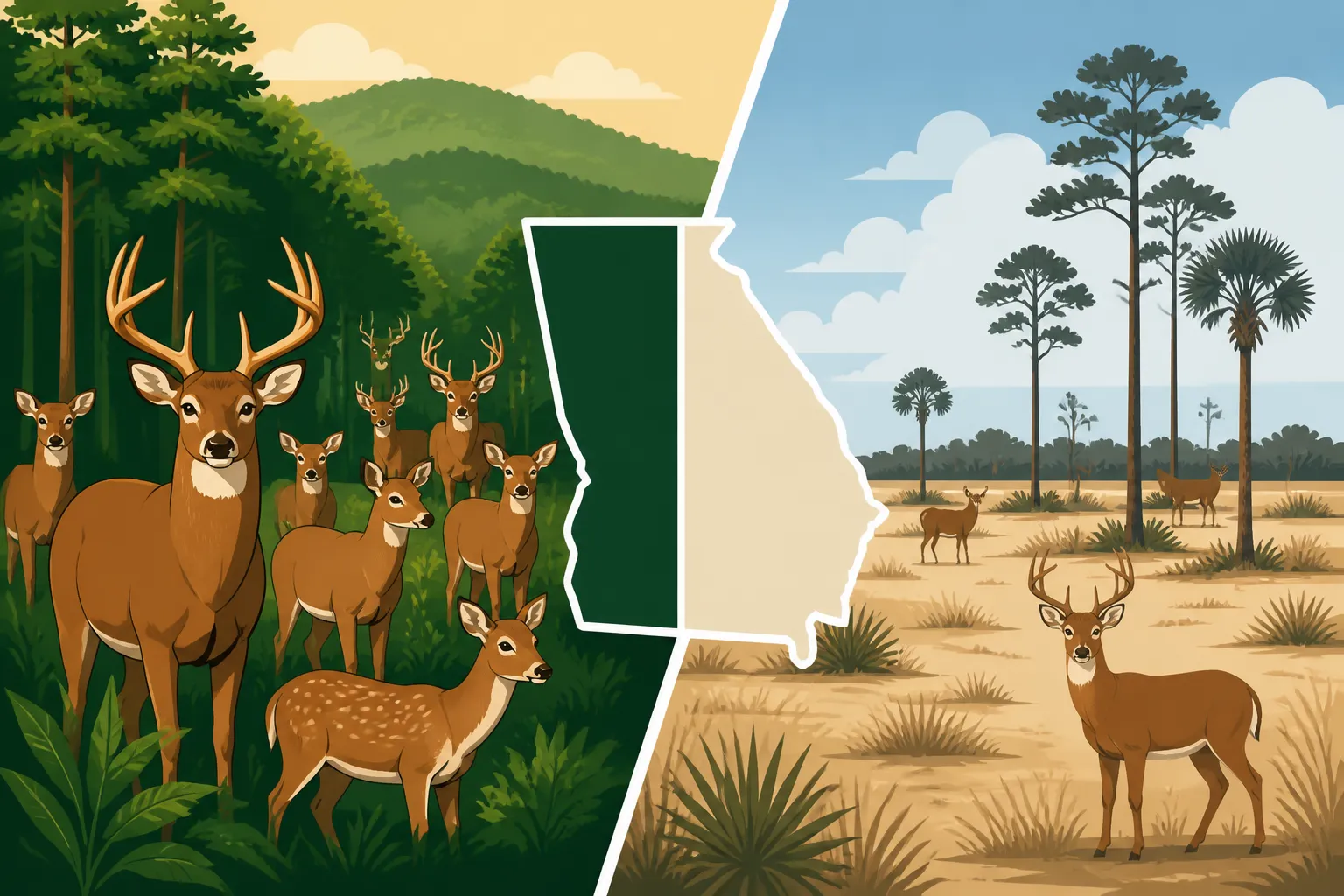
The Piedmont region, generally located in the central part of the state, is characterized by its rolling hills, mixed forests of pine and hardwoods, and a significant amount of agricultural land interspersed with suburban and exurban development. Think of areas around Athens, Macon, and Columbus—these are classic Piedmont landscapes. Here, the land is often fragmented, with smaller woodlots broken up by pastures, row crops, and expanding residential areas. This mosaic creates a particular kind of deer habitat, one that deer have adapted to, often thriving in close proximity to human activity.
Contrast that with the Coastal Plain, which sprawls across the lower half of Georgia. This region is much flatter, dominated by vast pine plantations, expansive agricultural fields of peanuts, cotton, and corn, and extensive bottomland swamps and river drainages. Towns are often smaller and more spread out, and large contiguous tracts of timber and farmland are common. The environment feels wilder in many places, and the sheer scale of the landscape can present different challenges and opportunities for hunters. The differing geographies alone, before we even consider specific food sources or hunting pressure, set the stage for distinct deer populations. Understanding these fundamental differences is the first step in deciphering where Georgia's deer truly thrive.
Deer Density in Georgia's Piedmont Region
When we talk about deer density in the Piedmont, we're discussing a landscape that’s been significantly altered by human activity over centuries. This region historically supported a robust deer population, and despite development, it continues to do so, albeit with some unique characteristics. The rolling terrain, combined with a mix of pine and hardwood forests, provides a diverse diet for deer. Acorns from various oak species, a wide array of forbs and woody browse, and agricultural crops are all readily available. However, the distribution of these resources isn't always uniform; you might find pockets of excellent cover and food separated by busy roads or sprawling neighborhoods.
The fragmentation of habitat in the Piedmont is a double-edged sword for deer. On one hand, smaller woodlots often mean more "edge habitat," where different types of cover meet, providing deer with both protection and easy access to food. Deer are masters of adapting to these environments, often becoming nocturnal in areas with high human disturbance. On the other hand, this fragmentation can lead to smaller home ranges and higher densities in specific, secluded parcels. It's not uncommon to find a robust deer population holding tight in a 50-acre block of woods nestled between a subdivision and a cow pasture. The deer learn to navigate these corridors and leverage every available food source. Using tools like GoHunt, hunters can often pinpoint these smaller, overlooked sanctuaries by analyzing satellite imagery and property lines, identifying where deer might be bedding and feeding away from direct human interaction.
Hunting pressure in the Piedmont can vary wildly. On readily accessible public lands or small private tracts that are heavily hunted, deer may be warier and numbers might seem lower. However, on private lands with little pressure, or in those hard-to-access pockets near urban fringes, deer can become quite numerous. Often, the challenge isn't a lack of deer, but rather the difficulty of accessing them or hunting them effectively in a fragmented landscape. For those hunting private land, understanding local landowner practices, crop rotations, and timber management plays a huge role in predicting deer presence. The overall picture in the Piedmont is one of adaptable deer thriving in a dynamic, human-influenced environment, often leading to localized high densities rather than vast, contiguous herds. Finding those honey holes often involves careful scouting and understanding how deer use every inch of available cover, a topic explored further in Hunting Piedmont Farmland Deer.
Deer Density in Georgia's Coastal Plain Region
Moving south into the vastness of Georgia's Coastal Plain, the deer landscape shifts dramatically. Here, you'll find extensive tracts of land, often dominated by commercial pine plantations, interspersed with massive agricultural operations and intricate river bottom ecosystems. This environment offers a different kind of bounty and challenge for white-tailed deer. The sheer scale of habitat can support large, contiguous herds, and deer often have larger home ranges compared to their Piedmont counterparts, especially in less developed areas.
Pine plantations, while seemingly uniform, can be excellent deer habitat, especially in different stages of growth. Newly clear-cut areas provide a flush of fresh browse, while mid-rotation pines offer thick cover and some browse. Mature pines, particularly longleaf savanna, can provide open understories with diverse forbs. But it's the large agricultural fields—peanuts, corn, cotton, and soybeans—that often drive the highest deer densities in the Coastal Plain. These fields act as massive food plots, providing consistent, high-energy forage throughout much of the year. When combined with adjacent swampy river bottoms or dense pine thickets for bedding, these areas become deer magnets. Hunters can use aerial maps, perhaps with the help of platforms like GoHunt, to identify these large-scale food and cover combinations that are characteristic of the region.
The hunting experience in the Coastal Plain can feel more expansive. While deer might be spread out over larger areas, consistent food sources often draw them into predictable patterns. River bottom swamps, for example, offer not only food but also secure cover from hunting pressure, making them prime spots, as discussed in Hunting Georgia Swamp and River Bottom Deer. Unlike the Piedmont, where deer might be tucked into suburban pockets, the Coastal Plain often boasts genuine wilderness-like tracts, particularly near the Okefenokee Swamp or along major river systems like the Altamaha. This generally leads to a perception of higher overall deer numbers, though finding trophy bucks often requires understanding how deer utilize these vast landscapes over longer periods, a strategy touched upon in Why the Coastal Plain Grows Older Bucks. The key difference here is the scale – consistent, large-scale habitat allows for larger, more widespread populations, rather than concentrated pockets.
Key Factors Influencing Deer Density in Both Regions
While we've painted a broad picture, several critical factors specifically contribute to the nuances of deer density in both the Piedmont and Coastal Plain, making one area more productive than another, even within the same region.
Habitat Quality and Food Availability
Ultimately, deer density is inextricably linked to the quality and quantity of available food and cover. In the Piedmont, the mix of hardwoods and agriculture provides a diverse diet. A strong mast crop year (acorns, persimmons) in the fall can lead to deer concentrating in hardwood bottoms, while a poor mast year might push them more heavily onto agricultural fields or supplemental food plots. The variety often means deer have options. Conversely, in the Coastal Plain, while mast crops are present, the sheer scale of agricultural production often means a consistent, high-calorie food source, especially for areas like Hunting a Standing Soybean Field or a peanut field after harvest. Pine plantations also offer significant browse at different growth stages, providing both food and excellent bedding cover. The type of timber management (e.g., prescribed burns encouraging new growth) can also significantly boost available forage, drawing deer in.
Hunting Pressure and Management Strategies
Hunting pressure plays an undeniable role in how deer populations are perceived and how often deer are seen. In densely populated areas of the Piedmont, accessible public land can be hammered, pushing deer into more nocturnal patterns or deeper, harder-to-reach cover. However, many private landowners in the Piedmont actively manage their properties for quality deer, limiting pressure and allowing bucks to reach older age classes. On the other hand, the vastness of the Coastal Plain means that while there's still pressure, it can be more spread out. Large timber companies or private landowners often lease hunting rights, and these leases can involve sophisticated management plans, sometimes aiming for Filling a Twelve-Deer Bag Limit while maintaining a healthy herd. Hunters using advanced mapping tools like GoHunt can often identify areas with less human encroachment by studying land ownership and access points, which can be critical for finding unpressured deer. Understanding Hunting Pressure on Georgia Public Land is vital for any hunter.
Predation and Disease
While sometimes overlooked, predators like coyotes and diseases like EHD can also influence localized deer densities in both regions. Coyotes are prevalent across Georgia and can impact fawn survival rates, especially in areas with less cover or higher coyote populations. While deer are resilient, persistent high predation can keep densities from reaching their full potential. Similarly, localized disease outbreaks, such as hemorrhagic disease (EHD), can cause significant die-offs, drastically but usually temporarily, reducing deer numbers in specific areas. Understanding Coyotes and Predators in Georgia can help hunters put the full picture together.
Urban and Suburban Adaptations (Piedmont Specific)
A unique aspect influencing Piedmont deer density is their incredible ability to adapt to human-dominated landscapes. Deer are regularly seen grazing in suburban yards, crossing busy roads, and using small green spaces as travel corridors. In many suburban archery-only zones, deer populations can actually reach very high densities due to reduced hunting pressure and abundant ornamental landscaping providing food. This means that while broad swaths of the Piedmont might seem less "wild," pockets of incredibly high deer density can exist where human activity inadvertently creates sanctuaries. Learning to read aerial photos, especially to spot these hidden havens, is a valuable skill in the Piedmont, as highlighted in Reading Aerial Photos for Piedmont Deer.
Here's a quick comparison of factors influencing deer density:
| Feature/Factor | Georgia Piedmont | Georgia Coastal Plain |
|---|---|---|
| Topography | Rolling hills, interspersed ridges and creek bottoms | Flat, low-lying, vast expanses |
| Dominant Cover | Mixed hardwoods, pine stands, fragmented woodlots, suburban green spaces | Extensive pine plantations (loblolly, longleaf), large swamps, river bottoms |
| Primary Food Sources | Acorns, diverse browse, agricultural crops (corn, soybeans), suburban landscaping | Large-scale agriculture (peanuts, cotton, corn, soybeans), diverse browse in timber and swamps |
| Habitat Fragmentation | High due to development, roads, smaller land parcels | Lower, large contiguous tracts of timber and agriculture |
| Hunting Pressure | Variable; can be high on public lands/small private tracts, low in suburban areas | Can be lower due to larger tracts, but concentrated around major food sources |
| Deer Adaptability | Highly adapted to human presence, often nocturnal | More natural deer behavior, but still adaptable to agriculture |
| Density Trend | Often localized high densities in specific pockets/sanctuaries | Generally more widespread higher densities over larger areas |
Making the Most of Deer Density Wherever You Hunt
Ultimately, comparing Piedmont and Coastal Plain deer densities isn't about declaring one region definitively "better" for deer hunting. Both offer unique challenges and incredible rewards. What it truly boils down to is understanding the specific parcel of land you're hunting and the factors influencing the deer there.
In the Piedmont, success often hinges on meticulous scouting and understanding how deer use fragmented habitats. You might find success by focusing on tight funnels between woodlots and fields, or by identifying those small, overlooked sanctuaries near human activity where deer feel secure. Knowing how to adapt your tactics, whether it's setting up on a Setting Up on a Piedmont Field Edge or knowing when to hold off on hunting a pressured area, is key.
In the Coastal Plain, the challenge can be navigating the sheer scale of the landscape. Success might come from identifying the primary food sources, understanding deer movement between bedding areas in thick pine or swamps and feeding grounds, and being willing to cover more ground. Hunters often find great success glassing powerline cuts at dawn and dusk, or by Still-Hunting South Georgia Pine Flats and focusing on subtle changes in topography that funnel deer. The overall Georgia Deer Herd Size is robust, but where they concentrate within that vastness is the puzzle.
Whether you're after a mature buck in the rolling hills of the Piedmont or the expansive pine flats of the Coastal Plain, the best strategy is always informed by knowledge of the local habitat. Use all the tools at your disposal – aerial maps, scouting cameras, and old-fashioned boot leather – to unravel the mysteries of deer movement and truly understand the density dynamics of your hunting grounds. The deer are there, in both regions; it's simply a matter of knowing where to look and how to adapt to their specific environment.
Disclaimer
This article is for general informational purposes only and does not constitute professional advice. Laws, prices and regulations vary by location and change over time. Consult a qualified professional for guidance on your specific situation.