Are Cheap Binoculars Good Enough?
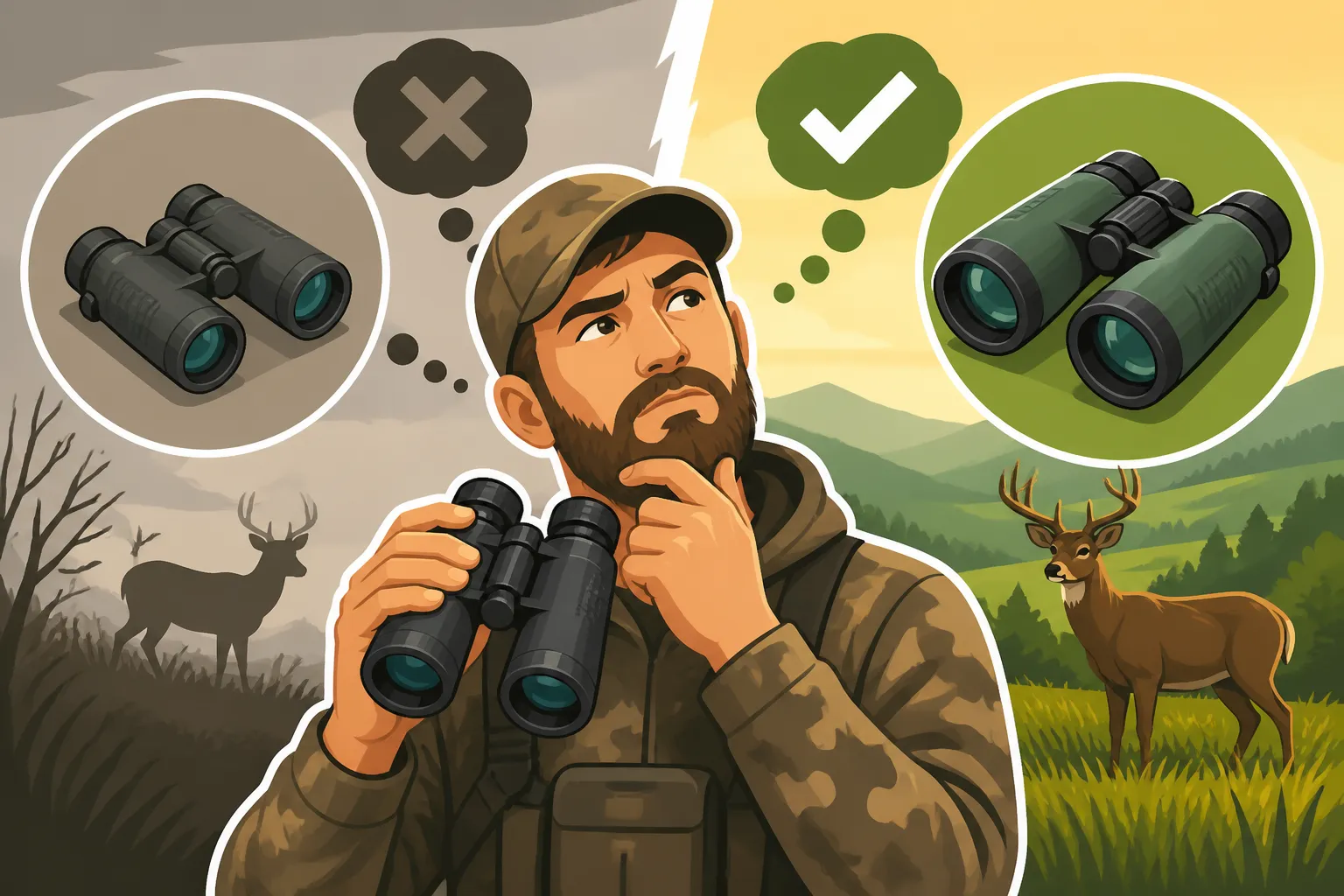
Let's be honest, hunting can be an expensive passion. Between licenses, tags, weapons, calls, and all the other gear, your wallet takes a hit. So, when it comes to optics, especially binoculars, it's natural to wonder if you really need to drop a small fortune or if those more affordable options are "good enough" for hunting here in Georgia. Many hunters face this exact dilemma, staring at price tags ranging from under $100 to well over $1,000, and this guide is here to help you figure out where your money is best spent for your specific Georgia hunting adventures.
Understanding What "Cheap" Binoculars Offer
When we talk about "cheap" binoculars, we're generally looking at models under $150, sometimes even under $100. These aren't necessarily bad; they just come with certain trade-offs. For a lot of casual hunters, or those just starting out, these can absolutely get the job done for basic glassing needs.
The Bare Essentials: Magnification and Field of View
Even budget binoculars will give you magnification, which is their primary purpose. Most commonly, you'll find options like 8×42 or 10×42, meaning they magnify the image 8 or 10 times, and they have 42mm objective lenses. This magnification allows you to spot deer in a distant field or identify movement in thick brush that your naked eye would miss.
However, the field of view (how wide an area you can see through the binoculars) often narrows on cheaper models as magnification increases, making it harder to scan large areas quickly. For instance, if you're trying to locate a gobbler across a wide pasture, an 8x might give you a broader initial scan than a 10x in a budget optic. You might also notice that the edges of the image aren't as crisp or bright as the center, which is a common characteristic of less expensive glass.
Durability and Weather Resistance for Georgia's Outdoors
Georgia weather is notoriously unpredictable. One moment it's sunny and mild, the next you're caught in a sudden downpour, especially during archery season. Cheaper binoculars often lack the robust build quality and advanced weather sealing found in their more expensive counterparts. This can mean they're more susceptible to fogging up internally in humid conditions, or they might not survive an accidental drop onto rocky North Georgia terrain.
While many budget optics claim to be "water resistant," true waterproofing and fog proofing (often achieved by purging with nitrogen or argon gas) are features usually reserved for mid-to-high range binoculars. If you hunt in Georgia's swamps and river bottoms, or frequently deal with morning dew and rain, this can be a significant concern. You don't want your optics failing you when a big buck steps out right at first light. Carrying a good quality lens cloth is always wise, but it won't fix internal fogging.
Where Cheap Binoculars Shine: Specific Georgia Hunting Scenarios
There are definitely situations where a budget pair of binoculars can be perfectly adequate, even beneficial, for a Georgia hunter. It all comes down to your hunting style and the environment you're in.
Close-Range Scouting and Deer Drives
If your hunting primarily involves shorter distances, such as navigating thick Piedmont creek bottoms or still-hunting through dense pine plantations, you might not need top-tier glass. For checking a scrape line 50 yards away or confirming a deer's antler size before a shot in an archery-only zone, most entry-level binoculars will provide sufficient clarity.
During deer drives, especially on public land where communication is key, a quick scan to identify incoming deer or distinguish a legal buck from a doe can be easily accomplished with simpler optics. The focus here is more on quick acquisition and basic identification rather than dissecting every detail at extreme range. Deer Drives With Three or Four Hunters often rely on close-range observation. You're trying to quickly identify the animal as it moves, not count antler points at 300 yards.
Supplemental Optics and Guest Hunters
Many experienced hunters keep a spare pair of less expensive binoculars in their truck or camp. These are perfect for those times you forget your primary pair, or for lending to a new hunter or a younger family member joining you in the field. It’s a great way to introduce someone to the importance of optics without the worry of them damaging a high-dollar piece of gear.
For youth hunts, where the focus is often on participation and learning the ropes, a simpler, lighter, and more durable (in a "less expensive to replace" sense) binocular is often a smart choice. Hunting the Georgia Youth Deer Weekend is a fantastic opportunity to get kids outdoors, and giving them their own pair of binoculars, even a basic one, can greatly enhance their experience.
Hunting Over Established Food Plots
If your primary hunting strategy involves sitting in a stand or blind overlooking a well-maintained food plot, especially one that's a reasonable size (say, under 150 yards), cheaper binoculars can work well. In these scenarios, the light conditions are often better (daylight, open fields), and the distances are generally controlled. You're mostly looking to identify deer, assess antler size, and ensure a clear shot.
The challenge with "cheap" optics in this setting often comes during those crucial low-light periods at dawn and dusk. This is when better glass truly separates itself, gathering more light and providing a brighter, clearer image. However, if you primarily hunt mid-day or if the deer typically appear closer, a budget option might still serve you adequately.
The Trade-Offs: Where Investing More Really Pays Off in Georgia
While cheap binoculars have their place, there are significant advantages to investing in higher-quality optics, especially when hunting Georgia's diverse and challenging landscapes. The difference often comes down to performance in critical situations.
Low Light Performance: The Hunter's Golden Hours
Georgia deer and turkey are most active during the first and last hours of daylight. This "golden hour" hunting is where high-quality binoculars truly earn their keep. Better glass features superior lens coatings and larger, higher-quality objective lenses that gather more available light, translating into a brighter, clearer image when it matters most.
Imagine trying to pick out a feeding deer in the shadows of a pine stand just before legal shooting light ends, or spotting a gobbler strutting at the edge of a field before the sun has fully risen. Cheaper binoculars often turn into dim, blurry tubes in these conditions, making it impossible to confidently identify your target. Premium optics can literally extend your effective hunting time by allowing you to see clearly in conditions where lesser binoculars fail. This is especially vital when Hunting Into the Extended Southwest Season where deer activity can extend into those low-light transition periods.
Clarity, Resolution, and Edge-to-Edge Sharpness
The difference in image quality between cheap and high-end binoculars is often astounding. Better optics offer incredible clarity, resolving fine details like individual hairs on a deer's coat or the tines of a rack at impressive distances. They also maintain sharp focus from the center of the image right to the edges, whereas budget models often have noticeable blurriness or distortion around the periphery.
This clarity is crucial for making ethical decisions in the field. Are those antlers legal? Is that a branch or a leg? Is that a fawn or a mature doe? In the vast, broken terrain of the Chattahoochee-Oconee National Forest Hunting, where you might be glassing across ravines or through dense hardwoods, superior resolution helps you pick apart cover and confidently identify game. For detailed scouting, an app like GoHunt can help you pinpoint areas of interest, but quality optics are what allow you to truly "read" the terrain once you're there.
Durability and Construction for Serious Conditions
Serious hunters demand gear that can withstand abuse. High-quality binoculars are built like tanks, often featuring rubber armor for shock absorption, robust internal mechanisms, and advanced sealing against water, dust, and fog. They're designed to be used in real-world hunting conditions, year after year, without degradation in performance.
If you're tracking a wounded deer through a cypress swamp, navigating a steep mountain ascent, or simply enduring a full season of Georgia humidity and occasional downpours, you need optics you can rely on. Cheap binoculars might work for a season or two, but they rarely stand up to the long-term rigors of dedicated hunting in varying conditions. Losing the functionality of your binoculars halfway through a hunt because of a little rain or a bumped tree is incredibly frustrating and can ruin your day.
Features to Look For Beyond Price Tag
Whether you opt for a budget-friendly pair or decide to invest a bit more, understanding key binocular features will help you make a smarter choice for Georgia hunting.
Objective Lens Size and Exit Pupil
The objective lens is the larger lens at the front of the binoculars. A larger objective lens (e.g., 42mm, 50mm) gathers more light, which is critical for low-light performance. The "exit pupil" is the diameter of the light beam that leaves the eyepiece, calculated by dividing the objective lens diameter by the magnification (e.g., 8×42 = 5.25mm exit pupil). Our pupils dilate in low light, often up to 5-7mm. The closer the exit pupil of your binoculars matches your eye's pupil, the brighter the image will appear in dim conditions.
For hunting in Georgia's thick woods and at dawn/dusk, an exit pupil of 4mm or higher is generally recommended. This means an 8×42 (5.25mm) or 10×42 (4.2mm) configuration is a solid choice. If you can find a quality 8×32 or 10×32 for hiking or brighter conditions, they're lighter, but might struggle more at low light.
Coatings and Prisms
Lens coatings are incredibly important but often overlooked. Cheaper binoculars might have basic coatings, if any, that reduce some glare. Better binoculars feature "fully multi-coated" lenses, meaning all air-to-glass surfaces have multiple layers of anti-reflective coatings. These coatings significantly improve light transmission, enhance contrast, and produce brighter, sharper images, especially in challenging light.
The type of prism also matters. Most quality binoculars use either Porro prisms or Roof prisms. Roof prism binoculars are more compact and streamlined but are more complex to manufacture, making them more expensive to produce with high optical quality. Porro prisms are typically found in bulkier, older designs but can offer excellent optical performance for the price. Bak-4 glass prisms are generally superior to BK-7 prisms, offering a clearer, brighter image with less vignetting.
Ergonomics and Eye Relief
Comfort matters, especially if you're spending hours glassing. Good binoculars feel balanced in your hands, offer a smooth focus wheel, and have comfortable eyecups. "Eye relief" is the distance your eye can be from the eyepiece and still see the full field of view. If you wear glasses, you'll want binoculars with generous eye relief (15mm or more) and adjustable eyecups that twist up and down. This prevents black rings (vignetting) around the image.
GoHunt resources often emphasize the importance of being comfortable and efficient in the field, and that includes your gear. Trying out different models in person, if possible, is always a good idea to see how they feel in your hands and whether they fit your face comfortably.
Weighing the Options: When to Splurge, When to Save
The decision to go cheap or invest more often comes down to a balance of budget, priorities, and how seriously you take your hunting.
Consider Your Budget and Priorities
Let's face it, not everyone has an unlimited budget. If buying top-tier binoculars means you can't afford a crucial hunting license or fuel to get to your hunting spot, then it's not a smart choice. Allocate your funds where they'll have the biggest impact on your success and enjoyment.
However, if binoculars are a tool you use extensively – for scouting, identifying game, ranging, and making critical ethical decisions – then perhaps allocating a larger portion of your gear budget here makes sense. Think about how often you'll use them and in what conditions. For instance, a dedicated turkey hunter relying on locating birds from afar might value better optics more than someone primarily running dogs for hogs at close quarters.
The "Good Enough" Sweet Spot
There's a fantastic middle ground in the binocular market, often in the $200-$500 range, where you can find excellent performance without breaking the bank. Brands like Vortex, Leupold, and Nikon offer superb value in this category. These binoculars typically boast fully multi-coated lenses, good eye relief, robust construction, and solid low-light performance that will serve most Georgia hunters very well.
These intermediate options bridge the gap between truly "cheap" and ultra-premium, providing a significant step up in clarity, durability, and low-light gathering without the sticker shock of alpha glass. They are often a great long-term investment that will perform reliably season after season, whether you're deer hunting in the Piedmont Versus Coastal Plain Deer regions or chasing gobblers in the mountains. For hunters who rely on detailed scouting with tools like GoHunt to plan their trips, these mid-range binoculars complement those efforts by providing crucial on-the-ground visual information.
Comparison Table: Budget vs. Mid-Range vs. Premium Binoculars for Georgia Hunting
Here’s a quick overview of what you can generally expect from different price tiers:
| Feature/Category | Budget (Under $150) | Mid-Range ($200-$500) | Premium ($700+) |
|---|---|---|---|
| Optical Quality | Decent, some distortion, poor low light | Very good, clear, good low light | Excellent, crystal clear, superb low light |
| Light Transmission | Fair, struggles at dawn/dusk | Good to excellent, bright images | Outstanding, bright and detailed in dimmest light |
| Durability | Variable, often not fully waterproof/fog proof | Good, usually waterproof/fog proof | Excellent, built to last, fully sealed |
| Field of View | Can be narrow, edges may blur | Wide, crisp edge-to-edge | Very wide, perfectly sharp edge-to-edge |
| Eye Relief | Adequate, can be tight for glasses users | Good, comfortable for most, often glasses-friendly | Excellent, very comfortable for all |
| Ergonomics | Basic, can feel plasticky | Comfortable, balanced, smooth focus | Superior, refined feel, precise adjustments |
| Weight | Often light (sometimes due to cheaper materials) | Moderate, well-balanced | Can be moderate to heavy (due to quality glass) |
| Best For | Casual hunting, short distances, backup | Most serious hunters, diverse Georgia conditions | Professional guides, dedicated long-range glassing |
Ultimately, "good enough" is a personal assessment. For some, a cheap pair will suffice. For others, the advantages of clearer, brighter images and robust durability in challenging Georgia hunting conditions will make the investment in higher-quality binoculars well worth it. Consider your specific needs, your hunting style, and the terrain you frequent, and you’ll find the right balance for your next hunting adventure.
Disclaimer
This article is for general informational purposes only and does not constitute professional advice. Laws, prices and regulations vary by location and change over time. Consult a qualified professional for guidance on your specific situation.