Georgia Minimum Rifle Caliber Rules
It can feel like you need a law degree to understand all the nuances of hunting regulations, and when it comes to firearms, the questions often start piling up. Many hunters, especially those new to Georgia or just looking to upgrade their gear, get hung up on what exactly constitutes a "legal" rifle caliber for deer and other big game. You don't want to show up on opening day only to find your trusted rifle isn't up to snuff or, worse, isn't allowed at all. This guide is here to clear the air, breaking down Georgia's rifle caliber rules in plain language, so you can hunt confidently and ethically, knowing your equipment meets the mark.
Understanding Georgia's General Rifle Caliber Regulations
One of the first things that often surprises hunters moving to Georgia or new to the sport here is that the state doesn't have an explicit minimum rifle caliber specified for deer hunting in the same way some other states might. This can lead to a bit of confusion, as many folks are used to seeing a clear .243 or .270 minimum written right into the rulebook. However, while there isn't a hard number, Georgia’s regulations focus more broadly on the type of firearm and ammunition, ensuring hunters are using appropriate means for big game.
The Basics of Big Game Caliber Requirements
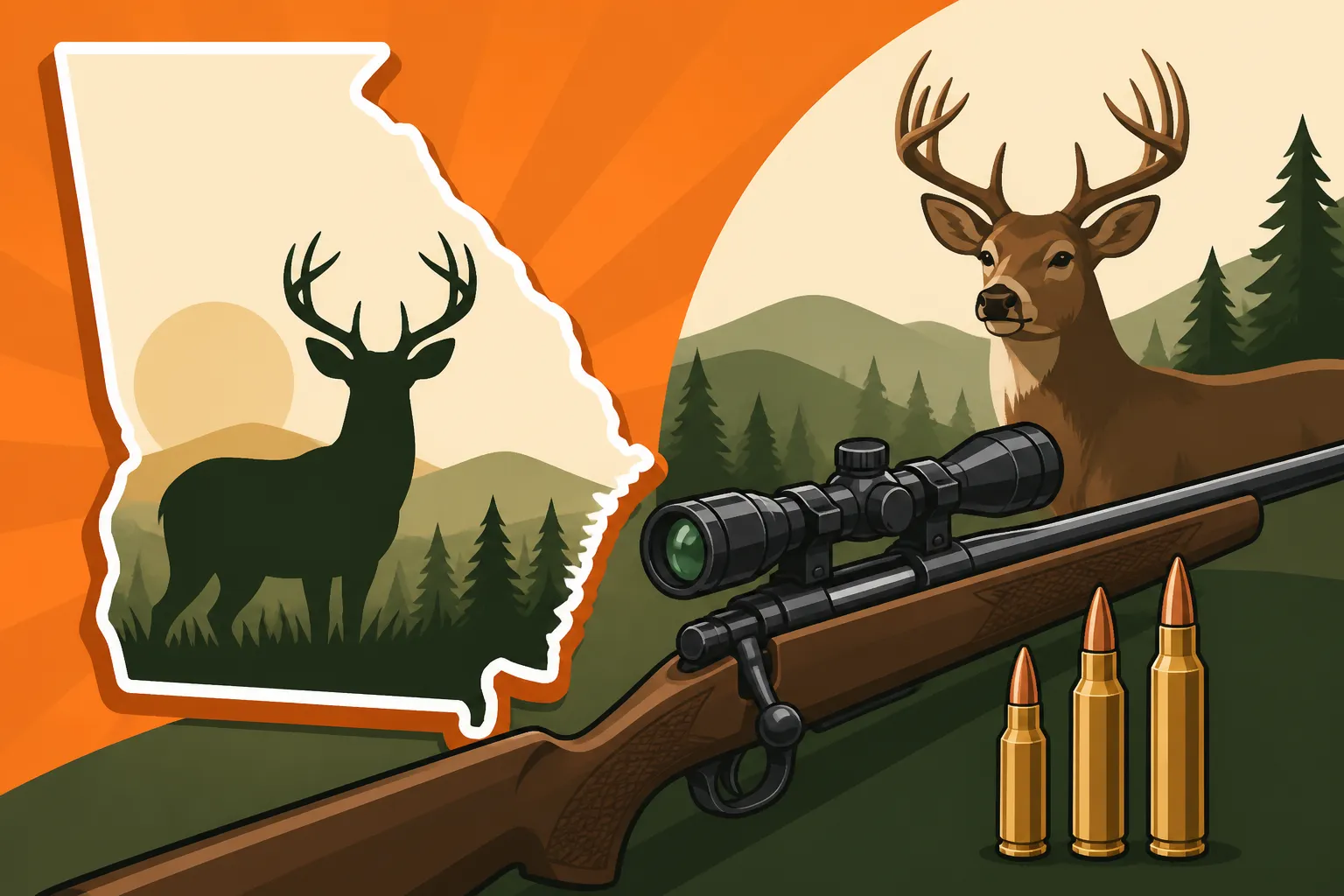
So, if there's no specific minimum caliber, what does the law say? For deer, Georgia regulations allow the use of centerfire rifles. This means calibers like the .223 Remington, .243 Winchester, .270 Winchester, .30-06 Springfield, .308 Winchester, and many others are all perfectly legal. The key distinction here is "centerfire," which excludes rimfire cartridges like the .22 Long Rifle, often used for small game. The intent behind this general allowance for centerfire rifles is to ensure hunters use cartridges powerful enough to humanely dispatch big game animals, like our robust whitetails. While a small centerfire round might be technically legal, the emphasis should always be on ethical harvest. This generally means selecting a caliber and bullet combination that delivers sufficient energy and penetration for a quick, clean kill.
It's crucial to understand that while the law doesn't state "you must use X caliber or larger," there's an implied ethical minimum that seasoned hunters across Georgia adhere to. Most wouldn't consider a .223 as their primary deer rifle, even if it's technically a centerfire cartridge. Why? Because bullet placement becomes absolutely critical, and the margin for error shrinks significantly with less powerful rounds, especially on a quartering shot or if a bone is hit. This isn't just about legality; it's about responsibility. As hunters, we owe it to the animal to make the cleanest kill possible. Consulting resources like the Georgia Department of Natural Resources (DNR) website or even dedicated hunting apps like GoHunt can help you stay current on the specific weapon allowances for each season and game type, ensuring you're never caught off guard.
Specific Rules for Other Game Animals
While deer are often the primary focus when discussing rifle calibers, Georgia also offers incredible opportunities for other big game, particularly black bears and year-round feral hogs. The regulations for these species largely mirror the general centerfire rifle rule, but with some practical considerations unique to the animal.
For black bear hunting, Georgia once again doesn't impose a strict minimum rifle caliber. However, much like deer, the ethical standard leans towards more powerful calibers due to the bear's size, bone structure, and incredible will to live. While a .243 might be legal, most experienced bear hunters would opt for something more substantial, such as a .270, .30-06, .300 Win Mag, or even larger. These calibers offer a greater margin of error for less-than-perfect shots and provide the necessary energy to penetrate thick hide and heavy bone. If you're planning to go after bruins, taking a moment to consider Rifle Calibers for Georgia Bear is a wise move, as the challenge is a step up from deer. The goal is always a swift, humane harvest, and choosing a cartridge with adequate power is a key part of that equation.
Feral hogs are another story entirely, and in a fantastic way for hunters. Georgia treats feral hogs as an invasive species, and as such, hunting them is allowed year-round, day or night (with proper lights), and with almost any legal firearm. This means there are no minimum rifle caliber restrictions at all. Whether you prefer a .223, a .308, or even something more exotic, it's fair game for hogs. This flexibility makes hog hunting a great opportunity to use various rifle setups or to simply get more trigger time with your preferred deer rifle. The most important factor here is choosing a caliber that you can shoot accurately and effectively, ensuring you can make precise shots on often fast-moving or wary animals.
Common Rifle Calibers and Their Suitability for Georgia Deer
Given that Georgia doesn't lay down a strict caliber minimum, the choice often comes down to what's effective, widely available, and comfortable for the hunter. There's a whole world of fantastic centerfire rifle cartridges out there, and many perform exceptionally well in Georgia's diverse hunting landscapes. Understanding the characteristics of popular options can help you make an informed decision for your next season afield.
Popular and Effective Calibers for Whitetails
Let's dive into some of the rifle calibers that Georgia hunters rely on year after year for deer. Each has its strengths, and often, the "best" one is simply the one you shoot most confidently.
The .243 Winchester is a perennial favorite, particularly for youth hunters, those sensitive to recoil, or anyone primarily targeting smaller-bodied deer often found in parts of Georgia. It's a flat-shooting cartridge that, with proper bullet selection and excellent shot placement, is more than capable of taking down a whitetail cleanly. The key here is "proper bullet selection" – opting for a heavier, bonded bullet designed for big game, rather than a varmint-specific bullet, will greatly improve its effectiveness. Many hunters swear by it, but it does require precision. If you've ever pondered Is a .243 Enough for Georgia Whitetails?, the answer is often "yes, with caveats." It's legal and, in the right hands, highly effective.
Stepping up a bit, we find the .270 Winchester and the .308 Winchester, two cartridges that are truly the workhorses of the deer hunting world, both nationally and here in Georgia. The .270 is known for its flat trajectory and excellent long-range capabilities, making it a great choice for open field edges or power lines, while still being perfectly capable in the timber. The .308 Winchester, on the other hand, is renowned for its efficiency, manageable recoil, and excellent accuracy. It performs beautifully in dense cover, where shots are often shorter, but it also has plenty of punch for those longer Piedmont field edges. Many hunters agonize over the choice, asking questions like .308 Versus .270 for Whitetails, but honestly, you can't go wrong with either. They are both incredibly versatile and effective for Georgia's whitetails.
Then there's the 6.5 Creedmoor, a relative newcomer that has absolutely soared in popularity. This cartridge offers a fantastic blend of low recoil, superb accuracy, and an impressively flat trajectory, making it an excellent choice for a wide range of hunting scenarios. Its ballistic efficiency means it retains energy well, which is great for those longer shots you might encounter when 6.5 Creedmoor for Piedmont Field Edges or across a wide-open cutover. It's a modern classic for a reason and has quickly earned its place among Georgia deer hunters.
Finally, the grand old .30-06 Springfield remains a top-tier choice. It's been taking deer (and much larger game) for over a century, and for good reason. It offers ample power, a wide array of bullet options, and generally excellent performance. While it might have a bit more recoil than some other options, its reliability and effectiveness are undeniable, especially if you plan on hunting mature bucks in dense hardwood bottoms or even taking on a black bear.
Considerations for Cartridge Selection Beyond Caliber
Choosing a rifle isn't just about the number on the box; it's about the whole package, from bullet design to how well you can shoot it. When thinking about your setup for Georgia hunting, several factors come into play beyond just the caliber itself.
Bullet Construction is paramount. For big game like deer and bear, you absolutely want an expanding bullet. This means selecting cartridges loaded with soft-point, hollow-point, or bonded bullets that are designed to expand upon impact, creating a larger wound channel and causing more tissue damage for a quicker, more humane kill. Varmint bullets, which are designed to fragment explosively on small targets, are generally unsuitable and unethical for deer, as they often lack the penetration needed to reach vital organs. Always read the box and choose bullets specifically labeled for big game.
Energy transfer and knockdown power are often discussed, and while a direct "knockdown power" measurement is elusive, the concept of kinetic energy transfer is real. A heavier, faster bullet typically transfers more energy to the animal, causing more hydrostatic shock and tissue destruction, which contributes to a faster kill. This is why a .30-06 generally feels more authoritative than a .243, even with perfect shot placement. It's about maximizing the efficiency of your shot.
Range considerations play a huge role in Georgia. Unlike vast open plains out West, much of our deer hunting takes place in relatively dense timber, thick swamps, or mixed pine and hardwood forests. This often means shots are closer, perhaps 50-150 yards. However, if you're hunting field edges, power lines, or clear-cuts, you might face shots out to 250-300 yards. Your caliber choice should ideally match the ranges you expect to encounter most often. For instance, while a flat-shooting cartridge is nice, it's not strictly necessary if all your shots are inside 100 yards in a place like the Okefenokee. Conversely, if you plan to Hunt a Green Field Planted for Deer, you'll appreciate a flatter trajectory. Understanding the Practical Range in Georgia Swamp Timber versus an open ag field can certainly influence your setup.
Finally, recoil and shooter proficiency are arguably the most important factors. The most powerful rifle in the world is useless if you flinch every time you pull the trigger. Choose a caliber that you can shoot comfortably and accurately, both on the range and in a hunting situation. Consistent practice is vital, and a rifle you can shoot well is always more effective than one that's too powerful for you to control. The best advice for any hunter is to spend ample time at the shooting range, mastering their chosen firearm, ensuring they can put rounds exactly where they need to go, which we'll discuss further in Zeroing at 100 Yards for Field Edge Hunting.
Legal Ramifications and Ethical Hunting Practices
When it comes to hunting, understanding the letter of the law is just the starting point. Overlaying that with a strong ethical compass is what truly makes a responsible hunter. Georgia's flexible rifle caliber rules put a greater emphasis on individual responsibility, making it even more important to grasp both the legal requirements and the ethical considerations.
What the Law Says About Rifle Use
As we've established, Georgia's hunting regulations for deer do not specify a minimum caliber for centerfire rifles. Instead, the focus is on the type of firearm that is legal for big game. For deer, this generally includes:
- Centerfire rifles: As discussed, a broad category encompassing most popular hunting calibers.
- Shotguns: 20 gauge or larger, firing slugs or buckshot (with specific buckshot rules).
- Muzzleloaders: .40 caliber or larger.
- Archery equipment: Both vertical bows and crossbows.
- Handguns: Centerfire, .20 caliber or larger.
It's critical to note that fully automatic firearms are strictly prohibited for hunting in Georgia, as are any firearms equipped with silencers or suppressors, unless specifically for predator control under certain circumstances, which doesn't apply to big game. The key takeaway for rifle hunters is to ensure their rifle is indeed a centerfire model and that they are using ammunition designed for hunting big game, not varmints or target practice. The GoHunt app, for example, is an excellent tool to quickly cross-reference Georgia's current hunting regulations, including any specific local exceptions or season requirements for different weapon types, ensuring you always hunt within the legal framework.
Beyond the firearm itself, always check the ammunition type. While Georgia doesn't specify bullet construction in its statutes for deer, using non-expanding or target ammunition on big game would be highly unethical and potentially lead to a wounded animal. Most sporting goods stores and ammo manufacturers clearly label cartridges suitable for deer or big game. Staying informed about these general guidelines is part of your Georgia Hunter Education Requirements.
Ethical Considerations and Shot Placement
The absence of a minimum caliber doesn't give hunters free rein to use just anything. It places a greater burden on the individual hunter to make responsible choices. This is where ethical hunting practices come squarely into play. The most powerful rifle in the world can't compensate for a poorly placed shot, and conversely, a well-placed shot with a moderately powered rifle can be devastatingly effective.
Ultimately, the hunter's skill and shot placement are paramount. You could be shooting a .300 Win Mag, but if you hit the deer in the leg, you're going to have a problem. On the other hand, a carefully placed shot with a .243 in the vitals will usually result in a quick, humane kill. Ethical hunting demands that we aim for the vital organs (heart and lungs) of the animal, ensuring a rapid, humane harvest. This minimizes suffering and respects the animal we are pursuing.
To achieve this, consistent practice at the shooting range is non-negotiable. Knowing your rifle, understanding its ballistics, and being able to hit a deer-sized target consistently at various ranges are far more important than the specific caliber itself. Practicing from different positions – standing, kneeling, from a treestand simulation – will make you a more versatile and ethical hunter. You need to be confident in your ability to make that critical shot when the moment arrives. Consider dedicating time to Zeroing at 100 Yards for Field Edge Hunting to ensure your rifle is perfectly tuned for common Georgia distances.
Furthermore, being prepared for the aftermath is also part of ethical hunting. Even with a perfect shot, a deer might run. Knowing how to efficiently Blood Trailing After Dark in Georgia and having the tools for a quick field dressing are essential skills that every hunter should possess. Respect for the animal extends beyond the shot itself, encompassing the recovery and processing of the game.
Special Cases and Regional Nuances
While the general rules for rifle calibers in Georgia are relatively straightforward, there are always a few special considerations and regional variations that can influence a hunter's choice. These aren't necessarily legal mandates, but rather practical considerations based on evolving trends or the unique characteristics of different Georgia hunting grounds.
Straight-Wall Cartridges and Their Growing Popularity
In recent years, you might have heard a lot about "straight-wall cartridges." These are rifle cartridges where the casing walls are straight, rather than tapered or bottlenecked, like most traditional rifle cartridges. Examples include the .45-70 Government, .350 Legend, and .450 Bushmaster. So, why are they becoming popular, and do they have a place in Georgia?
The rise of straight-wall cartridges primarily stems from hunting regulations in certain Midwestern states that restrict rifle hunting to specific "shotgun-only" zones, but often make an exception for straight-wall rifle cartridges due to their typically lower velocities and shorter effective ranges compared to bottlenecked rifle rounds. In Georgia, since centerfire rifles are generally allowed statewide for deer, the necessity for a straight-wall cartridge as a legal requirement isn't as pronounced. However, they are perfectly legal for hunting in Georgia, as they are indeed centerfire rifles.
Some Georgia hunters are adopting them for a few reasons:
- Reduced Recoil (for some): Cartridges like the .350 Legend offer very mild recoil while still delivering excellent performance on deer, making them a comfortable option for many.
- Brush-Busting Power: Heavier, larger diameter bullets often associated with straight-wall cartridges can sometimes perform better when encountering light brush or twigs on their path to the target, though no bullet is truly a "brush buster."
- Unique Appeal: Some hunters simply enjoy the novelty or the historical connection (in the case of the .45-70) of these cartridges.
If you're considering Straight-Wall Cartridge Options in Georgia, know that they are completely permissible and can be highly effective. The key, as always, is matching the cartridge to your hunting conditions and ensuring you can shoot it accurately.
Hunting Different Georgia Terrains
Georgia is a state of incredible topographical diversity, from the Appalachian foothills in the north to the vast swamps and coastal plains in the south. The terrain you hunt can subtly influence your practical choice of rifle caliber, even if the legalities remain constant.
In the North Georgia Mountains, for instance, you might find yourself glassing clear-cuts or long ridge lines where a longer shot is a real possibility. A caliber known for its flat trajectory, like a .270 or 6.5 Creedmoor, might feel more at home here. However, much of mountain hunting is also done in incredibly thick timber, where shots are often short and steep. For insights into hunting this challenging landscape, check out Hunting North Georgia Mountain Country. The steep angles and dense cover might lead some hunters to favor a powerful but less-range-dependent round like a .308 or even a traditional lever-action .30-30.
The Piedmont region of Georgia, characterized by rolling hills, mixed timber, and extensive agricultural fields, often presents a blend of opportunities. Here, you might have a long shot across a peanut field one day, and a tight 50-yard shot in a creek bottom the next. Versatile calibers like the .308, .270, or 6.5 Creedmoor excel in this type of mixed environment, offering a good balance of power and trajectory for varied shot distances.
Down in the Coastal Plain and South Georgia plantation country, the landscape changes dramatically to dense pine plantations, thick palmetto thickets, and expansive swamps. Shots here are frequently at very close range, sometimes under 50 yards, and often through incredibly thick cover. Deer can also be quite robust, especially on well-managed properties. While any legal centerfire rifle will work, the emphasis shifts heavily to rapid target acquisition and stopping power at close quarters. A .30-30, .45-70, or even a powerful .308 with a heavy bullet might be preferred by some for these close-range, high-impact scenarios.
The takeaway is this: while Georgia's minimum rifle caliber rules are refreshingly simple (any centerfire is generally fine), the best caliber for you often depends on where and how you hunt, and what you feel most confident shooting.
| Caliber | Pros for Georgia Deer Hunting | Cons for Georgia Deer Hunting | Best Use Case in GA |
|---|---|---|---|
| .243 Winchester | Low recoil, flat trajectory, effective with good shot placement. | Less margin for error, requires precise shot placement & appropriate bullets. | Smaller deer, youth hunters, open fields with known distances. |
| 6.5 Creedmoor | Low recoil, excellent accuracy, flat trajectory, good energy retention. | Less common historically, but availability is improving. | Mixed terrain, open fields, medium to longer range shots. |
| .308 Winchester | Versatile, good power, moderate recoil, compact rifles available. | Trajectory less flat than .270 for very long shots. | Dense timber, mixed woods and fields, all-around performer. |
| .270 Winchester | Flat-shooting, ample power, excellent for open country. | Can have more recoil than .243/6.5, more barrel length often preferred. | Open fields, clear-cuts, longer shots, mountainous terrain. |
| .30-06 Springfield | Powerful, versatile, wide range of bullet options, classic choice. | More recoil, can be overkill for smaller deer at close range. | All big game, dense timber, larger deer, general purpose. |
| .350 Legend (Straight-Wall) | Very low recoil, good for close-range shots, legal everywhere. | Limited long-range performance, less common ammo variety. | Dense cover, short-range hunting where minimal recoil is desired. |
Disclaimer
Please remember that hunting regulations can change. While this guide provides a comprehensive overview of Georgia's minimum rifle caliber rules based on current information, it is your responsibility as a hunter to consult the latest Georgia Department of Natural Resources (DNR) regulations and guidelines before heading afield. Always verify specific rules for the current hunting season and your chosen hunting area.