Georgia Whitetail Color Phase Rarities
Have you ever been out in the Georgia woods, patiently waiting, when a deer steps out of the shadows, and for a split second, you question everything you thought you knew about whitetails? It's not just the size of its rack or its gait that catches your eye, but something strikingly different about its coat. Most of us are familiar with the classic tawny brown, but occasionally, Mother Nature throws a curveball, presenting a deer with an unusual color. This guide dives into those rare color phase rarities in Georgia's whitetail deer population, exploring what causes them and what they mean for the animal.
The Standard Whitetail Palette: What We Usually See
When we talk about white-tailed deer in Georgia, most of us picture that familiar reddish-brown coat in the warmer months, transitioning to a grayer, thicker coat as the weather cools. This typical coloration provides excellent camouflage in our varied Georgia landscapes, from the thick pine plantations of the Coastal Plain to the rugged hardwood ridges of the North Georgia mountains. The belly and underside of the tail are usually stark white, giving the deer its name when it flags that tail in alarm. This standard color is a testament to thousands of years of evolution, helping deer blend in and survive.
Think about scouting your favorite patch of woods, whether you're using aerial maps or tools like GoHunt to understand terrain features. You're always looking for that tell-tale flash of brown or grey against the green and brown backdrop. The normal variation you'll see might be a slightly darker hue in a mature buck versus a fawn, or a richer red in a deer from a certain region. These are common, expected differences, but they're a far cry from the truly rare genetic anomalies that produce the striking color phases we're about to discuss. Understanding this baseline is key to appreciating just how unusual those rare sightings truly are.
The Science Behind Unusual Coat Colors
Deer coloration, much like hair color in humans, is governed by genetics. Pigments like melanin, specifically eumelanin (which creates black/brown colors) and pheomelanin (which creates red/yellow colors), are produced by specialized cells called melanocytes. The amount, type, and distribution of these pigments are all dictated by a deer's DNA. When there's a mutation or an unusual combination of recessive genes, the normal pigment production or distribution can be altered, leading to those head-turning color variations.
It’s not just a random occurrence; these are genetic quirks. For many of these rare traits to express themselves, the deer often needs to inherit a specific recessive gene from both parents. This makes them inherently rare in the broader population. Imagine the odds of two deer carrying a very specific, uncommon recessive gene mating and then passing on that exact combination to their fawn. It’s like hitting a biological lottery, resulting in an animal that looks distinctly different from its peers. This genetic roll of the dice is precisely why you might hunt for decades in Georgia and never see one of these unique deer.
Albino Whitetails: True Ghosts of the Forest
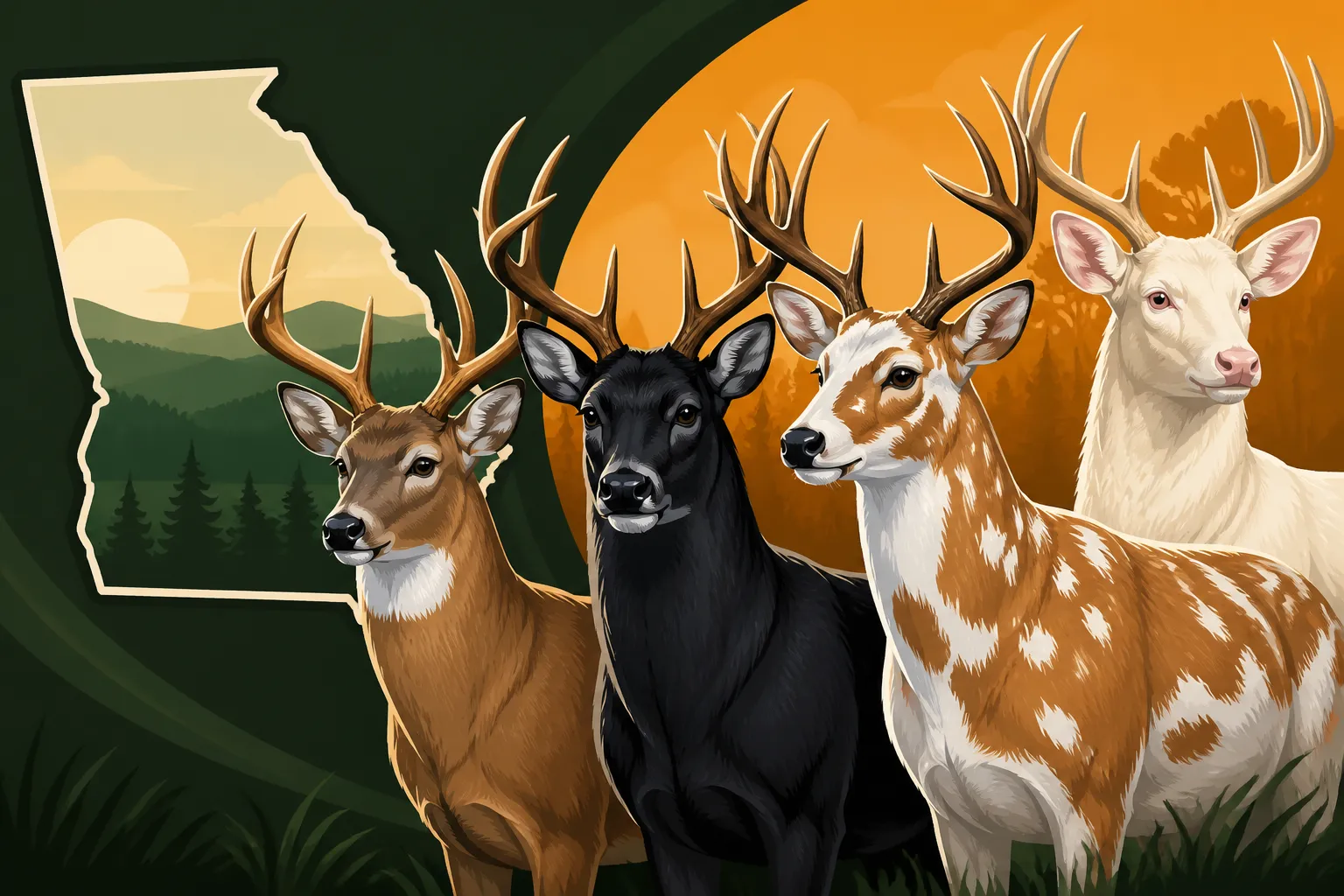
Perhaps the most recognized of the rare color phases is albinism. A true albino deer is completely white, often with pink eyes and a pink nose. This isn't just a pale coat; it's a complete lack of melanin in their skin, hair, and eyes. The pinkish hue comes from the blood vessels showing through the unpigmented tissues. Seeing a pure white deer with those distinctive pink eyes emerge from the deep green hardwoods is an almost surreal experience, something that sticks with a hunter for a lifetime.
True albinism is incredibly rare in the wild. These deer face significant challenges. Their lack of pigment makes them far more conspicuous to predators, both human hunters and natural foes like coyotes. Their eyes, lacking protective pigment, are often sensitive to bright sunlight, potentially impacting their vision, especially in broad daylight. While stunning to behold, their lives are often tougher than their brown counterparts. If you’re reviewing your trail camera photos, perhaps uploaded via an app that links to GoHunt, and you see something truly white with pink eyes, you’ve captured a genuinely rare phenomenon.
Leucistic Whitetails: The More Common Pale Beauty
Often confused with albinism, leucism is another condition that results in a deer with a white or very pale coat. The key difference, however, lies in the eyes. Leucistic deer typically have blue or normal brown eyes, not the pink eyes characteristic of true albinos. Their noses and hooves might also retain some normal pigmentation. This means their bodies produce some pigment, but it's either dramatically reduced or not distributed properly throughout their fur.
Leucistic deer can range from mostly white with a few patches of normal color to a pale cream or 'piebald' appearance, where there are distinct patches of white and normal brown. The piebald variation is probably the most commonly observed unusual coloration, though still quite rare. These deer often suffer from other genetic issues, such as short legs, spinal deformities, or overbites, which can further impact their survival. While they might have slightly better camouflage than a true albino due to some normal pigmentation in their eyes, they still stand out significantly more than a typically colored deer, making them more vulnerable.
Melanistic Whitetails: The Shadows in the Swamp
On the opposite end of the spectrum from albinism and leucism is melanism, a condition where a deer produces an excess of melanin, resulting in an unusually dark or even black coat. While albino and leucistic deer sightings make headlines, melanistic whitetails are exceedingly rare, making them arguably the most elusive color phase rarity in Georgia. Imagine a deer so dark it almost looks like a silhouette moving through a shaded swamp bottom or the dense undergrowth of a pine thicket.
The exact causes of melanism in whitetails aren't fully understood, but it's believed to be a genetic mutation that causes an overproduction of eumelanin. Some theories suggest it might be more prevalent in specific, isolated populations or habitats, possibly offering some form of camouflage in extremely dark or shadowed environments. However, these are largely speculative given the extreme rarity. If you're out Hunting Georgia Swamp and River Bottom Deer, encountering a melanistic whitetail would be an incredibly memorable experience, one that most hunters will never have the privilege of witnessing.
Here's a quick look at the distinguishing characteristics of these rare color phases:
| Feature | Typical Whitetail | Albino Whitetail | Leucistic Whitetail | Melanistic Whitetail |
|---|---|---|---|---|
| Coat Color | Brown/Tan, White belly | Pure White | White, Cream, or Piebald | Dark Brown to Black |
| Eye Color | Brown | Pink/Red | Blue or Brown | Brown |
| Nose/Hooves | Dark Brown/Black | Pink | Pink or Dark | Black |
| Rarity | Common | Extremely Rare | Rare (Piebald most common) | Extremely Rare |
| Survival Odds | High (good camouflage) | Low (poor camouflage, poor vision) | Moderate (variable camouflage, other health issues possible) | Unknown (likely normal to lower due to standing out) |
Ethical and Legal Considerations for Hunting Rare Color Phase Deer
Discovering a deer with an unusual color phase can certainly be a memorable event, and it often sparks a lot of conversation among hunters. The big question often arises: what are the rules and ethics around harvesting such a deer in Georgia?
Is it Legal to Harvest a Color Phase Deer in Georgia?
In Georgia, as a general rule, there are no specific state regulations that prohibit the harvesting of a deer based solely on its color phase, whether it's an albino, leucistic, or melanistic animal. If a deer is legal to harvest according to the current season dates, bag limits (like How Many Antlered Bucks You Can Take), and weapon restrictions, then its unusual coloration does not make it illegal to take. This means if it's during Georgia's Long Firearms Deer Season and you have a valid tag, that rare deer is fair game just like any other.
However, hunting ethics extend beyond what is strictly legal. Many hunters, when faced with such a unique animal, choose to pass on it. They view these rare deer as special creatures, almost mystical, and prefer to let them continue to roam and potentially pass on their unique genetics, however unlikely that may be for recessive traits. Others might see it as a once-in-a-lifetime trophy, a testament to nature's diversity. It's a personal decision, but one that should be made with respect for the animal and the hunting tradition. Always remember to check Georgia Deer Harvest Reporting Rules to properly tag and report any deer you take, regardless of its color.
Reporting and Research Opportunities
While not mandatory, if you do encounter a rare color phase deer, consider reporting your sighting to the Georgia Department of Natural Resources (DNR) or a local wildlife biologist. While they might not be actively tracking every single instance, such reports can sometimes contribute to broader understanding of deer genetics and population health. These observations, especially if you have photographs or video, can be valuable data points for wildlife management. You can often find contact information or reporting portals through official state wildlife websites, similar to how you might look up Georgia Deer Population Estimate data.
Some hunters might even contribute tissue samples if they harvest such an animal, particularly if a researcher or university is conducting studies on deer genetics. This is certainly not a requirement, but it's an opportunity for science to learn more about these fascinating anomalies. Using tools like GoHunt to mark the location of a sighting, even if you don't harvest the deer, can also be helpful for personal tracking and potential future observation.
Conservation and Management Perspective
From a wildlife management standpoint, these rare color phases are generally not considered a conservation concern. They are natural genetic variations, and their rarity is part of what makes them special. Wildlife agencies focus more on overall herd health, population numbers, habitat quality, and disease monitoring (such as Chronic Wasting Disease Risk in Georgia), rather than the prevalence of specific coat colors. Therefore, encountering one of these deer should be seen as a unique natural event rather than an indicator of a problem within the deer population.
Whether you choose to hunt it or simply marvel at its existence, seeing a color phase rarity in Georgia is truly an unforgettable moment, reminding us of the incredible diversity and occasional surprises that nature holds within our familiar forests.
Disclaimer
This article is for general informational purposes only and does not constitute professional advice. Laws, prices and regulations vary by location and change over time. Consult a qualified professional for guidance on your specific situation.