How CWD Reached South Georgia
Chronic Wasting Disease (CWD) is now part of the picture for Georgia deer hunters. After years of watching the disease spread through other states, Georgia recorded its first confirmed case in early 2025 — in Lanier County, in the southern part of the state.
The natural first question is: how did it get here? The honest answer, and the one Georgia DNR gives, is that nobody knows for certain. What we can do is look at the pathways CWD has used to reach new areas elsewhere, understand what Georgia’s response actually requires of hunters, and separate the real rules from the assumptions.
That last point matters more than you might expect. Georgia’s approach to CWD is deliberately different from what several other states have done, and hunters who assume Georgia copied the Wisconsin or Tennessee playbook will get it wrong.
Understanding Chronic Wasting Disease
CWD is a fatal neurological disease affecting cervids — white-tailed deer, elk, moose, and related species. It is not caused by a virus, bacterium, or parasite. It is caused by prions: abnormal proteins that cause normal proteins in the brain to misfold, producing progressive and irreversible damage to brain tissue.
How CWD spreads
Deer transmit CWD directly through saliva, urine, and feces. It also spreads indirectly through the environment — contaminated soil, food, and water. Prions persist in the environment for long periods, and according to Georgia DNR, deer can still become infected from a contaminated area years after an infected animal has died.
That environmental persistence is what makes CWD so difficult to manage. Once established in an area, the disease is nearly impossible to eradicate.
Symptoms — and why you probably won’t see them
This is where a lot of hunters get the wrong impression. CWD has an incubation period of roughly 18 to 24 months, and infected deer appear normal until near the end of it. The overwhelming majority of CWD-positive deer harvested by hunters look completely healthy.
When symptoms do appear in late-stage animals, they can include:
- Severe weight loss and emaciation
- Stumbling, poor coordination, tremors
- Head held low, drooping ears
- Excessive drooling and increased thirst
- Loss of fear of humans, lethargy, repetitive movements
These signs overlap with other conditions — EHD, injury, malnutrition — so visual assessment alone can’t confirm CWD. The only approved tests use lymph node or brain tissue.
If you see a deer behaving abnormally, report it to Georgia DNR. You can report sick or dead wildlife through the DNR website, or contact your regional Game Management office.
CWD’s Arrival in Georgia
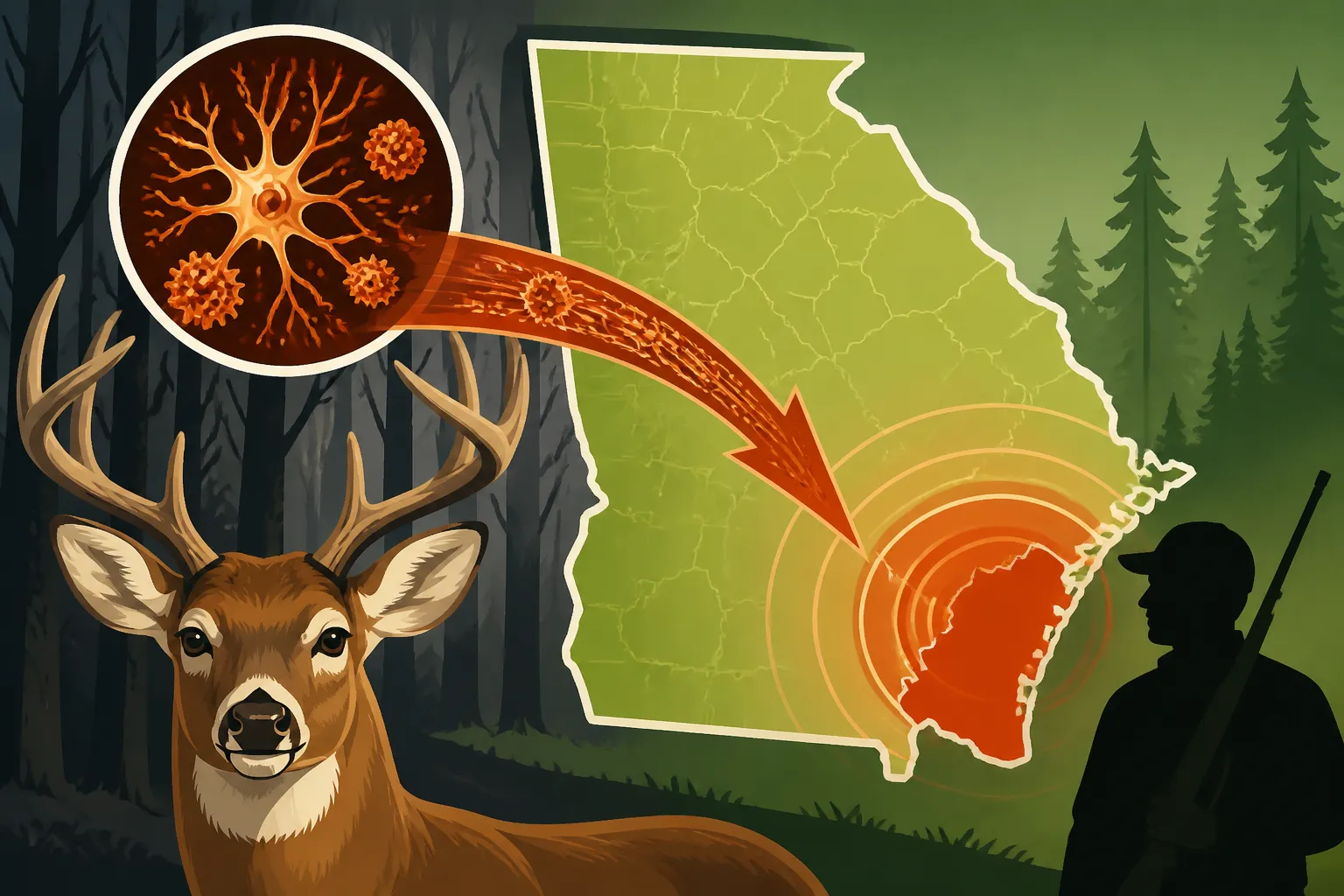
Georgia’s first confirmed CWD case was detected in early 2025 in a white-tailed deer in Lanier County, in South Georgia. The detection came through DNR’s ongoing surveillance sampling — the state had been testing deer for years as a precaution.
The CWD Management Area
Following the detection, DNR implemented its CWD Response Plan and established a CWD Management Area (CMA).
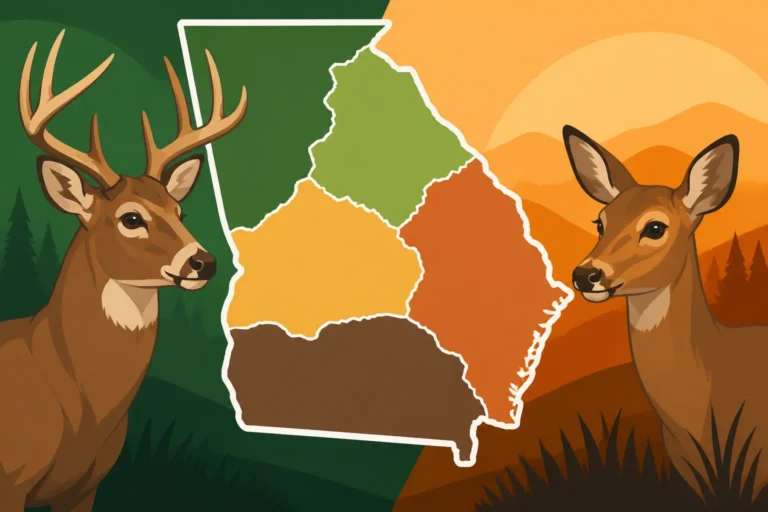
The CMA is defined by a specific rule: it covers the county where a positive deer was found, plus any county touching a five-mile radius around that location. It is not an arbitrary boundary, and it expands if new positives are found outside the current area.
The current CMA includes four counties: Atkinson, Lanier, Berrien, and Lowndes.
This is worth noting because the CMA was initially smaller — it covered Lanier and Berrien counties — and grew as the geographic picture developed. If you hunt in or near South Georgia, check the current CMA boundaries at the start of each season rather than relying on what you remember from last year.
How Did CWD Reach South Georgia?
Georgia DNR’s position is direct: at this time, we do not know how CWD got here.
That’s an unsatisfying answer, but it’s the accurate one, and it’s better than a confident guess. Based on how CWD has been introduced to new areas elsewhere, DNR identifies three possibilities:
1. Illegal importation of live deer. Moving live deer into Georgia is considered the single greatest risk for introducing CWD to new areas. Live importation of all deer species from other states has been prohibited in Georgia since 2005 under O.C.G.A. 27-5-2.1. Prohibition doesn’t make it impossible, and black-market transfers have played a documented role in outbreaks in other states.
2. Spread from an undiscovered pocket of CWD in another state. Surveillance catches what it samples. A low-prevalence pocket in a neighboring state could go undetected for years while deer move naturally across the landscape.
3. CWD-positive carcass parts from another state discarded in the area. A hunter brings home a deer from a CWD-positive state, and high-risk parts — brain, spinal cord, lymph nodes — end up discarded where local deer can access the site.
Natural movement versus human-assisted spread
Deer move. A buck’s home range is typically a few square miles, expanding during the rut. Over generations this produces slow, incremental spread of the disease front.
What deer don’t do is jump hundreds of miles across highways, rivers, and unsuitable habitat. When CWD appears far from any known infected area, human activity is almost always the explanation — whether through live animal movement or carcass transport.
This is why the rules Georgia does have focus on those two pathways specifically.
What Georgia Actually Requires of Hunters
Here’s where precision matters. Georgia has two carcass-related legal requirements, and neither one is what most hunters assume.
1. Statewide carcass disposal rule
Proper deer carcass disposal is required across all of Georgia — not just in the CMA. This applies to anyone transporting or disposing of deer carcasses or parts, including hunters, processors, and taxidermists.
Approved disposal methods for carcasses or unused parts:
- Leave them on the property where the deer was killed
- Use a commercial deer processor — processors are required to properly dispose of unused carcass parts
- Permitted solid waste landfill — as you would household garbage; smaller parts can be bagged and placed in household garbage containers
- Deep burial, incineration, or another approved method under the Dead Animal Disposal Act (O.C.G.A. § 4-5-1 to 4-5-11)
The logic is straightforward: carcass parts from a CWD-positive deer can transmit the disease if those parts are moved to a new area and discarded on the landscape.
2. Out-of-state carcass importation restriction
This is Georgia’s only carcass transport law, and it applies to deer harvested outside Georgia.
It is illegal to bring deer carcasses into Georgia from out of state unless specific conditions are met (O.C.G.A. 27-5-2.1). Hunters returning from out-of-state hunts may bring home only:
- Boned-out meat
- Hides
- Skulls or skull caps with antlers attached and all soft tissue removed (velvet antlers are acceptable)
- Jawbones with no soft tissue attached
- Elk ivories
- Finished taxidermy mounts
All other carcass parts must be left behind.
What is not required
To be explicit, because this is where bad information circulates:
- There are no county-level carcass transport restrictions in Georgia. You are not prohibited from transporting a deer harvested in the CMA to a processor or taxidermist outside the CMA.
- There are no CMA-boundary transport rules. The CMA is a surveillance and management designation, not a quarantine zone.
- There is no mandatory CWD testing anywhere in Georgia. Not in the CMA, not outside it.
If you’ve read otherwise — including in an earlier version of this article — that information was incorrect.
CWD Testing in Georgia: Voluntary, and Why It Still Matters
All CWD testing in Georgia is voluntary. DNR’s guidance is tiered:
Inside the CMA (Atkinson, Lanier, Berrien, Lowndes): DNR encourages all hunters who harvest deer to submit them for testing. Understanding the geographic spread and prevalence rate is the entire priority of the current response, and that depends on sample volume from the affected area.
Outside the CMA: Testing is not necessary. It is, however, available — DNR has established relationships with taxidermists and processors around the state to collect samples for hunters who want their deer tested. Note that CMA samples are the highest priority, so results from other counties may take considerably longer.
How to get a deer tested
Hunters can drop off a harvested deer head at a participating processor, taxidermist, or self-serve freezer site. Hunters who self-process can still drop off samples for testing. Current testing locations are listed at georgiawildlife.com/cwd/testing, and the list is updated as new sites are added.
DNR contacts the hunter directly if a deer tests positive.
Bag limit credit for positive deer
A practical detail worth knowing: deer that test positive for CWD through a DNR-approved test do not count toward your bag limit. The intent is to ensure that participating in voluntary testing carries no penalty — there’s no net loss of opportunity if your deer comes back positive.
On eating the meat
There has never been a documented human case of CWD. That said, the CDC recommends not consuming deer that test positive.
There is currently no reliable, approved food-safety test for meat itself. The only approved tests use lymph nodes or brain tissue. If you have venison in the freezer from a county that has since been added to the CMA and you’re uncomfortable eating it, DNR staff can advise on proper disposal — contact [email protected].
If you had your deer processed commercially, the CDC suggests asking to have your animal processed individually so you receive meat only from your deer. DNR does not regulate processing practices beyond permitting, so that decision — and any cross-contamination risk — rests with the hunter.
What Georgia Is Not Doing
Several states responded to CWD detections with aggressive measures. Georgia has explicitly chosen a different path, and hunters should know this rather than brace for restrictions that aren’t coming.
No baiting or feeding restrictions. DNR has no proposed baiting restrictions or regulation changes for the CMA. If you choose to bait or feed deer there, DNR offers practices that may reduce transmission risk:
- Broadcast feed over large areas (500+ square feet)
- Avoid troughs, gravity feeders, and piles on the ground
- Move feeding locations periodically to limit buildup of excrement in the soil
- Limit feeding to when you are actively hunting
No herd reduction. While other states have used significant deer herd reductions in management areas, Georgia DNR does not consider that an appropriate strategy here. The stated reasoning is practical: maintaining landowner and hunter cooperation matters more for long-term management than a short-term cull.
DNR is working with the landowner and hunters on the property where the positive deer was harvested to collect a limited number of additional samples from deer most likely to have had contact with it. The vast majority of samples statewide come from deer taken for other reasons — hunter harvest during season, roadkill, and crop damage permits.
Georgia’s strategy is cluster sampling — a targeted surveillance approach that has kept prevalence very low in other states that adopted it.
The Hunter’s Role
With no mandatory requirements inside the CMA, Georgia’s approach depends almost entirely on voluntary hunter participation. That’s not a weakness in the plan — it’s the plan.
Submit deer for testing if you hunt the CMA. Sample volume from Atkinson, Lanier, Berrien, and Lowndes counties is what determines how quickly DNR can map the actual extent of the disease.
Report abnormal deer. If you see a deer with severe weight loss, poor coordination, excessive drooling, or no fear of humans, report it with the location. Don’t harvest it if you can avoid doing so.
Dispose of carcasses properly — statewide. This one is a legal requirement, not a suggestion, and it applies whether you hunt in Valdosta or Blue Ridge.
Follow the out-of-state rules. If you hunt Alabama, Mississippi, Tennessee, or anywhere else, know what you can legally bring home before you make the trip. This is the pathway most likely to introduce CWD to a new corner of Georgia.
Report illegal live deer movement. Call the DNR Law Enforcement Ranger Hotline at 1-800-241-4113, or use the Ranger Hotline app.
Looking Ahead
CWD’s effects on deer populations develop slowly. According to DNR, it can take decades before population-level declines become noticeable, particularly in eastern white-tailed deer populations where habitat quality is good.
The mechanism is gradual. Infected deer look normal through an 18–24 month incubation period. If left unmanaged, prevalence climbs slowly. Once prevalence exceeds roughly 15% of a population, the effects become apparent — populations begin to decline, and a substantial portion of harvested venison ends up discarded.
The counterpoint is that prevalence in Georgia is currently very low, and cluster sampling has successfully held prevalence down in other states. If low prevalence is maintained, the negative effects can be minimized.
For hunters, that translates to something fairly undramatic: keep hunting, participate in testing if you’re in the CMA, dispose of carcasses properly, and check the current CMA boundaries each season. The response depends less on dramatic intervention than on a lot of people doing small things consistently.
A note on pets and livestock
CWD does not appear to naturally infect pets, cattle, or other livestock. Members of the deer family — including captive exotic deer — are susceptible. DNR and the Georgia Department of Agriculture provide guidance directly to permitted or licensed facilities holding deer species.
Disclaimer
This guide is for general informational purposes and is not a substitute for official guidance from the Georgia Department of Natural Resources. CWD management areas, testing locations, and regulations can change — including mid-season. Always consult current Georgia DNR hunting regulations and CWD advisories before hunting or handling game.
Corrections: An earlier version of this article contained several errors regarding the detection location, CWD Management Area boundaries, and Georgia’s testing and carcass transport requirements. It has been fully rewritten against Georgia DNR primary sources. We’re grateful to the Georgia DNR Wildlife Resources Division for flagging the inaccuracies.