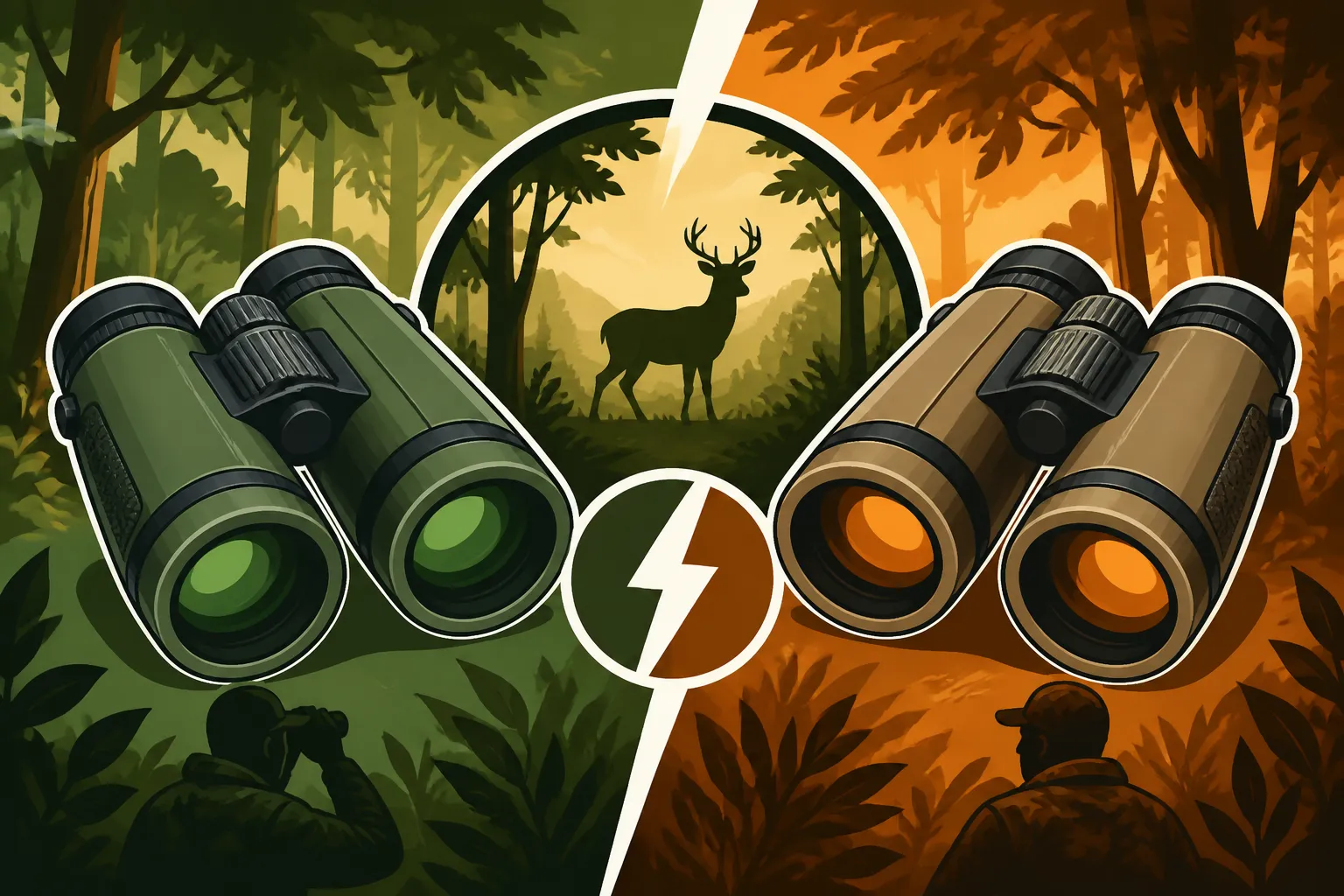
8×42 Versus 10×42 in the Woods
Choosing the right binoculars for your Georgia hunting adventures can feel like a genuine head-scratcher. You've probably found yourself staring at two seemingly identical pairs, one labeled 8×42 and the other 10×42, wondering if the slight difference in numbers actually translates to a significant difference in the field. This guide is here to cut through the confusion and help you understand which magnification and objective lens combination will best serve your specific hunting needs across Georgia's incredibly diverse landscapes.
Decoding Binocular Specifications: 8×42 Versus 10×42
When you see numbers like 8×42 or 10×42 on a pair of binoculars, it's not just a random code; it's telling you two crucial pieces of information about how they'll perform. Understanding these figures is the first step to making an informed decision, especially when you consider the varying light conditions and distances you'll encounter from the North Georgia mountains to the southern pine flats.
The first number, "8x" or "10x," refers to the magnification power. An 8x magnification means that the object you're looking at will appear eight times closer than it would to your naked eye. So, if a deer is 800 yards away, it will look like it's only 100 yards through 8x binoculars. Similarly, 10x magnification makes that same deer appear ten times closer, effectively bringing it to what looks like 80 yards. More magnification sounds better, right? Not always. Higher magnification can also make hand shake more noticeable, which can blur your image, and it often comes with a narrower field of view, making it harder to scan broad areas quickly.
The second number, "42," refers to the diameter of the objective lens in millimeters. This is the large lens at the front of the binoculars, facing your target. The objective lens's primary job is to gather light. A larger objective lens gathers more light, which generally means a brighter image, especially in low-light conditions like dawn, dusk, or deep in a swamp bottom. A 42mm objective lens is a very popular and versatile size, offering a good balance between light-gathering capability and manageable size/weight for most hunting scenarios.
So, when you're looking at an 8×42, you're getting 8 times magnification with a 42mm objective lens. With a 10×42, it's 10 times magnification with the same 42mm objective lens. The objective lens diameter stays the same, so the key difference truly boils down to how much closer you want your target to appear versus the stability and field of view you're willing to sacrifice.
Field of View and Exit Pupil Explained
Beyond just magnification and objective lens size, there are two other critical factors often overlooked: field of view (FOV) and exit pupil. These aspects significantly influence your practical hunting experience, especially in dynamic situations or challenging light.
Field of View (FOV): This is literally how wide of an area you can see through your binoculars at a specific distance, usually measured in feet at 1,000 yards. Think about it this way: if you're trying to locate a deer moving through thick woods, a wider field of view means you're scanning a larger area at once, making it easier to pick up movement or a tucked-away antler. Generally, lower magnification (like 8x) provides a wider field of view than higher magnification (like 10x) with the same objective lens size. This can be a huge advantage when you're still-hunting in dense cover or trying to follow a running hog in a Georgia pine plantation. When I'm mapping out potential stand locations on GoHunt and see those dense, unbroken stands of pines, I know a wider field of view will be invaluable for picking up subtle movements.
Exit Pupil: This is a bit more technical but directly impacts how well your binoculars perform in low light. The exit pupil is the diameter of the beam of light that exits the eyepiece and enters your eye. You calculate it by dividing the objective lens diameter by the magnification. For an 8×42, the exit pupil is 42mm / 8 = 5.25mm. For a 10×42, it's 42mm / 10 = 4.2mm. In broad daylight, your eye's pupil typically constricts to around 2-3mm, so both 8×42 and 10×42 will deliver plenty of light. However, in low light (dawn, dusk, deep timber), your pupil dilates to 5-7mm. An 8×42 with a 5.25mm exit pupil can deliver more light to your dilated pupil than a 10×42 with a 4.2mm exit pupil. This means the 8×42 will generally provide a brighter, more comfortable image in those crucial low-light hunting hours, which are often the best times to see deer movement. When you're trying to spot a deer just before shooting light or waiting for legal shooting light to end, every bit of brightness matters. This directly relates to why understanding Low-Light Performance in a Scope is so important, and the same principles apply to binoculars.
The Case for 8×42 Binoculars in Georgia's Diverse Terrains
The 8×42 binocular is often considered the workhorse for many hunters, and for good reason. Its blend of magnification, light-gathering ability, and user-friendliness makes it incredibly versatile, especially when traversing the varied landscapes Georgia throws at us. From thick mountain laurel in the north to dense swamp bottoms in the south, the 8×42 shines in scenarios where quick target acquisition and a stable image are paramount.
Consider the Chattahoochee National Forest, where you might be Hunting North Georgia Mountain Country. The terrain is often steep, and the timber is thick. Shots are typically closer, and deer might appear and disappear quickly among the trees. An 8×42 offers a wider field of view, allowing you to scan broader areas of cover more efficiently. When a buck steps out of a laurel thicket at 75 yards, that wider view makes it much easier to pick up and track before it vanishes again. The reduced magnification also means less noticeable hand shake, giving you a steadier image even after a long climb up a ridge. This stability is invaluable when trying to discern a deer's leg from a tree trunk.
Similarly, if you find yourself still-hunting through Still-Hunting South Georgia Pine Flats or picking your way through a dense river bottom, the 8×42 offers distinct advantages. These environments often demand quick reactions and observation at closer to moderate ranges. The wider field of view helps you spot game moving through dense palmettos or cypress knees without constantly swinging your binoculars, reducing fatigue. Furthermore, as we discussed, the larger exit pupil of an 8×42 means a brighter image in the low light of dawn and dusk, or when peering into the shadowy depths of a deep swamp. These are prime times for deer movement, and having that extra bit of light can make all the difference in identifying antlers or confirming a legal buck.
Stability and Comfort for All-Day Carries
Beyond optical performance, the physical characteristics of 8×42 binoculars often make them a more comfortable choice for extended periods in the field. This might seem like a minor point, but when you're humping it all day, every ounce and every ergonomic factor counts.
Because of their lower magnification, 8×42 binoculars are generally more forgiving when it comes to hand shake. Even if your hands aren't perfectly steady, the image through an 8x binocular will appear more stable than through a 10x pair. This is a huge benefit if you're glassing from an unsupported position, like standing up against a tree or trying to scan while balancing on uneven ground. Think about those long waits in a treestand, trying to identify movement in a distant thicket—the less effort you have to exert to keep the image steady, the more comfortable and effective your glassing will be. This reduced eye strain over hours of use can keep you sharper and more alert, which is precisely what you need when that deer finally appears.
Additionally, while both 8×42 and 10×42 often share similar physical dimensions, the perceived comfort during prolonged use can differ. The wider field of view and brighter image of the 8×42 can lead to less eye fatigue. When you're spending hours scouting new areas, maybe using your GoHunt app to mark potential hotspots and then glassing them, you'll appreciate any feature that reduces strain. For many hunters, especially those who prioritize portability and ease of use in diverse, often close-quarters hunting environments like much of Georgia, the 8×42 represents an ideal balance. When you're gearing up for a full day of hunting, a pair of binos that won't weigh you down or strain your eyes is a real asset, allowing you to focus on the hunt itself.
The Advantages of 10×42 Binoculars for Longer Range and Detail
While 8×42 binoculars are fantastic for many situations, there are undeniably times when you just need to see further and pick out finer details. This is where the 10×42 truly shines, offering that extra punch of magnification that can make all the difference in wide-open spaces or when scrutinizing a distant target.
Imagine you're hunting the edge of a vast clear-cut, a sprawling powerline, or a massive agricultural field in the Piedmont region, perhaps looking for Hunting Piedmont Farmland Deer. You've got hundreds of yards of open ground to cover, and you need to spot a deer that might be bedded down at 400 yards or moving subtly on the far side of a food plot. An 8x binocular might show you a "brown blob," but a 10×42 can often resolve enough detail to tell if that blob has antlers, if it's a deer versus a stump, or even if it's a buck worthy of pursuit. That extra 2x magnification really does make a difference when you're trying to Glassing a Powerline Cut at Last Light or searching for movement in a distant Hunting a Green Field Planted for Deer. It gives you the confidence to distinguish between a branch and a leg, or the curve of an antler.
The ability to resolve more detail at longer distances is also crucial for ethical hunting decisions. You want to be absolutely sure of your target and what's behind it before you ever raise your rifle. With 10x magnification, you can often make those critical distinctions sooner and with greater certainty, allowing you more time to assess the situation and plan your approach. This increased detail can be particularly helpful when using mapping tools like GoHunt to identify open areas where long-range observation will be key. You might pinpoint a distant stand of oaks on the map, and with 10x binos, confirm if deer are indeed feeding there.
Scrutinizing Distant Details and Target Identification
The primary allure of the 10×42 lies in its superior ability to bring distant objects closer and reveal fine details that might be missed with lower magnification. This isn't just about seeing a deer; it's about seeing which deer, especially when antler restrictions or specific harvest goals are in play.
For hunters who frequently encounter longer shooting lanes or expansive glassing opportunities, a 10×42 becomes an indispensable tool. Picture yourself perched high in a Treestand Setups in North Georgia Mountains overlooking multiple clearings or saddles, where deer might be moving several hundred yards away. That extra magnification allows you to not only spot movement but also to spend more time observing the animal to determine its age class, antler size, and overall health. You can count points, assess body size, and confirm whether it's the specific buck you've been chasing, all from a distance, minimizing the risk of spooking the animal with unnecessary movement.
This becomes even more critical in regions where you have very specific management goals, or simply want to be highly selective. For instance, if you're trying to determine the legality of a buck with specific antler parameters, the enhanced detail provided by 10x magnification is invaluable. When you're scouting expansive areas, perhaps planning a hunt in the Piedmont or Coastal Plain regions, and GoHunt reveals large, contiguous agricultural fields or vast timber cuts, a 10×42 allows you to efficiently scan these areas and pinpoint game with more precision. It helps confirm those fleeting glimpses of movement or identify faint signs of game, giving you the edge in discerning a mature deer from a younger one, or even a turkey from a stump. While you might sacrifice a bit of field of view, the ability to zoom in and identify a specific target often outweighs that trade-off in these open scenarios.
Choosing the Right Binoculars for Your Georgia Hunting Style
Ultimately, the best binocular for you isn't about one being inherently "better" than the other, but rather which one aligns more closely with your personal hunting style, the specific terrain you frequent in Georgia, and your individual visual preferences. It's a highly personal choice, much like selecting a rifle caliber or a favorite treestand.
To help you make this decision, let's break down the key considerations and a quick comparison.
| Feature | 8×42 Binoculars | 10×42 Binoculars |
|---|---|---|
| Magnification | 8x (Objects appear 8x closer) | 10x (Objects appear 10x closer) |
| Field of View | Wider, easier to scan and find moving targets | Narrower, more challenging for wide scanning |
| Low-Light Performance | Generally brighter (larger exit pupil) | Slightly dimmer (smaller exit pupil) |
| Image Stability | More stable, less noticeable hand shake | Less stable, more noticeable hand shake |
| Detail Resolution | Good at moderate distances | Excellent at long distances, finer detail |
| Weight/Size | Often slightly lighter/more compact, but similar | Often slightly heavier/larger, but similar |
| Ideal For | Dense woods, quick action, low light, still-hunting, Hunting Georgia Swamp and River Bottom Deer | Open country, long-range glassing, field edges, Glassing a Powerline Cut at Last Light |
Matching Your Binos to Your Terrain and Hunting Habits
Think about where you spend most of your time hunting in Georgia. Are you primarily in the dense hardwood bottoms of the Piedmont, where shots are generally under 100 yards and visibility is limited? Or are you hunting vast tracts of managed pine, sprawling ag fields, or powerline cuts in South Georgia?
If your hunting tends to be in thick cover, places where visibility is often limited to 150 yards or less, and you prioritize quick target acquisition and a stable image in low light, the 8×42 is likely your best bet. This holds true for Still-Hunting South Georgia Pine Flats or picking apart a tight creek bottom funnel. Its wider field of view makes it easier to track deer that are moving through dense foliage, and the brighter image will be invaluable during those crucial low-light periods at dawn and dusk. For instance, if you're trying to locate a gobbler flying down from a roost in thick woods, the wider FOV of an 8x can help you pick him up faster.
However, if you predominantly hunt open landscapes, such as large agricultural fields, extensive powerline cuts, or vast clear-cuts where long-range observation is common, then the 10×42 will serve you better. The increased magnification allows you to identify game at greater distances and discern crucial details like antler size or body characteristics, which are vital for selective harvesting. This is perfect if you're often scanning from a stationary position for extended periods, trying to spot a buck working a distant Scrape Lines Along a Logging Road. If you're using GoHunt to identify vast tracts of land and scouting for potential long-range glassing spots, the 10×42 will be an invaluable companion.
Consider also your physical condition and how steady you can hold binoculars. If you find your hands tend to shake, even slightly, that 2x magnification difference in a 10x pair will amplify it, making the image harder to stabilize. In such cases, the more forgiving 8×42 might offer a more comfortable and practical viewing experience. Ultimately, the best way to decide is to try both out in conditions similar to your typical hunting environment. Spend some time looking through each, not just in the store, but outdoors, at varying distances and in different light. Your eyes and your hunting style will tell you which one feels like the perfect fit for your Georgia adventures.
Trying Before You Buy and Considering Ergonomics
Making an investment in quality optics is a big decision, and it’s one you shouldn’t rush. Just like you wouldn't buy a new rifle without shouldering it and checking the fit, you shouldn't commit to binoculars without trying them out. This is especially true for the 8×42 vs. 10×42 debate. What feels great to one hunter might feel awkward or unstable to another.
The best approach is to visit a local outdoor retailer that has a good selection of quality binoculars. Don't just look through them inside the store. Ask if you can step outside and glass objects at various distances—a distant tree line, a sign across the parking lot, or even a bird in a tree. Pay close attention to how comfortable they feel in your hands, how easy it is to adjust the focus, and whether the image stays steady. If your hands tremble a bit, that 10x magnification will amplify it, making the view jumpy. The 8x, with its wider field of view and less intense magnification, is often much more forgiving and easier to hold steady for extended periods. This is particularly important if you plan on using them all day, hiking through thick terrain, or waiting patiently in a Hanging a Stand on a Mountain Saddle.
Also, consider the ergonomics. How do the binoculars fit your hands? Are the focus wheel and diopter adjustment easy to manipulate with gloves on? What about their weight and bulk? While 8×42 and 10×42 often come in similar housings, there can be subtle differences. A slightly lighter or more compact pair can make a big difference after miles of walking through a swamp or up a steep mountain ridge. If you're loading up your Packs Built for a Chattahoochee Day Hunt, every ounce matters. Some companies, like GoHunt in their gear discussions, emphasize the importance of field-testing equipment before commitment. Remember, the best binoculars are the ones you'll actually use comfortably and effectively in the field.
Disclaimer
This article is for general informational purposes only and does not constitute professional advice. Laws, prices and regulations vary by location and change over time. Consult a qualified professional for guidance on your specific situation.