Shot Placement on a Georgia Black Bear
Hunting a black bear in Georgia is an incredibly exciting and challenging endeavor, a true test of a hunter's skill and patience. However, with that excitement comes a tremendous responsibility to ensure a quick, clean, and ethical harvest. One of the biggest worries many hunters face, myself included, is making a bad shot. Bears are tough animals, and their unique anatomy can make shot placement a little trickier than, say, a whitetail deer. This guide is here to walk you through the ins and outs of precise shot placement on a Georgia black bear, aiming to boost your confidence and ensure a humane outcome every time.
Understanding Black Bear Anatomy for Ethical Shot Placement
Before you even pull the trigger or release an arrow, you need a solid understanding of where to aim. A black bear’s vital organs aren't quite in the same spot as a deer, and their heavy bone structure and thick fat layers can easily lead to a less-than-ideal outcome if you're not careful. This isn't just about killing the animal; it's about honoring it with a quick and humane harvest, minimizing suffering and ensuring a successful recovery.
The Vitals: Heart and Lungs
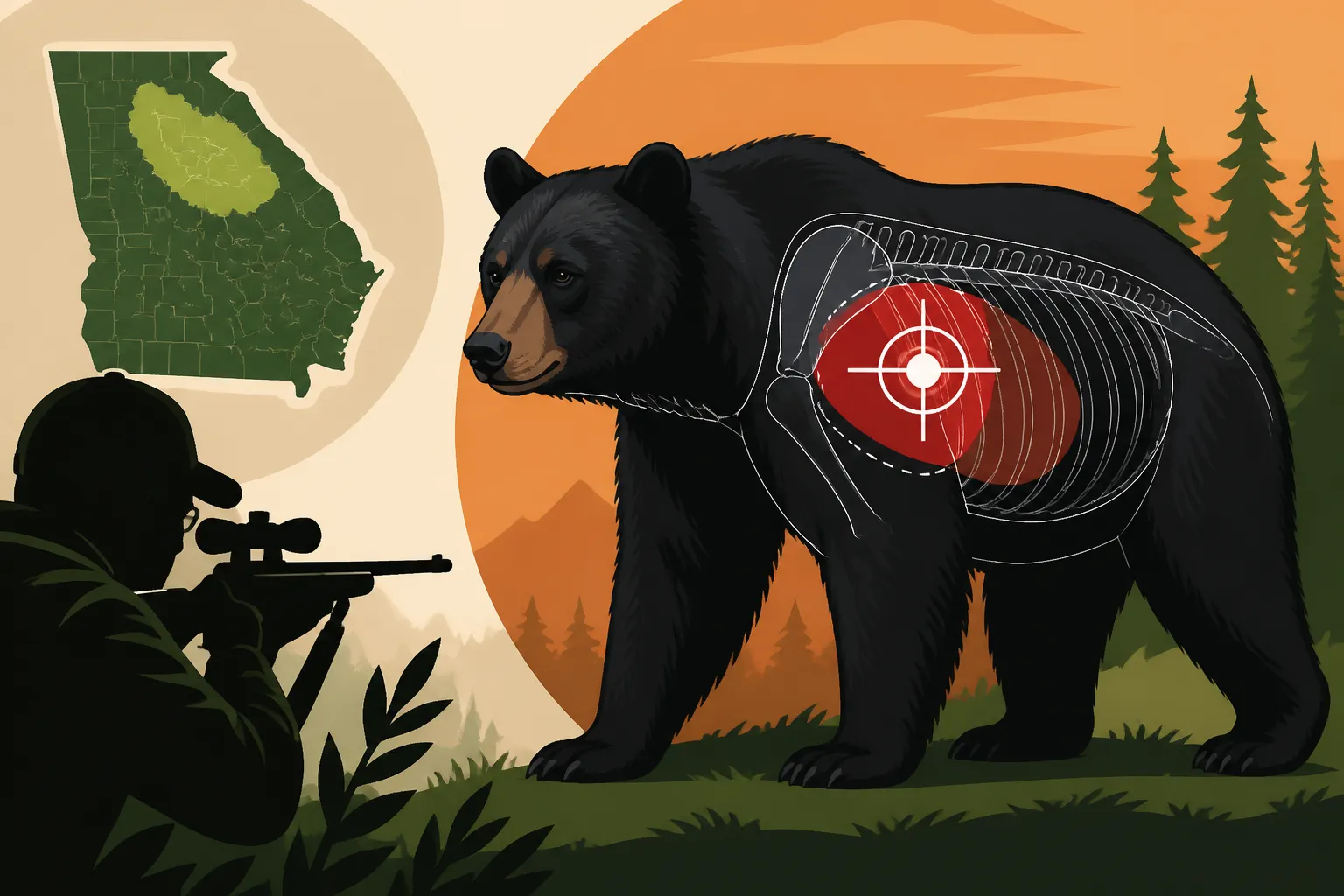
When it comes to bear hunting, the heart and lungs are your primary targets, just like with most big game. However, their position in a bear can be deceiving. A bear's shoulder blade and leg bones extend further back into the body cavity than you might expect, offering a considerable shield over the vital zone. Their dense musculature and thick hide can also absorb a lot of energy, meaning your projectile needs to be well-placed and have ample penetration.
The lungs are quite large, extending from just behind the shoulder all the way back to the diaphragm, and sit relatively low in the chest. The heart, slightly smaller, rests nestled between the lungs, low and just above the sternum, usually right behind the shoulder joint when the bear is broadside. A common mistake is aiming too high on a bear because they appear deep-chested. If you aim where you'd typically hit a deer's lungs, you might only graze the top of a bear's lungs or even hit above them, especially if you're not accounting for their anatomy. The key is to aim for the lower third of the chest cavity, just behind the front leg when it's extended forward. This gives you the best chance of hitting both lungs, or even better, the heart and both lungs. Remember that a bear's humerus (upper leg bone) and scapula (shoulder blade) are substantial. If you hit this bone, especially with an archery setup, you might not get the penetration needed to reach the vitals. Firearm hunters often have more leeway with bone, but a direct hit on the shoulder blade can still reduce energy transfer to the vitals. Taking some time to study detailed anatomy charts of a bear before you head out, perhaps even using a mapping tool like GoHunt to mark potential stand locations relative to feeding areas, can really make a difference.
Brain and Spinal Shots: High Risk, High Reward
While brain and spinal shots are often depicted in movies as instant kills, in real-world hunting scenarios, they are incredibly high-risk and generally not recommended for primary shot placement. The brain of a black bear is surprisingly small relative to its skull size and is heavily protected by thick bone. A slight miss, even by an inch, can result in a jaw shot, blinding the animal, or a superficial wound that leads to prolonged suffering and an unrecoverable bear. These are outcomes no ethical hunter wants.
Similarly, a spinal shot, particularly to the neck or spine, can drop an animal instantly. However, the spinal column is also a very small target, especially from various angles. If you hit a vertebra without severing the spinal cord, you could merely wound the animal, potentially paralyzing it without killing it, which creates a horrific situation. These shots are typically only considered as a finishing shot at very close range on a stationary, severely wounded animal, or in a self-defense scenario. For your initial shot on a healthy, moving bear, always prioritize the much larger and more forgiving heart-lung area. It’s better to aim for a vital zone that offers a larger margin of error, even if it means waiting for a better opportunity.
Ideal Shot Angles and Presentation for Bear Hunting
Getting the right angle is half the battle when hunting bear. Their heavy build and deep chest mean you need to be deliberate about how you approach your shot. Patience is truly a virtue here. You might have a bear come into range at an awkward angle, but if it's not the right shot, it's better to let it walk away and perhaps get another chance on a different hunt. Don't let buck (or bear) fever push you into a questionable shot.
Broadside: The Preferred Shot
Without a doubt, the broadside shot is the gold standard for black bear hunting. When a bear is standing perfectly broadside to you, its vital organs are most exposed, offering the largest target profile. For both archers and firearm hunters, this is the shot to wait for. The aiming point for a broadside bear is typically in the lower third of the body, just behind the front leg. Imagine drawing a vertical line straight up from the back of the bear's front leg when it's extended slightly forward, and then a horizontal line about one-third of the way up from the bottom of the chest. Where these two lines intersect is your bullseye for a heart-lung shot. This placement aims to strike through both lungs and potentially the heart, ensuring massive hemorrhage and a quick lights-out.
If the bear is slightly quartering away, meaning its far side is slightly exposed, you can still take a broadside-like shot, but you'll need to account for the angle. For a broadside shot, I always take a moment to confirm the wind direction and thermals, which is crucial for Hunting Bears Over Natural Food in the Mountains and making sure the bear doesn't scent you before you get a chance to settle your aim. Many hunters find it helpful to visualize the exit point; if you can imagine the arrow or bullet exiting on the opposite side of the chest in the same vital area, you've got a good angle.
Quartering Away: A Viable Option
The quartering-away shot can also be very effective, often even better than a pure broadside shot for some hunters, particularly those using archery equipment. In this scenario, the bear is angled slightly away from you, exposing its rib cage and creating a clear path to the vitals without having to contend with the heavy shoulder bone. The key here is to aim for the opposite front leg.
Imagine the bear is standing with its head facing slightly away from you, and its tail end is closer to you. Your aiming point would be further back on the side closest to you, but angled forward to exit through the opposite front shoulder or just behind it. This trajectory ensures that your projectile slices through the paunch and diaphragm before entering the vitals, maximizing internal damage to both lungs and potentially the heart. The biggest risk with a quartering-away shot is aiming too far back, which can lead to a gut shot. A gut shot is rarely fatal quickly and results in a long, difficult, and often unsuccessful tracking job. So, while it's a viable option, it requires even greater precision and understanding of bear anatomy to ensure you don't hit the stomach or intestines. Always visualize that exit point again, trying to hit the far shoulder with your projectile. Knowing the bear populations in areas like the Northern Zone bear season rules helps prepare for these opportunities.
Shots to Avoid: Frontal and Extreme Quartering
Now, let's talk about the shots that should almost always be avoided. This is where ethics really come into play, and it’s important to be disciplined.
-
Frontal Shot: A bear facing you head-on presents an extremely difficult and low-percentage shot. While theoretically, you could aim for the center of the chest to hit the heart, you'd have to penetrate the sternum, heavy chest bone, and potentially the thick, matted fur and fat. The vital area from this angle is small, and a slight deviation means hitting non-vital tissue, resulting in a wounded bear. Unless you are in a genuine self-defense situation at extremely close range, with a powerful firearm, and an unwavering aim, do not take a frontal shot. It is simply too risky for a clean, ethical kill. Many hunters spend hours practicing for a perfect broadside or quartering-away presentation, not a high-stress frontal encounter.
-
Extreme Quartering-To Shot: This is another angle that can lead to disaster. If a bear is heavily quartering towards you, its front shoulder and massive chest muscles effectively shield the vitals. Even if you manage to penetrate the shoulder, the angle often prevents the projectile from reaching the heart and lungs effectively. You'll likely hit gut or non-vital muscle, leading to a wounded animal that’s hard to recover. It's often impossible to achieve a clean passthrough or sufficient damage to the vitals from this angle.
-
Rear or Texas Heart Shot: This is an absolute no-go. While it might disable the hindquarters, it's rarely a quick kill and is considered highly unethical. It’s an act of desperation and should never be part of a planned hunting strategy.
Remember, your best bet is always to be patient. Wait for the bear to present either a clean broadside or a slight quartering-away shot. There are plenty of opportunities to be had throughout the season, whether you're hunting during the Georgia Northern Zone Bear Season Rules or the more limited windows for the Georgia Southern Zone Bear Weekend Dates. It's far better to come home empty-handed than to send a wounded animal off to suffer.
What to Do After the Shot: Tracking and Recovery
So, you've made the shot! The adrenaline is pumping, and your heart is probably doing a drum solo. But what happens next is just as critical as the shot itself. This phase often determines whether you recover your bear or if it becomes a lost animal. It takes discipline and a clear head to execute properly.
Immediate Reactions and Waiting Period
A bear's reaction to a shot can vary wildly, and it's not always a clear indicator of shot placement. Sometimes a perfectly hit bear will take off like a rocket, while a gut-shot animal might stand for a moment before slowly ambling off. This is why watching and listening carefully immediately after the shot is crucial.
- If you see a good hit (broadside, quartering away) and the bear reacts strongly (runs hard, bucks, or stumbles): Give it time. Even with a perfect heart-lung shot, bears are tough and can run a surprising distance. For a suspected double-lung or heart shot with a firearm, I usually wait at least 30 minutes to an hour. For archery, I stretch that to 1-2 hours, sometimes even longer if I only suspect one lung.
- If you suspect a marginal hit (e.g., gut shot, shoulder hit without deep penetration, or an unknown hit): This is where patience becomes paramount. For a suspected gut shot, you absolutely must back out and give the bear at least 4-6 hours, or even overnight if conditions allow (cool weather). Going in too soon will push the bear, and a gut-shot bear can travel for miles. This waiting period allows the bear to stiffen up and bleed out internally. I know it’s excruciating to wait, but it dramatically increases your chances of recovery.
- Pay attention to sounds: Did you hear a death moan? A crash? Keep your ears peeled in the immediate aftermath. These can be valuable clues.
Before you even step out of your stand or blind, mentally mark the last spot you saw the bear, any visible blood or hair, and the direction it traveled. Using a compass or a GPS feature on an app like GoHunt to mark that last visual point will be incredibly helpful later on.
Blood Trailing and Recovery Tips
Once the waiting period is over, it’s time to start tracking. This is often the hardest part, especially in the thick cover of Georgia's woods.
- Start at the point of impact: Go directly to where the bear was standing when you shot it. Look for blood, hair, bone fragments, or disturbed vegetation. Red, frothy blood often indicates a lung hit. Darker, chunky blood with gut contents points to a gut shot. A mix of muscle and fat will give you clues.
- Mark your trail: As you follow the blood trail, mark your path with flagging tape (easily visible, but removed on your way out) or GPS waypoints. This prevents you from getting lost or losing the trail if the blood thins out.
- Slow and methodical: Don't rush. Bears, especially wounded ones, can navigate incredibly dense cover. Take your time, scanning ahead and to the sides for any sign. Look for disturbed leaves, broken twigs, tracks in soft earth, or hair rubbed off on bushes. This is where Tracking a Deer Through Georgia Pine Straw or any experience tracking deer will be a major asset, though bears leave a bigger trail.
- Enlist help: A fresh set of eyes can make all the difference. Bring a friend or family member who can help search for signs. For tough trails, consider a tracking dog if legal and available in your area.
- Look for water: Wounded bears, like deer, often head for water to try and cool down or escape. Check creeks, ponds, and swampy areas if your trail leads that way. Be extra cautious when approaching water.
- Be prepared for a follow-up shot: When you find your bear, approach cautiously from behind or the side. If it's still alive, put another round or arrow into it quickly and ethically. Be mindful of Shot Placement on a Georgia Black Bear even on a wounded animal, aiming for the vitals or spine if safe and possible.
- Field dressing and retrieval: Once the bear is down, the hard work of Handling a Bear After the Shot begins. Bears are heavy, and getting them out of the woods, especially in Georgia's heat, can be a major undertaking. Have a plan for this before you ever leave home, including coolers and game bags. Consider the "gutless method" to debone the bear in the field to lighten the load if you're far from a vehicle.
Successful bear hunting is a combination of preparation, patience, and precise execution, both before and after the shot. By understanding bear anatomy and committing to ethical shot placement and recovery, you'll be well on your way to a memorable and responsible Georgia black bear hunt.
Disclaimer
Always consult the latest Georgia Department of Natural Resources (DNR) regulations and local laws before heading out on any hunt. Hunting regulations can change annually, and it is the hunter's responsibility to stay informed and compliant. This article provides general information and recommendations, not legal advice.