Field Dressing Knives Worth Carrying
There's nothing quite like the feeling of having a successful hunt in Georgia, whether it's dropping a big buck in the Piedmont or taking a hog in the sweltering low country. But that triumph quickly gives way to a critical task: field dressing your animal. This isn't just about getting the meat out; it's about doing it efficiently, cleanly, and safely, especially when you're battling Georgia's often warm, humid conditions. Choosing the right field dressing knife isn't just a preference; it's a necessity that can make the difference between a clean, quick job and a frustrating, messy ordeal. This guide will walk you through what truly makes a field dressing knife shine in Georgia's diverse hunting environments, helping you choose the best tool for the job.
The Realities of Field Dressing in Georgia
Field dressing is a fundamental skill for any hunter, but doing it effectively in Georgia presents its own unique set of challenges. It's not like the frigid temperatures of the North where you might have hours to get an animal cooled down. Here, every minute counts, and your gear needs to be up to the task.
Why Your Knife Choice Matters Here
Imagine you've just put down a beautiful whitetail in early archery season. The air is still thick with humidity, even in late September or early October, and the sun is already starting to climb. You know you've got to get that deer gutted and cooling down as fast as humanly possible to preserve the meat. A dull, flimsy, or poorly designed knife will slow you down, make the job harder, and potentially compromise the quality of your venison. You'll be struggling to make clean cuts, fumbling with a handle that's slick with blood, and wasting precious minutes.
A well-chosen field dressing knife, on the other hand, becomes an extension of your hand. It's sharp, holds an edge, and offers a secure grip, allowing you to work quickly and precisely. This efficiency is paramount for meat care. The faster you can remove the entrails, the quicker the carcass can begin to cool, inhibiting bacterial growth and ensuring your hard-earned harvest tastes as good as possible. It’s also a matter of safety; a sharp knife requires less force, reducing the chance of slippage and injury, which is the last thing you want when you’re alone in the woods. This is especially true if you find yourself on a solo hunt in a remote area, where a cut hand could quickly turn a minor inconvenience into a serious problem.
The Specific Challenges of Georgia's Environment
Georgia's hunting landscape is incredibly varied, from the steep, rocky terrain of the North Georgia mountains to the sprawling pine plantations and cypress swamps of the Coastal Plain. Each of these environments presents particular challenges for field dressing and, by extension, for your knife.
In the mountains, you might be dealing with uneven ground, thick underbrush, and the possibility of having to drag an animal a significant distance. Your knife needs to be robust enough to handle the job without breaking, and you might appreciate a slightly longer blade for reaching into larger animals like mature mountain bucks or even a black bear if you're lucky enough to draw a tag. Hunting the North Georgia Mountain Bear Zone or Treestand Setups in North Georgia Mountains often puts you in areas where a strong, reliable knife is essential.
Down in the swamps and river bottoms, humidity is king. Everything gets wet, everything gets slick, and mud is often a constant companion. Your knife handle needs to offer an exceptional grip even when wet or bloody, and the blade material should be corrosion-resistant to stand up to the damp conditions. Plus, the dense cover often means shorter visibility and working in tighter spaces. If you're Hunting a Funnel Between Two Swamps, you'll appreciate a knife that's easy to handle in close quarters. And let's not forget the ever-present threat of insects – trying to field dress with gnats swarming your face and hands is challenge enough without struggling with your tools.
Then there's the heat itself. Even during the firearms season in November, Georgia can experience surprisingly warm days. If you're deer hunting after a late-season cold front, you might still encounter mild temperatures. This heat accelerates spoilage, making that quick field dress all the more vital. Having a knife that allows for swift, clean work means you can move on to cooling your animal down, whether it’s getting it to a shaded spot or back to a cooler. Remember to read up on Field Dressing a Deer in Warm Weather to ensure you're doing everything you can to protect your harvest.
Essential Features of a Good Field Dressing Knife
When you're sifting through the countless options out there, it can feel overwhelming. But once you understand the core features that truly matter for field dressing in Georgia, the choice becomes much clearer.
Blade Shape and Material: What Works Best?
The blade is, of course, the heart of any knife. For field dressing, you want specific characteristics:
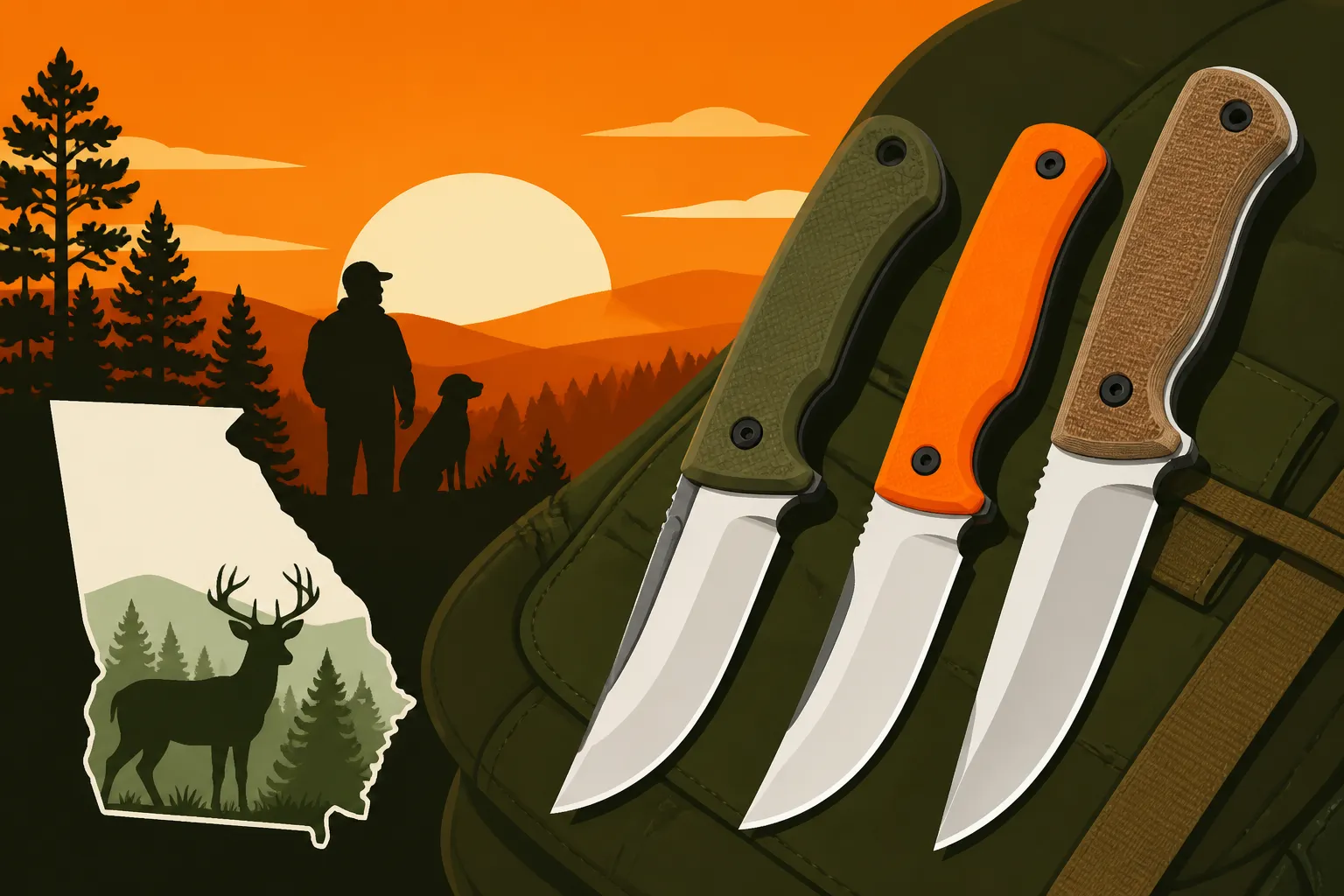
- Shape: A common and highly effective blade shape for field dressing is the drop point or clip point. Both offer a strong tip for initial penetration but also have enough belly to handle long, sweeping cuts for opening up the body cavity. A dedicated gut hook can also be incredibly useful, especially for cleanly opening the hide without puncturing the intestines, which is a major win for cleanliness and meat hygiene. While not a primary blade, a good gut hook as a secondary feature or on a separate tool is a real time-saver.
- Material: Stainless steel is generally the preferred choice for field dressing knives. Why? Because it resists rust and corrosion, which is a huge advantage in Georgia's humid climate. Blood and moisture can quickly tarnish and rust carbon steel if not meticulously cleaned immediately after use. Look for quality stainless steels like S30V, 440C, or AUS-8, which offer a good balance of edge retention and ease of sharpening. A knife that holds an edge longer means less time sharpening in the field and more time working.
- Blade Length: For general field dressing, a blade between 3 to 5 inches is often ideal. Anything much longer can become unwieldy and harder to control for intricate work around internal organs. A shorter blade allows for more precision, reducing the risk of accidental punctures. For tasks like separating the windpipe or cutting through the pelvis (if you opt for that method), a sturdy 4-inch blade is often perfect.
Handle Ergonomics and Grip Security
This is where many knives fall short in a real-world field dressing scenario. Your hands will be wet, possibly bloody, and you need absolute confidence that your knife won't slip.
- Material: Synthetic materials like G10, Kraton, Zytel, or rubberized polymers are excellent choices. They offer superior grip even when wet and are easy to clean. Wood or polished bone handles, while beautiful, can become incredibly slick and are harder to sanitize effectively after contact with blood and bodily fluids.
- Texture and Shape: Look for a handle with some texture – jimping on the spine, finger grooves, or a slightly tacky feel. The shape should fit comfortably in your hand, allowing for a secure grip in various positions. A slight pommel or guard can also help prevent your hand from sliding forward onto the blade during heavy use. Ergonomics are crucial; you might be working for a while, and a comfortable handle reduces hand fatigue and increases control.
Fixed Blade vs. Folder: The Great Debate
This is a classic discussion among hunters, and both have their merits for field dressing.
-
Fixed Blade: Many veteran hunters swear by fixed blades for field dressing, and for good reason. They are inherently stronger, with the blade extending through the entire handle (full tang), making them less prone to breakage. There are no moving parts to get jammed or dirty, and they are generally easier to clean thoroughly. For the rigorous demands of field dressing, especially if you're processing a larger animal, the robustness of a fixed blade is hard to beat. They also offer a quick draw from a sheath, which can be important when you're ready to get to work. For those long days out on public land, carrying a sturdy fixed blade in your pack is always a good idea. Consider looking at the selection offered by reputable brands through resources like GoHunt to find a fixed blade that suits your needs.
-
Folding Knife: Modern folding knives have come a long way in terms of strength and reliability. Many feature robust locking mechanisms and durable construction. Their primary advantage is portability; they fold down, making them easy to carry in a pocket or pack without a bulky sheath. Some folders also incorporate additional tools, like saw blades or gut hooks. However, they can be harder to clean thoroughly, as blood and tissue can get into the pivot mechanism. While convenient, for sheer durability and ease of sanitation, a fixed blade often wins out for dedicated field dressing. That said, a high-quality folder can serve as an excellent backup or for smaller game.
Beyond the Blade: Other Important Considerations
A great knife is more than just its blade and handle. How you carry it, maintain it, and whether it integrates with other tools are all factors that contribute to its overall value in the field.
Carrying and Sharpening Systems
You can have the sharpest knife in the world, but if it's not accessible or if you can't keep it sharp, it loses much of its utility.
- Sheath: For fixed blades, a good sheath is non-negotiable. It needs to securely hold the knife, protect the blade, and allow for comfortable carry. Kydex or heavy-duty nylon are popular choices for their durability and weather resistance. Ensure the sheath has good retention, so the knife doesn't fall out when you're moving through dense cover. Some sheaths offer multiple carry options, like belt loops or Molle attachments for your pack.
- Sharpening: A dull knife is a dangerous knife. You need a way to keep your edge keen, even in the field. A small, portable sharpening stone, a ceramic rod, or a pocket sharpener are essential accessories. Before you head out, make sure your primary field dressing knife is razor-sharp. You'll be amazed at how much easier and safer the job becomes. Don't forget that a truly sharp knife will retain its edge longer through the task, but a quick touch-up might be necessary if you're processing multiple animals or if you hit bone. Understanding how to properly sharpen your knife is a skill every hunter should master.
Multitools and Dedicated Field Dressing Kits
Sometimes, a single knife isn't enough, or you might find a specialized tool that streamlines a particular part of the process.
- Multitools: Many popular multitools include a knife blade, a saw, and other implements that can be useful during field dressing or general camp tasks. While the knife blade on a multitool might not be as robust as a dedicated fixed blade, the versatility can be a lifesaver. The saw, for instance, can be invaluable for cutting through the sternum or pelvic bone, eliminating the need to strain your primary knife or carry a separate bone saw. This can significantly simplify your gear load, especially if you're covering a lot of ground as described in Scouting Georgia Public Land Before Season.
- Dedicated Kits: Some companies offer field dressing kits that include a primary knife, a gut hook, a bone saw, and sometimes even gloves or game bags. These kits are designed to provide everything you need in one convenient package. While you might not use every item every time, having them on hand can be incredibly useful. Think about how much easier it is to Butchering a Deer at Camp when you have the right tools from the start. Tools like a specialized spreader to hold the cavity open can make working inside the animal much easier and cleaner.
Caring for Your Knife After the Harvest
The work doesn't end when the animal is field dressed. Proper knife care is crucial for longevity and hygiene.
- Immediate Cleaning: As soon as you've finished, clean your knife. Don't wait. Blood and tissue can dry and become much harder to remove. Use water, and if available, a mild soap. Many hunters carry a small bottle of water for this exact purpose. Rinse the blade, wipe it down, and dry it thoroughly. This is especially important for carbon steel blades.
- Sanitization: If you're concerned about pathogens, especially in areas where Georgia's Chronic Wasting Disease Management Area rules apply, sanitizing your knife is a good practice. A wipe-down with an alcohol pad or a solution of bleach and water (followed by thorough rinsing) can help. Always consult official guidelines for handling game in CWD zones, which might have specific instructions for tools. This diligence helps prevent cross-contamination and keeps your equipment in top condition. After a day spent navigating the woods, perhaps even doing a Blood Trailing After Dark in Georgia, taking care of your gear properly ensures it's ready for the next adventure.
My Top Picks for Georgia Hunting Conditions
Based on the unique demands of hunting in Georgia, certain types of knives consistently perform well. This isn't about naming specific brands, but rather highlighting categories and features that excel. Keep in mind that GoHunt is an excellent resource for researching various models and reading user reviews that often include field performance details.
Versatile All-Arounders
For many Georgia hunters, a single, reliable knife that can handle the vast majority of field dressing tasks is the way to go.
- Fixed Blade Drop Point: This is perhaps the most classic and versatile choice. A 3.5 to 4.5-inch fixed blade with a sturdy full tang and a drop point profile offers excellent control, strength, and utility. The tip is strong enough for initial cuts, and the gradual curve of the belly makes short work of opening the hide and separating organs. Look for one with a high-quality stainless steel blade and a textured, non-slip handle made from a synthetic material. These knives are workhorses, capable of handling everything from small game to a mature whitetail buck. They are easy to clean and dependable.
- Fixed Blade with Integrated Gut Hook: If you want to streamline the process of opening the hide without damaging the viscera, a knife with a dedicated gut hook on the spine of the blade is a fantastic option. This feature allows you to make a precise cut from the sternum to the pelvis, unzipping the hide cleanly. Just make sure the primary blade still meets the criteria for a good all-arounder – strong, sharp, and easy to handle. This combination gives you the best of both worlds: a reliable main blade and a specialized tool for one of the most critical steps in field dressing.
Specialized Blades for Specific Tasks
While an all-arounder will get most jobs done, sometimes a specialized tool can make certain aspects of field dressing much easier, cleaner, or safer.
- Caping Knife: If you plan on shoulder mounting your trophy, a small, highly maneuverable caping knife is invaluable. These typically have a short (2-3 inch), thin, pointed blade designed for precision cuts around the face, ears, and antler bases. While not for primary field dressing, having one in your kit if taxidermy is the goal will ensure you get a clean cape for your taxidermist, saving you time and money.
- Bone Saw (Folding or Fixed): While not a knife, a small, aggressive bone saw is a highly recommended companion for field dressing, especially for larger deer or hogs. It makes quick work of cutting through the sternum to fully open the chest cavity, and for splitting the pelvis if you choose to do so. This eliminates the need to force or damage your primary field dressing knife on bone. Many come in folding varieties that are compact and easy to carry, fitting perfectly in your pack alongside your Packs for a Day on Public Land. For anyone serious about efficient and clean processing, a bone saw is a game-changer and can alleviate the internal debate of Bone Saws Versus the Gutless Method.
- Ceramic or Tungsten Carbide Sharpeners: These compact sharpeners are not specialized blades themselves, but they are specialized tools to maintain your blades. A small, lightweight sharpener that can quickly put an edge back on your knife in the field is a must-have. Whether it's a pull-through design or a small ceramic stick, being able to touch up your edge after gutting one animal, or if you accidentally hit dirt, will dramatically improve your efficiency for the next one.
Choosing the right field dressing knife for Georgia hunting is an investment in efficiency, meat quality, and personal safety. By considering the blade, handle, and overall system, you can ensure you're well-equipped for any situation the Georgia woods throw your way.
Disclaimer
This article is for general informational purposes only and does not constitute professional advice. Laws, prices and regulations vary by location and change over time. Consult a qualified professional for guidance on your specific situation.