Barrel Length for Walking Pine Cover
There’s nothing quite like the experience of still-hunting through a vast expanse of Georgia pine cover. The scent of pine needles, the soft crunch underfoot, and the constant vigilance required to spot a deer before it spots you – it’s a truly immersive experience. But one frustration many of us have faced is constantly snagging a long rifle barrel on low-hanging branches or thick saplings, ruining a stealthy approach or making an already tough walk even harder. This guide is all about tackling that very real problem, helping you understand how different barrel lengths impact your hunt in dense pine and what might be the best choice for you to move freely and effectively through Georgia's distinctive woodlands.
Understanding the Terrain: Georgia Pine Cover
Georgia’s landscape is incredibly diverse, from the mountains of the north to the coastal plain in the south. However, one of the most common hunting environments, particularly for deer, is the vast stretches of pine timber, ranging from dense, young plantations to more mature, but still thick, stands. Understanding this specific terrain is crucial before deciding on the right firearm setup.
The Challenges of Dense Pine Plantations
Imagine a young pine plantation, perhaps only 5-10 years old. The trees are planted close together, their lower limbs still alive and reaching out, creating a wall of green. Sunlight struggles to penetrate, and the ground is often a tangled mess of pine straw, fallen limbs, and briars. Moving silently through this can feel like wading through molasses, especially if you're trying to still-hunt. Every step needs to be deliberate, and every piece of gear you carry has the potential to become a noisy impediment. A long rifle barrel, extending several feet in front of you, becomes a grappling hook, catching on every branch, twig, and vine. It's not just about the noise, either; constantly fighting your rifle to free it from tangles is exhausting and can throw off your balance, making steady shots even harder if and when you do get a chance. This is particularly true when you’re trying to navigate areas you've identified through tools like GoHunt as having thick canopy cover, which usually indicates dense undergrowth.
Navigating Thickets and Underbrush
Even in more mature pine stands, or especially in mixed pine and hardwood edges, you’ll encounter thickets and underbrush that demand compact gear. These aren't always vast plantations; sometimes it's just a dense creek bottom running through a block of pines, or a thick transition area where different timber types meet. Deer, being the smart animals they are, love these impenetrable spots. They use them for bedding, for escape routes, and for moving unseen between feeding areas. To effectively hunt these spots, you need to be able to get in there with them. A 24 or 26-inch barrel might offer slightly more velocity, but if you can't even get it pointed in the right direction without a major wrestling match, that extra velocity is academic. Hunting these zones often means tight shooting windows, quick target acquisition, and the need to move quietly and unhindered. This is where your chosen barrel length can truly make or break your hunt, impacting your ability to execute tactics like Still-Hunting South Georgia Pine Flats or approaching a bedding area quietly.
How Barrel Length Impacts Maneuverability
When you're threading through thick pine, every inch of your rifle's length matters. It's a fundamental aspect of firearm design that directly affects how you handle the weapon in challenging environments.
The Trade-offs: Short vs. Long Barrels
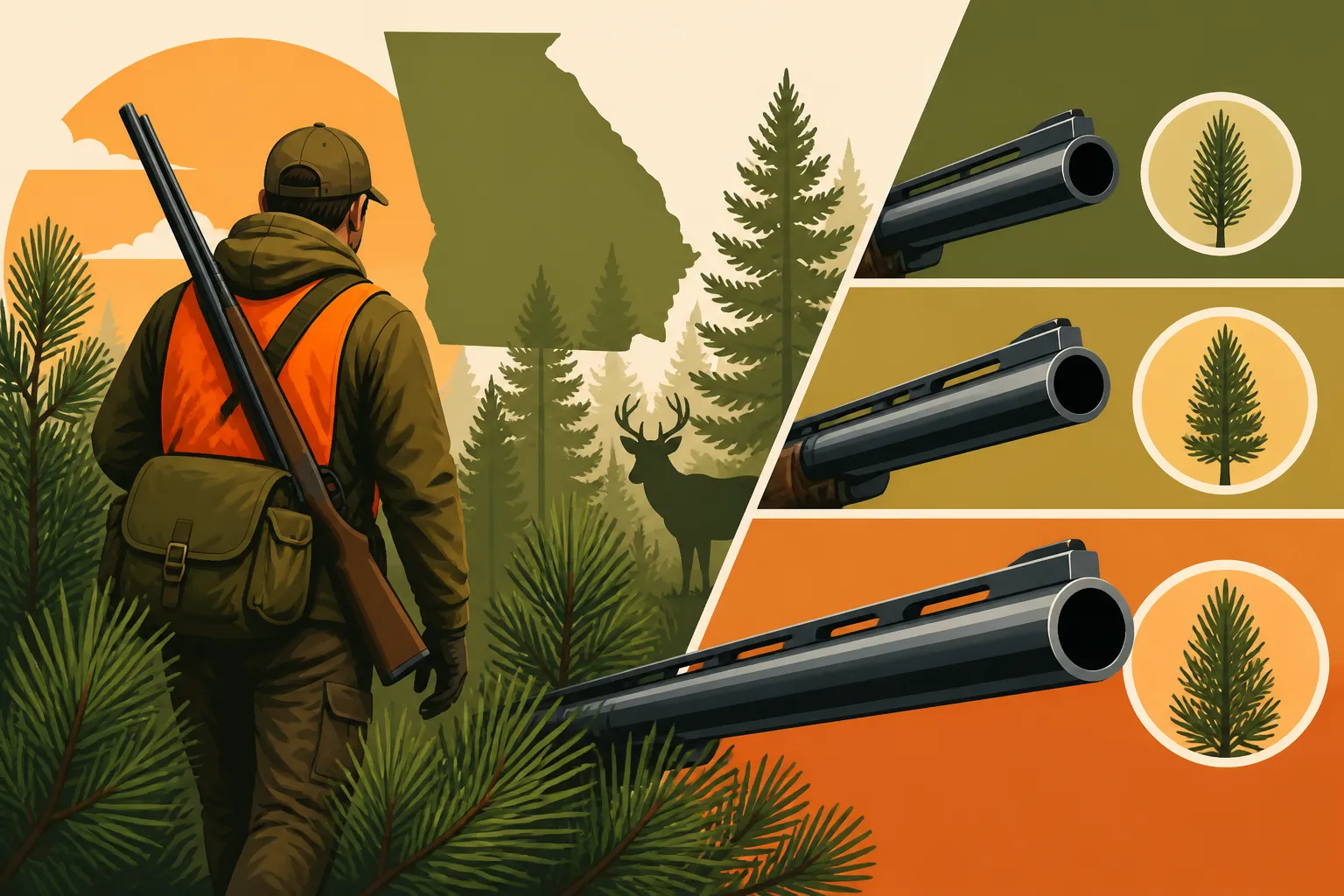
Choosing a barrel length is always a compromise, but for hunting dense Georgia pine, the balance often tips heavily towards maneuverability. A shorter barrel (think 16 to 20 inches) is significantly easier to swing, point, and keep clear of obstructions. It reduces the overall length of your rifle, making it less likely to snag on brush, easier to carry close to your body, and quicker to bring to bear if a deer suddenly appears at close range. The primary trade-off is typically a slight reduction in muzzle velocity and, theoretically, a minor impact on accuracy at very long ranges. However, in thick pine cover, "very long ranges" usually means 75 yards, maybe 100 yards at an absolute push, not 300 yards across an open field. For these shorter distances, the velocity loss is negligible in terms of terminal ballistics for deer, and the practical accuracy difference is often imperceptible for most hunters. For instance, a 16-inch barrel might lose 100-150 feet per second compared to a 24-inch barrel with the same cartridge, but a deer shot at 50 yards isn't going to know the difference. Your ability to get a clean shot, however, will be vastly improved.
On the flip side, a longer barrel (22-26 inches) excels in open country, where maximum velocity for flatter trajectories and greater range is desired. It also generally provides a longer sight radius for iron sights, if you use them, and can offer a more stable swing for deliberate long-range shots. But in dense pine, these advantages vanish. That extra length becomes a liability. It protrudes further, gets caught more easily, and makes it cumbersome to turn or adjust your position quickly. Trying to follow a running deer through the pines with a long barrel can feel like steering a barge down a narrow creek – slow, unwieldy, and prone to collision. When considering a rifle for diverse hunting scenarios in Georgia, it's worth thinking about whether the terrain you primarily hunt necessitates a different approach to barrel length than what might be traditional for more open areas.
Practical Considerations for Close-Quarters Hunting
Hunting deer in thick pine cover is inherently a close-quarters affair. Visibility is limited, shooting lanes are often narrow tunnels, and deer can materialize and vanish in an instant. This demands a rifle that can be deployed quickly and quietly. Imagine still-hunting and spotting a deer at 30 yards, partially obscured by a young pine. With a short, compact rifle, you can subtly raise it, find a small window, and make the shot. With a long barrel, you might find yourself needing to take several extra steps to clear a branch, or worse, have to lift your rifle high over the brush, announcing your presence with a metallic scrape or a rustle of leaves.
Beyond the shot itself, consider the journey. You might be walking for hours through this dense stuff. Every time you have to untangle your rifle, every awkward maneuver to avoid a snag, adds to the physical and mental fatigue. A lighter, shorter rifle carried correctly (perhaps using a good sling, as we'll discuss later) can feel like a natural extension of your body, rather than an unwieldy appendage. The reduced length also helps immensely when trying to shoot from a kneeling or sitting position, where vertical clearance can be an issue, or when hunting from a compact ground blind that you've brushed in along a Setting Up on a Piedmont Field Edge. The ability to maneuver freely means you can maintain your focus on the hunt, rather than constantly battling your equipment.
Optimal Barrel Lengths for Georgia Pine Hunting
Given the nature of Georgia’s pine cover, a shorter barrel often proves to be the superior choice for practical hunting scenarios. It’s about finding the sweet spot where you maintain sufficient ballistic performance while maximizing your ability to move and react in tight spaces.
Specific Recommendations for Different Firearm Types
When we talk about optimal barrel length for dense pine, we're generally looking at rifles, but the principle applies to other firearms as well.
- Bolt-Action and Lever-Action Rifles: For most deer cartridges, a barrel length of 18 to 20 inches is often ideal. This provides an excellent balance of maneuverability and ballistic performance for shots out to 150-200 yards, which is more than enough for the vast majority of shots you'll get in Georgia's pine woods. A 16-inch barrel is also a viable option, especially for cartridges like the .30-30 or .45-70, which were designed for shorter barrels and closer ranges. Many modern bolt actions now offer compact models specifically with these shorter barrels, knowing that many hunters operate in dense environments. If you're using a common caliber like a .308 or a 6.5 Creedmoor, an 18 or 20-inch barrel will still deliver plenty of energy and accuracy for ethical deer hunting.
- AR-Platform Rifles: These semi-automatic rifles are inherently compact, and many come standard with 16-inch barrels. For hunting in pine cover, this length is fantastic. Their shorter overall length, combined with often collapsible stocks, makes them incredibly agile. The .223/5.56mm is common, but increasingly, hunters are using larger calibers like .300 Blackout, 6.5 Grendel, or .450 Bushmaster, all of which perform admirably from 16-inch barrels at typical woods ranges.
- Shotguns (Slug Guns): If you're using a shotgun for deer hunting with slugs, especially in areas that might restrict rifles, an 18 to 20-inch smoothbore or rifled barrel is perfectly suited. These are designed for quick handling and powerful performance at shorter ranges, making them excellent for thick cover.
It's really about matching your gear to the environment, not just the game. Many hunters find that once they try a shorter barreled rifle in dense cover, they never want to go back to their longer "open field" guns for those types of hunts.
Balancing Accuracy with Portability
The idea that shorter barrels are inherently inaccurate is often a misconception, particularly at hunting distances relevant to dense cover. While a longer barrel can contribute to a more consistent powder burn and higher velocity, and theoretically a tiny bit more inherent accuracy on a bench rest, the practical accuracy difference for a hunter in the field is usually negligible. A well-made rifle with a quality 18 or 20-inch barrel, shooting good ammunition, will easily be accurate enough to consistently place shots within a deer's vital zone out to 150-200 yards. The real gain in accuracy comes from the hunter's ability to handle the rifle effectively.
Consider the following comparison for common rifle barrel lengths:
| Barrel Length (Inches) | Primary Advantage(s) | Primary Disadvantage(s) | Ideal Georgia Terrain | Typical Cartridge Example |
|---|---|---|---|---|
| 16 | Maximum maneuverability, compact | Slight velocity loss | Deep pine thickets, dense swamps | .300 Blackout, .30-30 |
| 18 | Excellent maneuverability, good ballistics | Minor velocity loss | Dense pine, mixed hardwoods | .308 Win, 6.5 Creedmoor |
| 20 | Balanced maneuverability & ballistics | Still very manageable in cover | General woods hunting, some open | .270 Win, .30-06, .308 Win |
| 22 | Good ballistics, moderate maneuverability | Can snag in very dense cover | Open pine, field edges, more open hardwoods | .270 Win, .30-06, 7mm Rem Mag |
| 24+ | Max velocity, long-range potential | Cumbersome in thick cover, heavy | Open fields, mountain long shots | Magnum calibers |
Ultimately, a rifle you can quickly get on target, handle without snagging, and comfortably carry for miles will lead to more accurate shots in the real-world conditions of Georgia's pine country. Portability isn't just about weight; it's about the physical dimensions and how they integrate with your movement through the environment. This balance allows you to focus on Finding Sign in Big Chattahoochee Timber instead of fighting your rifle.
Additional Gear and Techniques for Pine Cover
Beyond just barrel length, there are other strategies and gear choices that can significantly enhance your ability to navigate and hunt effectively in dense Georgia pine cover.
Carrying Methods and Slings
Even with an optimally short barrel, how you carry your rifle makes a huge difference. A cheap, flimsy sling that lets your rifle flop around is a recipe for frustration and noise. Invest in a good quality, comfortable sling that allows you to carry the rifle securely and close to your body.
- Two-Point Sling: This is the most common and versatile. When still-hunting, I often carry my rifle with the sling over one shoulder and across my chest, with the barrel pointed diagonally down and forward. This keeps the rifle tight against my body, reducing swing and snagging, while allowing for a relatively quick transition to shooting. You can also carry it slung across your back, especially during long hikes into your hunting area, but be mindful of how quickly you can get it into action if needed.
- Single-Point Sling (for ARs): While more commonly seen in tactical applications, a single-point sling on an AR-platform rifle can keep the rifle hanging centered in front of you, allowing for very rapid deployment. However, it can also lead to the rifle swinging more if you're not actively controlling it with your hands.
- Hand Carry: Sometimes, especially when you're in an area where you expect a shot at any moment, carrying the rifle in your hands, ready to shoulder, is the best option. This works especially well with shorter barrels, as the reduced length makes it less fatiguing and easier to keep clear of brush. You might even want to try a specialized pack designed for hunting, like those discussed in Packs Built for a Chattahoochee Day Hunt, which often include better rifle carrying systems.
Regardless of the sling, practice moving with your rifle in different positions. Understand how it feels, how to keep it quiet, and how quickly you can shoulder it. This muscle memory is invaluable when a deer busts out of a thicket.
Scopes and Optics for Tight Spaces
Just as barrel length matters, so does your choice of optics. In dense pine cover, long-range, high-magnification scopes are often overkill and can even be a hindrance.
- Low Magnification Variable Scopes: A scope with a low bottom end, like a 1-4x, 2-7x, or 3-9x, is generally perfect for this environment. The 1x or 2x setting gives you a wide field of view, making it easy to acquire a fast-moving target or find a deer in heavy cover. You can then dial up the magnification to 4x, 6x, or 7x for a more precise shot if the animal stops or offers a clearer window. A large objective lens isn't as critical as it might be in open country, as light often struggles to penetrate the dense canopy anyway. Focus on clarity and a good reticle that's easy to see in low light.
- Red Dot Sights: For ultra-close ranges (under 75 yards) and fast target acquisition, a red dot sight on a rifle can be incredibly effective. They offer unlimited eye relief, a wide field of view, and a simple aiming point that's quick to get on target. While not traditional for many deer hunters, they are gaining popularity, especially for still-hunting in extremely thick areas. Just ensure your chosen red dot is robust enough to handle the bumps and scrapes of woods hunting.
- Binoculars and Rangefinders: While not directly mounted on your rifle, compact binoculars (8×32 or 10×32) are indispensable. You'll use them constantly to pick apart dense cover, identify deer, and ensure you're looking at a legal animal. A small, simple rangefinder can also be useful, not just for knowing exact distance, but for mentally mapping out shooting lanes and identifying potential obstructions. Rangefinders in Thick Coastal Plain Cover provides further insights into selecting the right rangefinder for these environments.
- Snake Boots and Bug Spray: Let's be real, you're in Georgia, and whether it's early archery season or the heart of firearms season, snakes and bugs are a factor. Invest in good quality snake boots, especially if you're venturing deep into pine thickets or swamps. Nothing ruins a hunt faster than a snake encounter, and preventing bites is paramount. Similarly, effective bug spray is essential for maintaining focus, preventing distractions from mosquitoes and ticks that thrive in humid, shady pine cover. Snake Boots for Coastal Plain Walking is a fantastic resource for this.
By combining the right barrel length with smart gear choices and mindful carrying techniques, you can transform your experience in Georgia’s pine cover from a frustrating struggle to a smooth, effective hunt. It's all about making yourself and your equipment an extension of the natural environment, moving with purpose and stealth.
Disclaimer
This article is for general informational purposes only and does not constitute professional advice. Laws, prices and regulations vary by location and change over time. Consult a qualified professional for guidance on your specific situation.