Muzzleloaders Under Georgia Primitive Weapons Rules
Stepping into Georgia's woods with a muzzleloader during the primitive weapons season can feel like a journey back in time, offering a unique challenge and a deep sense of connection to hunting heritage. But let's be honest, figuring out exactly what's legal, what works best, and how to stay effective in our humid Southern climate can be a real head-scratcher. This guide aims to clear up the confusion around Georgia's primitive weapons rules, helping you choose the right gear and tactics for a successful and enjoyable muzzleloader hunt.
Understanding Georgia's Primitive Weapons Season
The primitive weapons season in Georgia is a cherished window, offering hunters a chance to pursue deer with equipment that demands a bit more skill and patience. It's a time when the woods often feel quieter, and the pursuit feels more primal, but it also comes with specific regulations that you absolutely need to understand before you head afield.
What Qualifies as a Primitive Weapon?
When Georgia's regulations talk about "primitive weapons," they're referring to a very specific set of tools. This isn't just a free-for-all for anything that isn't a modern centerfire rifle. Generally, this means archery equipment (longbows, recurves, compound bows, and crossbows), shotguns (20 gauge or larger, loaded with slugs or buckshot), and, crucially for our discussion, muzzleloaders. For muzzleloaders, the key is that they must be loaded from the muzzle and can only fire a single projectile. This definition is intended to create a particular kind of hunting experience, one that emphasizes closer shots and a more deliberate approach, rather than the long-range capabilities of modern firearms. Hunters often use this season as a bridge between the early archery season and the full firearms season, sometimes even stacking opportunities. You can learn more about the structure by reading Georgia Deer Season Structure Explained.
The intent behind these specific definitions is to level the playing field, making the hunt more about tracking, stealth, and ethical shot placement at shorter distances. For example, a hunter carrying a traditional cap-and-ball revolver might wonder if it counts; typically, only rifles and shotguns falling under the muzzleloader definition are permitted for deer, ruling out handguns in most primitive weapon contexts unless explicitly stated for specific quota hunts. Always double-check the latest Georgia hunting regulations booklet, as interpretations and specific wording can sometimes shift slightly from year to year. Understanding these nuances is key to staying legal and making sure your hunt is a rewarding one.
Key Dates and Zones for Primitive Weapons
Georgia's primitive weapons season, often referred to as "primitive weapons week," is typically a short but highly anticipated window, usually sandwiched between the archery-only season and the statewide firearms opener. The exact dates can shift slightly each year, and they are county-specific, so what applies in one region might be different a few counties over. It's crucial to consult the Georgia Department of Natural Resources (DNR) official hunting regulations for the current season's schedule. This season is strategically placed to give hunters an opportunity with slightly more powerful tools than archery, but still before the full-on rifle pressure begins, which means the deer might be a little less wary than they become later in the fall.
Beyond the statewide primitive weapons week, some Wildlife Management Areas (WMAs) might have their own specific primitive weapons hunts, which could occur at different times or have additional rules, such as quota limitations. These special hunts are often great opportunities to access well-managed land, but they require careful planning and application. When planning your hunt, whether on private land or public ground, a tool like GoHunt's mapping features can be incredibly helpful for identifying specific county boundaries and WMA zones, ensuring you're always aware of the regulations for your chosen hunting spot. This is particularly important for residents and non-residents alike, as penalties for hunting out of season or with an illegal weapon can be severe. Make sure you're aware of Georgia Primitive Weapons Season Dates for your target area well in advance.
Muzzleloader Types and Legalities in Georgia
Choosing a muzzleloader isn't just about picking one off the shelf; it's about understanding the different types and, more importantly, ensuring that your chosen firearm complies with Georgia's specific primitive weapons rules. This distinction can sometimes trip up even experienced hunters who are new to muzzleloading in the state.
Traditional vs. Modern Muzzleloaders
When we talk about muzzleloaders, there's a spectrum from the truly "primitive" to what some call "modern inline" muzzleloaders. Traditional muzzleloaders typically include flintlocks and percussion cap rifles that might use exposed hammers and require loose powder, patch, and ball or a conical bullet. These are often single-shot, slower to reload, and echo the historical hunting experience. Then you have the more "modern" inline muzzleloaders. These often feature a more rifle-like appearance, use 209 primers (the same primers found in shotgun shells), and frequently employ saboted bullets. They are generally more accurate, easier to clean, and offer faster ignition, bridging the gap between historical accuracy and modern convenience.
Georgia's regulations are often more permissive than some other states, typically allowing both traditional and modern inline muzzleloaders during the primitive weapons season, provided they meet the basic definition of being loaded from the muzzle with a single projectile. This means you generally aren't restricted to just flintlocks or cap-and-ball rifles. Many hunters appreciate this flexibility, allowing them to use a reliable inline setup that might offer better accuracy and reliability in less-than-ideal weather conditions. However, it's always wise to verify the specific wording in the current year's regulations to ensure no new restrictions have been added regarding ignition systems or barrel types. Regardless of your choice, remember the spirit of the primitive hunt, which often means closer shots and a more deliberate process than you might experience with a high-powered rifle.
Specific Caliber and Loading Requirements
Georgia's primitive weapons regulations typically specify a minimum caliber for muzzleloaders used for deer. For example, a common requirement is that the muzzleloader must be .40 caliber or larger. This ensures sufficient knockdown power for ethical deer harvesting. Furthermore, the single-projectile rule is absolute: you cannot load multiple projectiles, such as birdshot or buckshot, into a muzzleloader for deer hunting during this season. It's a single bullet, whether it's a patched round ball, a conical bullet, or a sabot holding a smaller projectile.
The loading process itself is also fundamental to the definition. The firearm must be loaded from the muzzle. This means no breech-loading systems, even if they fire what appears to be a "muzzleloader" cartridge. The simplicity of the loading process—powder, then projectile, rammed down the barrel—is a core part of the primitive weapons experience. When buying a muzzleloader or preparing for the season, ensure your chosen firearm adheres to both the caliber minimum and the single, muzzle-loaded projectile requirement. These rules are designed to ensure humane harvesting of game while maintaining the distinct challenge of primitive weapon hunting. For those venturing into the woods, knowing your weapon's capabilities and limitations, especially regarding Practical Range in Georgia Swamp Timber or open fields, is paramount.
Ammunition and Ballistics Considerations for Georgia
Once you have your legal muzzleloader, the next big decision involves your ammunition components: powder and projectile. These choices profoundly impact your muzzleloader's performance, accuracy, and effectiveness in the field, especially given Georgia's varied terrain and often humid conditions.
Propellants: Black Powder vs. Substitutes
For muzzleloaders, your choice of propellant typically boils down to traditional black powder or one of the many modern black powder substitutes. Real black powder, available in different granulations (e.g., FFFg, FFg), is the classic choice, known for its distinct smoky signature and reliable ignition. However, it's also highly corrosive, requiring immediate and thorough cleaning after every use, and it's quite sensitive to moisture. Keeping powder dry in Georgia's often damp environment can be a real challenge, as discussed in Keeping Powder Dry in Georgia Humidity.
Black powder substitutes, like Pyrodex, Triple Seven, or Blackhorn 209, have gained immense popularity for good reason. They are generally less corrosive, much easier to clean (often with just soap and water), and offer more consistent performance across varying temperatures and humidity levels. Some substitutes, particularly Blackhorn 209, burn cleaner and can offer velocities closer to modern smokeless powder, pushing the ethical range a bit further. While most substitutes are suitable, always check the manufacturer's recommendations for your specific muzzleloader, especially regarding primer type (percussion cap, musket cap, or 209 primer) and loading data. The right propellant can make a world of difference in consistency and cleaning ease, which means more time hunting and less time scrubbing your barrel.
Bullet Choices: Sabots, Conicals, and Round Balls
The type of projectile you choose for your muzzleloader is arguably as critical as your powder. Each type has its advantages and disadvantages, and what works best can depend on your rifle's twist rate, your intended range, and your hunting conditions.
-
Round Balls: These are the most traditional projectile, typically loaded with a patch. They are incredibly accurate at shorter ranges, particularly in slower twist barrels (like 1:66 or 1:48 twist rates), and are generally very effective for deer out to about 75-100 yards. They're also usually the most economical option. However, their ballistic coefficient isn't great, meaning they shed velocity quickly and aren't ideal for longer shots.
-
Conical Bullets: Heavier and longer than round balls, conicals (like PowerBelt or Hornady FPB) offer more mass and better downrange energy. They are often chosen for moderate ranges, providing good accuracy in barrels with twist rates around 1:28 to 1:48. They expand well on impact and can be a great choice for hunters looking for a balance between traditional feel and modern performance. They're typically loaded directly down the bore without a sabot.
-
Saboted Projectiles: These are essentially modern pistol or rifle bullets (often .45 or .40 caliber) encased in a plastic sleeve (sabot) that allows them to be fired through a larger bore muzzleloader (typically .50 caliber). Once the sabot leaves the barrel, it falls away, and the bullet continues to spin and fly. Sabots offer superior ballistic performance, flatter trajectories, and excellent accuracy at longer ranges, often out to 150-200 yards with the right setup and shooter. They require faster twist rates, usually 1:28 or 1:24, which is common in many modern inline muzzleloaders. If you're pondering Sabot Versus Conical for Deer, consider your rifle's twist rate and your typical shot distances. Sabots generally excel in situations where you might encounter longer shots across a field edge or powerline cut.
Always test different bullet and powder combinations at the range to see what your specific muzzleloader prefers. What shoots great in one rifle might be wildly inaccurate in another, even if they're the same model.
Field Craft and Tactics for Muzzleloader Hunting
Muzzleloader hunting in Georgia calls for a different mindset and approach compared to hunting with a modern centerfire rifle. Because of the inherent limitations of muzzleloaders—primarily shorter effective range, slower reload times, and sensitivity to weather—field craft and tactical precision become even more critical for success.
Scouting and Stand Placement Specific to Muzzleloaders
Effective scouting is always important, but it's paramount for muzzleloader hunting. Since your effective range is generally shorter, often 100-150 yards at most for many setups, you need to identify active deer sign in areas where you can reasonably expect a close-range shot. This means looking for fresh rubs, scrapes, and heavy travel corridors, particularly those leading to and from prime food sources or bedding areas. Think about natural funnels, pinch points, and cover transitions. Tools like GoHunt's detailed satellite imagery can help you identify these features from home, allowing you to narrow down your on-the-ground scouting efforts. Once you're in the field, confirm those spots with fresh sign.
Stand placement then becomes a game of precision. Unlike rifle hunting where you might have a wider engagement zone, with a muzzleloader, you need to anticipate exactly where a deer will appear and ensure it's within your comfort zone. This could mean setting up your treestand or ground blind to cover a specific trail, a small opening in the timber, or a crossing point in a creek bottom. Consider the wind direction carefully, as deer will often circle downwind of food sources. Placing your stand so that your scent isn't blowing into their approach path is crucial. For public land hunters, Scouting Georgia Public Land Before Season is indispensable for finding these prime, less-pressured spots that align with muzzleloader limitations. Whether you're hanging a stand on a Ridge-Top Saddle for Rutting Bucks or on a Piedmont Field Edge, remember that closer is always better when you're restricted to a single, slower shot.
Overcoming Weather Challenges Humidity, Rain
Georgia's weather, particularly during the early fall primitive weapons season, can be notoriously challenging for muzzleloader hunters. High humidity and sudden rain showers are common, and moisture is the bane of black powder and percussion caps. A damp charge or a wet primer can lead to a misfire, turning a perfect shot opportunity into a frustrating click.
To combat humidity, ensure your powder and primers are stored in watertight containers. Many hunters will even carry a small, sealed bag with pre-measured powder charges and extra primers, ready to load quickly and keep dry. When sitting in the stand, consider covering the muzzle of your rifle with a piece of electrical tape or a balloon to prevent moisture from entering the barrel, especially if rain is expected. This also helps keep debris out. After any rain, or even just after a day of high humidity, it's wise to at least remove your breech plug and inspect your powder for dampness, or ideally, fire a fouling shot and reload with fresh components. Some muzzleloader models are designed with features like sealed breeches or corrosion-resistant coatings that offer a bit more protection. When the weather turns chilly later in the season, even if it's still primitive weapons, dressing appropriately with Warm-Weather Clothing for Georgia Hunters in the early primitive season transitions to insulated gear as temperatures drop. Being prepared for the elements not only protects your gear but ensures you're ready when that buck finally steps out.
Maintenance and Care for Your Georgia Muzzleloader
Muzzleloaders, particularly those using traditional black powder, demand a much higher level of post-shooting care than modern firearms. Neglecting immediate and thorough cleaning can quickly lead to irreversible corrosion and damage, especially in Georgia's humid climate.
Post-Hunt Cleaning and Storage
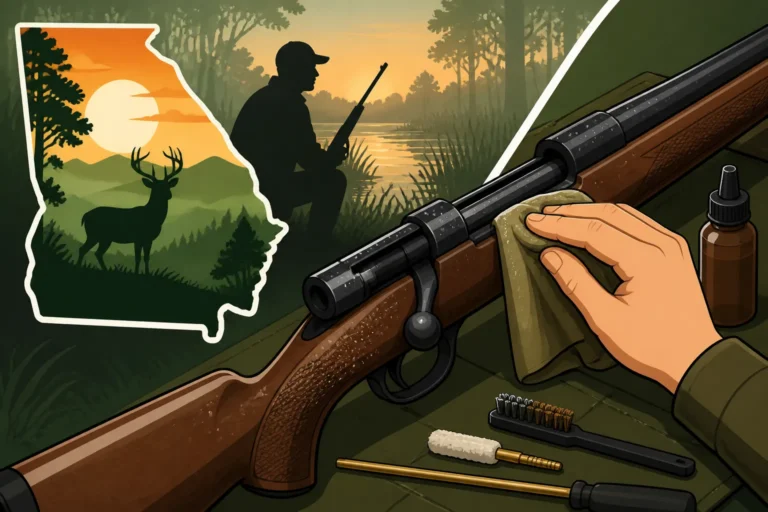
The golden rule of muzzleloader maintenance is to clean it immediately after firing, ideally within a few hours. Black powder and many substitutes leave behind corrosive residues that will aggressively attack steel if left untreated. Delaying cleaning, especially overnight, can result in rust forming inside the barrel and around the breech plug.
A typical cleaning routine involves:
- Disassembly: Remove the breech plug (if applicable), nipple, and any other removable components.
- Soak/Swab: Use a black powder solvent, or even just hot soapy water, to run patches down the barrel until they come out clean. A bronze brush can help dislodge stubborn fouling. For inline muzzleloaders, pay close attention to the breech plug channel, as fouling loves to accumulate there.
- Clean Components: Scrub the breech plug, nipple, and any other fouled parts with solvent and a brush.
- Dry Thoroughly: This step is crucial. Use dry patches to remove all moisture, then follow up with an air compressor or let parts air dry completely. Moisture left behind can ironically cause rust.
- Lubricate and Protect: Once dry, apply a thin coat of rust preventative oil to all metal surfaces, inside and out. Reassemble the firearm.
- Storage: Store your muzzleloader in a dry environment. A gun safe with a dehumidifier is ideal. Avoid storing it in a padded case for extended periods, as these can trap moisture. Regular checks are also a good idea. For a good comparison on care, refer to Cleaning a Rifle After a Humid Sit. Proper care ensures your muzzleloader remains reliable and safe for many seasons to come.
Troubleshooting Common Muzzleloader Issues
Even with diligent care, muzzleloaders can present unique challenges in the field. Knowing how to troubleshoot common issues can save a hunt from being cut short.
- Misfires/Hangfires: This is perhaps the most common frustration. If your muzzleloader goes "click" instead of "boom," first ensure the primer or cap is properly seated. If using a cap, check if it's firing. If it fires but the main charge doesn't ignite (a hangfire or just a fizzle), moisture in the powder charge is usually the culprit. You can try recapping or repriming, or if safe, removing the breech plug and replacing the charge. Always wait a safe amount of time (30-60 seconds) after a misfire before opening the breech or looking down the barrel, as a hangfire can still ignite.
- Stuck Projectile: If you're having trouble seating a bullet or if it gets stuck partway down the barrel, do not force it. This is a dangerous situation. Often, it's due to incorrect bullet diameter for your bore, a fouled barrel, or improper loading technique. The safest approach is often to remove the breech plug (if possible) and push the projectile out from the breech end. If your muzzleloader doesn't have a removable breech plug, you'll need a CO2 discharge tool or to visit a gunsmith.
- Fouling Issues: Rapid fouling can make subsequent shots difficult to load or inaccurate. If you're experiencing this, try a different brand or type of powder substitute known for cleaner burning, or swab the barrel with a moist patch between shots at the range. Always use the proper size patch or sabot for your bore to ensure a good gas seal and prevent excessive fouling.
- Accuracy Problems: Inconsistent accuracy can stem from many factors: inconsistent powder charges, varying bullet seating pressure, improper cleaning, or even a loose scope or sights. Start by ensuring your cleaning routine is solid, your powder charges are measured precisely (a trick that GoHunt users often share is to use a small powder flask for consistency), and your bullet seating pressure is firm and uniform. Then, experiment with different bullet/powder combinations at the range. Small adjustments can often yield significant improvements in group size.
By understanding these common issues and how to address them, you can approach your muzzleloader hunting with greater confidence and competence, ensuring that your time in the Georgia woods is spent pursuing game, not battling your equipment.
Disclaimer
This article is for general informational purposes only and does not constitute professional advice. Laws, prices and regulations vary by location and change over time. Consult a qualified professional for guidance on your specific situation.