Hunting a Clear-Cut Regrowth Edge
Hunting a clear-cut regrowth edge in Georgia can feel like trying to find a needle in a haystack, especially when those deer seem to vanish into thin air right after a logging operation. You know they're still around, but they've just retreated into a dense, thorny fortress that looks impenetrable. This guide is all about demystifying those seemingly impenetrable clear-cuts and giving you the strategies, scouting tips, and gear insights to successfully hunt the deer that call these thick havens home.
Understanding Clear-Cuts and Deer Behavior
Clear-cuts, for all their initial ugliness to the eye, are absolute magnets for wildlife, especially white-tailed deer. When a section of timber is completely harvested, it creates an explosion of new growth that transforms the landscape and, in turn, how deer utilize the area. Ignoring these areas is missing out on some of the best hunting opportunities Georgia has to offer.
The Life Cycle of a Clear-Cut
A clear-cut isn't a static environment; it changes dramatically over several years, and understanding these stages is crucial for knowing where deer will be and how best to hunt them.
Initially, a fresh clear-cut (year 0-1) might look desolate, with just exposed soil, stumps, and logging debris. Deer activity here will be minimal, primarily focused on crossing through or browsing any remaining green shoots on the very edges. There isn't much cover, and the food source is sparse. Give it some time, though.
By years 1-3, things start to get interesting. The sun-drenched forest floor erupts with a thick tangle of weeds, briars, blackberry bushes, honeysuckle, young saplings, and various other pioneer plants. This stage is often an absolute deer paradise. It offers an incredible buffet of high-quality forage, particularly early successional plants that deer crave. It also provides immediate, impenetrable security cover where fawns can hide, and mature deer can feel safe from predators and hunters. Imagine trying to push through a chest-high wall of briars – that's what a deer considers a safe haven.
As the clear-cut matures into years 3-7, the growth becomes even denser. The saplings grow taller, and woody browse dominates. While still offering immense cover, some of the very best browse might be growing out of reach, and the sheer thickness can make movement challenging for both deer and hunters. However, this is still prime bedding habitat, and deer will create intricate trail systems within these thickets. Finally, beyond 7-10 years, the canopy begins to close, shading out the undergrowth. The prime browse diminishes, and the area becomes more like a young, dense forest, still offering cover but less food value. Most deer activity will then shift to the edges of this maturing forest.
Why Deer Love Regrowth Edges
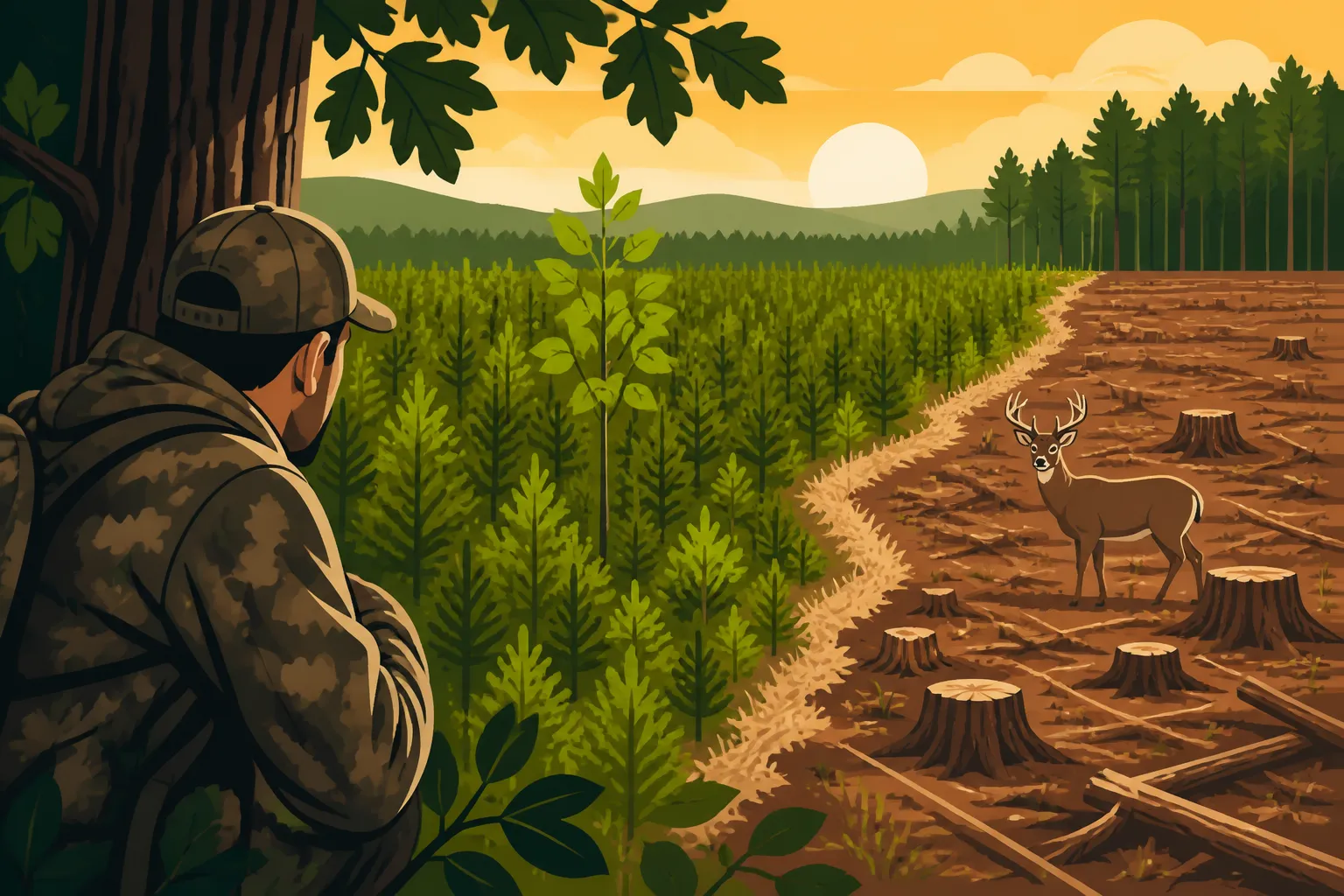
Deer aren't just fond of clear-cuts; they often depend on them, especially the critical "edge" where the dense regrowth meets mature timber or a field. This edge habitat provides the best of both worlds, creating a natural funnel and sanctuary.
First and foremost, it's about food. The regenerating plants within a clear-cut provide a diverse and nutritious food source that's often richer and more abundant than what's found in a mature, shaded forest. Deer will spend hours browsing on blackberry canes, honeysuckle, greenbrier, young oak sprouts, and a host of other succulent plants. They can step out of the dense cover right onto this buffet line.
Secondly, and perhaps most importantly, is the unparalleled cover and security. Those impenetrable briar patches and thick saplings offer deer a sense of safety that mature timber simply can't. Predators, including humans, struggle to navigate them quietly or effectively. This is where deer feel comfortable bedding down for the day, raising fawns, and retreating when pressured. When you find yourself hunting the Georgia rut in mid-October, mature bucks will often cruise these edges, checking for does that are feeding or bedded inside the thicket.
The "edge" itself is a dynamic transition zone. Deer will use trails along this seam, entering the thicket for cover and food, and exiting into mature timber or nearby food plots to feed or travel. These edges act as natural travel corridors, often concentrating deer movement into predictable patterns, which is exactly what we as hunters are looking for. They offer thermal cover in winter and shade in the brutal Georgia summers, making them year-round residences for deer.
Scouting and Locating Key Clear-Cut Edges
Finding the right clear-cut and, more specifically, the hot spots along its edges, is paramount. You can't just pick any clear-cut; you need to find one that's in the sweet spot of its life cycle (typically 1-7 years old) and offers strategic advantages.
Reading Topography and Aerial Maps
Modern technology has made scouting for clear-cuts incredibly efficient. Satellite imagery and topographic maps are your best friends here. Tools like GoHunt or other digital mapping platforms allow you to scout from your couch, identifying potential hot spots long before you ever set foot in the woods.
Start by looking for recently cut areas. On aerial maps, these will appear as lighter green patches or even bare ground that slowly turns into dense, textured green as the vegetation grows. Pay close attention to the shape of the clear-cut. Are there fingers of timber extending into the cut? Are there narrow necks of regrowth connecting larger blocks of timber? These are natural funnels that deer will exploit. Look for clear-cuts that butt up against agricultural fields, established food plots, or mature hardwood bottoms, as these transition zones are prime entry and exit points. A clear-cut that borders a creek bottom or a swamp, for example, can create an exceptional travel corridor. You might find a natural funnel between two swamps that incorporates a clear-cut edge, forcing deer into predictable paths.
Topographical maps will help you identify elevation changes, saddles, and drainages that meet the clear-cut. Deer often prefer to travel along contours or cross ridges at saddles, and if a clear-cut happens to intersect these features, it creates a high-traffic area. Note any old logging roads or skid trails that might still exist within or along the edge of the clear-cut; these often become deer highways. Reading Aerial Photos for Piedmont Deer can give you even more insights into how to interpret these critical maps for your region.
Identifying Active Sign in the Thicket
Once you've narrowed down potential clear-cuts on your map, it's time for some boots-on-the-ground scouting. This is where you confirm your suspicions and pinpoint the precise locations where deer are active.
Focus your scouting efforts on the edges of the clear-cut. Look for distinct trails entering and exiting the thicket. These trails will often be well-worn, especially where deer are forced to squeeze through particularly dense vegetation. Don't be afraid to poke your head a little way into the clear-cut itself. You're looking for evidence of browsing – torn leaves, nipped-off shoots, and fresh droppings in patches of palatable plants like blackberry or greenbrier.
Rub lines and scrape lines are clear indicators of buck activity. During the pre-rut and rut, bucks will often parallel the clear-cut edges, establishing their scent marks. A major scrape line along a logging road bordering a clear-cut is a goldmine. Look for rubs on small saplings just inside the clear-cut, as bucks will often use the cover to rub before stepping out. Don't forget to look for bedding areas, too. These will usually be small, matted-down spots, often just inside the densest part of the regrowth, providing excellent visibility downwind and thick cover.
Pay attention to natural bottlenecks. A point where the mature timber extends into the clear-cut, creating a narrow pinch, or a section where the clear-cut itself narrows significantly, will funnel deer traffic. These are ideal locations for stand placement. Scouting Georgia Public Land Before Season emphasizes the importance of early season scouting, and this holds especially true for clear-cuts, as the dense foliage can make finding trails difficult once hunting season begins in full swing.
Effective Hunting Strategies for Clear-Cut Edges
Hunting clear-cut edges requires a specific mindset and approach. The dense cover that attracts deer also presents challenges for hunters, demanding careful planning and execution.
Stand Placement and Wind Considerations
When setting up on a clear-cut edge, your stand placement is everything. You want to be positioned to intercept deer as they transition between the heavy cover and more open areas. Often, the best spots are just inside the clear-cut, allowing you to peek into the thicket where deer are browsing or bedding, while also watching for movement along the edge or in the adjacent timber. Look for a large, mature tree on the edge of the regrowth that provides good cover and a clear shooting lane into the clear-cut itself, as well as along the edge.
Consider the prevailing wind patterns. Deer, especially mature bucks, will almost always circle downwind before entering an open area or crossing a major trail. Position your stand so that your scent blows away from known travel routes or bedding areas. If you're hunting a ridge or a saddle that borders a clear-cut, understanding Wind and Thermals on a Mountain Ridge becomes even more critical, as thermals can carry your scent uphill in the morning and downhill in the evening. A well-placed hang-on stand with climbing sticks or even a mobile saddle hunting setup can be incredibly effective for adapting to different wind directions throughout the season.
Ground blinds are another excellent option, especially if suitable trees for treestands are scarce or if you need to be highly mobile. A well-brushed-in ground blind can offer fantastic concealment and is often less intrusive than a treestand in these dense environments. When hunting with a crossbow versus a vertical bow in Georgia, a ground blind can also provide a stable shooting rest for those close-range shots often encountered in thick cover.
Still-Hunting and Driving Clear-Cuts
While sitting on a stand can be productive, sometimes the best way to hunt a clear-cut is to go in after the deer.
Still-hunting is an art form, and it's particularly effective along clear-cut edges or even making slow, deliberate pushes into the clear-cut itself. Move at a snail's pace, taking only a few steps every minute, and stopping frequently to scan intently. Use your binoculars to pick apart the dense cover, looking for horizontal lines (a deer's back) in a world of vertical saplings. Focus on the ground just inside the thicket where deer might be bedded or browsing. This method works well when hunting solo or with one partner, especially in South Georgia pine flats where clear-cuts are common. It's about being patient, quiet, and using the wind to your advantage.
For larger clear-cuts or when hunting with a group, small, organized deer drives can be highly effective. The key is to keep the drives small and quiet. Instead of loud shouting, use subtle pushes with one or two drivers slowly making their way through the thickest parts of the clear-cut. The goal isn't to blast deer out but to gently nudge them towards standers strategically placed on the clear-cut's edges or along known escape routes. Communication among the group is essential, using radios to coordinate movements and ensure safety, especially when you're hunting deer drives with three or four hunters. Always ensure everyone is wearing blaze orange requirements for safety.
Timing Your Hunts for Maximum Success
The timing of your hunt around a clear-cut edge can significantly influence your success. Deer movement patterns are largely dictated by time of day, pressure, and the rut.
Early mornings are excellent for catching deer transitioning from open feeding areas or mature timber back into the clear-cut for bedding. They might linger on the edges, grabbing a last bite before settling in. Set up well before daylight, allowing time for the woods to settle down before deer start moving.
Evenings are equally productive, as deer emerge from the clear-cut's sanctuary to feed in adjacent fields or browse along the edges before dark. Again, be in your stand early, perhaps two or three hours before sunset, and stay until legal shooting light fades.
Perhaps the most overlooked time is midday. While many hunters are out for lunch, deer within the clear-cut might be moving between bedding areas, browsing, or even cruising for does during the rut. If you can slip into a stand quietly and stay put, the midday lull can often yield sightings of less pressured deer. During the peak of the rut, bucks will often cruise the clear-cut edges at any time of day, actively searching for does, so persistence is key.
Gear Considerations for Clear-Cut Hunting
Hunting clear-cuts, with their dense vegetation and often warm Georgia weather, demands specific gear choices to ensure comfort, safety, and effectiveness.
Optics and Visibility in Thick Cover
In the dense environment of a clear-cut, your optics are more important than ever. Good binoculars are not just for long-range glassing; they are essential for picking apart the tangled mess of saplings and briars at close range. An 8×42 or 10×42 binocular with good low-light performance will help you spot a flicking ear or a horizontal backline in the shadows of the thicket. You're trying to resolve details in what looks like a solid wall of green, and quality glass makes a huge difference.
A rangefinder, even for close shots, can be invaluable. Distances in thick cover can be deceptive, and knowing the precise yardage to a shooting lane or a specific patch of browse can prevent a missed shot or a wounded animal. While you might not need a rifle scope with extreme magnification, clear glass with an illuminated reticle can be a game-changer in the low light often found within dense regrowth, especially during those crucial dawn and dusk hours.
Clothing and Protection
Georgia's climate means warm weather is often a factor, even into deer season, especially during When Georgia's Archery Season Opens. Lightweight, breathable camouflage is a must to prevent overheating. Layering is always a good idea, allowing you to shed clothes as the day warms up or add them back on for cooler mornings or evenings.
However, the defining characteristic of clear-cut hunting gear is protection. Those briars and thorny bushes aren't just for deer; they're a hazard for hunters. Investing in durable, thorn-resistant brush pants is a wise decision. They might be a bit stiffer, but they'll save your legs from countless scratches and punctures.
Crucially, snake boots are non-negotiable in Georgia, especially when busting through thick cover where venomous snakes like rattlesnakes and cottonmouths love to hide. Walking through a clear-cut, you're constantly pushing through dense undergrowth, making it easy to step on or near a coiled snake without seeing it. Snake boots for Georgia swamp ground are designed to protect you from bites and offer peace of mind.
Lastly, don't forget bug protection, especially during the early archery season. Mosquitoes, ticks, and gnats can be relentless in the humid, sheltered environment of a clear-cut. A good permethrin treatment on your outer clothing combined with a reliable personal repellent will make your hunt much more tolerable.
| Clear-Cut Stage | Key Deer Activity | Optimal Hunting Strategy | Essential Gear |
|---|---|---|---|
| 1-2 Years | Heavy browsing, fawning | Stand on feeding trails, careful still-hunt | Snake boots, brush pants, good binoculars |
| 3-5 Years | Primary bedding, rub/scrape lines | Stands just inside edge, small quiet drives | Rangefinder, durable broadheads, scent control |
| 6-8 Years | Interior bedding, limited ground browse | Ambush major trails, adjust for overhead cover | Climbing sticks, quiet pack, low-light scope |
Disclaimer
Hunting is an activity with inherent risks. Always prioritize safety, understand and follow all Georgia Department of Natural Resources hunting regulations, and obtain proper licenses and permits. Be aware of your surroundings, hunt ethically, and never hunt beyond your abilities or comfort level.