Night Hunting Georgia Alligators From a Boat
There's nothing quite like the thrill and challenge of hunting Georgia's apex predator, the American alligator, especially when the sun dips below the horizon and the swamp comes alive with a different kind of energy. Many hunters find the prospect of navigating these complex waterways at night, while simultaneously spotting and engaging a powerful reptile from a boat, incredibly daunting. This comprehensive guide is designed to equip you with the knowledge, strategies, and safety protocols needed to successfully hunt Georgia alligators from a boat after dark, turning that initial apprehension into confident pursuit.
Getting Started with Georgia Alligator Hunting
Before you even think about loading gear into a boat, you need to understand the unique framework Georgia has in place for alligator hunting. It's not like deer or turkey season where you can just buy a tag and go; gators require a special, competitive approach.
The Quota Hunt System and Permits
Georgia's alligator hunting is managed through a quota hunt system, which means permits are limited and allocated through a lottery drawing. This isn't a first-come, first-served situation; it's more akin to drawing for a coveted limited-entry tag out West. The Georgia Department of Natural Resources (DNR) sets a specific number of permits for designated harvest zones each year to ensure the sustainable management of the alligator population. The application process typically opens in late spring or early summer, and you'll apply online through the Go Outdoors Georgia website. It's a highly competitive draw, with thousands of applicants vying for a few hundred permits, making successful application an achievement in itself. For a deeper dive into the application process, you might want to review how to get ready for Applying for a Georgia Alligator Quota Hunt. Each permit is non-transferable and specific to a zone, outlining the legal harvest parameters, including the maximum size of the alligator.
Once you draw a permit, you’ll receive an alligator harvest tag, which must be immediately attached to your harvested alligator. Understanding the specifics of your chosen zone is crucial. Some zones encompass vast river systems like the Altamaha, others focus on specific lake or swamp areas. Your odds might vary slightly between zones, with some being more popular or having historically higher success rates due to denser alligator populations or easier access. This system ensures that the alligator population remains healthy and vibrant across the state, even as interest in hunting them grows.
Understanding Georgia's Alligator Season Rules
Georgia's alligator season is relatively short, typically running for several weeks starting in late summer or early fall. The exact dates can vary year to year, so always check the current Georgia DNR regulations, but you can generally expect the season to open around mid-August and run through October. This timeframe is chosen because alligators are still active, but the brutal summer heat has begun to mellow, making nighttime activities a bit more bearable for hunters. Legal hunting hours are strictly from sunset to sunrise, emphasizing the night hunting aspect that is so effective for these reptiles.
A critical rule to grasp is the legal size requirement for harvested alligators. In Georgia, you must harvest an alligator that is at least four feet in length. This regulation protects juvenile alligators and helps maintain a healthy breeding population. It's absolutely imperative to be able to accurately estimate an alligator's length before engaging it, as harvesting an undersized gator will lead to penalties. Measuring a live, potentially agitated alligator in the dark is a skill that takes practice and a good eye, and we'll touch on how to refine this later. Each permit allows for the harvest of one alligator, and once tagged, that’s your season. You can learn more about the specifics of Minimum Legal Alligator Length in Georgia to ensure you're compliant. Beyond size, be aware of any local ordinances or specific WMA rules that might apply to your hunt zone, as these can add layers to the general statewide regulations.
Outfitting Your Boat and Gear for Night Operations
Night hunting alligators from a boat is an equipment-intensive endeavor. It's not just about having a boat; it's about having the right boat and the right gear, all meticulously organized for safety and efficiency in the dark.
Choosing the Right Boat for Georgia's Waters
The choice of boat can make or break your alligator hunt. Georgia's alligator habitats vary widely, from vast, open lakes to winding, shallow rivers, dense cypress swamps, and tidal marshes. A flat-bottomed jon boat, typically 16-20 feet in length, is often the workhorse for many Georgia gator hunters. Its shallow draft allows access into skinny water, and its open layout provides ample space for gear and working a gator. Stability is paramount; you’ll be standing, scanning with lights, and potentially wrestling a powerful animal, so a wobbly boat is a recipe for disaster. Look for boats with a wide beam to enhance stability. For navigating extremely shallow, overgrown areas, especially in the larger coastal marshes or the fringes of the Okefenokee, an airboat is ideal, but these come with significant costs and specific operational considerations. For a detailed comparison, check out Airboats and Jon Boats for Gator Hunting.
Beyond the basic hull, consider modifications. A stable, elevated casting platform on the bow can significantly improve your visibility and provide a better vantage point for harpooning. Many serious gator hunters install custom rails or grab bars for added safety. The power source is also critical. A reliable outboard motor is necessary for covering distance, but a quiet electric trolling motor is essential for the stealthy approaches needed to get close to a gator without spooking it. Make sure your battery bank for the trolling motor can last for a full night of constant use.
Illumination and Navigation Essentials After Dark
Hunting at night inherently means dealing with low visibility, making reliable and powerful lighting indispensable. You'll need a combination of fixed and handheld lights. A powerful, handheld spotlight is your primary tool for scanning the water for alligator eye shine. Look for a spotlight that offers a bright, focused beam and a comfortable grip, as you'll be holding it for hours. LED technology has advanced significantly, offering powerful beams with extended battery life. Headlamps are also crucial; they keep your hands free for steering, rigging, or handling gear, allowing you to see what you're doing without blinding your companions. Red light options on headlamps can be useful for preserving night vision while performing tasks like tying knots or checking maps.
Navigation at night, especially in unfamiliar waterways, presents its own set of challenges. Boat navigation lights (red/green bow, white stern) are not optional; they are required by law for safety. Beyond that, a reliable GPS unit or a robust mapping app on a ruggedized tablet or smartphone is an absolute must-have. Apps like those offered by GoHunt or similar platforms can be invaluable. Pre-load your hunting zone maps, mark potential hazards (stumps, shallow areas, rocks), and identify key features like deep channels or creek mouths. These tools can help you avoid getting lost, running aground, or colliding with obstacles in the darkness. Remember, even familiar waters look entirely different at night, and channels can be tricky to discern. Always carry backup navigation tools, such as a paper map and compass, as electronics can fail.
Alligator Hunting Specific Tackle and Tools
This is where alligator hunting truly diverges from most other forms of hunting. You're not just taking a shot; you're engaging in a physical battle that requires specialized tackle. The primary tool for initially securing an alligator is a harpoon. This typically consists of a long pole (8-12 feet) with a detachable, barbed harpoon point (known as a dart) that is tethered to a float and heavy-duty line. When the dart penetrates the alligator's tough hide, it detaches from the pole, leaving the line and float attached. For a deeper look into the specifics of this tackle, you can explore information on Harpoons and Snatch Hooks for Alligators.
Beyond the harpoon, you'll need:
- Heavy-duty lines and floats: Think crab pot line, rated for hundreds of pounds, and large, brightly colored poly balls or boat fenders as floats. You might need several lines attached to one gator if it's particularly feisty.
- Snatch hooks/gaffs: These are useful for retrieving lines or further securing a gator if the initial harpoon shot wasn't ideal.
- Restraint gear: Heavy ropes, duct tape, or zip ties for securing the gator's jaws and legs once it's subdued.
- Dispatch tool: A "bang stick" (a device that fires a cartridge when pressed against the gator's head) or a large caliber handgun (e.g., .22 magnum or larger) for ethical dispatch. Ensure you are familiar with the legal requirements for firearms use during your hunt.
- Safety gear: Absolutely non-negotiable. Personal flotation devices (PFDs) for everyone on board, a comprehensive first-aid kit, a marine radio or satellite communicator, and a spare paddle or push pole. The swamp is an unforgiving place at night, and safety should be your top priority. You might also consider snake boots for any land excursions, even brief ones, as well as plenty of bug spray for Georgia's persistent mosquitoes.
Here's a quick checklist for your night hunt:
| Gear Category | Essential Items | Notes |
|---|---|---|
| Boat & Navigation | Stable Jon boat (16-20 ft), outboard motor, electric trolling motor, deep cycle batteries, GPS/mapping app (GoHunt), boat navigation lights, anchor, push pole/paddle, spare prop. | Prioritize stability, shallow draft, and quiet operation for close approaches. Pre-mark hazards on your GPS. |
| Lighting | Powerful handheld spotlight, headlamps (with red light option), spare batteries/power banks. | Essential for spotting eye shine and safely working after dark. A focused beam is key. |
| Alligator Tackle | Harpoon with multiple darts, heavy-duty lines (at least 200 lb test), multiple large floats, snatch hook/gaff. | Ensure all lines are securely tied and ready for deployment. Prepare multiple darts for contingencies. |
| Dispatch & Handling | Bang stick (with ammo) or legal handgun, large knife, rope/duct tape/zip ties for securing jaws and legs. | Understand legal dispatch methods and practice safe handling. A bang stick is common and effective for a humane dispatch. |
| Safety & Emergency | PFDs (for all on board), comprehensive first-aid kit, marine radio/satellite communicator, fire extinguisher, air horn/whistle, emergency repair kit, spare fuel. | Wear your PFDs. Know how to use all safety equipment. Inform someone of your float plan. |
| Personal Items | Rain gear, bug spray, snacks, water, durable gloves, appropriate footwear (snake boots if applicable), camera. | Georgia nights can be humid. Keep hydrated. |
Scouting and Locating Alligators Under the Stars
Finding an alligator at night isn't like stumbling upon a deer track. It requires specific knowledge of their habitat preferences and careful, methodical scanning techniques.
Identifying Prime Alligator Habitat
Alligators are creatures of habit and prefer specific environments. In Georgia, you'll find them in a variety of freshwater and brackish habitats, including rivers, large lakes, impoundments, and coastal marshes. They especially favor areas with dense vegetation for cover, deeper water access, and proximity to basking areas or food sources. When scouting, look for river bends that create slow-moving eddies, the mouths of small creeks emptying into larger bodies of water, or secluded coves in lakes. These spots often concentrate baitfish and other prey, making them attractive to gators.
In the southern regions of the state, particularly near the Altamaha River system, the Ocmulgee River, and the fringes of the Okefenokee Swamp, you'll find dense populations. These areas offer abundant food and prime habitat. The coastal marshes, while challenging to navigate, also hold significant numbers of large gators. When using your GPS, look for deeper channels winding through shallower flats, or areas where cypress knees and lily pads offer perfect ambush cover. Alligators are often found in these transitional zones, where they can easily move between open water and dense cover. Understanding Where Georgia's Alligators Concentrate will significantly narrow down your search area. Pay attention to water temperatures; gators are cold-blooded and become less active in cooler water. During the warm late summer and early fall, they are most active, especially at night.
Techniques for Spotting Gators at Night
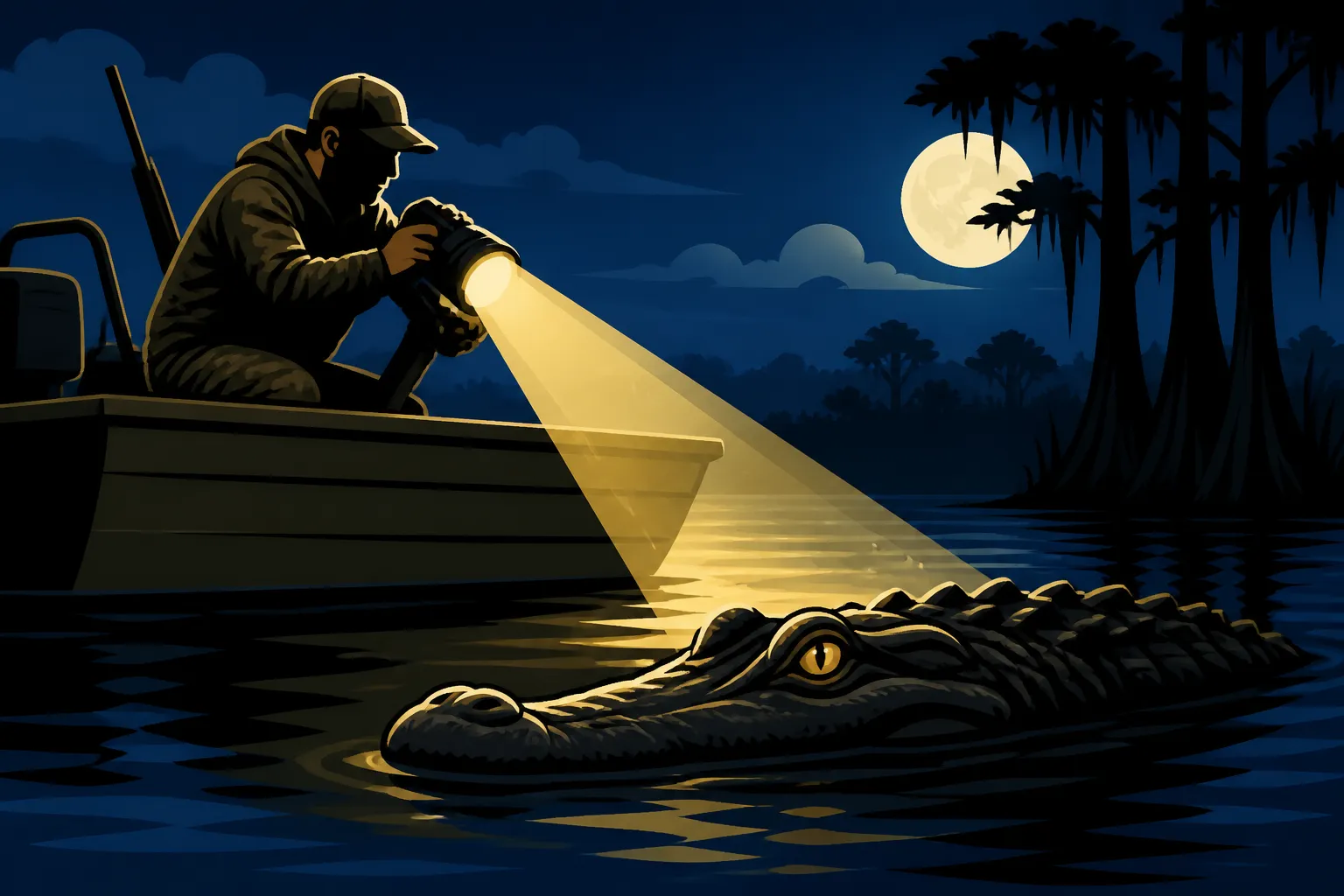
This is where the real "magic" of night gator hunting happens. Alligators possess a reflective layer behind their retinas, causing their eyes to glow bright red when illuminated by a powerful spotlight. This distinctive "eye shine" is what you're looking for. Begin by slowly scanning the water's edge and open water with your spotlight. Sweep the beam systematically, from bank to bank, across open stretches, and into any pockets of vegetation. The key is patience and a steady hand. You'll quickly learn to differentiate alligator eye shine from other reflective objects like floating debris, distant lights, or even the eyes of other nocturnal animals (frogs, raccoons, deer, often have different color or intensity of eye shine).
Once you spot a pair of red eyes, maintain a steady beam on them. This will usually hold the gator's attention. As you approach, those eyes will tell you a lot about the gator's size and demeanor. Large gators typically have wider-set eyes that are higher above the water. A calm, slow approach is crucial. If the eyes suddenly disappear, the gator has likely submerged, and you need to stop, wait, and re-scan. Sometimes, they will surface nearby. Often, a brief flash of light, then turning it off, and repeating, can make a curious gator surface again if it's spooked. Learning to read the gator's reaction to your light and boat movement is an acquired skill that improves with experience.
Stealthy Approaches and Successful Engagement
Spotting a gator is just the first step. The real challenge, and the true test of your hunting prowess, comes in the approach and the engagement. This requires a blend of stealth, precision, and quick thinking.
Mastering the Silent Approach
Once you've spotted a legal-sized alligator, the game of cat and mouse truly begins. The goal is to get within harpooning range—usually 10-20 feet—without alerting the gator. This almost always means using your electric trolling motor at the lowest possible speed, or even paddling silently. An experienced boat operator will anticipate the current and wind, making subtle corrections to keep the boat tracking towards the gator. Keep the main spotlight on the gator’s eyes, but try to minimize other noises. Avoid banging gear, talking loudly, or operating your outboard. Any sudden noise or movement can cause the gator to dive, and once a gator gets wise to your approach, it becomes exponentially harder to re-locate, especially in dense cover.
Some hunters find success in turning the spotlight off briefly if the gator seems particularly wary, then turning it back on to re-acquire the eyes from a closer distance. This can sometimes make the gator curious enough to hold its position. If the gator does submerge, don't give up immediately. Stop your boat, kill all forward momentum, and wait quietly for several minutes while continually scanning the area. Often, they will resurface nearby, trying to assess the threat. Patience during this phase is paramount. Rushing the approach is the most common mistake made by new alligator hunters.
Harpooning and Securing Your Alligator
You've made a perfect, silent approach, and the gator's eyes are locked in your spotlight beam, just feet from the bow of your boat. Now comes the moment of truth. The harpooner, typically positioned on the bow platform, must execute a precise throw. The goal is to drive the harpoon dart firmly into the thick hide on the gator's back or neck, avoiding the armored scutes down the middle of its back. A good shot allows the dart to penetrate deep enough to hold, while leaving the line and float securely attached. It's an often overlooked skill, but practice throwing your harpoon at a target (safely, of course) can make a huge difference.
Once the dart is in, the gator will almost certainly explode into a flurry of thrashing and diving. This is where your heavy-duty lines and floats come into play. Immediately after the strike, the harpooner releases the pole and allows the line to run freely with the float attached. The gator will try to dive and escape, pulling the float behind it. Your job then becomes to follow the float, letting the gator tire itself out. This might involve a prolonged chase across the water. When it surfaces, you may need to apply a second or third harpoon to further secure it, especially if it's a large, powerful animal. The more lines you have in it, the less chance it has of escaping and the more control you have over its movements. Maneuvering a boat to follow a thrashing gator while managing lines is a chaotic dance. For more detailed insights on the struggle, consider reading about Landing an Alligator From a Small Boat. Keep the gator away from the boat as much as possible to avoid tail whips or lunges.
Dispatching and Tagging Your Harvest
Once the alligator is exhausted and you have multiple lines securing it, you can begin the process of bringing it alongside the boat for dispatch. This is a critical and potentially dangerous phase, requiring calm, coordinated action from everyone in the boat. The most humane and legal method of dispatch in Georgia is typically with a bang stick or a small caliber handgun aimed precisely at the brain. The brain is located just behind the eyes, slightly above the line of the jaw. A precise shot here will result in a quick, humane dispatch. Never attempt to dispatch a gator without it being securely tethered and controlled.
Once dispatched, the alligator will go limp, but it's important to remember that reflex actions can persist for some time. Exercise extreme caution. The first priority after dispatch is to secure the gator’s jaws. Even a "dead" gator can snap its jaws shut with immense force. Heavy-duty duct tape, rope, or zip ties are often used to ensure the jaws remain closed. Then, the harvest tag provided with your permit must be immediately attached to the alligator. In Georgia, this tag typically needs to be securely fastened to the alligator's tail within 10 inches of the tip, or another specified location, and remain there until the gator is processed. Failure to immediately tag your gator can result in significant legal trouble.
Safety, Regulations, and Post-Hunt Responsibilities
Alligator hunting is inherently dangerous, and conducting it at night from a boat amplifies those risks. Meticulous attention to safety, strict adherence to regulations, and proper post-hunt care are paramount.
Critical On-Water Safety Practices
Safety cannot be overstressed when hunting alligators at night. Firstly, always wear a U.S. Coast Guard-approved personal flotation device (PFD). Drowning is a real risk, especially if you fall overboard in unfamiliar waters at night, potentially amidst struggling alligators or entangled lines. Never hunt alone; having at least one other experienced person in the boat is essential for assistance with navigation, spotting, and especially handling a powerful animal. Inform someone reliable on shore of your float plan, including your intended launch point, hunting area, and expected return time.
Boat capacity limits are not suggestions; they are maximums. Overloading a boat, especially with heavy gear and a struggling alligator, significantly compromises stability. Be constantly aware of your surroundings, not just for alligators, but for submerged logs, stumps, shallow spots, and other boat traffic. Collisions are more likely at night. Keep all sharp objects, like harpoons and knives, sheathed or secured when not in immediate use. The confined space of a boat, coupled with darkness and a thrashing animal, increases the risk of accidental injury. Ensure everyone in the boat understands the plan for a gator engagement, including their roles and responsibilities, to avoid chaos and injury.
Post-Harvest Care and Reporting
Once your alligator is legally dispatched and tagged, the work isn't over. Proper care of the carcass is vital for preserving the quality of the meat and hide. Alligator meat is excellent, but like any wild game, it requires prompt cooling. If possible, get the alligator to a processing facility or cooler as quickly as you can. In warm Georgia nights, this often means having large coolers with ice ready at your launch site. Many hunters will immediately gut the alligator once back on shore to facilitate cooling.
Georgia has mandatory harvest reporting requirements for alligators. This usually involves checking in your alligator at a designated check station or reporting it online through the Georgia Game Check system within a specified timeframe, often 24 hours. They will verify your tag and collect important biological data, such as length, sex, and sometimes stomach contents, which helps with population management. Understanding Georgia alligator checking requirements and Georgia Alligator Tag Transfer Rules is crucial for ensuring you remain compliant with all DNR regulations. Keep detailed records of your hunt, including date, time, location, and the alligator's measurements.
Avoiding Common Pitfalls and Ethical Considerations
New alligator hunters often fall prey to a few common mistakes. The most frequent is underestimating the power and resilience of an alligator. Even smaller gators can put up an incredible fight. Rushing the approach, making a poor harpoon shot, or failing to have enough backup lines can result in a lost gator, which is both disheartening and unethical. Always err on the side of caution with equipment; use stronger lines, more floats, and sharper harpoon darts than you think you might need.
Another pitfall is inadequate preparation for navigation and safety in the dark. Getting lost or running aground in the middle of a swamp at 2 AM is not a fun experience and can quickly turn dangerous. Double-check all your gear, especially lights and navigation tools, before you launch. Ethically, hunting alligators means respecting the animal and the resource. This includes striving for a quick, humane harvest, not wasting any part of the animal, and strictly adhering to all legal regulations. Remember that you are an ambassador for hunters, and your actions reflect on the entire hunting community. A successful alligator hunt is not just about bringing home a trophy; it's about a well-executed, safe, and ethical pursuit of one of Georgia's most fascinating creatures.
Disclaimer
Please note: Hunting regulations and laws can change frequently. Always consult the latest Georgia Department of Natural Resources (DNR) regulations and local ordinances before engaging in any hunting activity. This guide is for informational purposes only and does not supersede official government regulations or professional advice. Safety should always be your top priority in the field.