Deer Carts for Coastal Plain Ground
There's nothing quite like the rush of finally dropping a deer, especially after a long, patient sit in the humid Georgia air. You breathe a sigh of relief, adrenaline still pumping, and then the reality sets in: now you have to get it out. If you've ever found yourself staring down a hefty buck or doe in the middle of a South Georgia pine flat or deep in a palmetto thicket, miles from your truck, you know the dread. Dragging a deer through soft, sandy soil or across tangled briars and cypress knees can quickly turn a triumphant moment into an exhausting, sweat-soaked ordeal that can jeopardize the quality of your hard-earned venison. This guide is all about making that retrieval process easier, specifically for those challenging Coastal Plain conditions, by leveraging the humble but incredibly effective deer cart.
Why a Deer Cart is Essential on the Coastal Plain
The Coastal Plain of Georgia, stretching from the Piedmont down to the coast, offers some fantastic hunting opportunities. However, it presents a unique set of challenges when it comes to game recovery. Forget those easy drags across frozen, open hardwoods you might see up north. Here, you're often dealing with heat, thick vegetation, and soft ground that can make even a small deer feel like a ton of bricks. A quality deer cart isn't just a convenience; it's often a necessity for preserving your meat and your back.
The Unique Challenges of Coastal Plain Terrain
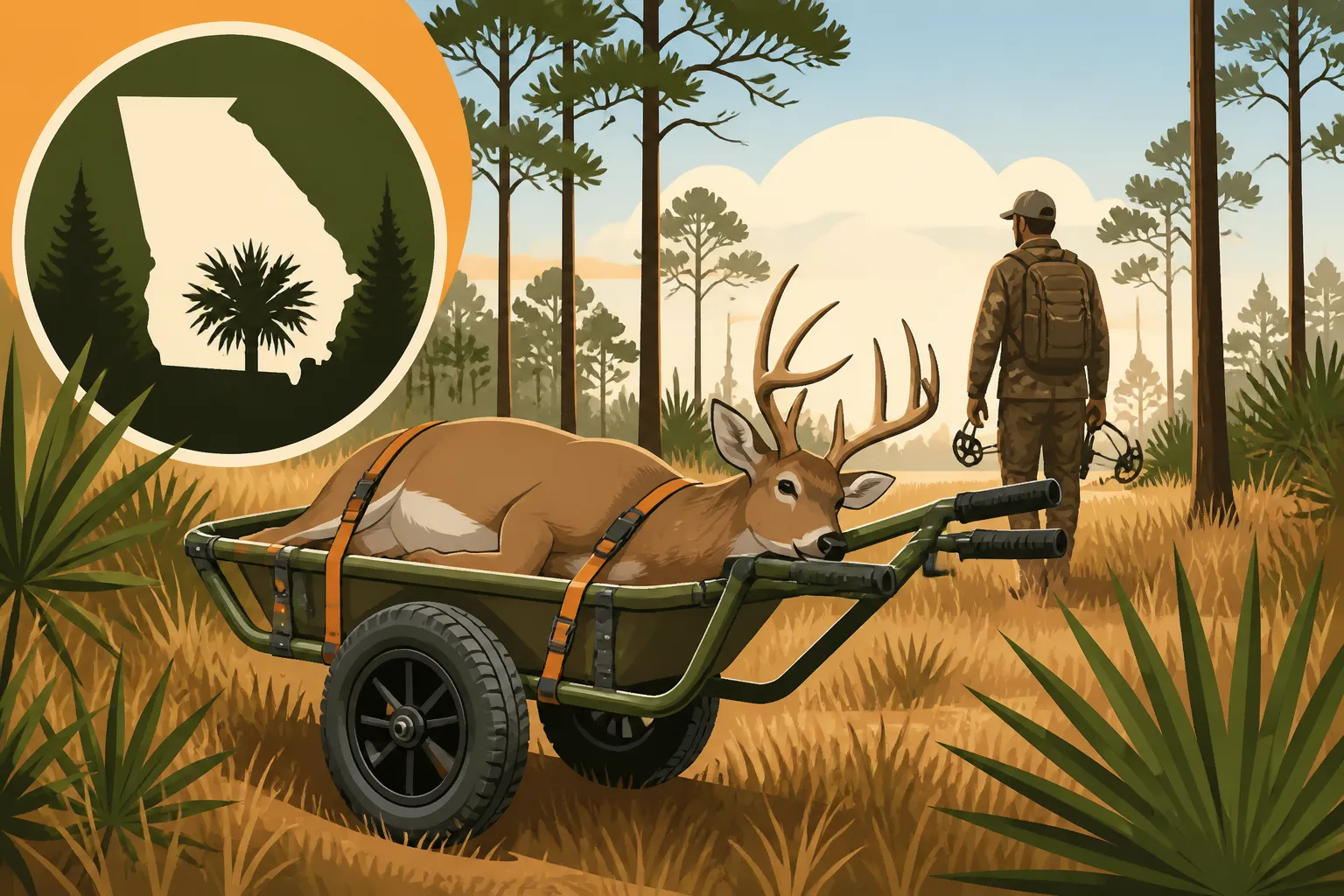
Picture this: you've just dropped a solid eight-pointer in a cutover, bordered by a longleaf pine stand. You walk up, tag it, and then look back towards your vehicle. It's a mile, maybe more, and the ground is a mix of sandy loam, scattered palmetto patches, and those deceptive shallow depressions that fill with water after a rain. If you try to drag that deer by hand, every single footstep will be a battle. The sandy soil offers little purchase, making each pull a true test of endurance. Your boots sink, your muscles burn, and the deer seems to snag on every unseen root and low-hanging branch.
Then there are the palmetto thickets. These seemingly innocuous plants can form an impenetrable wall, their stiff fronds acting like tiny, unyielding spikes that grab at anything trying to pass. A deer, already heavy and awkward, becomes a magnet for these snags, making it almost impossible to navigate without serious effort or damage to the hide. While it's flat, don't let that fool you into thinking it's easy going. The terrain might not have steep climbs, but it has its own brand of unforgiving obstacles. You also have to consider areas Where South Georgia Pine Flat Bucks Bed which often includes dense cover that's a nightmare to drag through.
Preserving Your Harvest in Warm Weather
One of the biggest concerns for any Georgia hunter, especially in the early archery or firearms seasons when temperatures can still be surprisingly high, is meat spoilage. After the shot, the clock starts ticking. Every minute that deer lies on the ground, especially with its hide on, in 70 or 80-degree weather, the internal temperature of the carcass begins to rise. Bacteria thrive in these conditions, and if you can't get that deer field-dressed and cooled quickly, you risk losing valuable meat.
A deer cart dramatically speeds up the extraction process. Instead of spending hours struggling, pulling, and resting, you can load the deer onto a cart and cover ground much more efficiently. This quick egress allows you to get the animal back to your vehicle, field dress it, and get it into a cooler with ice (or to a processor) far sooner. This is absolutely critical for maintaining the quality of your venison, ensuring that your hard work in the stand translates into delicious meals later on. When you consider the effort of Field Dressing a Deer in Warm Weather, minimizing the time from shot to cooling is paramount.
Key Features to Look for in a Coastal Plain Deer Cart
Choosing the right deer cart for Georgia's Coastal Plain isn't about picking the cheapest option; it's about investing in a tool that will stand up to the specific challenges you'll face. You want something rugged, easy to maneuver, and durable. Thinking through these features before you buy will save you a lot of frustration down the road.
Wheels and Tires: The Foundation of Mobility
The wheels are arguably the most crucial component of a deer cart destined for the Coastal Plain. Smaller, hard plastic wheels are simply not going to cut it. They'll sink into soft sand, get bogged down in mud, and struggle over even small obstacles like palmetto roots.
Instead, prioritize large-diameter wheels with wide, pneumatic (air-filled) tires.
- Large Diameter: A larger diameter wheel (think 18-24 inches) provides better leverage for rolling over obstacles like downed logs, brush, and uneven ground. It reduces the angle of approach needed to clear an obstacle, making your job easier.
- Wide, Pneumatic Tires: This is where the magic happens for soft ground. Wide tires distribute the cart's weight (and the deer's weight) over a larger surface area, preventing them from sinking deeply into sand or mud. Pneumatic tires offer cushioning, which makes the ride smoother over rough terrain and reduces jarring to the cart and your body. Think of it like a fat-tire mountain bike vs. a road bike on a gravel path—the fat tires just float better. However, be aware that pneumatic tires can get flats, so checking pressure and carrying a small repair kit or patch can be a smart move. Some hunters prefer solid, puncture-proof tires for peace of mind, but these often sacrifice some of that crucial float and cushioning. When you're researching options, a good resource like GoHunt might offer reviews on different tire types and how they perform in varied terrain.
Frame Construction and Capacity
The cart's frame needs to be robust enough to handle the weight of a mature Georgia deer, plus whatever gear you might pile on it.
- Material: Most deer carts are made from steel or aluminum.
- Steel frames are generally heavier but incredibly strong and durable. They can take a beating and often cost less. The downside is their weight, which adds to your load, and their susceptibility to rust if not properly maintained, especially in humid conditions.
- Aluminum frames are lighter, making the cart easier to transport and maneuver when empty. They are also rust-resistant. However, aluminum can be less rigid than steel and might be more prone to bending or damage if overloaded or used roughly. For the average deer in Georgia, a well-designed aluminum cart is often a fantastic compromise between strength and weight.
- Weight Capacity: Always check the manufacturer's stated weight capacity. A mature buck in Georgia can easily weigh over 150-200 pounds, and you want a cart that can comfortably handle that. Don't forget that you might also put your backpack, rifle, or other gear on the cart.
- Design and Balance: Look for a cart with a low center of gravity and a wide wheelbase. This stability is critical when traversing uneven ground or when loading a heavy animal. A poorly balanced cart will constantly want to tip, making your job much harder. Some carts feature a "basket" style design, while others are more like a two-wheeled dolly with a platform. Both can work, but consider how easy it will be to load and secure a deer on each.
Noise Reduction and Portability
When you're sneaking through the woods, even after the shot, you want your gear to be as quiet as possible. A squeaky wheel or rattling frame on a deer cart can be incredibly annoying and might even spook other game if you're not careful.
- Quiet Operation: Look for carts with sealed bearings in the wheels or designs that minimize metal-on-metal contact. Lubricate axles regularly to prevent squeaks. Some higher-end models focus specifically on silent operation, a feature worth considering for serious hunters.
- Portability: You need to get the cart to your hunting location. Many carts are designed to fold flat for easy transport in the bed of a truck, SUV, or even strapped to an ATV. Check the folded dimensions to ensure it fits your vehicle. Quick and easy assembly/disassembly is also a plus, especially if you're setting it up in the dark before a hunt or breaking it down quickly after a recovery.
Here's a quick comparison of common cart wheel types:
| Wheel Type | Pros | Cons | Best For |
|---|---|---|---|
| Pneumatic (Air-Filled) Wide | Excellent float on soft ground, shock absorption, quiet | Prone to flats, requires maintenance (air pressure) | Sandy soil, uneven terrain, long distances |
| Solid Rubber Wide | Puncture-proof, zero maintenance, durable | Less float on soft ground, less shock absorption | Rocky terrain, shorter drags, firm ground |
| Hard Plastic Narrow | Very lightweight, cheap | Sinks in soft ground, poor over obstacles, noisy | Small game, very short/easy drags, paved paths |
Using Your Deer Cart Effectively in Georgia's Flatlands
Having the best deer cart in the world won't do you much good if you don't know how to use it right. On the Coastal Plain, with its unique blend of soft ground and dense vegetation, a few smart techniques can make all the difference in a smooth, efficient retrieval.
Loading Your Deer Securely
Getting a heavy deer onto a cart, especially if you're hunting solo, can be a challenge. The key is leverage and technique.
- Positioning the Cart: Always position the cart right next to the deer, ideally on the downhill side if there's any slope, or with the wheels angled slightly towards the deer to act as a ramp.
- The Roll Technique: If you're alone, the simplest way is often the "roll" method. Roll the deer onto its side closest to the cart. Then, grab the legs on the far side and pull, rolling the deer up and over onto the cart. This uses the cart's frame as a pivot point, minimizing direct lifting. For heavier deer, you might lift the head and shoulders first, then pivot the hindquarters.
- Using a Rope or Game Hoist: Some hunters carry a short rope or a small, lightweight game hoist (like a block and tackle system) to assist with loading. You can tie one end of the rope to a nearby tree or your vehicle's bumper, loop it around the deer, and use the mechanical advantage to pull the deer onto the cart.
- Securing the Load: Once the deer is on, don't just hope it stays there. Use several heavy-duty ratchet straps or strong bungee cords to secure the deer tightly to the cart frame. Crisscross the straps to prevent shifting. You want that deer to be a stable part of the cart, not a wobbly passenger that could fall off or cause the cart to tip. This is especially important when navigating bumpy ground or inclines.
Navigating Obstacles and Soft Ground
The Coastal Plain might be "flat," but it's far from obstacle-free. You'll encounter sandy stretches, mucky areas, tangled briars, palmetto thickets, and sometimes small ditches or creeks.
- Sandy Soil: When pulling through deep sand, lean back and use your body weight. Keep a steady, consistent pace, rather than short, jerky pulls. If the tires start to dig in, try to keep the cart moving. Sometimes, it helps to push from behind if you have a partner. If you're using a GoHunt app or similar mapping tool, you might have marked areas of particularly soft ground during your Scouting Georgia Public Land Before Season that you can try to avoid.
- Palmetto Thickets and Briars: These are notorious for snagging. The best strategy is often to find the path of least resistance around them. If you must go through, lift the front of the cart slightly to let the wheels roll over the thicket, rather than pushing into it. Keep the deer's antlers (if present) from snagging. A machete or heavy-duty clippers can be a lifesaver for clearing a narrow path.
- Cypress Knees and Roots: These can be unforgiving. Approach them slowly and try to roll one wheel over at a time if possible. Lift and pivot the cart if a root is too large to roll over directly. A wider wheelbase will generally handle these better than a narrow one.
- Ditches and Creeks: For small ditches, carefully lower one wheel, then the other, guiding the cart down and then up the other side. For wider or deeper creeks, you might need to unstrap the deer, carry it across in sections (if safe), and then reassemble on the other side. This is often where Dragging a Deer Out of a Swamp techniques come into play if you don't have a cart, but a cart can often bridge smaller gaps.
- Working with a Partner: If you have a hunting buddy, one person can pull from the front while the other pushes from behind, or helps lift the cart over difficult obstacles. This significantly reduces the effort for both.
Maintenance and Storage for Longevity
A deer cart is an investment, and proper care will ensure it lasts for many seasons of tough Georgia hunting.
- Cleaning: After each use, especially if it's been through mud, sand, or blood, thoroughly clean your cart. Wash off all dirt and debris. Blood can be corrosive and attract pests, so clean it off immediately.
- Lubrication: Regularly lubricate the wheel axles and any folding mechanisms with a rust-inhibiting lubricant. This prevents squeaks and ensures smooth operation.
- Tire Care: If you have pneumatic tires, check the air pressure before and after each hunt. Keep them properly inflated to get the best performance. Inspect for any punctures or wear and repair or replace as needed.
- Storage: Store your cart in a dry place, out of direct sunlight and rain. If it folds, fold it to save space. Proper storage prevents rust, prolongs the life of the tires, and keeps the cart ready for its next adventure.
Alternative Methods and When a Cart Might Not Be the Best Fit
While deer carts are fantastic for the Coastal Plain, they aren't the only way to get a deer out, and sometimes, they might not even be the best way. Understanding when to use a cart and when to consider other methods is part of being a prepared hunter.
Dragging by Hand: When It Works (and when it doesn't)
We've all been there: you drop a deer, and you're only a couple hundred yards from the truck, or it's a small deer, or the ground is perfectly firm and clear. In these ideal (and rare) circumstances, dragging by hand with a good game drag rope can be perfectly fine.
- When it works: Short distances (under a quarter-mile), small-bodied deer (especially does or young bucks), very firm or frozen ground (not common in Coastal Plain), or wide-open fields.
- When it doesn't: Long distances, soft sand or mud, dense briars or palmettos, large-bodied deer, or warm weather. Dragging tears up the hide, introduces dirt and debris to the carcass, and can cause significant bruising to the meat, especially if you're pulling over rough ground. Plus, it's utterly exhausting. If you have to Dragging a Deer Out of a Swamp, a cart might help for parts of it, but sometimes pure brute force or other methods are needed for truly impassable sections.
Field Quartering: A Backpacking Approach
When the distance is extreme, the terrain is genuinely impassable for a cart, or you're hunting in a wilderness area with no vehicle access, field quartering is often the most practical solution. This method involves breaking the deer down into manageable pieces right where it falls.
- The Process: Field quartering means skinning the deer, removing the backstraps, tenderloins, and then breaking down the large muscle groups from the hindquarters and shoulders. These pieces are then placed into game bags and carried out in a backpack. The carcass skeleton and gut pile are left behind. This is a common practice for hunters in mountainous terrain, but it can be necessary in extremely remote or dense parts of the Coastal Plain.
- When to Consider: Very long hauls (over a mile or two), extremely dense cover (like a cypress swamp or nearly impenetrable thicket), or when hunting completely solo and a cart is still too much.
- Requirements: This method requires specific gear: a sharp knife, game bags to protect the meat from dirt and flies, and a sturdy backpack with a good frame to carry the weight. It also requires the hunter to be proficient in butchering skills. You can learn more about this by researching Butchering a Deer at Camp or Field Dressing a Deer in Warm Weather to adapt techniques.
ATVs and Side-by-Sides: Limited Access
For hunters with access to private land or certain public lands with designated trails, an ATV or side-by-side (SXS) can be an excellent way to retrieve a deer.
- Pros: Fast, minimal physical exertion, can handle rough terrain. Many come with racks or small beds perfect for hauling a deer.
- Cons: Access is often limited. On public lands, there are strict Vehicle Rules on Georgia Public Land, and ATVs are typically restricted to designated trails or roads. On private land, thick woods or extremely dense cover might still prevent direct access to a downed deer. They also require significant investment, fuel, and maintenance. While great for logging roads and open areas, they aren't always a magic bullet for getting a deer out of a dense pine thicket.
Ultimately, the best method for extracting your deer from the Georgia Coastal Plain often involves a combination of these techniques, chosen strategically based on the specific situation. For the vast majority of deer taken in these areas, however, a reliable deer cart is your best friend, saving your back, your time, and your venison.
Disclaimer
This article is for general informational purposes only and does not constitute professional advice. Laws, prices and regulations vary by location and change over time. Consult a qualified professional for guidance on your specific situation.