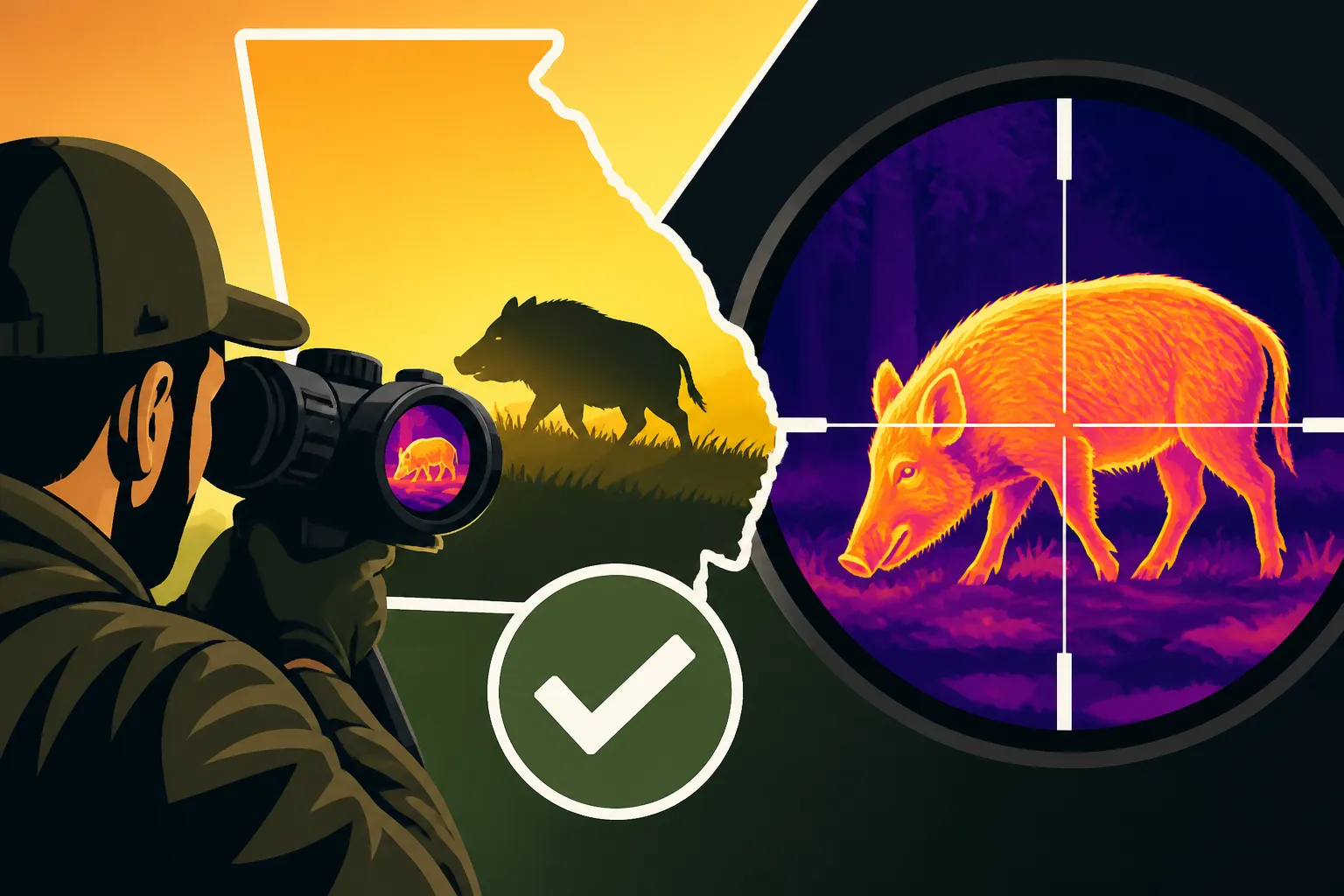
Thermal Scopes Legal for Georgia Hogs
The problem of feral hogs in Georgia isn't just a nuisance; it's a destructive force that impacts agriculture, native wildlife, and even our hunting seasons. Many hunters, desperate to gain an advantage against these wily and nocturnal creatures, often wonder about the latest technology, specifically if thermal scopes are legal to use. This comprehensive guide will clear up the confusion surrounding thermal optics for hog hunting in Georgia, outlining the regulations, practical benefits, and ethical considerations so you can hunt effectively and within the law.
Understanding Georgia's Night Hunting Regulations for Feral Hogs
Navigating the rules for night hunting, especially when advanced optics are involved, can feel like trying to track a hog through thick palmettos after a rain — confusing and prone to missteps. Georgia has a clear stance on hunting feral hogs, acknowledging the significant damage they cause. This often leads to more liberal regulations compared to other game species, but there are still specific parameters you need to understand, particularly concerning electronic devices.
General Legality of Night Hunting Hogs
First and foremost, Georgia law permits hunting feral hogs at night. This is a crucial distinction, as many other game animals have strict daylight-only hunting hours. The reason for this flexibility is purely practical: feral hogs are prolific breeders, destructive, and often most active under the cover of darkness. Allowing night hunting is one tool in the state's ongoing effort to manage their population. You can hunt them year-round, which is another testament to the state's view on their pest status. If you're looking for more details on this, check out Feral Hog Hunting Year-Round in Georgia.
However, the ability to hunt at night doesn't automatically mean any method or piece of equipment is fair game. This is where the specifics of light sources and optical enhancements come into play. Many states differentiate between artificial lights and thermal/night vision optics, and Georgia is no exception. It’s always your responsibility as a hunter to be absolutely certain of the current regulations before heading afield, especially with high-tech gear.
Georgia's Stance on Thermal Optics
Here's the good news that many hog hunters are eager to hear: thermal imaging scopes are indeed legal for hunting feral hogs at night in Georgia. This wasn't always the case everywhere, but Georgia has embraced the use of modern technology to combat the feral hog problem. The law specifically allows for the use of artificial lights, night vision, and thermal imaging devices while hunting feral hogs. This means you can mount that thermal scope on your rifle and confidently pursue hogs under the cloak of darkness.
This legality extends to both private and public lands, though it's absolutely vital to double-check specific Wildlife Management Area (WMA) or other public land regulations, as some may have unique restrictions on weapon types, hunting hours, or even specific equipment. Always consult the Georgia Department of Natural Resources (DNR) official regulations book or website for the latest information. Don't rely on hearsay or forum discussions; get it straight from the source. For broader information on the rules, consider reading Georgia Feral Hog Regulations.
Night Vision vs. Thermal Imaging
While both night vision and thermal imaging enhance your ability to see in low light or darkness, they do so through fundamentally different mechanisms. It's worth understanding this distinction, not just for technical knowledge, but because hunters often lump them together.
Night vision devices, typically green-hued, amplify existing ambient light (starlight, moonlight). They require some light to work, and their effectiveness can be hampered by complete darkness or heavy fog. They show you actual light reflected off objects, meaning you see contours, shadows, and sometimes even color differences if it's a higher-end digital night vision.
Thermal imaging, on the other hand, detects heat signatures. It doesn't need any ambient light whatsoever. It "sees" the heat emitted by an animal (or engine, or warm rock) against a cooler background. This means a hog hiding in thick brush, where night vision might only show a dark blob, will glow brightly with its heat signature through the foliage on a thermal scope. This is a significant advantage in the dense cover common in much of Georgia's hog country. Both are legal for hogs, but thermal often offers a distinct advantage in target detection and identification in challenging conditions.
The Undeniable Advantages of Thermal Scopes for Hog Hunting
Once you've confirmed the legality of using a thermal scope, the next question is usually "Is it really worth it?" For many dedicated hog hunters, the answer is a resounding yes. Thermal scopes offer a suite of advantages that can dramatically increase your success rate and enhance your overall hunting experience, particularly when tackling nocturnal swine.
Superior Target Detection in Darkness and Cover
This is perhaps the biggest selling point for thermal optics. Feral hogs are masters of concealment, even in relatively sparse cover. They often move through dense thickets, river bottoms, and overgrown fields where traditional optics, or even night vision, struggle to penetrate. A thermal scope, however, cuts through that visual clutter. A hog's body heat stands out like a beacon against the cooler vegetation, allowing you to detect animals that would otherwise remain hidden.
Imagine you're sitting on a field edge, the moon obscured by clouds, trying to pick out hogs moving through a standing peanut field. With a conventional scope, it's a dark, indistinct mass. With a thermal unit, those hogs become clear, bright targets, easily distinguishable from the surrounding environment. This allows for earlier detection, better observation, and more precise shot placement. Even in light fog or mist, where traditional optics would totally wash out, thermal can often still pick up heat signatures. Many hunters rely on their thermal units like those offered by companies often reviewed by GoHunt to scout fields before even setting up.
Enhanced Safety and Target Identification
Hunting at night inherently carries increased risks, primarily due to reduced visibility. Misidentification of targets, or inadvertently aiming at something other than a hog, is a serious concern. Thermal scopes significantly mitigate this risk. Because they display heat signatures, you can often discern the distinct shape of an animal's body and differentiate it from rocks, stumps, or even other, non-target animals, especially at closer ranges. The heat signature of a hog is distinctly different from that of a deer, for instance.
This clarity improves safety for both the hunter and any companions, as well as non-target wildlife. You can confirm that what you're aiming at is indeed a feral hog before taking the shot. Additionally, being able to scan large areas for heat signatures means you can identify potential dangers, like other hunters or even livestock, before they become a problem. Responsible night hunting demands careful target identification, and thermal technology is a powerful aid in that regard.
Tracking and Recovery in Low Light
After the shot, the challenges of night hunting don't end; they often intensify. Blood trailing a deer in broad daylight can be tough enough, but trying to follow a hog's trail through thick Georgia undergrowth in the dark is an entirely different beast. This is another area where thermal scopes can be a game-changer. While they don't necessarily show blood trails directly, they can help in several critical ways.
Firstly, if the hog doesn't drop immediately, you can often watch its heat signature as it runs, giving you a better idea of its direction and how far it traveled. Secondly, once you begin the search, you can scan the area with your thermal device. A recently deceased animal will retain body heat for a significant period, often making it glow clearly against the cooler ground and vegetation. This can dramatically shorten recovery times and prevent lost game, which is not only frustrating but also disrespectful to the animal. It's an invaluable tool for ensuring ethical recovery, particularly on a tough creature like a hog. When you're out there, having tools like the ones discussed by experts at GoHunt can really make a difference.
Practical Considerations for Using Thermal Scopes
While the benefits of thermal scopes are clear, simply owning one isn't a magic bullet. There are practical aspects to consider, from choosing the right unit to understanding how environmental factors can affect its performance and, of course, the ethical responsibilities that come with such powerful technology.
Choosing the Right Thermal Scope
Not all thermal scopes are created equal, and what works for a tactical professional might be overkill (or underkill) for a hog hunter in Georgia. When selecting a thermal scope, consider several key factors:
- Resolution and Refresh Rate: Higher resolution (e.g., 640×480 vs. 320×240) means a clearer image and better detail, which is crucial for identification. A higher refresh rate (e.g., 60Hz vs. 30Hz) provides smoother video, making it easier to track moving targets without lag.
- Detection Range: How far out do you need to detect a hog-sized heat signature? This often correlates with the lens size and sensor quality. For typical Georgia hunting scenarios, especially in timber and field edges, moderate ranges are usually sufficient.
- Magnification: Fixed magnification scopes are simpler, but variable magnification allows for greater versatility. Remember, too much magnification can make scanning difficult, while too little might not provide enough detail at longer distances.
- Battery Life: Night hunts can be long. Look for scopes with good battery life or easily swappable/rechargeable battery packs.
- Durability and Weatherproofing: Georgia weather can be unpredictable. Your scope needs to stand up to humidity, rain, and the occasional bump in the woods.
- Ease of Use: A complex menu system isn't what you want when a hog is on the move. Look for intuitive controls and quick access to essential features.
Companies like GoHunt often feature reviews and comparisons of various thermal optics, which can be a great starting point for research. Just remember to compare features and read real-world reviews from hunters.
| Feature / Aspect | Standard Night Vision (NV) | Thermal Imaging (TI) |
|---|---|---|
| Detection Source | Ambient light (starlight, moonlight) | Heat (infrared radiation) |
| Image Appearance | Typically green monochrome, shows light reflection | Variable color palettes (white hot, black hot, rainbow), shows heat contrast |
| Visibility in Dark | Requires some light; poor in total darkness | Works in absolute darkness |
| Visibility in Cover | Obscured by dense brush, fog, smoke | Penetrates light fog, smoke, and some foliage, highlights heat |
| Target Identification | Good for discerning features, difficult through cover | Excellent for detecting presence, shape; can be harder for fine detail at range |
| Environmental Impact | Degraded by bright lights (blooming), limited by total dark | Can be affected by extreme heat (e.g., hot asphalt on a summer day) |
| Primary Use Cases | General observation, identifying distinct objects | Detection, finding camouflaged targets, tracking warm bodies |
Ethical Considerations and Responsible Use
With great power comes great responsibility, and thermal scopes are powerful tools. While legal, their use comes with ethical implications that every hunter should ponder. The primary concern is ensuring fair chase and avoiding unethical advantages.
- Target Identification Beyond Doubt: While thermal helps detect, always confirm your target beyond a shadow of a doubt before pulling the trigger. Ensure it's not a deer, a domestic animal, or even another person. The heat signature of a small deer can look similar to a large hog at long distances. Always combine thermal with visual confirmation if possible, and understand the limits of your equipment.
- Respect for the Animal: Just because you can shoot a hog at extreme distances under the cover of night doesn't mean you should if you can't guarantee an ethical shot. Know your effective range and stick to it.
- Minimizing Disturbance: Hogs are invasive, but all wildlife deserves respect. Try to minimize disturbance to other non-target animals in the area, especially if you're hunting near areas where other species might be bedding down.
- Public Perception: Be mindful that the general public might not understand the necessity of hog control or the technology used. Responsible, ethical hunting is the best way to maintain a positive image for hunting.
Always remember that laws and technology evolve. What's legal today might have nuances tomorrow. Stay informed about Georgia Night Hog Hunting Light Rules and other changes.
Zeroing and Practice with Thermal Optics
Just like any other sighting system, a thermal scope needs to be properly zeroed to your rifle. This isn't always as straightforward as with a traditional scope, as you're not looking through glass at a physical target. Most thermal scopes come with a digital zeroing process, often involving shooting at a heat source (like a hand warmer or a specialized thermal target) and adjusting the reticle digitally.
It’s crucial to practice extensively with your thermal setup, both during the day (when you can compare the thermal image to what you see with the naked eye) and at night. Understand how the image quality changes with distance, weather, and different backgrounds. Get comfortable with target acquisition, scope manipulation, and finding your reticle in various scenarios. Don't let your first time using your thermal in the dark be when a hog is standing broadside. Familiarity breeds confidence and accuracy. Also, consider the impact of shot placement on a Georgia Black Bear, and apply that same precision to hogs, even if they are more numerous.
Alternatives and Complementary Night Hunting Methods
While thermal scopes are a fantastic tool, they're not the only way to hunt hogs at night, nor are they always the most suitable for every situation or budget. Many hunters combine methods or rely on more traditional approaches, especially when starting out.
Using Traditional Lights and Spotlights
Before advanced night vision and thermal became widely accessible, hunters often used powerful spotlights to hunt hogs at night. This method is still perfectly legal for hogs in Georgia. The bright beam of a light can temporarily stun or disorient hogs, allowing for a shot.
However, there are downsides. Hogs can quickly become "educated" to lights, making them wary and harder to approach. The sudden burst of light can also spook other game in the area, and holding a light while simultaneously aiming and shooting can be awkward, especially if hunting alone. Furthermore, intense lights can significantly degrade your natural night vision for minutes after turning them off, making it harder to navigate dark terrain. This method, while effective, often requires a dedicated light person or a weapon-mounted light system. For more on the specific rules, read up on Georgia Night Hog Hunting Light Rules.
Night Vision Scopes and Monoculars
As discussed, night vision (NV) works by amplifying ambient light. NV scopes are also legal for hog hunting in Georgia and can be a more budget-friendly option than thermal for some hunters. They excel in open areas with some moon or starlight, providing a clearer, more detailed image of the environment compared to thermal, which primarily shows heat contrast.
Many hunters use a combination: a thermal monocular for scanning and locating hogs, and a night vision scope (or even a traditional scope with a clip-on NV device) for target identification and shooting. This leverages the strengths of both technologies. Night vision monoculars are also excellent for navigation when walking in the dark, as they provide a wide field of view and help avoid obstacles.
Trapping Feral Hogs at Night
Sometimes, the most effective "hunting" method for feral hogs isn't with a gun, but with a trap. Feral hog trapping is incredibly effective for removing large numbers of hogs, especially when used consistently. Traps are typically baited with corn or other attractants, and can be checked periodically or monitored with cellular game cameras. This method is often employed by landowners and wildlife managers who need to reduce populations significantly and continuously.
Trapping can be done day or night and doesn't involve the same regulations as hunting with firearms regarding optics. It's a highly efficient, non-selective method for control. If you're dealing with a consistent hog problem on private land, combining hunting efforts with a robust trapping program can yield incredible results. If you're interested in trapping, you might also be curious about Trapping Georgia Raccoon and Bobcat.
Calling and Decoying Hogs
While less common than for other game, calling can sometimes be effective for hogs, especially predator calls that mimic the distress of a small animal. Hogs, being opportunistic omnivores, will often investigate these sounds as a potential food source. This can be combined with thermal or night vision during the night, as the call draws them closer into your detection range.
Decoys are generally not a primary tactic for hog hunting, as their effectiveness can be limited, and hogs are often wary. However, in certain scenarios, especially if hogs are used to seeing other animals in a particular field, a silhouette or a scent decoy might provide a slight advantage by drawing them in or distracting them momentarily. This is more of an advanced or experimental tactic, but worth mentioning as part of a comprehensive strategy. Much like Coyote Calling in Georgia Farm Country can be effective for those predators, strategic calling can sometimes bring in hogs.
Ultimately, the choice of equipment and method depends on your specific hunting situation, budget, and personal preference. Thermal scopes offer a distinct advantage for night hunting hogs in Georgia, but understanding the full spectrum of options allows you to make informed decisions and adapt your strategy for maximum success.
Disclaimer
This article is for general informational purposes only and does not constitute professional advice. Laws, prices and regulations vary by location and change over time. Consult a qualified professional for guidance on your specific situation.