Handgun Hunting Rules in Georgia
Hunting in Georgia offers an incredible variety of experiences, but navigating the rules, especially when it comes to less common methods like handgun hunting, can feel like trying to untangle a fishing line after a big blow. Many folks wonder if it's even allowed, and if so, what calibers or seasons apply. This guide is here to cut through the confusion and give you a clear, comprehensive understanding of handgun hunting regulations and best practices in the Peach State, ensuring you stay legal and ethical in the field.
Understanding Georgia's General Firearms Hunting Regulations
Before we dive specifically into handguns, it's really helpful to get a handle on Georgia's overall approach to firearms for hunting. The state generally aims for clarity and flexibility, but there are always nuances depending on the game animal and the specific hunting area. When you're out there, whether in the sprawling Chattahoochee National Forest or on a quiet private tract in the Piedmont, you need to know your equipment is up to snuff and within the law.
General Legal Firearms for Hunting
Georgia's hunting regulations define what constitutes a legal firearm for various game animals. For big game like deer and bear, there’s a strong emphasis on using calibers powerful enough to ensure a quick, humane kill. This isn't just about legality; it's about ethical responsibility. While rifles and shotguns are often the first thing people think of, handguns are absolutely a viable option, provided they meet specific criteria for power and projectile type. For instance, you won't be using a tiny .22 rimfire handgun to chase a mature whitetail buck; the regulations wisely prevent that for good reason. The state's goal is to prevent unnecessary suffering and promote fair chase. It’s always a good idea to check out the broader regulations for what constitutes Georgia Legal Firearms for Deer Hunting to ensure your setup aligns with all requirements.
For many years, the discussion around what's "legal" often focused on rifle calibers and shotgun gauges, leaving handgun hunters feeling a bit in the dark. However, the intent behind the regulations applies universally: use a tool that is effective and responsible for the animal you are pursuing. This means considering bullet energy, construction, and the accuracy capabilities of your specific handgun.
Carrying a Handgun While Hunting
Beyond just hunting with a handgun, many hunters carry a handgun for personal protection or as a backup, regardless of their primary weapon. Georgia has fairly clear laws regarding carrying firearms, and these typically extend to the hunting woods. If you have a Georgia Weapons Carry License (GWCL), you generally have the right to carry a handgun openly or concealed while hunting, much as you would in other lawful places. This is separate from actually hunting with the handgun.
However, even with a GWCL, it's essential to remember that specific Wildlife Management Areas (WMAs) or federal lands might have additional rules or restrictions. Always double-check the regulations for the specific area you plan to hunt. For instance, some federal refuges might have more stringent rules about loaded firearms or the type of ammunition allowed. On private land, your permission to hunt often includes the right to carry, but it's always respectful to discuss your intentions with the landowner, especially if you plan to openly carry. Just because you can carry a handgun doesn't mean you shouldn't be aware of how it might be perceived or impact others around you, especially during crowded times like Why Georgia's Gun Opener Draws the Biggest Crowds.
Handgun Rules for Specific Game Species in Georgia
The heart of handgun hunting in Georgia lies in understanding which animals you can legally pursue with one, and what those specific requirements entail. It's not a one-size-fits-all situation, and getting this wrong could lead to a fine or worse, an unethical harvest.
Deer and Bear Hunting with a Handgun
This is where most handgun hunting interest lies for many Georgian hunters. Yes, you can hunt deer and bear with a handgun in Georgia, but there are crucial caliber restrictions to ensure an ethical harvest. For both deer and bear, Georgia law specifies that handguns must be centerfire and use an expanding bullet. Rimfire handguns, like those firing a .22LR, are strictly prohibited for big game.
When it comes to caliber, the rule of thumb is "adequate for the game." While Georgia doesn't list an exact minimum handgun caliber number like some states do, the prevailing interpretation for deer and bear dictates a caliber with sufficient energy and projectile weight for a clean kill. Common and ethical choices include:
- .357 Magnum: A solid choice, especially with heavier bullet weights (158gr+). It's popular for deer at closer ranges, typically under 50 yards, and offers manageable recoil.
- .44 Magnum: Often considered the quintessential hunting handgun round. It delivers excellent energy and can be effective on deer and even black bears out to 75-100 yards for skilled shooters.
- 10mm Auto: A modern favorite, offering good capacity in semi-autos and substantial power, suitable for deer at moderate ranges.
- .45 Colt (especially in "Ruger Only" loads or .454 Casull): The standard .45 Colt is good, but if you have a revolver strong enough for magnum-level loads, it becomes a powerful big game contender. The .454 Casull is overkill for deer but certainly effective for bear.
Essentially, if you’re considering a handgun for deer or bear, think about what you’d use for Rifle Calibers for Georgia Bear and aim for comparable power in a handgun. The key is shot placement and understanding your effective range. A powerful handgun is useless if you can't shoot it accurately under pressure. Always verify the most current regulations through the Georgia Department of Natural Resources (DNR) to be absolutely sure. For those planning to hunt in specific areas, remember that some public lands, like certain WMAs, may have additional restrictions on firearms, so checking those local rules is paramount.
Turkey, Small Game, and Feral Hog Hunting with Handguns
Handguns are also permissible for a wider array of other game in Georgia, often with fewer stringent caliber rules than for big game.
Turkey Hunting
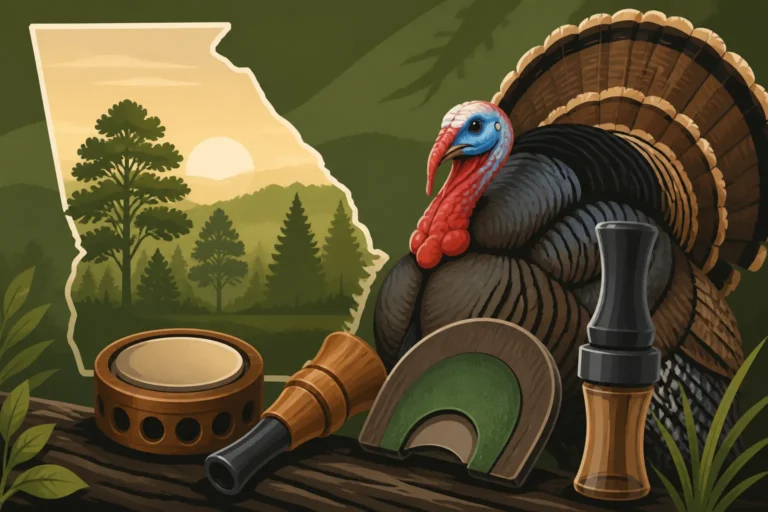
Turkey hunting with a handgun is absolutely an option for Georgia hunters, though it's less common than using a shotgun. The regulations for turkey generally stipulate that hunters may use any firearm that fires a single projectile, excluding rimfire weapons, for wild turkeys. This means your centerfire handgun, provided it fires a single projectile (not shot), is legal. Calibers like a .357 Magnum, 10mm, or .44 Magnum can be effective at very close ranges, typically within 25-30 yards. The challenge, of course, is getting a wary gobbler that close and making a precise head or neck shot, which is often required for a clean kill. Many turkey hunters prefer the wider pattern of a shotgun, but for those who enjoy the challenge, a handgun can add an exciting dimension to the hunt. Just remember, a miss or a poor hit can easily result in a wounded bird, so marksmanship is paramount. This can be a very different game than Calling a Georgia Gobbler Off the Roost with a scattergun.
Feral Hogs
This is where handguns truly shine for many hunters! Feral hogs are considered a nuisance species in Georgia and can be hunted year-round, day or night, with very few restrictions on methods, including firearms. This means handguns of almost any centerfire caliber are perfectly legal for hogs. Many hunters carry a handgun as a secondary weapon specifically for hogs encountered while deer or turkey hunting. Popular choices range from 9mm and .40 S&W for close-range defense and opportunity shots, up to the more powerful .357 Mag, 10mm, and .44 Mag for dedicated hog hunts. Because hogs are tenacious animals, heavier, controlled-expansion bullets are highly recommended to ensure adequate penetration and stopping power. The ability to hunt hogs at night with lights further increases the utility of a handgun for quick, decisive action. Hunting Feral Hogs Over Bait at Night often involves close encounters where a handgun can be very effective.
Small Game
For small game animals like squirrels and rabbits, handguns are also legal. However, the choice of caliber here often shifts. Rimfire handguns, particularly those chambered in .22LR, are excellent and widely used for small game due to their light recoil, affordability, and accuracy. Centerfire handguns can also be used, but are typically overkill and can cause excessive meat damage. When hunting small game, precision is key to a clean harvest and maximizing the meat yield. A steady hand and a well-practiced shot with a .22 handgun can make for a very rewarding day in the woods, whether you're hunting Squirrel Hunting Georgia Bottomland Hardwoods or Rabbit Hunting Georgia Fencerows.
Ethical Considerations and Practical Advice for Handgun Hunters
Beyond simply being legal, ethical and practical considerations are paramount when choosing to hunt with a handgun. It's a different discipline than rifle hunting, and it demands a higher degree of skill and self-awareness.
Choosing the Right Caliber and Ammunition
When selecting a handgun for hunting, especially for big game, power is important, but accuracy and control are arguably even more so. A powerful caliber like a .44 Magnum is fantastic, but if the recoil prevents you from shooting it accurately beyond 25 yards, it's not the right choice for a 50-yard shot at a deer.
Table: Popular Handgun Calibers for Georgia Hunting
| Caliber | Typical Game Species | Recommended Bullet Weight Range | Typical Effective Range (Skilled Shooter) | Notes |
|---|---|---|---|---|
| .22LR | Small Game | 30-40 grain | 15-25 yards | Excellent for squirrels, rabbits. Inexpensive to shoot. Rimfire, NOT for big game. |
| 9mm Luger | Feral Hogs (close range) | 115-147 grain | 15-25 yards | Good for self-defense, opportunistic hog shots. Limit to smaller hogs. |
| .357 Magnum | Deer, Feral Hogs | 125-180 grain | 25-50 yards | Versatile, manageable recoil, good for deer. |
| 10mm Auto | Deer, Feral Hogs, Bear | 150-200 grain | 30-75 yards | Powerful semi-auto option. Good penetration. |
| .44 Magnum | Deer, Feral Hogs, Bear | 180-300 grain | 50-100 yards | Classic big game handgun. Significant power, more recoil. |
| .45 Colt | Deer, Feral Hogs (with +P loads) | 200-300 grain | 25-75 yards | Powerful, especially in modern, strong revolvers with appropriate loads. |
For ammunition, always choose high-quality, expanding bullets designed for hunting. For deer and bear, look for jacketed hollow points (JHP) or soft points (JSP) that are specifically engineered for deep penetration and controlled expansion on game. Avoid target ammunition or full metal jacket (FMJ) rounds, as they typically pass through without delivering enough energy transfer for a humane kill. Think about what a good 6.5 Creedmoor for Piedmont Field Edges bullet does, and try to replicate that performance in a handgun bullet design.
Consider the weight of the bullet as well. Heavier bullets tend to penetrate deeper, which is crucial for reaching vital organs on larger animals like deer and bear, especially if you encounter a quartering shot. Don't be swayed by marketing; focus on proven performance and what you can shoot accurately. You can usually find a wide selection of hunting handgun ammunition at sporting goods stores.
Marksmanship and Practice
Hunting with a handgun demands superior marksmanship compared to rifle hunting. The shorter sight radius, lighter weight, and different grip all contribute to a steeper learning curve for accuracy. It's not enough to be able to hit a target at the range; you need to be able to do it consistently and under pressure, often from an unsupported position.
- Practice Regularly: This cannot be stressed enough. Spend time at the range, practicing from various field positions – standing, kneeling, and even simulating shots from a treestand or ground blind.
- Know Your Limits: Determine your true effective range. This isn't the maximum distance you can hit a paper plate; it's the maximum distance you can consistently place a bullet into a 6-inch vital zone under hunting conditions. For many handgun hunters, this means limiting shots to 25-50 yards for big game. Pushing beyond your comfort zone is where mistakes happen.
- Focus on Fundamentals: Grip, stance, sight alignment, sight picture, and trigger control are all critical. Small errors are magnified with a handgun. A simple Zeroing at 100 Yards for Field Edge Hunting with a rifle feels entirely different than zeroing a handgun for 25 or 50 yards.
Field Considerations
When you head into the woods with a handgun as your primary hunting weapon, or even as a backup, there are specific field considerations to keep in mind.
- Holster Selection: A good, secure holster is non-negotiable. It needs to protect the firearm, keep it readily accessible, and prevent accidental discharge. Chest holsters are popular with many hunters, especially those using a backpack, as they keep the handgun clear of obstructions and easy to draw. Hip holsters are also viable, but ensure they don't interfere with your pack or treestand harness.
- Shot Placement: For big game, precise shot placement is absolutely critical with a handgun. Aim for the "kill zone" – typically the lung and heart area – and avoid marginal shots. If you have any doubt about making a clean shot, wait for a better opportunity or pass on the shot entirely.
- Tracking and Recovery: Even with a perfect shot, animals can run. Being prepared for Blood Trailing After Dark in Georgia or Tracking a Deer Through Georgia Pine Straw is essential. Handgun-harvested animals might not show the same immediate reaction as those hit with a high-powered rifle, making clear blood trails crucial.
Licensing, Reporting, and Public Land Considerations for Handgun Hunters
Even if your handgun and chosen caliber are legal for a particular species, you still need to adhere to all the broader hunting regulations in Georgia. This includes proper licensing, reporting your harvest, and understanding rules specific to public hunting lands.
Licensing Requirements for Handgun Hunters
Just like any other hunter in Georgia, you'll need the appropriate hunting licenses. This means a valid resident or nonresident hunting license, and if you're pursuing big game like deer, bear, or turkey, you'll also need a Big Game license or a Sportsman's License bundle. These licenses ensure you're legally permitted to participate in the activity.
- Base Hunting License: This is your foundational permit.
- Big Game License: Required for deer, bear, and turkey.
- Sportsman's License: This popular option bundles several licenses and stamps together, often including the hunting license, big game license, and various state stamps, which can be a cost-effective choice for active hunters. It's helpful to understand What the Resident Sportsman License Bundles Together.
- WMA Access Permit: If you plan to hunt on any of Georgia's Wildlife Management Areas, you'll need a Georgia WMA Access Stamp Requirement in addition to your other licenses. These permits fund the management and maintenance of these crucial public lands.
You can typically purchase all necessary licenses online through the Georgia Department of Natural Resources (DNR) Go Outdoors Georgia platform, or through authorized license vendors across the state. Always carry proof of your licenses while afield, whether it's a physical copy or stored on your phone via the GoHunt app.
WMA-Specific Rules for Handguns
While Georgia's statewide regulations provide a general framework, Wildlife Management Areas (WMAs) often have additional, specific rules that supersede or add to those general rules. It is absolutely critical to check the current regulations for the specific WMA you plan to hunt. These rules might include:
- Restricted Weapons Hunts: Some WMAs might designate specific hunts as "archery-only," "primitive weapons only," or "shotgun-only," which would naturally exclude handgun hunting during those specific periods. Always check the WMA hunt schedule.
- Loading Restrictions: On some WMAs, or even certain areas within them, there might be rules about having firearms loaded outside of specific hunting zones or during transit.
- Ammunition Restrictions: While rare for handguns, it's always worth checking if any lead ammunition restrictions apply, though this is more common in other states or for specific federal lands.
Using a mapping app like GoHunt can often provide quick access to WMA boundaries and may even link to specific regulations, but always refer to the official Georgia DNR regulations for the most accurate and up-to-date information. Understanding Hunting Pressure on Georgia Public Land also helps in choosing which WMAs might be better suited for less common methods like handgun hunting.
Game Checking and Transport
Regardless of the weapon used, all deer and turkey harvested in Georgia must be reported through the Georgia Game Check system. This can be done online, via the Go Outdoors Georgia app (which you might also use to access GoHunt features for mapping), or by phone. This process collects vital data for wildlife management.
- Reporting Deadline: There's a specific deadline for reporting your harvest, usually within 24 or 72 hours, depending on the species and location. Make sure you know and adhere to The Georgia Deer Reporting Deadline.
- Tagging: You must immediately tag your harvested big game animal with information such as your name, license number, date of kill, and county of kill. This tag must remain with the carcass until it is processed.
- Transport: When transporting your handgun-harvested game, ensure it's tagged correctly and that you adhere to any rules regarding carcass movement, especially if you're hunting in or near a Georgia's Chronic Wasting Disease Management Area.
Handgun hunting in Georgia can be a challenging and rewarding pursuit, offering a unique connection to the hunting tradition. By understanding the rules, committing to ethical practices, and honing your skills, you can successfully add handgun hunting to your repertoire.
Disclaimer
This article is for general informational purposes only and does not constitute professional advice. Laws, prices and regulations vary by location and change over time. Consult a qualified professional for guidance on your specific situation.