Thermal and Night Vision for Hog Hunting
There’s nothing quite like the frustration of setting out your corn, carefully tending your feeder, and then pulling your trail camera card only to see pictures of hogs showing up like clockwork… at 3 AM. It feels like they know exactly when you're not there. If you've been battling the nocturnal nuisance of feral hogs in Georgia, this guide is going to walk you through how thermal and night vision optics can dramatically shift the odds in your favor, turning those frustrating night raids into successful hunts.
The Allure of Night Hunting for Hogs in Georgia
Feral hogs are truly a force of nature, and not in a good way, especially here in Georgia. They reproduce at an astounding rate, damage agricultural lands, destroy sensitive wildlife habitat, and can even spread diseases. For hunters, it often feels like an uphill battle, especially when these intelligent animals quickly learn to avoid human activity during daylight hours. This is precisely why hunting them under the cloak of darkness has become such a compelling and effective strategy for many Georgians.
Why Hogs are Such a Problem at Night
Anyone who's dealt with feral hogs knows they're notoriously wary creatures. They're smart, they're adaptable, and they learn quickly. During the hot Georgia summers, or in areas with heavy hunting pressure, hogs become almost exclusively nocturnal. They'll spend their days bedded down in thick cover – dense river bottoms, overgrown pine plantations, or deep swamps – emerging only after the sun dips below the horizon to feed. This behavior makes them incredibly difficult to intercept during traditional daylight hunting hours. You might scout a field edge until you’re blue in the face, find fresh rooting and tracks, only to find they vanished before first light. Feral Hog Hunting Year-Round in Georgia is a testament to how pervasive this issue is across the state. They hit your food plots, tear up pecan orchards, and root through freshly planted crops, all while you're tucked in bed. It’s a constant battle that demands a different approach.
The Legalities of Night Hunting in Georgia
Before you even think about gearing up, it's absolutely crucial to understand the rules of engagement for night hunting feral hogs in Georgia. Unlike deer or bear, feral hogs are considered a non-game species, and the state has very liberal regulations regarding their take, precisely because of the damage they inflict. This means they have no closed season, no bag limits, and you can hunt them day or night. However, there are still specific rules you need to follow, especially concerning artificial lights. You can't just shine a spotlight on a deer while hunting hogs, for instance.
Generally, landowners or their designees can hunt feral hogs at night with the aid of artificial lights, including thermal and night vision devices, on private land. This is a huge advantage and a key reason why these technologies are so popular. However, if you're hunting on public lands like Wildlife Management Areas (WMAs) or federal lands, the rules can be different and are often more restrictive. Always double-check the specific regulations for the particular WMA or public tract you plan to hunt. For instance, Georgia Night Hog Hunting Light Rules will confirm that while thermal and night vision are generally permitted for hogs on private land, they may have specific restrictions on public ground regarding the type of light source or even the use of night vision. Always consult the Georgia Department of Natural Resources (DNR) regulations for the most current information.
Understanding Thermal Vision Technology
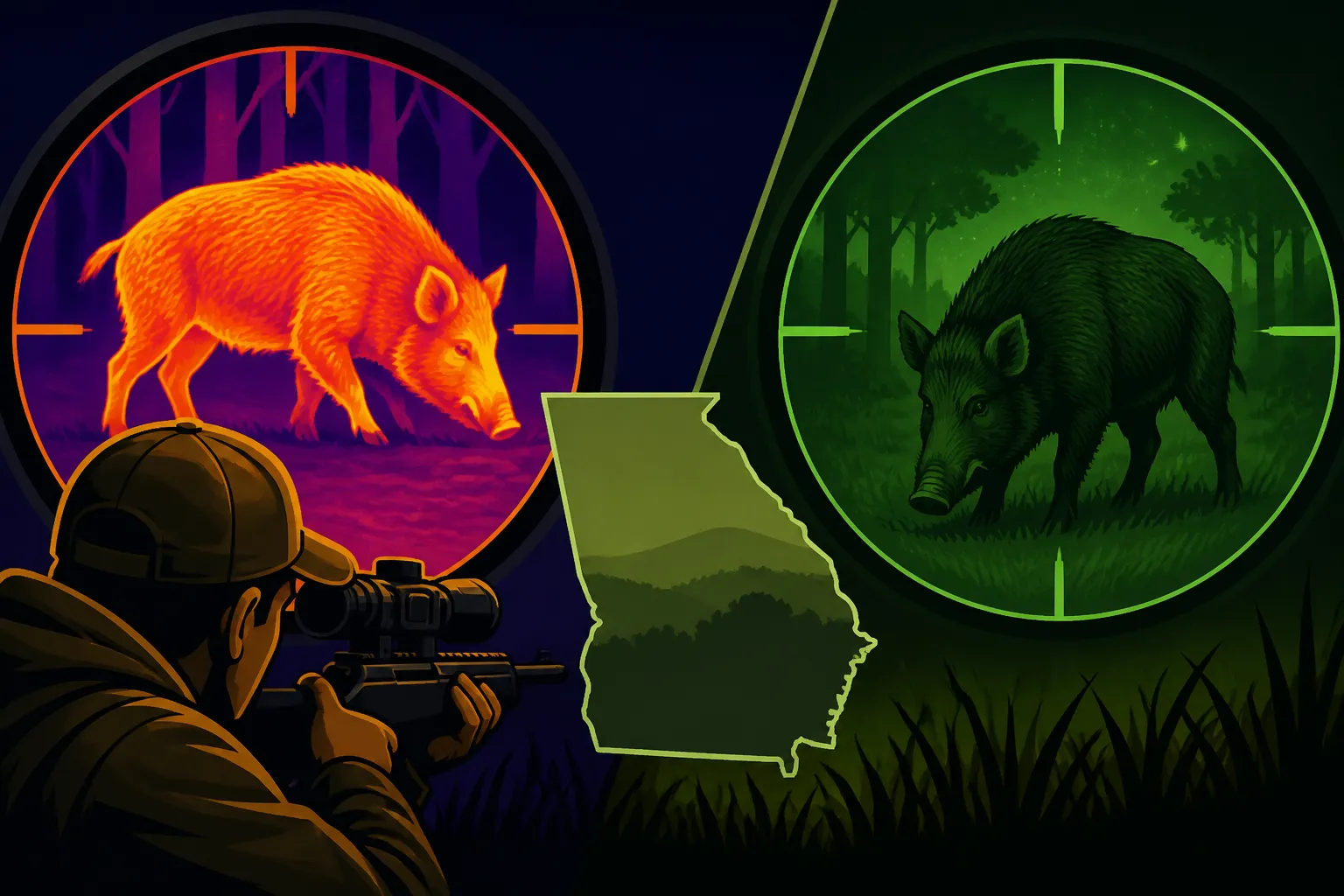
Thermal vision has become a game-changer for night hog hunting, offering a completely different way to "see" in the dark. It doesn't rely on ambient light like traditional night vision, making it incredibly effective even on the darkest, moonless nights or in thick fog. If you've ever felt like hogs just appear out of nowhere, thermal can help you spot them long before they ever get close.
How Thermal Optics Work for Hunters
At its core, thermal imaging detects infrared radiation, or heat signatures, emitted by objects. Everything above absolute zero emits some level of thermal energy. Animals, being warm-blooded, stand out vividly against cooler backgrounds. Instead of creating an image based on reflected visible light, thermal optics create an image based on temperature differences. This means a hog, even one bedded deep in thick brush, will often appear as a bright, unmistakable blob against the cooler vegetation around it. This is why you can spot them through light fog, smoke, or even some types of camouflage that would render them invisible to traditional night vision or the naked eye. The warmer the object, the brighter it appears (or the more intense the color, depending on the chosen color palette).
Advantages of Thermal for Hog Hunting
The benefits of thermal for hog hunting are numerous and, frankly, revolutionary. First and foremost is the ability to detect animals in complete darkness, or through conditions like fog, dust, and light cover that would completely blind other optical systems. You don't need moonlight, starlight, or any supplemental IR illuminator. Imagine being set up on a food plot in the pitch black, and suddenly seeing a group of hogs emerge from a distant treeline as glowing shapes on your screen. This early detection gives you ample time to assess the situation, plan your approach, and get into position. This is especially useful in situations where Hunting Feral Hogs Over Bait at Night where you might be waiting patiently for movement.
Another huge advantage is positive identification. While it won't tell you if it's a boar or a sow with perfect clarity from a distance, it will tell you it's an animal. The distinct thermal signature of a hog, with its stocky body and specific heat patterns, is quite recognizable. This reduces mistaken identity risks compared to just using a flashlight or even some night vision setups. You can see the size of the animal, its general shape, and how many are in the group. This proactive information is invaluable for a safe and successful hunt.
Different Types of Thermal Devices
Thermal technology comes in several forms, each suited to different hunting applications and budgets.
- Thermal Monoculars: These are handheld devices, perfect for scanning and scouting. They're lightweight, portable, and excellent for locating hogs at a distance before you ever raise your rifle. Many hunters will use a thermal monocular to spot a group, then switch to a weapon-mounted optic for the shot. Think of it as your primary scouting tool in the dark.
- Thermal Scopes: These are designed to be mounted directly onto your rifle, replacing your traditional daytime scope. They provide a magnified, thermally-generated image for aiming and shooting. Modern thermal scopes offer multiple reticle options, zeroing capabilities, and often recording features, allowing you to capture your hunts. This is where the magic truly happens for making precise shots in the dark.
- Thermal Clip-ons: These devices attach in front of your existing daytime scope. They essentially "convert" your daytime optic into a thermal scope without requiring re-zeroing your primary scope. This offers a lot of versatility, letting you use your familiar daytime setup and just add thermal capability when needed. It's a great option if you want to switch between day and night hunting without changing your primary zero.
- Thermal Binoculars: Offering two eyepieces, these are great for extended viewing and reducing eye fatigue compared to monoculars. They're often used for observation teams or by those who spend significant time glassing large areas at night.
When considering a thermal device, you'll often see brands like Pulsar, ATN, Trijicon, and AGM mentioned. Each offers a range of models with varying sensor resolutions (e.g., 384×288, 640×480), refresh rates (e.g., 30Hz, 60Hz), and lens sizes. Higher resolution and refresh rates generally translate to a clearer, smoother image, which can be critical for positive identification and shot placement at longer distances.
Exploring Night Vision Technology
While thermal vision sees heat, night vision amplifies existing light. It’s a different beast entirely, and for many years, it was the only real option for seeing in low-light conditions. Although thermal has taken center stage for some applications, traditional night vision still has a strong place in a hunter's arsenal, especially when you need to see more detail.
How Night Vision Differs from Thermal
Night vision relies on amplifying ambient light – starlight, moonlight, or even distant artificial light sources. It collects these faint photons and intensifies them thousands of times, presenting a green-tinted image to the user. This is distinctly different from thermal, which "sees" heat. Because night vision uses reflected light, it provides much greater detail and depth perception than thermal. You can often make out branches, leaves, and specific features of the terrain, which is harder with thermal's heat-blob imagery.
However, this reliance on ambient light is also its primary limitation. On a completely overcast, moonless night in a dense swamp, night vision without an infrared (IR) illuminator might be practically useless. An IR illuminator acts like a flashlight that only the night vision device can see, providing additional light that isn't visible to the naked eye.
Benefits and Limitations of Night Vision for Hogs
One of the biggest benefits of night vision is its ability to provide better environmental awareness. When you're trying to navigate through dense woods or discern exactly where a hog is standing relative to a fence line, the detail offered by night vision can be invaluable. You can often see the exact body posture, which way an animal is facing, and even clearer distinctions between animals within a group. This is particularly useful when you need to confirm clear shooting lanes in tricky cover.
However, night vision has its drawbacks. As mentioned, it needs some light. If you're in a truly dark environment without an IR illuminator, you're out of luck. Even with an IR illuminator, hogs can sometimes become "IR-aware" and react to the beam, similar to how they might react to a visible flashlight. Also, dense fog, heavy rain, or thick brush can obscure the reflected light, making it difficult to see through these conditions. It's fantastic for open fields under moonlight or with an illuminator, but less effective at "seeing through" obstructions compared to thermal.
Generations of Night Vision Devices
Night vision technology has evolved through several "generations," each offering improvements in clarity, range, and performance:
- Generation 1: These are the oldest and least expensive, offering a relatively dim and grainy image with limited range. They're often prone to "blooming" (bright spots flaring out around light sources) and have a shorter lifespan. While they can work for very close-range observation, they are generally not recommended for serious hunting due to their limitations.
- Generation 2: A significant leap forward, Gen 2 devices offer much brighter, clearer images with better resolution and less distortion. They use a Microchannel Plate (MCP) which greatly improves light amplification. These are a popular choice for many hunters who want good performance without the top-tier price of Gen 3.
- Generation 3: The current pinnacle of widely available night vision technology. Gen 3 devices feature gallium arsenide photocathodes and other enhancements, providing exceptional clarity, sensitivity, and range, especially in extremely low-light conditions. They are more expensive but offer vastly superior performance. If you want the best possible image quality and the ability to see in near-total darkness, Gen 3 is the way to go.
Many night vision devices also incorporate digital technology, which can offer features like recording video and connecting to apps. While digital night vision might not always match the pure optical performance of high-end analog Gen 2 or Gen 3, it offers incredible versatility and is often more budget-friendly.
Choosing Between Thermal and Night Vision
Deciding between thermal and night vision for hog hunting can feel a bit like choosing between apples and oranges – both are great, but they serve different purposes. Your choice will ultimately depend on your budget, your hunting style, and the specific conditions you anticipate.
Key Differences in Performance
The core difference lies in what each technology sees. Thermal detects heat, which means it excels at detection. A hog hidden in thick foliage or camouflaged against the background will often be immediately visible as a heat signature to a thermal device. You'll know something is there, even if you can't tell exactly what it is or its precise features. This makes thermal fantastic for quickly scanning large areas and finding animals.
Night vision, on the other hand, sees reflected light. This means it provides much more detail and better depth perception. You can often make out the texture of bark on a tree, the specific shape of a hog's ear, or the subtle undulations of the terrain. However, if there's no ambient light, or if dense cover completely blocks light, night vision struggles without a strong IR illuminator.
Here’s a quick comparison:
| Feature | Thermal Vision | Night Vision |
|---|---|---|
| Detection | Excellent (detects heat signatures) | Good (detects reflected light) |
| Identification | Good (general shape, size, number) | Excellent (detailed features, environment) |
| Conditions | Works in total darkness, fog, light cover, smoke | Needs ambient light (moon, stars) or IR ill. |
| Range | Good for detection at distance | Good for identification at moderate range |
| Image | Heat map (various color palettes) | Green or monochrome (amplified ambient light) |
| Obstructions | Can "see through" light cover, fog | Blocked by thick cover, fog |
| Cost | Generally higher for good quality | Varies widely by generation, digital often cheaper |
Factors to Consider for Your Hunting Style
Your personal hunting preferences and the typical Georgia environments you hunt in will heavily influence your decision.
- Primary Goal: Detection or Identification? If your main challenge is simply finding hogs in vast, dark areas or dense cover, thermal is often the superior choice. If you're hunting more open fields and need to make very precise shots or navigate complex terrain where detailed environmental awareness is key, night vision might be a better fit, especially if you have good moonlight or a powerful IR illuminator.
- Hunting Environment: Are you primarily hunting open agricultural fields in South Georgia, where a little moonlight goes a long way and you need to see details across longer distances? Night vision could be effective. Or are you often in dense Piedmont hardwoods or thick swamp bottoms, where light penetration is minimal and hogs hide effectively? Then thermal's ability to see heat through light cover will be a huge asset.
- Budget: Thermal devices, especially high-resolution ones, often come with a higher price tag. If your budget is tighter, a good quality Gen 2 or digital night vision device might be a more accessible entry point into night hunting. Remember, even a basic thermal monocular for spotting, combined with a regular scope and a powerful light, can be incredibly effective.
- Ethical Considerations: Being able to positively identify your target and ensure a clean shot is paramount. Both technologies, when used correctly, can facilitate this. However, it’s worth noting that some hunters feel night vision provides a more "natural" view for precise shot placement in situations where fine detail matters, while thermal's strength is initial detection.
Ultimately, many seasoned night hunters eventually find that a combination of both technologies offers the best of both worlds. Using a thermal monocular to scan and locate, then transitioning to a night vision scope for detailed identification and the shot, is a common and highly effective strategy.
Maximizing Your Investment
Regardless of which technology you choose, maximizing your investment involves more than just buying the device. It's about knowing how to use it effectively and leveraging other resources. For instance, using mapping apps like GoHunt can help you scout potential hog travel routes, bedding areas, and feeding locations during the day, so you know where to focus your night vision or thermal scans. Studying aerial photos for creek bottoms, logging roads, and changes in timber density can give you a significant edge.
When you're looking at optics, don't just jump at the cheapest price. Consider the resolution of the sensor, the refresh rate (especially for thermal), battery life, and durability. Hog hunting can be tough on gear, so you want something that can stand up to the elements and the rigors of being out at night. Look for warranties and customer support too. Even without mentioning specific prices, it's clear that investing in reputable brands typically pays off in the long run.
Practical Considerations for Night Hog Hunts
Night hunting for hogs isn't just regular hunting after dark; it requires a different mindset and a different set of precautions. Safety, preparation, and ethical considerations become even more critical when you're operating in low or no light.
Safety First Under the Stars
Your first priority should always be safety. Without the benefit of natural light, it's easy to lose your bearings, trip, or even mistake an object for an animal. Always know your surroundings during daylight hours. Mark potential hazards like fences, ditches, or steep drops on your mapping app. It's a good idea to scout your hunting area thoroughly during the day, noting landmarks and potential shooting lanes.
When you're out there, always follow basic firearm safety rules: treat every firearm as if it's loaded, keep the muzzle pointed in a safe direction, keep your finger off the trigger until ready to shoot, and be sure of your target and what's beyond it. Thermal and night vision can help with target identification, but they don't replace common sense and due diligence. Never shoot at a heat signature or a vague shape if you can't positively identify it. Hunting with a partner, each equipped with a light source or an optic, can add another layer of safety. Also, having a reliable headlamp with a red or green light option for navigating without spooking game is invaluable.
Setting Up for Success
Success in night hog hunting often boils down to careful preparation. Hogs are creatures of habit, especially when it comes to feeding and travel routes. Scout your area diligently during the day, looking for fresh rooting, tracks, and trails. Scrape Lines Along a Logging Road might give you an idea of where deer are moving, but for hogs, you're looking for areas of heavy disturbance, especially near food sources like cornfields, pecan groves, or even oak stands during acorn drops. Mapping tools like those provided by GoHunt can overlay property lines, topo maps, and satellite imagery, helping you pinpoint ideal ambush locations and potential travel corridors.
Consider your stand placement. A ground blind brushed in well can be very effective, giving you a stable rest and concealing your movement. If using a treestand, make sure your climbing sticks and stand are secure and familiar to you in the dark. Plan your entry and exit routes carefully, minimizing noise and scent disruption. Hogs have an incredible sense of smell and hearing, so being as quiet and scent-free as possible is critical. Baiting, where legal, can also concentrate hogs and make them more predictable. Hunting Feral Hogs Over Bait at Night is a common and effective tactic in Georgia.
Ethics and Responsible Night Hunting
While feral hogs are a nuisance species, and regulations are generally lenient, ethical hunting practices remain paramount. The goal is to remove these destructive animals efficiently and humanely. This means taking responsible shots and making every effort to recover any animal you shoot. Thermal and night vision aid in this significantly by allowing for better shot placement and more accurate tracking of wounded animals.
If you wound a hog, use your thermal or night vision device to track its heat signature. A wounded animal will often leave a clear thermal trail as it moves through cooler vegetation. This is where the advantage of thermal truly shines. You can follow that trail, or spot the animal bedded down, often much faster and more effectively than with a flashlight alone. Remember to be mindful of private property boundaries, especially if tracking. Always ensure you have permission to cross property lines if a wounded animal strays onto neighboring land. Being a responsible night hunter means not only putting hogs down effectively but doing so in a way that respects the land, other landowners, and the hunting tradition.
Integrating Your Gear for Optimal Results
For those who are serious about year-round hog control in Georgia, having a robust setup that combines different technologies can provide an unparalleled advantage. It's not always about one or the other; sometimes, it's about making them work together.
Combining Thermal and Night Vision
Many experienced night hunters find that the ultimate setup involves leveraging the strengths of both thermal and night vision. Here’s a common and highly effective strategy:
- Thermal for Detection: Use a handheld thermal monocular (or even a thermal binocular) as your primary scouting tool. Periodically scan large areas, treelines, and food plots. This will quickly tell you if there are hogs present and give you a general idea of their numbers and movement patterns. The speed and effectiveness of thermal for initial detection are unmatched. It’s like having an invisible radar.
- Night Vision for Identification and Shot Placement: Once you’ve located hogs with your thermal device, transition to a weapon-mounted night vision scope (or a night vision clip-on combined with your daytime scope). The night vision will provide the detailed image quality needed for positive identification of the hog, assessing its exact body position, and ensuring you have a clear shot free of obstructions. The enhanced depth perception and detail allow for more precise aim, leading to quicker, more humane kills.
This combination allows you to quickly cover ground and locate targets with thermal, then switch to the precision of night vision for the critical moment. This integrated approach minimizes the time you spend blindly scanning with a weapon-mounted optic and maximizes your chances of a successful, ethical harvest.
Essential Accessories for Night Hog Hunting
Beyond your primary thermal or night vision device, there are several accessories that can significantly improve your night hunting experience in Georgia:
- Infrared (IR) Illuminator: If you're using night vision, a powerful, adjustable IR illuminator is practically a necessity, especially on dark nights. Look for models with adjustable beams (flood to spot) and variable power settings. Some can even be focused to create a very tight beam for long-range identification.
- Suppressors: In Georgia, suppressors are legal for hunting, and they are an absolute game-changer for night hog hunting. Suppressors for Georgia Predator Hunting extends to hogs as well. The reduced muzzle blast not only protects your hearing and your hunting partners' but also dramatically reduces the disturbance to other game and the local community. Hogs will often scatter less widely after an unsuppressed shot, potentially allowing for follow-up shots on multiple animals.
- Tripods and Shooting Sticks: A stable shooting platform is always important, but even more so in the dark. A good tripod or sturdy shooting sticks will help you hold your thermal or night vision scope steady for long periods of observation and provide a stable rest for the shot.
- Red or Green LED Headlamp: While white light spooks game, red or green light preserves your night vision and is much less disturbing to animals. Use it for navigating to and from your stand, field dressing, or packing out game.
- Portable Chargers/Extra Batteries: Thermal and night vision devices can be power-hungry. Always carry spare batteries or a portable power bank to keep your devices running through a long night hunt. There's nothing worse than having your gear die just as hogs show up.
- Game Retrieval Cart: Hogs can be incredibly heavy, and dragging them out of a swamp or across a field in the dark is no fun. A sturdy game cart can make retrieval significantly easier, especially when you’re dealing with Dragging a Deer Out of a Swamp – a task often performed after a successful hog hunt in similar terrain.
- Mapping Apps: As mentioned before, a robust mapping app on your phone, like GoHunt, is invaluable. It helps you navigate, mark key spots, understand property boundaries, and plan your approach and exit routes. Make sure your phone is fully charged, or carry a power bank, as GPS can drain batteries quickly.
By integrating these tools and tactics, you'll be well-equipped to tackle the challenge of Georgia's nocturnal hog population, turning those frustrating late-night visits into successful and rewarding hunts.
Disclaimer
This article is for general informational purposes only and does not constitute professional advice. Laws, prices and regulations vary by location and change over time. Consult a qualified professional for guidance on your specific situation.