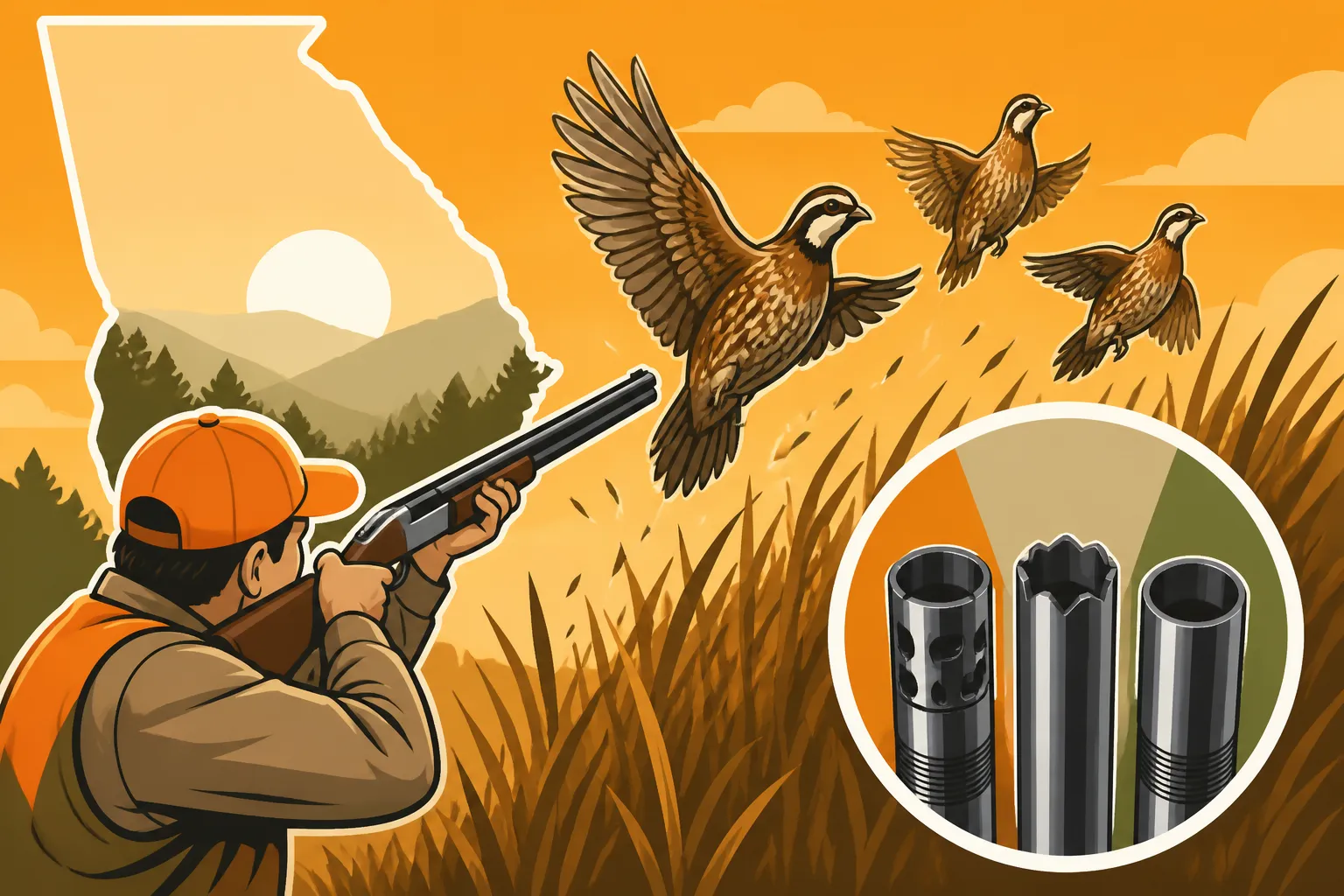
Choke Choice for Fast Covey Flushes
There’s nothing quite like the heart-stopping rush of a covey of bobwhite quail exploding from beneath your feet, a blur of feathers and frantic wings. In those split seconds of chaos, many hunters feel a moment of panic, often leading to missed shots or frustrating misses. This guide is all about helping you understand how your shotgun’s choke choice can dramatically improve your success rate when faced with those legendary fast covey flushes across Georgia's diverse landscapes, turning those frustrating blurs into memorable retrieves.
Understanding the Challenge of Fast Covey Flushes
The bobwhite quail covey flush is legendary for a reason: it's incredibly fast and unpredictable. One moment, your dogs are locked on point, tails quivering, and the next, what seemed like an empty patch of broom sedge erupts in a cacophony of wings and whistling calls. For many of us, this sudden explosion of birds is the ultimate test of reflexes and shotgun handling.
The Bursting Bobwhite Phenomenon
Imagine walking through a pine plantation near Thomasville, the air crisp, your pointing dog frozen solid ahead. You step in, and suddenly, a dozen or more birds rocket straight up and out in every direction. This isn't like a single bird flying predictably. A covey flush is a three-dimensional explosion, often with birds weaving through timber or dipping low over the ground. You might have birds crossing, birds going away, and birds veering sharply to the left or right, all within the first 10 to 20 yards. The sheer volume and speed can overwhelm even experienced shooters, making a well-placed shot a real challenge. It requires quick target acquisition and a pattern that can effectively cover multiple, rapidly moving targets.
Speed and Spread: Why Chokes Matter for Quick Shots
When birds are bursting out just a few yards in front of you, the shot string hasn't had much time to spread. A tight choke at such close range can concentrate the pattern so much that you literally "thread the needle" through the middle of the covey, missing every bird, or blow a single bird to smithereens, leaving little to retrieve. Conversely, a pattern that opens up quickly can increase your chances of connecting with one or two birds without destroying them. The goal is to deliver a pattern that is wide enough to catch a fast-moving target but dense enough to ensure a clean kill. This balance is exactly where choke selection becomes crucial, especially given the lightning-fast nature of a covey rise. Many hunters diligently scout their hunting spots, perhaps using mapping tools like GoHunt to understand cover types and potential bird locations, but neglect the equally important gear choice that is their choke.
Georgia's Upland Bird Hunting Landscape
Georgia offers a rich tapestry of upland bird hunting opportunities, from meticulously managed quail plantations to wild, open pine savannahs and forgotten field edges. Each of these environments presents unique challenges and dictates different approaches to gear, including your choke choice.
Diverse Habitats and Shot Distances
Think about the varied terrain across Georgia. In the northern mountains, you might encounter grouse, but for bobwhite quail, we're usually talking about the open pine forests of South Georgia or the regenerating clear-cuts of the Piedmont. In a classic South Georgia pine flat, especially on a managed plantation, the birds might hold tight in the wiregrass or broom sedge, leading to very close flushes when your dog points. Here, shots are often quick and within 20-30 yards. However, venture into overgrown field edges or dense briar patches on public land, and birds might flush wilder, offering longer shots through heavier cover, or they might put some brush between you and them the moment they get airborne. The type of cover—be it dense gallberry, open longleaf pine, or a cutover choked with young pines—significantly influences how far birds are when they flush and how quickly they disappear from view.
Pressure and Behavior
Just like deer, quail in heavily hunted areas tend to be more wary. Birds on a well-managed private plantation might hold tighter, allowing for closer, more controlled shots. These birds are accustomed to dog work and human presence. Conversely, wild birds on public land, or those on less managed private tracts, often flush much further out, making longer shots necessary, or they might flush extremely tight in dense cover, making a clear shot challenging. The pressure a covey experiences throughout the season can also affect their behavior. Early in the season, birds might be more forgiving, but by late December or January, after several encounters with hunters, they'll be far more prone to running on the ground or flushing at the slightest hint of danger. This behavioral adaptation means your choke choice might even need to adapt as the season progresses. Many hunters use resources like GoHunt to track hunting pressure on various public lands, understanding that this can influence how birds behave and thus how you approach your setup, including your choke selection.
Decoding Shotgun Chokes for Upland Birds
Understanding how different chokes work is fundamental to making an informed decision for fast covey flushes. It’s not just about what sounds good on paper; it’s about what pattern your shotgun throws with your chosen ammunition at the distances you expect to shoot.
The Basics of Choke Constriction
A choke tube is essentially a constricted section at the muzzle end of your shotgun barrel, designed to control the spread of the shot pattern. A tighter choke, like a Full or Improved Modified, will keep the shot pellets in a more concentrated group over a longer distance. This is great for longer shots, like pass-shooting ducks or geese, where targets are distant. An open choke, such as a Cylinder or Skeet, has minimal constriction, allowing the shot pattern to spread out much faster and wider. This wider pattern is what we typically want for closer, fast-moving targets where a broader spread increases the probability of hitting. The degree of constriction is measured in thousandths of an inch, dictating how much the pattern is squeezed down before it exits the barrel. The trick with quail is that they can present both very close and slightly longer shots, sometimes within the same flush, making a versatile choke choice or a multi-choke setup ideal.
Common Choke Options and Their Applications
Let's break down the most common choke types and where they fit into the quail hunting picture:
- Cylinder (CYL): Offers the least constriction. It's designed for extremely close-range shooting, typically out to 15-20 yards. The pattern spreads very quickly, making it excellent for point-blank shots on birds that jump right underfoot. However, beyond 20 yards, the pattern can become too thin, leading to missed birds or cripples. For a true, bursting covey at 10-15 yards, Cylinder can be very effective, ensuring a wide pattern to catch a rapidly scattering bird.
- Skeet (SKT) / Skeet 1: Often very similar to Cylinder, with just a touch more constriction. It's designed for clay target games with close, fast targets. For quail, it provides a slightly denser pattern than a true Cylinder, offering a bit more range while still delivering a wide spread for close flushes. Many consider this a prime choice for the initial shot on a covey.
- Improved Cylinder (IC): A step up in constriction from Skeet. This is arguably the most popular all-around choke for upland birds, especially quail. It provides a good balance of spread and pattern density, effective out to about 30 yards. For most covey flushes, where the shot might be anywhere from 15 to 25 yards, an Improved Cylinder gives you enough spread to hit a bird without blowing it apart, while still holding enough pellets to ensure a clean kill. It's a fantastic middle-ground choke. For a detailed look at various shotgun setups, you might find our guide on Shotguns for Georgia Quail and Dove helpful.
- Modified (MOD): Provides more constriction than Improved Cylinder, keeping the pattern tighter for shots out to 35-40 yards. While excellent for doves or pheasants that might be flying further, it can be a bit too tight for the average close-range covey flush. If your birds consistently flush wild and fly further, or if you're hunting very open country where longer shots are the norm, a Modified choke might be useful.
- Full (F): The tightest common choke, designed for maximum range and pattern density, often out to 40+ yards. For quail, this is almost always too tight for the first shot on a covey. It dramatically increases the chance of missing due to a very small pattern, or "wadding" birds if you do connect at close range. It's generally not recommended for covey flushes.
Here's a quick comparison of common choke options for fast covey flushes:
| Choke Type | Constriction Level | Ideal Range (Yards) | Quail Covey Flush Suitability | Notes |
|---|---|---|---|---|
| Cylinder (CYL) | Least | 10-20 | Excellent for close flushes | Wide pattern, very forgiving up close, can thin out quickly. |
| Skeet (SKT) | Very Light | 15-25 | Excellent for close flushes | Slightly denser than Cylinder, good balance for initial shots. |
| Improved Cylinder (IC) | Light | 15-30 | Highly Recommended | Great all-around, balanced spread and density for most situations. |
| Light Modified (LM) | Moderate-Light | 20-35 | Good secondary choke | A bit tighter, useful if birds flush a little wilder. |
| Modified (MOD) | Moderate | 25-40 | Generally too tight | Better for longer shots, risking "threading the needle" on close birds. |
Considerations for Sub-Gauge Shotguns
Many quail hunters, myself included, love the lighter swing and reduced recoil of sub-gauge shotguns like 20-gauge, 28-gauge, and .410 bore. These guns are often a joy to carry all day, especially when you're working a big property or hitting multiple spots. However, the smaller shot column in a sub-gauge means fewer pellets, which can impact pattern density, especially with more open chokes.
- 20-Gauge: This is a fantastic choice for quail. It carries enough pellets to maintain a good pattern with open chokes. An Improved Cylinder in a 20-gauge is highly effective and widely favored for covey flushes. You'll get plenty of pellets in the pattern without excessive recoil.
- 28-Gauge: Often called the "gentleman's gauge," the 28-gauge is a sweet-shooting gun. While it has fewer pellets than a 20-gauge, its smaller bore actually means it often patterns incredibly efficiently. For a 28-gauge, an Improved Cylinder or even a Skeet choke can deliver surprisingly dense and effective patterns for quail.
- .410 Bore: This is the smallest of the common gauges and presents the biggest challenge for consistent kills on fast-flushing quail. With its very limited pellet count, even an open choke like Cylinder or Skeet can produce a sparse pattern. To achieve a reliable kill zone, many .410 users opt for tighter chokes like Modified or Full, but this then necessitates extremely precise shooting at close range, increasing the difficulty of connecting with a rapidly moving bird. It's a true expert's gun for quail, typically used for the sheer challenge rather than maximum harvest. For more on what to consider when selecting your shotgun for walking the fields, check out Upland Guns for Quail Plantation Walks.
Making Your Choke Choice for Georgia's Fast Covey Flushes
The ultimate goal is to select a choke that gives you the best chance of a clean, ethical kill on fast-flushing quail without over-complicating your shot. For most of us, this means prioritizing pattern spread over extreme range.
The "Open" Advantage
For those classic, close-range covey flushes that Georgia is famous for, an open choke almost always provides an advantage. When birds burst out at 10-20 yards, you need a pattern that opens quickly to cover a broader area. An Improved Cylinder or Skeet choke is usually your best friend here. It gives you a wider margin for error, which is crucial when your reflexes are kicking in and you're trying to pick a bird out of a flurry. With a tight choke, you're trying to hit a fast-moving, small target with an equally small pattern, leading to frustration. With an open choke, you increase the probability of connecting with at least one bird while still delivering enough energy for a clean kill. It's about maximizing your effective pattern diameter at the typical ranges of a covey flush.
Double Barrel Wisdom: Two Chokes for Two Situations
If you're lucky enough to carry a double-barrel shotgun – either a side-by-side or an over/under – you have a distinct advantage: you can employ two different chokes. This is where you can truly optimize your setup for the unpredictable nature of quail hunting. The most common and highly effective setup for quail is to run an Improved Cylinder in your first barrel and a Light Modified or Modified in your second barrel.
Think about it: the first shot on a covey flush is almost always the closest. The birds are just getting airborne, spreading out, and often still within 25 yards. Your IC choke in the first barrel provides that wide, forgiving pattern you need. If you connect, great! If you miss, or if a second bird offers a slightly longer shot as the covey disperses, your second barrel, with its tighter choke, is ready. This allows you to engage birds that have put a little more distance between themselves and you, or perhaps picked up some speed. This versatility is invaluable when pursuing fast-flying quail in habitats that might range from dense cover to more open areas, like when you're Working a South Georgia Quail Covey Rise.
Patterning Your Shotgun
This is perhaps the most overlooked, yet critical, step in choke selection. You absolutely must pattern your shotgun with your chosen choke and ammunition. Different guns, even of the same make and model, will pattern differently. The same choke tube can produce varying patterns with different brands or types of shotshells.
To pattern your shotgun:
- Set up a large piece of paper (or a dedicated patterning target) at 20, 25, and 30 yards. These are your typical covey flush distances.
- Shoot several rounds at each distance, aiming at the center of the target.
- Analyze the pattern: Is it evenly distributed? Are there large gaps a bird could fly through? Is it too dense in the center, or too sparse at the edges?
- The goal is a pattern that has enough density to ensure multiple pellet strikes on a bird (typically 3-5 pellets of small shot like 7.5 or 8) within a roughly 30-inch circle, without being so tight that you have no margin for error. A good pattern ensures you are confident in your setup for Georgia Wild Quail Season Opening Day. Using tools and resources, including those found on platforms like GoHunt, can often help hunters find patterning ranges or local events.
Adjusting for Conditions
Your choke choice isn't set in stone for the entire season or every hunting trip. Be flexible!
- Early Season vs. Late Season: Early in the season, birds might hold tighter, favoring more open chokes. As the season progresses and birds become "wiser" due to hunting pressure, they might flush wilder, making a slightly tighter choke like Light Modified more useful, especially for a second shot.
- Habitat Changes: Hunting in thick, dense cover like heavy broom sedge or briar patches where shots will be close? Lean towards Cylinder or Skeet. Hunting more open pine savannahs or field edges where birds might get out a bit further? An Improved Cylinder is often perfect, or perhaps an IC/Light Modified combination in a double.
- Dog Work: If you're hunting with an experienced, close-working pointer, you can expect tighter flushes and more controlled shots, again making open chokes ideal. If your dog ranges wider or you're hunting with flushers, birds might get up at slightly longer distances, warranting a bit more constriction.
Remember, the goal is to be effective and ethical. A clean kill is always paramount. By taking the time to understand your chokes, pattern your gun, and consider the conditions you're hunting in, you'll be much better prepared for those thrilling, fast covey flushes across Georgia.
Disclaimer
This article is for general informational purposes only and does not constitute professional advice. Laws, prices and regulations vary by location and change over time. Consult a qualified professional for guidance on your specific situation.